

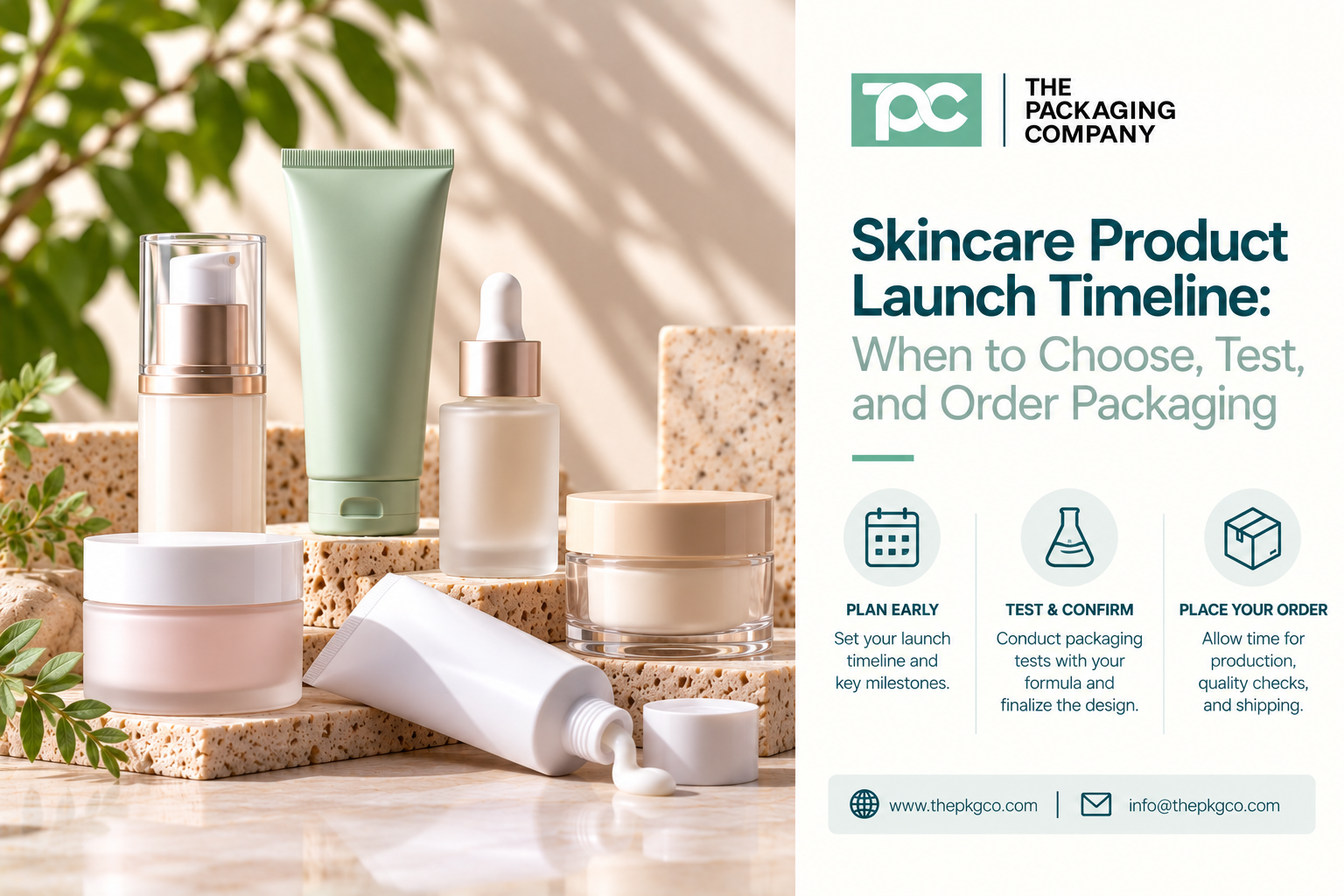
Launching a skincare product involves more than completing a formula and approving a label. Packaging needs its own development timeline, with decisions that affect sampling, compatibility testing, artwork, manufacturing, filling, and delivery.
For beauty brands, effective skincare packaging planning starts while product requirements are still being developed. Waiting until the formula and artwork are finished can create avoidable delays if the selected bottle, jar, tube, or dispensing system needs further review.
This guide explains when to choose, test, and order packaging during a skincare product launch timeline, which approvals matter at each stage, and how brands can coordinate packaging suppliers, formulators, and contract filling partners. For available formats and customization options, brands can also explore The Packaging Company’s skincare packaging solutions.
Why Skincare Packaging Needs Its Own Development Timeline
A packaging project does not move directly from selecting a container to placing a bulk order. Several decisions need to happen between those stages, and some must be completed before the next stage can proceed.
For example, artwork cannot be finalized accurately without knowing the actual decoration area. A filling partner cannot complete packaging compatibility testing without suitable physical samples. Bulk production should not begin before the agreed components and decoration have been approved.
Brands should therefore plan around approval milestones rather than assuming packaging will be available whenever the formula is ready.
A typical skincare packaging development process includes:
- Define the product and packaging requirements.
- Select a suitable packaging format.
- Request and review physical packaging samples.
- Complete formula compatibility, stability, and filling assessments.
- Finalize packaging artwork and decoration specifications.
- Approve pre-production samples and production requirements.
- Manufacture and inspect empty packaging components.
- Complete filling, final assembly, and finished-product approval.
- Prepare inventory and distribution for launch.
Some activities can overlap, particularly formulation development and preliminary packaging selection. However, the final approvals should follow a clear sequence.
Stage 1: Define Product Requirements Before Selecting Packaging
The first packaging decision should be based on the actual skincare product rather than an attractive reference image.
Before contacting a skincare packaging supplier, brands should establish basic requirements with their product development team and formulator.
- Product type: Serum, moisturizer, cream, cleanser, mask, treatment, or another skincare format.
- Formula characteristics: Preliminary viscosity, dispensing needs, and any relevant material sensitivity identified by the formulator.
- Target fill quantity: The proposed fill volume or weight for each SKU.
- Product positioning: Clinical skincare, premium beauty, daily-use skincare, or another market segment.
- Sales channels: Retail, e-commerce, professional distribution, or other channels.
- Target markets: Countries or regions where labeling and finished-product requirements must be considered.
- Estimated production volume: Initial order quantities and the number of product SKUs.
- Launch deadline: The date by which filled, approved inventory needs to be ready.
These details help narrow packaging options before unnecessary sample requests or artwork development begins.
Approval milestone: A preliminary product specification is available for the packaging supplier, formulator, and filling partner.
Stage 2: Select the Packaging Format While the Formula Is Being Developed
Once the product requirements are clear, brands can begin comparing packaging formats. This is where skincare packaging development connects product characteristics with dispensing design, material selection, customer use, and brand presentation.
Airless Packaging for Serums and Treatment Products
Brands may evaluate airless packaging when developing serums, moisturizers, eye treatments, or products requiring a particular dispensing experience.
Early decisions may include bottle capacity, pump output, actuator design, material, refill direction, and whether an airless bottle or jar is more appropriate.
Formula viscosity and pump performance should be evaluated with the actual product during subsequent testing, rather than assumed from appearance alone.
Cosmetic Jars for Creams, Masks, and Balms
For richer creams, masks, and balm-style products, brands may review cosmetic jars. Material options, capacity, closure fit, inner seals, and decoration area can influence both packaging development and the final customer experience.
Jars may also require additional attention to filling methods, sealing arrangements, and how the customer accesses the product.
Squeeze Tubes for Cleansers, Creams, and Lotions
Brands developing hand creams, cleansers, lotions, and targeted treatment products may evaluate squeeze tube packaging.
Tube diameter, material structure, orifice size, closure direction, and formula viscosity can all affect the final dispensing experience. These characteristics should be reviewed with the filling partner before approving production.
Approval milestone: A packaging format and a shortlist of suitable components have been identified for physical sampling.
Stage 3: Request Physical Packaging Samples
A catalog photograph is useful for finding an initial direction, but it cannot replace physical packaging samples.
During this stage, skincare brands should request samples of the shortlisted packaging components and review them with the people responsible for product development and filling.
Initial packaging sample evaluation may include:
- Actual container capacity and dimensions
- Packaging material and construction
- Pump, cap, lid, or closure design
- Dispensing opening and actuator direction
- Component fit and assembly
- Available decoration area
- Packaging weight and handling experience
- Fit with planned cartons or secondary packaging
Stock samples are useful for evaluating basic packaging characteristics. However, they do not necessarily represent the final decorated production configuration.
Brands should distinguish between an initial stock sample, a decoration sample, and a pre-production sample. These serve different purposes and may be reviewed at different stages of the project. For airless projects, our airless packaging supplier sampling checklist covers additional component review points.
Approval milestone: The brand selects a sample configuration to advance into formula compatibility and filling evaluation.
Stage 4: Complete Compatibility, Stability, and Filling Reviews
One of the most important parts of a skincare product launch timeline is the evaluation of the actual formula in the selected packaging system.
This work belongs to the brand, formulator, contract manufacturer, filling partner, and any qualified testing specialists involved in the project.
Depending on the product and applicable requirements, the evaluation may consider:
- Formula compatibility with packaging-contact materials
- Potential formula or packaging material changes over time
- Stability under the selected storage and testing conditions
- Dispensing consistency and pump output
- Filling-line compatibility
- Closure and sealing performance
- Leakage during handling, storage, or transport
- Appropriate testing for the intended market and finished product
These reviews should not be treated as a formality. A packaging format that appears suitable during initial selection may still require changes after evaluation with the actual formula.
Planning consideration: Formula stability and packaging compatibility studies may take longer than initial sample sourcing. Brands should ask their formulator and filling partner to establish the required testing schedule early, rather than assuming every result will be available within the packaging supplier’s sampling period.
Approval milestone: The responsible technical teams have accepted the packaging configuration for the next development stage, with required testing completed or appropriately accounted for in the project’s approval plan.
Stage 5: Finalize Packaging Artwork and Decoration
Artwork development can begin during packaging selection, but production artwork should be finalized against the approved packaging specifications.
A common skincare product launch mistake is approving label artwork before confirming the container’s actual decoration dimensions.
For example, a design originally prepared for a standard bottle may need changes when applied to a curved airless bottle, a small squeeze tube, or a jar lid.
Brands should confirm:
- Approved container dimensions and dielines
- Printable or label application area
- Logo placement and orientation
- Pantone or other color references
- Selected printing or decoration method
- Finish requirements, such as matte, glossy, or frosted treatments
- Cap, pump, collar, or lid color coordination
- SKU-specific artwork files
- Required labeling information reviewed by the brand’s regulatory team
- Any secondary packaging or carton requirements
When launching several products, brands should also confirm whether each SKU requires a separate decoration setup and production quantity. For a closer look at artwork and production quantities across a product line, see our guide to ordering cosmetic packaging for multiple SKUs.
Artwork files should have clear version numbers so the approved version is the one used for production.
Approval milestone: The correct decoration specifications and production artwork files have been approved by the brand.
Stage 6: Approve the Pre-Production Sample Before Bulk Manufacturing
Before manufacturing custom skincare packaging in volume, the brand and supplier need an agreed production reference.
The pre-production sample, often called a PPS, represents the configuration being approved for the manufacturing run.
This approval should account for the agreed packaging components and applicable decoration details, including:
- Container and closure configuration
- Specified capacity and dimensions
- Material and finish direction
- Decoration and artwork version
- Color references and acceptable appearance
- Applicable component specifications
- Purchase order quantity by SKU
- Delivery and production requirements
Brands should avoid assuming that an approved stock sample automatically means the final decorated packaging is ready for production.
The PPS approval is an important point in the timeline because it establishes the reference for the subsequent manufacturing stage. Changes after approval may require revised sampling, new artwork, or an updated production schedule.
Approval milestone: The pre-production sample and relevant production specifications are formally approved.
Stage 7: Allow Time for Packaging Manufacturing and Inspection
Once the PPS is approved and the production requirements are confirmed, the supplier can proceed with the agreed manufacturing process.
Manufacturing time depends on the packaging format, material, tooling requirements, decoration complexity, order quantity, and production schedule.
For many custom packaging projects, The Packaging Company’s typical production lead time is approximately 90 days after PPS approval. Actual lead time should be confirmed for the specific project, and shipping or other post-production activities must also be considered.
During packaging production, the manufacturer or supplier may coordinate component manufacturing, decoration, quality inspection, packing, and shipping arrangements according to the agreed project scope.
Before planning a filling date, brands should confirm when the empty packaging is expected to arrive at the filling facility rather than relying solely on a production completion date.
Approval milestone: Empty packaging components have completed the agreed production and quality review process and are ready for shipment or delivery.
Stage 8: Coordinate Filling, Assembly, and Finished-Product Approval
Packaging delivery is not the same as product launch readiness.
After empty packaging reaches the designated filling facility, the brand’s manufacturing partners still need to complete the applicable filling, assembly, inspection, and finished-product release activities.
The filling partner should have already reviewed the selected packaging system so that product filling does not become the first time the formula and components are evaluated together.
Depending on the product, this phase may involve:
- Receiving and inspecting empty packaging components
- Filling-line setup and processing
- Product filling and closure application
- Required quality and release checks
- Labeling and secondary packaging
- Finished-product inspection
- Final approval for distribution
The Packaging Company supplies empty packaging components. Brands, formulators, filling partners, and relevant testing or compliance specialists are responsible for confirming formula compatibility, filling processes, finished-product performance, and applicable regulatory requirements.
Approval milestone: Finished products have passed the brand’s required release process and are ready for distribution.
Stage 9: Build Packaging Delivery Into the Launch Schedule
Many skincare launch schedules begin with a marketing date and work backward. Packaging planning should also work backward from the date approved packaging needs to arrive at the filling facility.
Brands should account for packaging production, transportation, customs processing where applicable, filling schedules, finished-product inspection, warehousing, and distribution.
A practical launch plan should identify separate dates for:
- Packaging sample selection
- Compatibility and filling review milestones
- Artwork approval
- PPS approval
- Expected packaging production completion
- Empty packaging delivery to the filling facility
- Filling and finished-product release
- Inventory arrival at the required distribution location
- Retail or e-commerce launch
Brands should also allow a contingency period for possible sample revisions, production changes, shipping delays, or unfinished testing.
These dates should reflect the actual project and supplier commitments. There is no single launch schedule that works for every skincare formula or packaging format.
Skincare Product Launch Timeline: Key Packaging Approvals
| Launch Stage | Key Packaging Decision | Primary Responsibility |
|---|---|---|
| Product requirements | Confirm product type, target fill, formula characteristics, and launch needs | Brand and formulator |
| Packaging selection | Shortlist suitable containers, materials, and dispensing systems | Brand and packaging supplier |
| Initial sampling | Review physical components and select a testing configuration | Brand, supplier, and filling partner |
| Compatibility review | Evaluate formula, packaging, filling, and finished-product requirements | Brand, formulator, filler, and testing partners |
| Artwork development | Approve decoration specifications, dielines, and labeling artwork | Brand and design team, with supplier input |
| Pre-production approval | Approve PPS and manufacturing specifications | Brand and packaging supplier |
| Packaging production | Manufacture, inspect, and ship empty components | Packaging supplier and manufacturing partners |
| Filling and release | Fill, assemble, test, and approve finished products | Contract manufacturer and brand |
| Launch | Confirm approved inventory is ready for distribution | Brand and distribution partners |
Common Packaging Decisions That Can Delay a Skincare Launch
Packaging delays often happen when an earlier decision changes after the next stage has already started.
- Changing container capacity after artwork development: A new size may require revised artwork dimensions or packaging samples.
- Switching materials after compatibility evaluation: A different material or component may require additional review with the actual formula.
- Finalizing decoration before approving dielines: Incorrect artwork dimensions can delay sample and production approvals.
- Underestimating the number of SKUs: Different sizes, colors, or printed versions may require separate production planning.
- Booking filling before confirming packaging delivery: A delay in empty packaging arrival can affect the filling partner’s production schedule.
- Treating PPS approval as a minor step: Late revisions can affect manufacturing readiness and lead time.
The purpose of skincare packaging planning is not to eliminate every possible change. It is to identify the decisions that must be confirmed before the project advances.
How TPC Supports Skincare Packaging Development
The Packaging Company works with skincare, cosmetic, beauty, and personal care brands sourcing empty packaging components for product launches and ongoing production programs.
TPC can support packaging format review, component options, physical sampling, customization and decoration planning, production requirements, and the supply of approved empty packaging.
Brands should coordinate packaging development with their formulator, contract manufacturer, and regulatory or quality teams so that the packaging supply schedule matches their product testing and filling requirements.
For an upcoming skincare launch, share your product type, target capacity, preferred format, estimated quantity, number of SKUs, and timeline when you contact The Packaging Company.
FAQ: Skincare Packaging Planning and Launch Timelines
When should a skincare brand start packaging development?
Skincare brands should begin packaging planning while product requirements and formulation are being developed. Early packaging selection allows time for physical samples, formula compatibility review, filling assessments, artwork preparation, and production approvals before the launch deadline.
Should skincare packaging be selected before the formula is finalized?
Brands can shortlist packaging formats before the formula is final. However, the selected packaging system should undergo the necessary compatibility, stability, and filling evaluations with the actual product before final production approval.
What is the difference between a packaging sample and a pre-production sample?
An initial packaging sample helps a brand evaluate a container’s size, material, appearance, and basic function. A pre-production sample is used to approve the agreed production configuration, including applicable component and decoration specifications, before bulk manufacturing.
How long does custom skincare packaging production take?
Production timing varies by packaging format, customization, order quantity, and approval requirements. Many TPC custom packaging projects have an estimated production lead time of approximately 90 days after PPS approval. Sampling, testing, approvals, shipping, filling, and finished-product release require additional planning.
Who is responsible for formula compatibility testing?
The skincare brand, formulator, filling partner, and qualified testing specialists are responsible for confirming compatibility and finished-product requirements with the actual formula. TPC supplies empty packaging components and supports the packaging selection and supply process.