

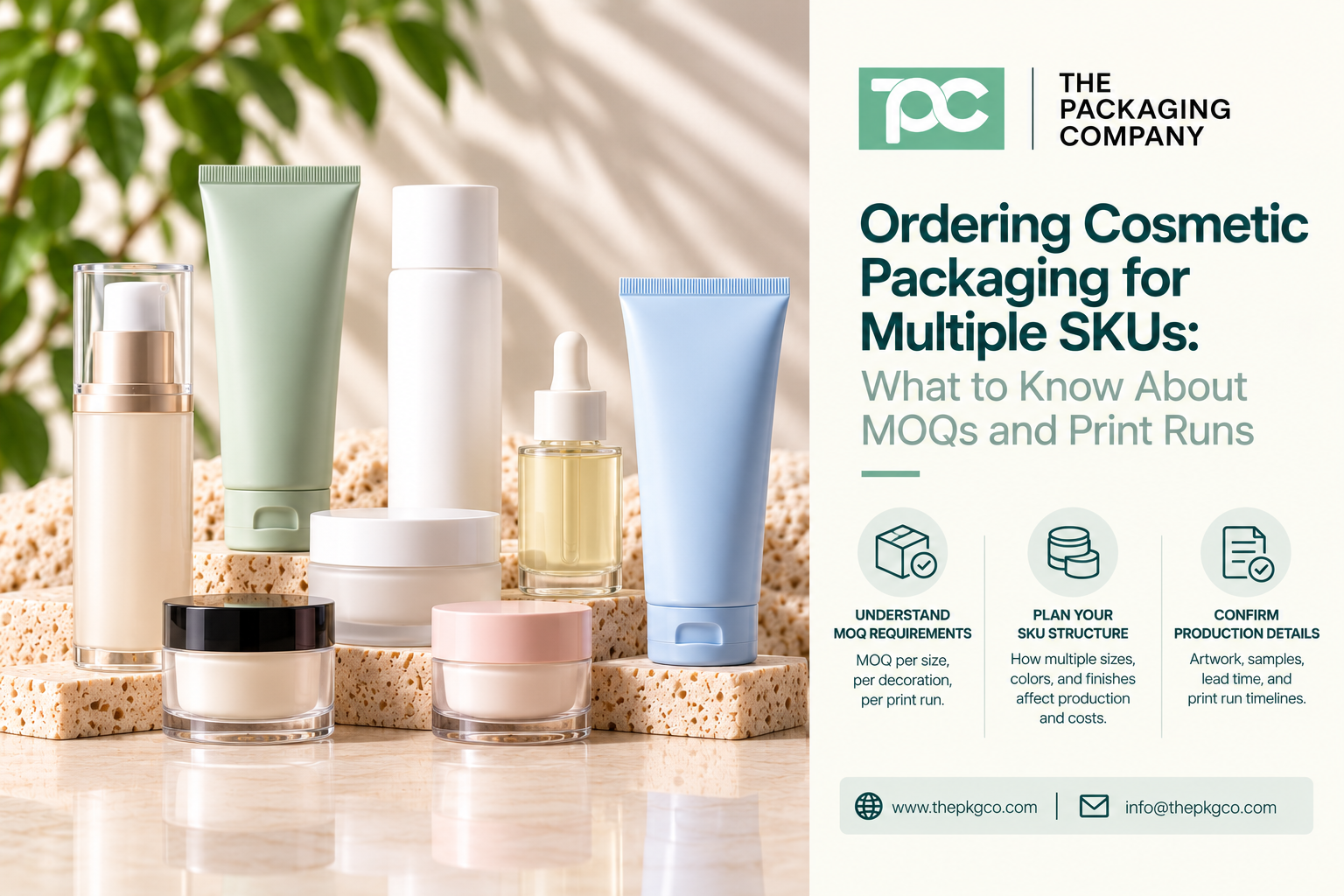
One of the first questions brands usually ask is whether the minimum order quantity can be shared across multiple products.
For most custom packaging projects, it does not work that way.
At The Packaging Company, most custom cosmetic packaging projects begin at 5,000 units per SKU per print run. Different sizes, colors, decoration artwork, components, or packaging formats may need to be treated as separate production runs.
Understanding this before finalizing your product assortment can help prevent unexpected quantity requirements later in the sourcing process.
For brands still selecting containers and planning a broader product line, explore our custom cosmetic packaging options across airless packaging, cosmetic jars, bottles, squeeze tubes, droppers, and lip and eye packaging.
What Does Cosmetic Packaging MOQ Mean?
MOQ stands for minimum order quantity.
In custom cosmetic packaging, MOQ usually refers to the minimum number of units required to manufacture or decorate a specific packaging configuration.
The important part is the word specific.
A brand may think of several products as one collection, but the manufacturer may need to treat them as separate production items because they use different:
- Container sizes
- Colors
- Artwork
- Decoration
- Closures
- Components
- Packaging structures
That is why cosmetic packaging MOQ planning becomes especially important when a launch includes multiple SKUs.
Why 5,000 Units Usually Cannot Be Split Across Several Sizes
Consider a skincare brand launching the same serum in three sizes:
- 15 ml
- 30 ml
- 50 ml
It may seem reasonable to order 2,000 pieces of the 15 ml bottle, 2,000 pieces of the 30 ml bottle, and 1,000 pieces of the 50 ml bottle and treat the combined 5,000 pieces as one order.
In most custom production situations, that would not meet the MOQ.
Each size is a different SKU and normally requires its own production quantity.
If the MOQ is 5,000 units per SKU per print run, the project may instead require:
- 15 ml: 5,000 units
- 30 ml: 5,000 units
- 50 ml: 5,000 units
The total packaging commitment could therefore become 15,000 units rather than 5,000.
This is one reason brands should review MOQ requirements before committing to a large number of capacities.
Different Colors Can Also Create Separate Print Runs
Size is not the only factor that affects cosmetic packaging minimum order quantities.
Imagine a brand uses the same 50 ml jar but wants three colors:
- White for moisturizer
- Blue for night cream
- Green for a mask
The physical jar may be the same, but each version has a different color specification and potentially different artwork.
Depending on the production and decoration process, those variations can require separate manufacturing or print runs.
A collection that appears to use one jar from a design perspective may therefore function as several separate SKUs from a manufacturing perspective.
Brands developing several colorways should confirm this early instead of assuming that all variations can be combined into one MOQ.
Artwork Changes Matter Too
Two products can use the same bottle, pump, capacity, and color but still require separate print runs if the decoration changes.
For example, a 30 ml airless bottle for a vitamin C serum may use one product name and artwork file, while the same bottle for a peptide serum may use different product copy, ingredient callouts, or decoration.
Even though the container itself is identical, the printed packaging is no longer identical.
This is where brands sometimes underestimate the number of production runs involved in a product launch.
If several formulas require unique printed artwork, confirm whether each artwork version carries its own minimum quantity.
Packaging Format Makes an Even Bigger Difference
A beauty or skincare product line may include:
- An airless bottle for serum
- A cosmetic jar for moisturizer
- A squeeze tube for cleanser
- A dropper bottle for facial oil
From the brand’s point of view, these may all belong to one collection.
From a packaging-production standpoint, however, they are completely different packaging systems.
Each format may involve different materials, components, manufacturing processes, decoration methods, production timelines, and MOQ requirements.
This does not mean brands should avoid creating full product lines. It means quantity planning should happen at the individual packaging-format level rather than only at the collection level.
How to Plan Multiple SKUs Before Requesting a Quote
Before asking a packaging supplier to quote a multi-SKU project, organize the launch by individual packaging configuration.
A basic planning table could look like this:
| Product | Format | Size | Color | Decoration | Planned Qty. |
|---|---|---|---|---|---|
| Serum | Airless Bottle | 30 ml | White | Screen Print | 5,000 |
| Moisturizer | Cosmetic Jar | 50 ml | White | Screen Print | 5,000 |
| Cleanser | Squeeze Tube | 100 ml | White | Offset Print | 5,000 |
| Eye Treatment | Airless Bottle | 15 ml | White | Screen Print | 5,000 |
This gives both the brand and packaging supplier a clearer picture of how many individual production configurations need to be evaluated.
It also makes it easier to identify where a product line may be simplified before production begins.
Should You Reduce the Number of SKUs?
Not necessarily.
The goal is not to remove products simply because MOQ requirements exist. The goal is to understand the packaging commitment associated with each variation.
For an established beauty brand with proven demand, multiple sizes and decoration versions may make sense.
For a new product line, however, launching too many packaging variations at once can create significantly more inventory than expected.
Before production, consider whether every size, color, and packaging variation serves a meaningful commercial purpose.
Packaging planning should support the product launch strategy rather than create unnecessary inventory complexity.
Review Samples Before Committing to Bulk Production
MOQ planning is only part of the sourcing process.
Brands should also review packaging samples before moving into bulk production.
Stock samples can help evaluate:
- Container size
- Material and finish
- Component fit
- Pump or dispensing function
- Overall presentation
Formula compatibility, filling, dispensing, and stability testing should also be completed before final bulk-production approval.
A container that looks appropriate in a rendering may perform differently once it is filled with the actual formula.
This is especially important for airless systems, pumps, droppers, and other dispensing packaging.
Decoration Can Change the Production Plan
Customization is another area where MOQ and print-run requirements can change.
Common cosmetic packaging decoration options include:
- Screen printing
- Hot stamping
- Labeling
- UV coating
- Matte or glossy finishes
- Soft-touch finishes
- Metallic effects
- Custom color matching
The more variations a collection uses, the more production coordination may be required.
For example, the same bottle produced in two different colors with two different artwork files may effectively create four decorated configurations.
That is why decoration should be discussed at the same time as quantity planning—not after the packaging has already been selected.
Plan MOQ Around Reorders, Not Just the First Launch
Brands often focus primarily on the first purchase order, but MOQ planning should also consider what happens when one SKU sells faster than the others.
Suppose a three-product line launches with 5,000 units of packaging for each SKU.
Six months later, the serum may be nearly sold out while the moisturizer and cleanser still have significant inventory remaining.
The next serum packaging order may need to meet its MOQ again even though the other products do not need to be reordered.
That can affect cash flow, warehouse requirements, and inventory planning.
Considering expected reorder patterns during the original packaging-planning process can help brands make better decisions about sizes, formats, and SKU count.
Work With Your Packaging Supplier Before Finalizing the Line
The best time to discuss cosmetic packaging MOQ requirements is before every size, color, finish, and decoration option has been finalized.
A packaging supplier can help identify which variations are likely to require separate production runs and where a product line may be simplified without changing the overall brand direction.
For brands sourcing wholesale cosmetic packaging, The Packaging Company supports packaging selection, samples, customization, production planning, and shipping for bulk projects.
Most custom projects begin at 5,000 units per SKU per print run, although minimum quantities can vary depending on packaging format, materials, decoration method, and customization requirements.
Production lead time is typically approximately 90 days after PPS approval.
Planning a Multi-SKU Cosmetic Packaging Project?
If your upcoming launch includes several formulas, capacities, colors, or decoration versions, share the complete SKU plan before requesting final pricing.
Include the packaging format, size, estimated quantity, decoration requirements, formula type, and intended launch timeline for each product.
Our team can review your project and help determine a practical packaging and production approach.