



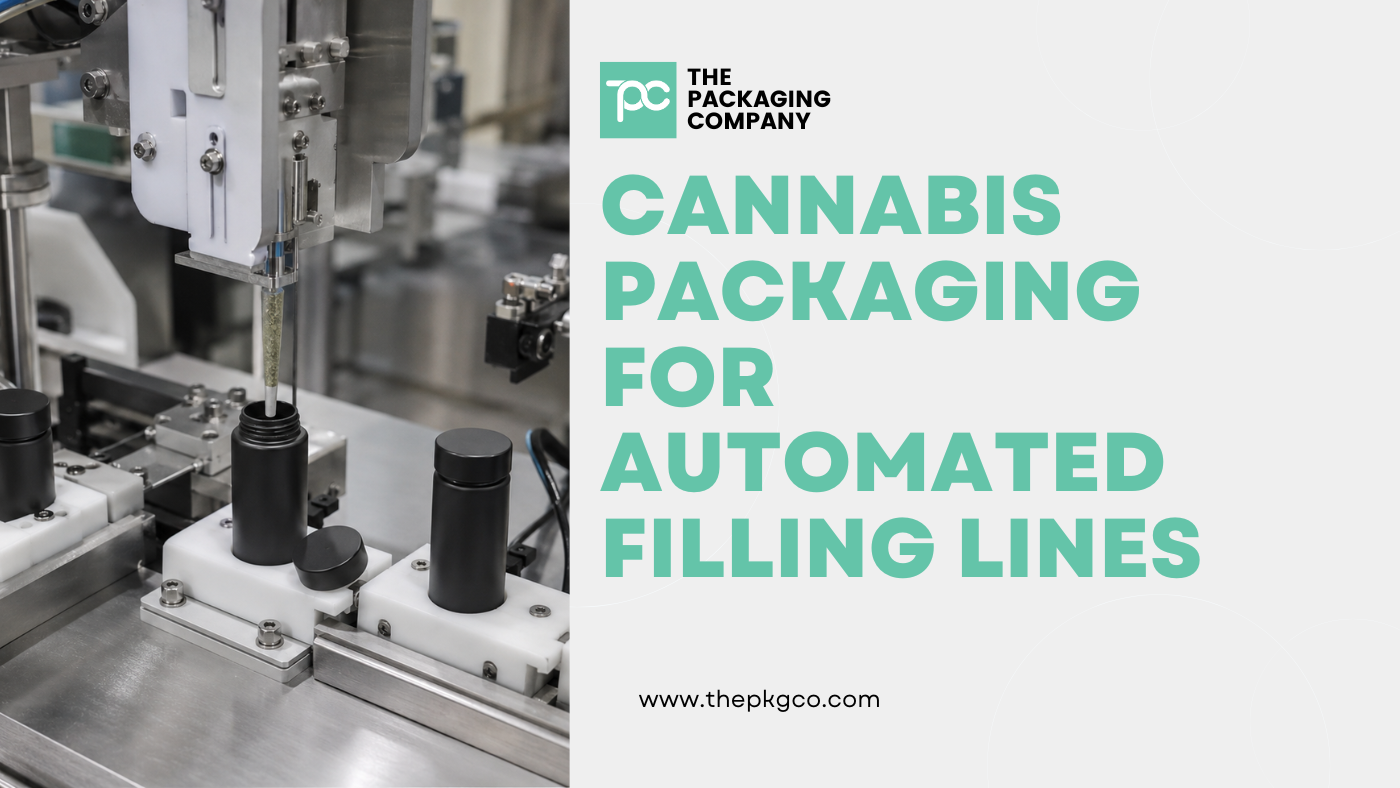
The package that looks best in a sample meeting is not necessarily the package that runs best at 60, 100, or several hundred units per minute.
For cannabis brands moving into higher-volume production, packaging needs to be evaluated as part of the filling and assembly process.
This becomes especially important once a company is ordering 25,000, 50,000, or more units of a single format.
At that point, a small dimensional inconsistency or closure problem can be repeated thousands of times.
Before approving a production package, the brand, filler, equipment team, and packaging supplier should confirm that the package works with the actual line.
Why Packaging Line Compatibility Matters More at Scale
A small brand can sometimes accommodate a difficult package with manual labor.
A large operation has less flexibility.
High-volume production depends on repeatability.
The packaging system may need to move through:
- Container feeding
- Orientation
- Filling
- Insertion
- Capping or closing
- Labeling
- Inspection
- Cartoning
- Case packing
A package that creates friction at one of these stations can lower throughput for the entire line.
Start by Asking How the Package Gets Onto the Line
Packaging teams often focus first on filling.
But the container has to reach the filler correctly before filling can happen.
Ask:
- Will containers be manually loaded?
- Will they be unscrambled?
- Do they need a consistent orientation?
- Can the package stand upright reliably?
- Does an unusual geometry require dedicated handling?
- Can the equipment accommodate the package width and height?
A highly distinctive package can still be an excellent production package.
It simply needs to be evaluated with the equipment rather than assuming every shape behaves like a standard round bottle.
Dimensional Tolerance Is a Production Requirement
Packaging drawings should identify dimensions that matter to the line.
Those may include:
- Overall width
- Overall height
- Neck dimensions
- Closure dimensions
- Opening diameter
- Base geometry
- Label panel dimensions
The equipment team should identify which dimensions have the smallest operating window.
A decorative surface dimension may tolerate more variation than a neck finish that has to work with a capping head.
Do not manage every dimension as if it carries the same operational risk.
Closing and Capping Need to Be Tested With the Real Package
Child-resistant closures can create additional operating considerations because the closure has to satisfy both production and CR performance requirements.
Depending on the format, evaluate:
- Closure feeding
- Application force
- Torque
- Alignment
- Thread engagement
- Snap engagement
- Repeated-use performance
A closure that is too loose is a problem.
A closure that is applied so tightly that intended adult users struggle with it can also create a problem.
Production settings should be established around the actual package system.
Do Not Approve a Package From Empty Samples Alone
Filled-product behavior can be different from empty-package behavior.
Depending on the application, the fill can affect:
- Container stability
- Weight distribution
- Residue around the closure
- Seal performance
- Dispensing
- Package deformation
With airless pumps, droppers, topical tubes, roll-ons, and liquid formats, the formula itself is part of the packaging system.
With pre-roll tins and tubes, the physical size, count, orientation, and insert determine how the package assembles.
Viscosity Can Change Filling Performance
For liquid and topical cannabis products, the package cannot be separated from the filling behavior of the formula.
A low-viscosity liquid and a thick cream place different demands on filling equipment.
Brands should give the filler actual information about:
- Viscosity
- Fill temperature
- Target volume
- Foaming behavior
- Particulates where applicable
- Required fill accuracy
Then evaluate the package opening and closure around that process.
Labeling Creates Another Dimensional Check
A bottle or jar can fill successfully and still create trouble at labeling.
Review:
- Usable label panel
- Taper
- Surface texture
- Seams
- Orientation requirements
- Registration to direct decoration
If a label has to align with a molded feature, closure, or printed element, the equipment needs a reliable orientation reference.
Pre-Roll Packaging Has Its Own Automation Questions
Pre-roll production adds another set of variables.
The operation may need to:
- Count pre-rolls
- Orient them
- Load them into tubes or tins
- Place inserts
- Close CR packaging
- Apply labels
- Inspect finished packages
Multipacks can increase the value of automation because each finished retail unit contains several individual products.
The package should make that assembly easier rather than introducing unnecessary steps.
SKU Proliferation Makes Changeover Important
A modern cannabis operation may run several strains, counts, brands, and product formats on the same equipment.
Packaging choices affect how difficult those changeovers become.
If every SKU uses a completely different container geometry, closure, insert, and label position, the plant has more change parts and settings to manage.
Standardizing physical packaging across SKUs can reduce that burden.
The visible branding can still change while the equipment sees a familiar structure.
Run a Line Trial Before the Bulk Order
For a high-volume production package, a line trial should happen before a large purchase when practical.
A useful trial can answer:
- Does the package feed reliably?
- Does it remain oriented?
- Can the filler reach the target output?
- Does the closure apply consistently?
- Does the label apply cleanly?
- Does the package jam?
- Do operators need manual intervention?
- Does the finished package pass inspection?
Do not wait until the first 50,000-unit production order to discover that a cap does not work with the existing chuck.
Who Should Approve the Package?
For high-volume packaging, the approval team should extend beyond marketing.
Include:
- Brand
- Procurement
- Operations
- Quality
- Filling partner
- Packaging engineer
- Equipment supplier where needed
Each group sees a different failure mode.
Marketing may notice that the package does not look premium enough.
Operations may notice that it cannot run efficiently.
Quality may notice that a critical dimension is inconsistent.
The filler may notice that product is collecting around the opening.
A good production package solves all of those problems together.
A Pre-Order Line Compatibility Checklist
1. Container dimensions confirmed
2. Critical tolerances identified
3. Filling method confirmed
4. Closure application tested
5. Label panel tested
6. Filled samples reviewed
7. Product orientation confirmed
8. Changeover requirements understood
9. Finished package inspection criteria defined
10. Production sample approved before bulk order
How TPC Supports Production-Line Packaging Projects
The Packaging Company works with brands, contract manufacturers, fillers, and other production partners to move custom packaging from concept into production.
TPC combines U.S.-side engineering with direct China-side production oversight and can support modifications to existing packaging platforms as well as fully custom-engineered structures.
The earlier the filling and equipment constraints are identified, the more useful the packaging development process becomes.
If your company is planning a 25,000-unit, 50,000-unit, or larger packaging run, contact TPC with the product, package format, filling method, equipment requirements, and production quantity so those constraints can be reviewed before bulk production.
Frequently Asked Questions
What is packaging line compatibility?
Packaging line compatibility means the container, closure, label, insert, and other components can move through the intended filling and packaging equipment reliably. It includes dimensions, feeding, filling, closing, labeling, orientation, and other production interactions.
Should cannabis packaging be tested on the filling line before ordering?
For higher-volume programs, a line trial is highly useful when practical. It can identify dimensional, closure, labeling, feeding, or assembly problems before tens of thousands of production units are committed.
Why do package tolerances matter?
Automated equipment works within defined operating ranges. Variation in critical dimensions can affect feeding, positioning, filling, capping, or labeling even when the package still looks visually acceptable.
Can the same packaging structure be used for multiple cannabis SKUs?
Yes. Standardizing physical structures while changing artwork or labels can make production changeovers easier and reduce the number of packaging components an operation needs to manage.
Do child-resistant closures create automation challenges?
They can. CR closures still need to be fed, aligned, applied, and verified consistently while maintaining their intended child-resistant function. The exact operating requirements depend on the closure design.
Who should approve packaging for an automated cannabis line?
Approval should involve the teams affected by the package, including brand, procurement, operations, quality, the filler or co-packer, packaging engineering, and equipment specialists when necessary.