



A packaging bill of materials sounds like an internal operations document.
For a multi-state cannabis company in 2026, it is becoming much more useful than that.
States are asking producers and licensees for increasingly detailed packaging information. Extended producer responsibility programs are creating new reporting and recordkeeping obligations. Cannabis regulators may require documentation on the packages used for specific products.
At the same time, procurement teams still need to reorder the exact package six or twelve months later without discovering that nobody knows which liner, gasket, insert, resin, or artwork revision was used last time.
A well-built cannabis packaging BOM connects those problems.
What Is a Cannabis Packaging BOM?
A bill of materials, or BOM, is a controlled record of the components that make up the finished packaging system.
For cannabis packaging, the BOM can include:
- Primary container
- Closure
- Liner
- Gasket
- Insert or tray
- Label
- Secondary carton
- Sleeve
- Other product-contact or packaging components
The useful version goes beyond a list of names.
It connects each component to its material, dimensions, supplier reference, compliance documentation, artwork, and market use.
Why This Matters More in 2026
Packaging reporting requirements are becoming more detailed.
New York’s cannabis packaging sustainability guidance requires licensees that package products for retail sale to report information including packaging weight by material composition, reusable packaging data, and packaging cost.
California’s SB 54 packaging EPR system now includes producer registration and data-submission infrastructure, with source-reduction reporting guidance published in August 2026.
Colorado’s producer responsibility program requires covered producers to maintain records and report data, while annual producer dues began in 2026.
Oregon’s Recycling Modernization Act requires covered producers, subject to applicable exemptions, to register with a producer responsibility organization, report their supply of covered products into the state, and pay applicable fees.
Not every cannabis company or package is necessarily obligated under every EPR program.
But the direction is clear: knowing exactly what materials are entering a market is becoming more operationally valuable.
Start With the Primary Container
For each container, record:
- Internal part number
- Supplier part number
- Package name
- Material
- Capacity
- Critical dimensions
- Color
- Decoration
- Component weight if available
Do not write only “glass jar.”
That description is not specific enough to place a confident reorder or support detailed material reporting later.
Record the Closure Separately
The closure is often made from a different material than the container.
A glass jar may use a plastic CR closure. A metal tin may include a polymer insert or gasket. An aluminum overshell cap may contain a plastic child-resistant mechanism.
If those components are collapsed into a single description such as “glass package” or “metal package,” the BOM loses useful information.
Record:
- Closure material
- Closure dimensions
- CR mechanism
- Liner
- Gasket
- Thread or fit specification where relevant
Include the Child-Resistant Documentation Reference
The BOM should tell the team where the child-resistant documentation is stored.
Useful fields include:
- Applicable CR standard
- Test report identifier
- Testing laboratory
- Tested package configuration
- Internal document location
This does not replace the test report.
It connects the production package to the documentation that supports it.
Track Inserts, Trays, and Gaskets
Small packaging components create some of the biggest recordkeeping gaps.
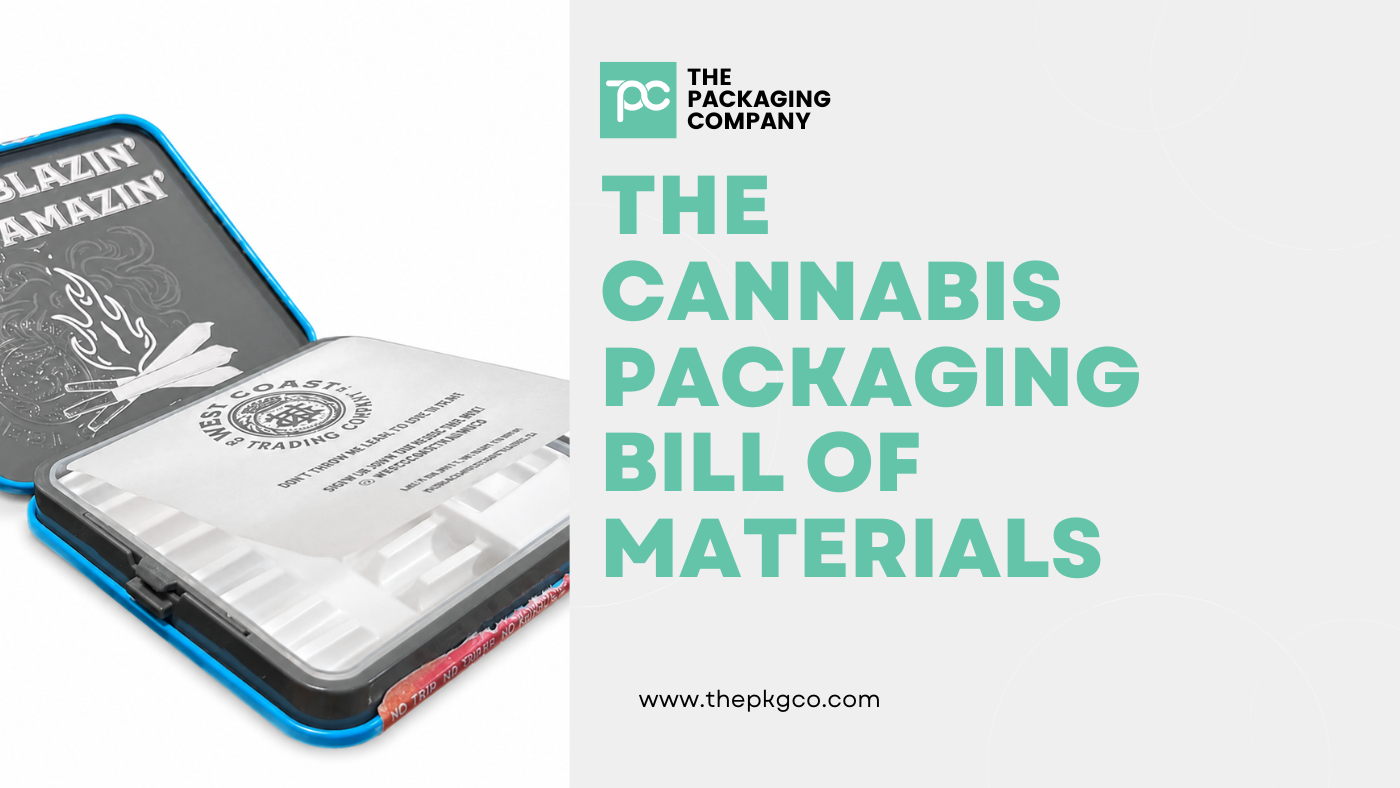
A tin may be described internally as “metal” even though the finished system also contains a plastic tray and gasket.
Those components matter for:
- Reorders
- Fit
- Product protection
- Material reporting
- Recycling claims
- Quality control
Do not hide them inside a generic finished-package description.
Artwork Needs Version Control
The physical BOM and artwork system should connect.
For each SKU, record:
- Artwork filename
- Revision number
- Approval date
- Applicable state
- Decoration method
- Label version
- Secondary package version
This becomes especially important when one physical package is used across multiple states.
The container may remain the same while warnings, symbols, dosage statements, or other artwork elements change.
Add a State-Use Field
A multi-state operator should be able to identify where each finished packaging configuration is approved for use.
Create a simple state-use matrix.
| Package configuration | CA | NY | CO | Other markets |
|---|---|---|---|---|
| SKU / Package A | Approved | Separate artwork | Approved | Review |
The matrix should be maintained by the brand’s compliance process. A packaging supplier can support documentation and specifications, but the licensee should confirm the regulatory requirements that apply to the finished product.
Track Packaging Weight by Component
Material weight is becoming more useful as EPR programs mature.
Where practical, maintain component weights for:
- Container
- Closure
- Insert
- Label
- Carton
- Sleeve
- Other components
This gives the company a better starting point when reporting systems ask for packaging material data.
It also makes value engineering more measurable.
If a redesigned package reduces plastic by a certain amount per unit, the company can estimate the effect across the actual annual volume.
Separate Material Facts From Marketing Claims
The BOM should identify the material.
It should not automatically turn that fact into a broad environmental claim.
For example:
Accurate BOM fact: Glass jar body.
Accurate scoped statement: The glass jar body may be recyclable where accepted.
Potentially inaccurate statement: The entire package is fully recyclable.
The finished package may also contain a plastic CR lid, liner, label, adhesive, or secondary component.
Environmental claims should be scoped to the actual component and applicable recycling system.
Make the BOM Useful for Reorders
A compliance-only BOM is not enough.
The same record should help procurement reorder the package accurately.
Add:
- Supplier
- Supplier SKU
- MOQ
- Typical lead time
- Last PO quantity
- Last production date
- Approved sample reference
- Inspection criteria
- Current artwork revision
Now the BOM supports compliance, procurement, and production at the same time.
Use the BOM for Change Control
The BOM also creates a baseline against which future changes can be evaluated.
If a supplier proposes a different resin, liner, gasket, thickness, closure, or production method, the company can compare the proposed change against the approved record.
The team can then determine whether the change requires:
- New samples
- Filled-product testing
- Line testing
- Artwork changes
- Compliance review
- Updated documentation
Without a controlled baseline, teams may not realize that a package changed until something goes wrong.
A Practical Cannabis Packaging BOM Template
| Field | Example of what to record |
|---|---|
| Package ID | Internal controlled part number |
| Component | Jar, lid, liner, tray, label, carton |
| Material | Glass, aluminum, PP, PET, paperboard, etc. |
| Weight | Component weight where available |
| Dimensions | Critical package dimensions |
| Supplier | Approved source |
| Supplier SKU | Supplier reference number |
| CR documentation | Test report and tested configuration reference |
| Decoration | Print, coating, label, hot stamp, color |
| Artwork revision | Current approved file |
| Market use | States or channels where configuration is used |
| MOQ / lead time | Current procurement planning data |
How TPC Can Support a Better Packaging Specification System
The Packaging Company works with cannabis and regulated-product companies across CR tins, tubes, jars, bags, topical formats, secondary packaging, and custom-engineered packaging.
For multi-SKU and multi-state programs, the objective should not stop at delivering a package.
The physical package, specifications, approved decoration, CR documentation, materials, and reorder information should remain connected throughout the program.
If your company is standardizing packaging across brands or states, contact TPC to review the physical package architecture and identify where common structures can reduce unnecessary complexity.
Frequently Asked Questions
What should be included in a cannabis packaging BOM?
A strong BOM should identify the container, closure, liner, gasket, insert, label, secondary packaging, materials, dimensions, supplier references, artwork versions, CR documentation, and market use. Component weights can also be useful for sustainability and EPR reporting.
Why do cannabis brands need packaging material data?
Material data supports procurement, sustainability reporting, environmental claims, value engineering, and increasingly EPR obligations. Some state cannabis programs also request packaging-related reporting directly from licensees.
Should the closure and container be listed separately?
Yes. They may use different materials and perform different functions. Separating them provides a more accurate record for reorders, compliance documentation, and material reporting.
Should child-resistant test reports be part of the BOM?
The BOM should at minimum reference the applicable report and tested package configuration and show where the full documentation is controlled. This connects the package being ordered to the documentation supporting it.
Can a packaging BOM help with EPR reporting?
Yes. A detailed component and material record gives the company a better foundation for reporting packaging composition and weight where required. The company should still determine its specific obligations under each state’s EPR program.
How often should a cannabis packaging BOM be updated?
Update it whenever an approved component, material, supplier, artwork version, package configuration, or other controlled specification changes. It should reflect the package currently being produced, not the package that was originally designed years earlier.