



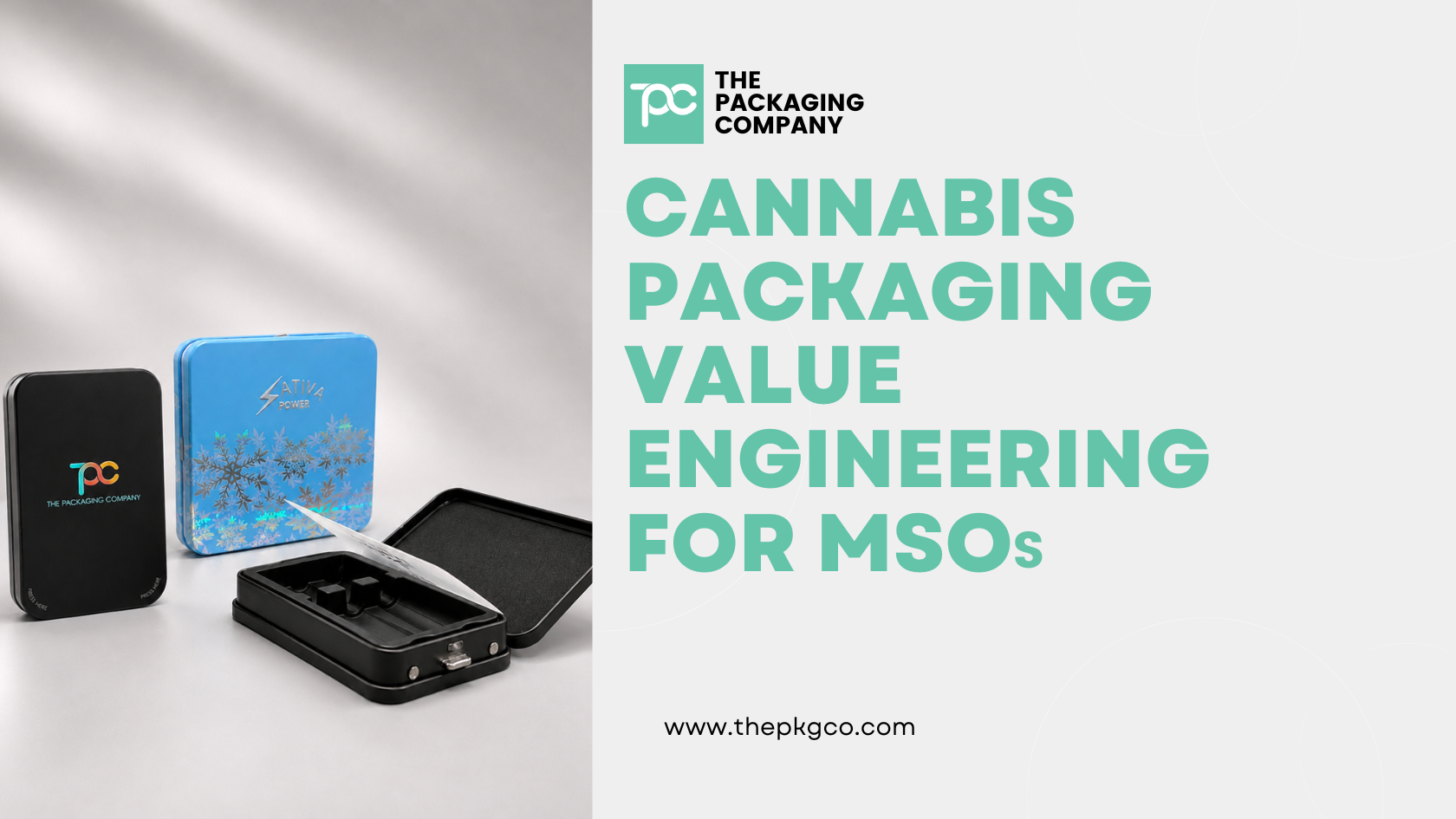
There are two very different ways to lower cannabis packaging cost.
The first is to ask the supplier to make the same package cheaper.
The second is to figure out why the package costs what it does and remove expense that is not creating enough value.
The second approach is value engineering.
For multi-state operators and high-volume cannabis brands, it can be a much better lever than repeatedly negotiating pennies off the same specification.
The goal is not to cheapen the package.
The goal is to protect the things that affect compliance, product performance, operations, and brand perception while simplifying the things that do not.
Start With the Cost Architecture, Not the Unit Price
The quoted unit cost is the output of many decisions.
Those decisions can include:
- Material
- Package weight
- Dimensions
- Number of components
- Closure
- Insert
- Decoration
- Tooling
- Assembly
- Pack-out
- Production quantity
If you want a different cost, determine which input can change safely.
That creates a more productive conversation than simply saying, “We need another 10%.”
Protect the Non-Negotiables First
Before taking cost out, establish what cannot be compromised.
For a regulated cannabis package, that may include:
- Child-resistant performance
- Required documentation
- Product compatibility
- Seal performance
- Critical dimensions
- Filling-line compatibility
- Product protection
- Required label space
Brand-critical elements also need to be identified.
If customers recognize a product because of a specific metal shape, lid color, or opening experience, removing that feature may save money while destroying part of the reason the package works.
Value engineering should begin by creating a protected list.
Lever 1: Reduce Component Count
Every additional packaging component can create cost beyond the material itself.
It may require:
- Separate production
- Separate inspection
- Inventory management
- Assembly
- Freight volume
- A separate supplier or purchase order
Ask whether every component is solving a real problem.
For example, a pre-roll tin may contain an outer tin, tray, paper wrap, label, and secondary carton.
That may be appropriate for a premium SKU.
But if the carton duplicates branding already printed directly onto the tin and provides no necessary regulatory or protective function, it is worth evaluating whether the extra component earns its cost.
Lever 2: Standardize the Physical Package Across SKUs
A cannabis operator running 20 SKUs does not necessarily need 20 different package structures.
One of the strongest value-engineering moves is often to standardize the physical platform.
For example:
Same:
- Tin
- Closure
- Insert
- Critical dimensions
Different:
- Artwork
- Strain color
- Label
- Variable information
This can improve purchasing leverage while reducing the number of physical components procurement and operations need to manage.
For a parent company with several brands, the same principle can sometimes extend across product families while keeping customer-facing decoration distinct.
Lever 3: Right-Size the Package
Oversized packaging can create several forms of cost at once.
It may use:
- More raw material
- A larger insert
- A larger master carton
- More warehouse space
- More freight cube
But right-sizing needs to be done around the product.
A pre-roll multipack needs enough space to avoid crushing products and allow appropriate presentation. A concentrate jar needs workable tool access and headspace. A topical bottle needs enough capacity for the fill and dispensing system.
The goal is not “make it smaller.”
It is “remove unused dimension that is not helping the product.”
Lever 4: Optimize the Insert
Custom inserts are a common place for over-engineering.
A tray may be thicker, deeper, more complex, or more segmented than the product actually requires.
Ask:
- Does every cavity need to be this deep?
- Can the geometry be simplified?
- Does the insert need to hold the product this tightly?
- Can several counts use one tray?
- Is the insert protecting the product or merely adding visual complexity?
Do not eliminate the insert if it prevents crushing, movement, residue transfer, or batch commingling.
Instead, engineer it around the job it actually performs.
Lever 5: Simplify Decoration Without Losing Shelf Impact
Packaging decoration can involve multiple production operations.
A package might combine custom color, direct print, hot stamping, embossing, coating, labels, and secondary graphics.
Each feature may look good in isolation.
That does not mean every feature is contributing equally to the customer’s perception.
Line up the package at normal retail viewing distance and ask:
Which three visual characteristics make this package recognizable?
Protect those.
Then evaluate whether the remaining decoration is earning its manufacturing complexity.
Lever 6: Use Existing Platforms Before Cutting New Tooling
Fully custom packaging can create valuable differentiation, but it also introduces development and tooling cost.
Before engineering a new structure, ask whether an existing package platform can solve 80% or 90% of the problem through modification.
Customization might happen through:
- Color
- Decoration
- Insert geometry
- Secondary packaging
- Surface finish
Custom tooling becomes more attractive when the functional or brand advantage justifies the expected lifetime volume.
It should not be the default simply because the project is called “custom.”
Lever 7: Engineer the Master Carton Too
Value engineering should not stop at the retail package.
How many finished units fit safely into each master carton?
Could a small dimensional change materially improve carton utilization?
Can the package be protected with fewer internal dividers without increasing damage?
When tens of thousands of units move internationally, shipping configuration can influence the economics of the package.
Retail dimensions and shipping dimensions should therefore be considered together.
Lever 8: Design Around the Reorder, Not Just the First PO
The economics of a 10,000-unit first run can look very different from the economics of 300,000 units purchased over several years.
If the SKU has credible repeat demand, evaluate:
- Annual volume
- Number of reorders
- Forecast visibility
- Tooling amortization
- Shared components
- Material purchasing
- Artwork changes
A decision that makes no sense for one small production run can become rational across a long repeat program.
This is why strategic packaging should be evaluated on lifetime production economics, not only first-PO economics.
What Not to Value Engineer Away
Some savings are expensive.
Be cautious about changes that affect:
- CR mechanism geometry
- Package sealing
- Formula-contact material
- Critical tolerances
- Line compatibility
- Product protection
- Documentation
- The feature customers actually pay more for
If a proposed change touches a tested child-resistant configuration or another critical function, confirm whether additional validation or testing is necessary before production.
A Practical Value-Engineering Workshop
For a high-volume package, put the current packaging system on a table component by component.
For each component ask:
What job does this perform?
What happens if we remove it?
Can another component perform the same job?
Does the customer see or value it?
Does compliance require it?
Does production require it?
Can it be shared across more SKUs?
Does it increase freight or assembly complexity?
That exercise usually produces better opportunities than beginning with a target percentage reduction.
How TPC Approaches Packaging Value Engineering
The Packaging Company works across existing packaging platforms and fully custom-engineered packaging.
That gives brands two directions to explore.
An existing format can be simplified, standardized, resized, redecorated, or adapted to a new SKU.
When the existing architecture is the problem, TPC’s engineering team can also evaluate a more structural redesign.
For larger cannabis organizations, the goal is not simply a lower purchase price.
It is a packaging system that can repeat across SKUs and production runs without sacrificing the reasons the package was selected.
If your team is reviewing a high-volume tin, tube, jar, bag, or other cannabis package for cost reduction, contact TPC with the current package, annual volume, and target problem to review where the cost architecture can change.
Frequently Asked Questions
What is packaging value engineering?
Packaging value engineering is the process of analyzing the functions and cost drivers of a packaging system and changing its design or production approach to improve economics without sacrificing required performance. It can involve components, material, dimensions, decoration, tooling, inserts, logistics, and standardization.
How can cannabis brands reduce packaging cost?
Common opportunities include standardizing one package across several SKUs, right-sizing dimensions, simplifying inserts, reducing unnecessary components, optimizing decoration, improving carton utilization, and using existing tooling where appropriate. Any change that affects compliance or critical function should be evaluated separately.
Does lighter packaging always cost less?
No. Material weight is only one cost driver. Tooling, manufacturing cycle, decoration, components, quality requirements, assembly, and freight also contribute to total economics. A lighter structure may also create performance problems if material is removed from a critical area.
Should an MSO use the same packaging across multiple brands?
Not necessarily the same visible package, but shared underlying components can sometimes reduce complexity. One structure may support multiple brands through different decoration, colors, labels, or secondary packaging while maintaining distinct consumer-facing identities.
What packaging features should not be cut to save cost?
Protect features required for child resistance, regulatory compliance, product compatibility, sealing, filling-line operation, product protection, and brand-critical differentiation. The best savings come from removing complexity that does not contribute enough value.
When is custom tooling worth the investment?
Custom tooling becomes more attractive when an existing platform cannot solve an important functional or brand problem and the expected lifetime production volume can justify the development investment. Evaluate tooling over the full expected program rather than only the first order.