



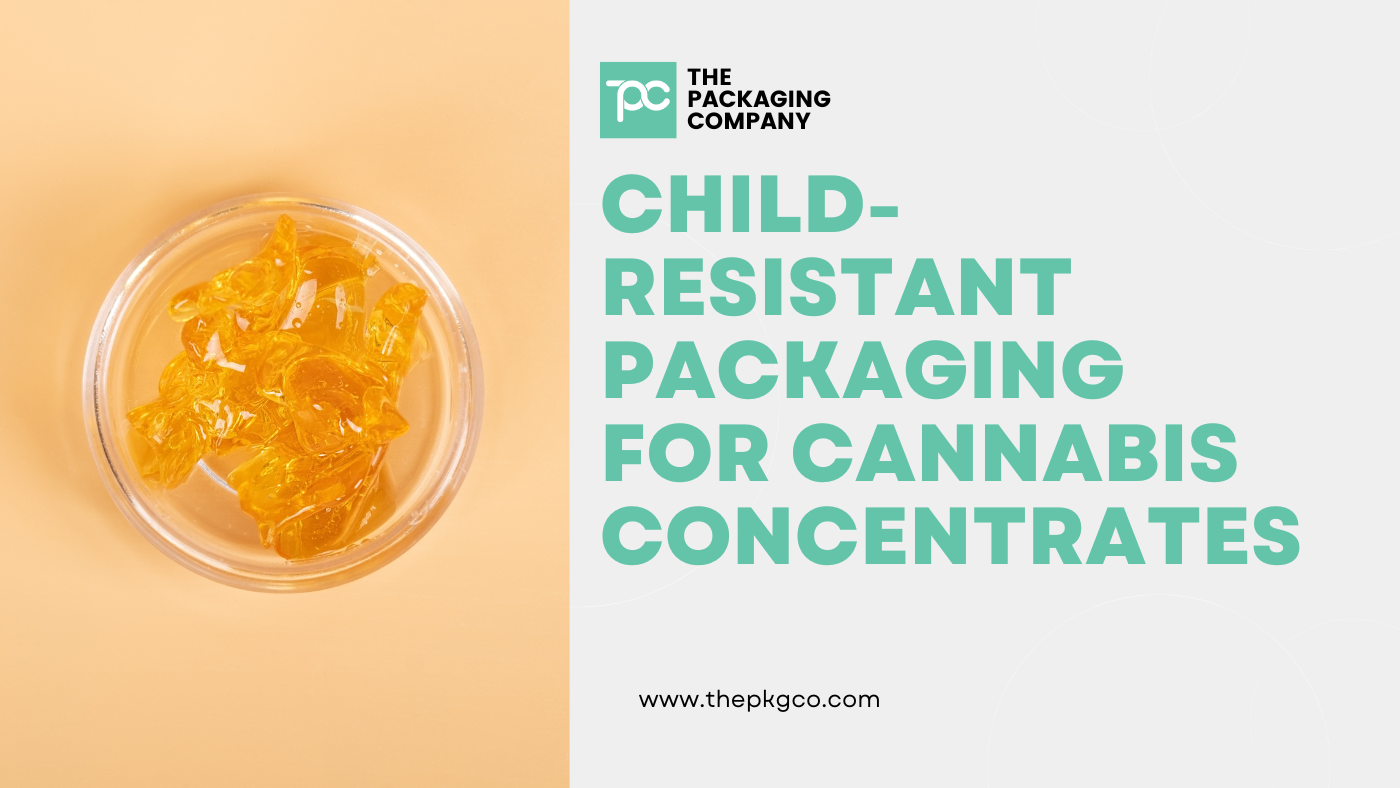
Concentrate packaging has a harder job than its size suggests.
A jar holding a small amount of rosin, wax, badder, live resin, or another extract may sit in direct contact with a high-value product for weeks or months before it reaches the consumer. During that time, the package has to protect the concentrate, maintain its closure performance, survive distribution, support clean dispensing, and meet the child-resistant requirements that apply in the market where it will be sold.
That makes material selection especially important.
For many premium concentrate programs, glass remains the most practical starting point. But the decision should not stop at “glass versus plastic.” Brands also need to think about jar size, headspace, liners, closures, child-resistant performance, secondary packaging, decoration, and how one packaging platform will work across multiple extract SKUs.
What Cannabis Concentrate Packaging Actually Needs to Do
A concentrate jar is not just a smaller version of a flower jar.
The product characteristics are different, and the packaging requirements should reflect that.
A strong concentrate package should accomplish several things at once:
- Limit unnecessary product interaction with the container
- Maintain a reliable seal during storage and distribution
- Protect volatile and aromatic components as much as the complete package system allows
- Give the consumer enough access to remove the product cleanly
- Provide appropriate headspace without dramatically oversizing the package
- Maintain child-resistant performance where required
- Support decoration and branding appropriate for the product’s retail position
That last point matters more than it may appear.
Concentrates are often sold in small fill weights at relatively high retail values. A package that feels oversized, cheap, difficult to access, or poorly sealed can weaken the presentation of a product that may represent one of the more premium SKUs in the brand’s assortment.
Why Glass Remains the Default for Many Concentrate Brands
Glass is widely used for concentrates because it gives brands a stable, rigid primary container without requiring the product to remain in prolonged contact with a polymer jar body.
That does not mean every plastic package will damage a concentrate, and it does not mean glass eliminates every packaging variable.
It does mean glass removes one major material-selection question from the primary container itself.
Research involving cannabinoids has shown that some cannabinoids can adsorb onto polymer surfaces under certain conditions. The amount of loss varies substantially depending on the specific cannabinoid, polymer, sample matrix, temperature, concentration, and storage period. That research does not mean every commercial plastic concentrate jar will fail, but it does show why material compatibility should not be assumed.
For a premium extract that may remain packaged for an extended period, glass is therefore a sensible starting point.
It also provides:
- A rigid package that resists deformation
- A premium tactile presentation
- A nonporous primary container body
- A recyclable glass jar body
- Multiple decoration possibilities
The closure still matters.
A glass concentrate jar may use a plastic child-resistant cap, liner, gasket, or other closure components. Those pieces should be evaluated separately rather than describing the entire assembled package as if it were one material.
Glass Does Not Automatically Solve Every Preservation Problem
Choosing glass is only the beginning.
The finished package still needs an effective closure and liner system.
A glass jar with a poor seal can still allow unwanted exchange with the surrounding environment. A clear glass jar can also expose the product to light unless the package is decorated, colored, coated, or placed inside secondary packaging.
The concentrate itself should influence the package specification.
A brand packaging a soft badder may have different access and headspace priorities than a brand packaging brittle shatter. A live resin program may place greater emphasis on volatile retention and sealing performance. Rosin brands may care heavily about premium presentation because packaging is part of how the product communicates quality at retail.
The right question is not simply, “Is the jar glass?”
It is:
How does the complete jar, closure, liner, decoration, fill level, and storage system perform with the actual concentrate?
Why Plastic Concentrate Jars Require More Careful Evaluation
Plastic is not automatically unsuitable for cannabis concentrates.
But “plastic” is also not one material.
Different polymers have different chemical resistance, barrier properties, stiffness, surface characteristics, and compatibility profiles. The concentrate itself also varies dramatically by extraction method, terpene content, formulation, and storage conditions.
That makes broad statements such as “all plastic reacts with concentrates” too simplistic.
A better sourcing approach is to ask:
- What polymer is the product-contact surface made from?
- Has this material been used successfully with a similar concentrate?
- How long will the finished product remain packaged?
- At what temperatures will it be filled, transported, stored, and displayed?
- Does the concentrate contain a particularly high concentration of terpenes or other components that warrant additional compatibility testing?
- Will the brand perform a filled-product compatibility study before bulk production?
For a value-oriented product or short distribution cycle, a properly selected polymer package may still be workable.
For a high-value extract where the brand wants to minimize material uncertainty, glass is often the easier platform to validate.
5ml, 7ml, or 9ml: Concentrate Jar Size Is About More Than Fill Weight
Small differences in concentrate jar capacity can materially change the user experience.
A brand should not choose a 5ml, 7ml, or 9ml jar simply by finding the smallest container that physically holds the target fill weight.
Concentrates vary in density and physical behavior. The same nominal product weight can occupy a different volume depending on the extract and processing method.
Jar selection should account for:
- Actual filled-product volume
- Desired headspace
- Product consistency
- Ease of access with a dab tool
- Risk of product contacting the closure or liner
- Visual presentation after filling
- Future fill weights using the same package
| Jar size | What to evaluate |
|---|---|
| 5ml | Compact presentation for small fills where minimizing excess package volume is important |
| 7ml | Additional working space and headroom without moving into a substantially larger package |
| 9ml | More access, headspace, or flexibility for larger fills and thicker product presentations |
Those are starting points, not universal fill rules.
The most reliable process is to fill actual production samples with the real concentrate and evaluate the package before committing to bulk production.
Do Not Ignore the Opening Diameter
Capacity gets most of the attention during sourcing, but the opening can matter just as much.
A small jar may technically hold the concentrate while creating a frustrating user experience if the consumer cannot easily reach the product along the edges or bottom.
This becomes especially noticeable with thicker extracts.
Brands should evaluate the package with the tool the customer is likely to use rather than inspecting an empty jar on a conference-room table.
During sampling, check:
- Whether the tool can reach the corners and bottom
- Whether product accumulates beneath the shoulder of the jar
- Whether the closure interferes with clean access
- Whether residue collects on threads or sealing surfaces
- Whether repeated use affects closure performance
A few millimeters of structural difference can matter when the entire package is only a few centimeters wide.
Where Child Resistance Fits Into the Concentrate Package
For regulated cannabis products, the child-resistant mechanism needs to be treated as part of the complete packaging specification.
The relevant requirement is commonly tied to the federal child-resistant testing procedures in 16 CFR §1700.20, depending on the state and finished-product configuration.
A buyer should confirm that the child-resistant documentation corresponds to the actual jar and closure being purchased.
That means checking the complete configuration rather than assuming any CR cap can simply be placed onto any glass jar.
Changing the cap geometry, jar finish, dimensions, liner, or other structural components can affect whether existing test documentation applies.
The package also needs to remain practical for adults.
A concentrate customer may open the jar repeatedly over the life of the product, so the closure experience should be evaluated with actual filled samples rather than only during the first opening.
When a Tin Jar Makes Sense for Concentrates
Glass is not the only rigid presentation available to an extract brand.
A child-resistant tin jar can make sense when the brand wants a metal-forward presentation, more exterior decoration area, or a package structure that fits into a broader metal packaging system across flower, edibles, and concentrates.
There is an important distinction, though.
A 90ml tin jar and a compact 5ml to 9ml glass concentrate jar solve different packaging problems.
For a small concentrate fill, simply moving the product into a much larger metal container can create unnecessary empty space. Brands considering a tin format should evaluate whether the concentrate will contact the tin directly, whether an insert or internal component will be used, and whether the complete product-contact system has been validated.
TPC’s Child-Resistant Tin Jar has a 90ml capacity and is positioned for flower, edibles, and concentrate applications. It is a separate format from TPC’s compact glass concentrate jars.
For some brands, that larger format can become part of the presentation.
For others, the better solution is to keep the concentrate in a compact glass primary jar and use metal or paperboard as secondary packaging.
Secondary Packaging Can Create the Premium Experience Without Changing the Primary Jar
Concentrate brands sometimes ask too much of the primary container.
The jar needs to protect the product and meet the functional requirements. It does not necessarily need to provide every square inch of brand storytelling.
A secondary carton, sleeve, or custom outer package can add:
- More artwork space
- Premium unboxing
- Additional regulatory copy area
- Light protection around clear glass
- Structure for retail display
- More differentiation between product tiers
This can be particularly useful for extract brands selling several concentrate types in the same jar.
The primary glass structure remains standardized while artwork, cartons, sleeves, labels, or decoration identify the individual SKU.
Paperboard should be treated as secondary outer packaging rather than the direct primary container for a cannabis concentrate.
Build a Concentrate Packaging Platform, Not a Different Jar for Every SKU
For a growing extract brand, the best packaging decision may not be the package that is perfect for one SKU.
It may be the package that performs well across ten.
Imagine a concentrate portfolio containing:
- Live resin
- Live rosin
- Badder
- Wax
- Limited drops
- Multiple strains
If those products can use one validated jar platform, the company can standardize more of its packaging system.
The physical jar, closure, and critical specifications stay consistent. Differentiation can happen through direct printing, coating, lid decoration, labels, cartons, and SKU artwork.
For a multi-brand operator or parent company, the same idea can sometimes extend beyond one brand.
That can reduce unnecessary package variation, simplify sampling and procurement, and make reorders easier to manage.
The objective is not to eliminate differentiation.
It is to spend complexity where the customer can actually see or value it.
TPC’s Square Glass Concentrate Jar
TPC’s Square Glass Concentrate Jar is designed specifically for wax and other cannabis extract programs.
The platform is available in:
- 5ml
- 7ml
- 9ml
The package uses a glass jar body with a separate plastic child-resistant cap and an airtight liner. It is certified to 16 CFR §1700.20 and has a minimum production quantity of 10,000 units.
The jar has a square profile with a 42mm listed dimension and can be customized with options including silk screen printing, UV coating, and hot stamping.
The glass jar body is recyclable. The plastic closure is a separate component and should be evaluated according to the applicable local recycling system rather than describing the entire assembled package as a single recyclable material.
For brands comparing additional formats, TPC’s child-resistant jar collection includes glass, plastic, and tin structures for different regulated-product applications.
What to Test Before Ordering 10,000 Concentrate Jars
A concentrate package should be evaluated with the actual product before a production order.
A useful sample review should include:
Fill fit.
Confirm that the actual concentrate fits comfortably at the intended weight without excessive empty space or unwanted contact with the closure.
Tool access.
Use the same type of dab tool or applicator the consumer is likely to use and check access to the bottom and corners.
Seal performance.
Inspect the liner and closure after repeated opening and closing, especially if residue reaches the sealing area.
Material compatibility.
Store filled samples under conditions that reasonably represent the product’s distribution and shelf-life environment.
Decoration durability.
Check coatings, printing, and other finishes after handling, shipping simulation, and repeated use.
Secondary package fit.
If a carton, sleeve, or insert is being used, test the complete finished packaging system rather than developing each component independently.
A small jar leaves very little room for packaging mistakes.
Testing the real fill before production is much less expensive than discovering a dimensional, access, compatibility, or sealing problem after thousands of units have been produced.
Frequently Asked Questions
What is the best child-resistant packaging for cannabis concentrates?
Glass jars are a strong default for premium cannabis concentrates because they provide a rigid, nonporous primary container and reduce the number of polymer compatibility variables at the jar body. The closure, liner, fill level, storage conditions, and applicable child-resistant requirements still need to be evaluated as part of the complete package. The best format ultimately depends on the extract, fill quantity, market, and desired consumer experience.
Is glass better than plastic for cannabis concentrates?
Glass is often easier to validate for premium concentrate programs, but plastic is not automatically unsuitable. Research has shown that cannabinoids can adsorb onto certain polymer surfaces under some conditions, and different plastics behave differently. Brands using a polymer concentrate jar should evaluate the specific resin with the actual product and expected storage conditions rather than relying on the word “plastic” alone.
What size jar should I use for cannabis concentrates?
Common compact concentrate jar sizes include 5ml, 7ml, and 9ml, but capacity should not be selected from fill weight alone. Extract density, consistency, desired headspace, tool access, and visual presentation all affect the appropriate jar size. Filled samples should be evaluated before committing to a production quantity.
Does a concentrate jar need to be child-resistant?
Child-resistant requirements for cannabis concentrates depend on the state and finished packaging configuration. Many regulated cannabis markets require child-resistant packaging and reference federal testing procedures such as 16 CFR §1700.20. Brands should verify the exact requirements in every market where the finished concentrate will be sold and make sure the certification documentation matches the actual package configuration.
Can cannabis concentrates be packaged in a tin?
Yes, tin packaging can be used in concentrate programs when the package structure and product-contact components are appropriate for the application. A larger tin jar serves a different purpose than a compact 5ml to 9ml glass concentrate jar, so brands should evaluate fill volume, internal components, product contact, and presentation before making the switch. A compact glass primary jar inside premium secondary packaging is another option.
What is TPC’s MOQ for custom glass concentrate jars?
TPC’s Square Glass Concentrate Jar has a minimum order quantity of 10,000 units. The platform is available in 5ml, 7ml, and 9ml capacities and is certified to 16 CFR §1700.20. Customization options include silk screen printing, UV coating, and hot stamping.
Ready to Review Your Concentrate Packaging?
The right concentrate jar starts with the product, not the catalog.
If your team is developing a new extract line, standardizing several concentrate SKUs, or replacing an existing jar, contact TPC to review the fill, capacity, closure, decoration, child-resistant requirements, and production plan before the next run.