



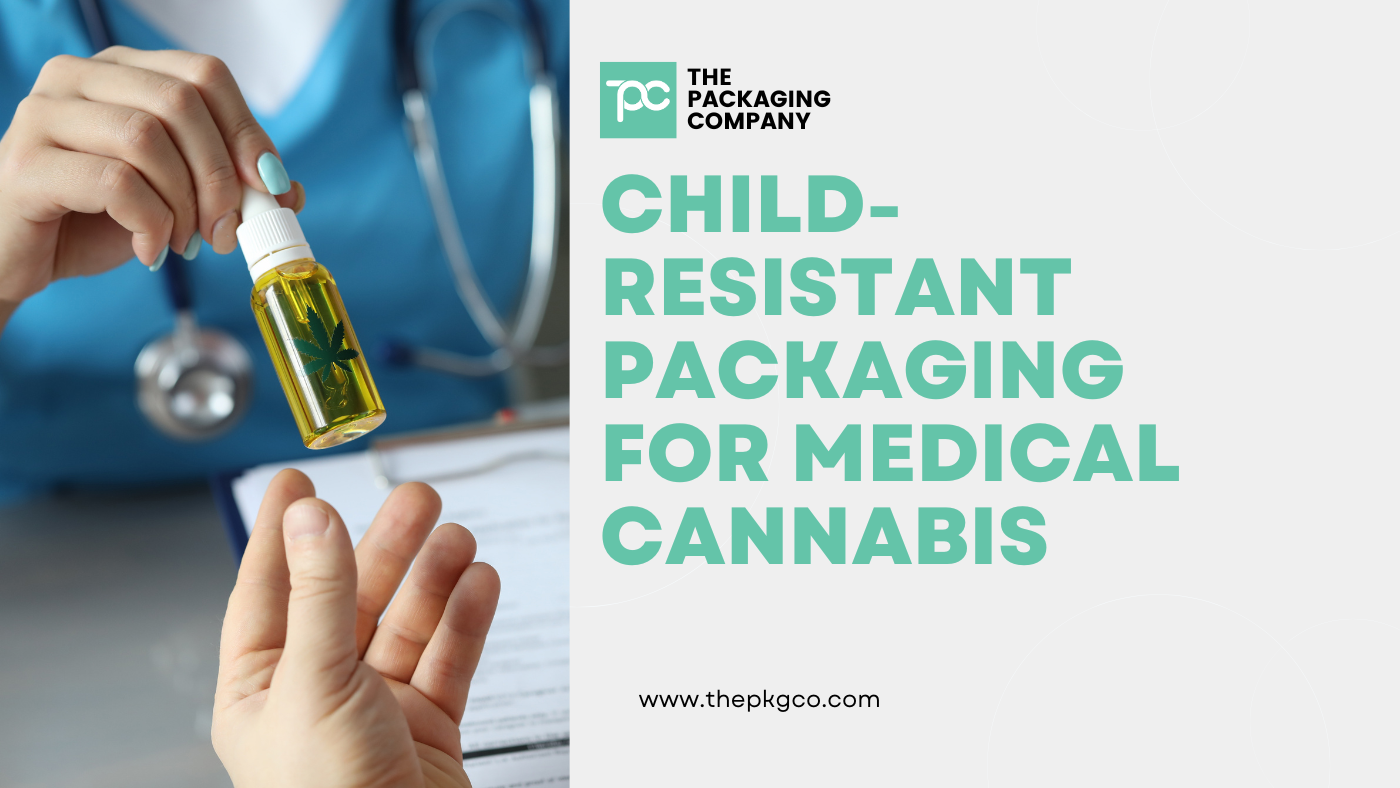
Medical cannabis packaging has to solve a slightly different problem from packaging built only for an adult-use retail shelf.
The package still needs to protect the product, meet applicable child-resistant requirements, survive distribution, and support the brand. But depending on the state, a medical cannabis program can also introduce patient-specific labeling, dosage information, batch traceability, package inserts, storage instructions, and other documentation that changes what the packaging system needs to accommodate.
That does not mean medical cannabis packaging is automatically subject to a tougher child-resistant standard than adult-use cannabis.
In many markets, the same federal child-resistant framework under 16 CFR Part 1700 sits underneath both. The difference is often everything that surrounds the CR mechanism.
For brands serving medical patients, there is another consideration that should receive more attention: usability. A package can technically pass child-resistant testing and still create a frustrating experience for a patient who has limited grip strength, reduced dexterity, or difficulty operating a complicated closure.
The best medical cannabis packaging program therefore treats compliance, documentation, product performance, and patient use as parts of the same system.
Medical Cannabis Does Not Have One Separate National Packaging Standard
Cannabis packaging remains regulated primarily at the state level.
There is no single federal “medical cannabis package” specification that every state follows. States build their own cannabis programs and can require different combinations of child resistance, tamper evidence, opacity, resealability, labeling, product information, and documentation.
The federal Poison Prevention Packaging framework remains an important reference point for child-resistant packaging.
Under 16 CFR Part 1700, qualifying special packaging must meet defined child-resistant and adult-use effectiveness requirements.
Adult-use cannabis programs can rely on the same framework. New York’s current adult-use regulations, for example, require retail cannabis packaging to remain child-resistant for the useful life of the product and require licensees to maintain documentation showing compliance with 16 CFR §§1700.15 and 1700.20.
So the useful distinction is not:
Medical = strict CR packaging
Adult-use = less strict CR packaging
A more accurate framework is:
Both markets can require documented child resistance, while medical programs may layer additional patient, dosage, traceability, and dispensing requirements around the package.
What Medical Programs Can Add to the Packaging Requirement
Pennsylvania shows how different the packaging specification can become when the product is part of a medical program.
Under Pennsylvania’s medical marijuana regulations, the package must minimize oxygen exposure and be child-resistant, tamper-proof or tamper-evident, opaque with an exception for dry leaf, and resealable.
But the regulations continue well beyond the container itself.
The label must include information such as:
- Product form, quantity, and weight
- Number of individual doses
- THC and CBD percentages
- Applicable cannabinoid and terpene information
- Harvest batch or process lot identification
- Packaging date
- Expiration date
- Storage instructions
- Required warnings
- Information identifying the intended dispensary
Pennsylvania also requires prior written approval of medical marijuana packaging and label content by the Department.
That creates a much broader packaging-management problem than simply sourcing a compliant jar or bottle.
The physical package needs enough usable surface area for required information, and the packaging team needs a controlled way to manage artwork, lots, labels, and production changes without accidentally creating a mismatch between an approved package and the product being produced.
Florida Shows How Patient Information Can Change the Package
Florida provides another useful example.
Florida medical marijuana must be packaged in compliance with the U.S. Poison Prevention Packaging Act. The state’s statute also requires the package label to carry information including the medical marijuana treatment center, batch and harvest information, physician information, patient information, product and dosage form, THC and CBD concentration, recommended dose, and required warnings.
Florida also requires a patient package insert containing information on topics such as clinical pharmacology, indications and use, dosage and administration, dosage forms and strengths, contraindications, warnings, precautions, and adverse reactions.
Specific formats add further requirements. Marijuana for smoking must use a sealed receptacle and the package must be plain, opaque, and white, subject to the state’s specified branding allowances. Edible receptacles also have specific appearance and information requirements.
This illustrates the real difference between a medical packaging project and a standard consumer packaging exercise.
The brand may not have complete freedom to optimize every square inch for marketing.
Regulatory information, patient information, dosing instructions, warnings, and traceability can consume a meaningful portion of the package architecture.
Documentation Matters as Much as the CR Mechanism
For procurement teams, medical cannabis packaging should be treated as a documented package specification rather than a general product category.
“We use a child-resistant bottle” is not enough information.
The operating file for a package should identify:
- Exact container
- Exact closure
- Relevant dimensions
- Material specifications
- Child-resistant test documentation
- Liner or gasket configuration
- Decoration specification
- Approved artwork version
- Required labeling areas
- Secondary packaging components
- Applicable state or market
This becomes more important when a company sells the same formulation in several states.
The package platform may remain the same while labels, warnings, dosing information, or other requirements change by market.
A multi-state operator should be able to answer a basic question quickly:
Which exact packaging configuration is approved for this SKU in this state?
If answering that question requires searching through old emails from three suppliers, the packaging program has a documentation problem.
Child Resistance and Patient Usability Are Not Opposites
Medical packaging creates a difficult design balance.
The package needs to resist access by young children while remaining practical for the intended adult user.
The federal child-resistant testing protocol recognizes this directly.
Under 16 CFR §1700.20, the senior-adult panel contains 100 participants between the ages of 50 and 70. The test measures whether adults can open and, where appropriate, properly resecure the package. The applicable federal standard generally requires senior-adult use effectiveness of at least 90%.
That is important, but brands should understand what the test does not prove.
The federal protocol excludes participants whose illness, injury, or disability would interfere with their effective participation. Participants who cannot operate conventional non-child-resistant screening packages are also excluded from the final senior-adult panel.
That means CR certification should not be treated as a complete accessibility test for every medical patient.
A patient using cannabis for a condition that affects hand strength, grip, coordination, or dexterity may interact with the package very differently from someone on the regulatory test panel.
For medical-focused products, brands should consider running additional real-use evaluations with representative users after the compliant package has been selected.
What to Evaluate Beyond CR Certification
A package can meet the regulatory child-resistant threshold and still create avoidable friction.
During sample evaluation, look at the entire interaction.
Opening force.
How much force does the package require, and where does the user need to apply it?
Grip position.
Can the package be operated comfortably without requiring a very specific hand position?
Instruction clarity.
Can the opening instructions be understood quickly, or does the mechanism require explanation?
Resealing.
Can the patient tell when the package has been properly resecured?
Repeated use.
Does the opening experience change after dozens of cycles?
Product access.
Once the package is open, can the patient actually dispense the intended amount cleanly?
That last question is particularly important for liquid, topical, and semi-solid medical cannabis products.
A perfect CR closure does not help much if the patient cannot consistently get the product out of the package.
Format Selection Should Follow the Product and Use Case
Medical cannabis can include far more than flower and pre-rolls.
Depending on the market and product program, brands may need packaging for:
- Topical creams
- Gels
- Balms
- Liquid formulations
- Tinctures
- Roll-on products
- Syrups
- Other controlled-dose or specialty formats
The package should follow the product rather than forcing every medical SKU into a generic bottle or jar.
Child-resistant droppers
Glass dropper bottles can work well for liquid products when controlled manual dispensing and formula compatibility are priorities.
The dropper, bulb, pipette, bottle, and child-resistant closure should be evaluated as a complete system.
Child-resistant airless packaging
Airless systems can be useful for creams, gels, and other formulas where minimizing repeated air exposure and providing controlled dispensing are important.
Formula viscosity and pump output should be tested with the actual product before production. A package that pumps water successfully tells you very little about how it will perform with a high-viscosity topical.
Child-resistant squeeze tubes
A squeeze tube can be a practical format for topical formulas where directional dispensing and portability matter.
TPC’s Child-Resistant Squeeze Tube is available in 30ml, 60ml, and 90ml sizes with 3-layer or 5-layer aluminum laminate or all-plastic structures. The format is specifically certified to ASTM F1702, with production beginning at 10,000 units per size.
Child-resistant roll-ons
Roll-on formats can make sense for topical products designed for targeted application.
The application component, formula viscosity, ball movement, leakage resistance, and closure all need to work together.
TPC offers standard child-resistant roll-on packaging beginning at 10,000 units, as well as a clinical-format roll-on beginning at 20,000 units.
TPC’s child-resistant topical packaging category includes squeeze tubes, airless pumps, roll-ons, droppers, cream jars, lip balm formats, syrup packaging, and other regulated-product structures.
The Package Should Support Consistent Use
For medical-focused products, dispensing performance deserves more attention than it often receives.
A patient may use the same package repeatedly over several weeks.
If the package dispenses a dramatically different amount from one use to the next, leaks around the closure, becomes harder to operate as product accumulates, or fails before the formula is finished, the packaging problem directly affects the product experience.
This is especially important with:
- Airless pumps
- Droppers
- Roll-ons
- Nasal or spray formats
- Syrup closures
- Squeeze tubes
Brands should test filled packages through repeated use rather than evaluating only the first dispense.
Useful testing can include:
- Priming behavior
- Output consistency
- Leakage
- Closure resealing
- Formula compatibility
- Product residue around the closure
- Performance at expected storage temperatures
- Near-empty dispensing behavior
For a medical product, predictable package performance is part of the overall quality experience.
Medical Packaging Does Not Have to Look Clinical
A regulated medical product still has a brand.
Compliance requirements may limit artwork, colors, claims, or available label space in certain states, but that does not mean the finished package has to look generic.
Brands can create differentiation through:
- Package geometry
- Material choice
- Controlled color systems
- Direct printing
- Coatings
- Secondary cartons
- Clear information hierarchy
- Consistent structures across a product family
In medical packaging, clarity itself can become part of the brand.
A package that makes the product name, strength, instructions, opening mechanism, and other important information easy to understand can feel more considered than one overloaded with decorative elements.
The goal is not to choose between compliance and presentation.
It is to design the presentation around the information the product is required to communicate.
Multi-State Medical Brands Should Standardize the Structure Where Possible
For an operator selling medical cannabis across multiple markets, creating a completely different package for every state can become expensive and difficult to manage.
A better strategy is often to standardize the physical package as far as the applicable rules allow, then localize the components that actually need to change.
For example:
Standardized:
- Bottle or jar structure
- CR closure
- Pump or applicator
- Primary material
- Critical dimensions
Market-specific:
- Label copy
- Warnings
- Patient information
- Dose information
- Universal symbols
- Secondary packaging
- Required inserts
This approach can reduce the number of physical packaging platforms being purchased while maintaining the flexibility needed for different regulatory programs.
It also makes change control easier. If a state changes a labeling rule, the company may be able to update one artwork component instead of re-engineering the entire package.
What to Ask a Packaging Supplier for a Medical Cannabis Project
Before requesting a quote, give the supplier enough information to evaluate the complete application.
A strong project brief should include:
- Product type
- Formula or fill characteristics
- Target fill volume
- States where the product will be sold
- Expected production quantity
- Required child-resistant documentation
- Desired dispensing method
- Artwork and labeling requirements
- Secondary packaging requirements
- Launch timing
- Any known patient-use concerns
That is a better starting point than simply asking for “a medical cannabis bottle.”
The package needs to be selected around the actual product, market, user, and production program.
How TPC Supports Medical and Regulated Packaging Programs
The Packaging Company works with medical, cannabis, pharmaceutical, wellness, and other regulated-product companies on made-to-order packaging programs.
TPC combines U.S.-side packaging engineering with direct production oversight through its wholly owned China operation.
For medical and topical applications, TPC’s CR portfolio includes child-resistant squeeze tubes, child-resistant airless pump bottles, child-resistant roll-ons, child-resistant glass dropper bottles, cream jars, syrup bottles, nasal spray packaging, and other custom formats.
MOQ varies by format. The CR squeeze tube, glass dropper bottle, and standard CR roll-on generally begin at 10,000 units. The clinical-format roll-on begins at 20,000 units, while the CR nasal spray format begins at 50,000 units. Airless MOQ should be confirmed for the specific format.
For larger medical or multi-state programs, the goal should be more than finding a compliant individual container.
The stronger packaging program connects the package, documentation, patient experience, formula, labeling requirements, and reorder process from the beginning.
If your team is preparing a new medical cannabis product, reviewing an existing CR package, or trying to standardize packaging across multiple markets, contact TPC to review the project.
Frequently Asked Questions
Is medical cannabis packaging required to be child-resistant?
Many state medical cannabis programs require child-resistant packaging, but the exact requirement depends on the state and product. Florida requires medical marijuana to be packaged in compliance with the U.S. Poison Prevention Packaging Act, while Pennsylvania requires medical marijuana product packaging to be child-resistant along with several other package characteristics. Brands should verify the rules for each state where the finished product will be dispensed.
Are medical cannabis packaging rules stricter than adult-use rules?
Not universally. Adult-use programs can impose robust child-resistant, tamper-evident, resealability, sustainability, and documentation requirements of their own. Medical programs may differ because they can add patient-specific labels, dosage information, storage instructions, package inserts, approval processes, or traceability requirements around the physical package.
Does child-resistant certification mean a package is easy for older patients to open?
No. Federal child-resistant testing includes a senior-adult panel between ages 50 and 70 and generally requires at least 90% senior-adult use effectiveness, but that is not the same as accessibility testing for every medical patient. The federal protocol excludes participants whose illness, injury, or disability would interfere with testing. Medical-focused brands should consider additional usability testing when the intended patient population may have limited dexterity or grip strength.
What packaging works for medical cannabis topicals?
Potential formats include child-resistant airless bottles, squeeze tubes, roll-ons, cream jars, and other dispensing systems depending on the formula and state requirements. Package selection should account for viscosity, compatibility, dose or output needs, application method, closure performance, and repeated use. Filled-product testing should be completed before bulk production.
Can the same medical cannabis package be used in multiple states?
Sometimes. A brand may be able to standardize the physical container and child-resistant closure while changing labels, warnings, inserts, symbols, or secondary packaging by state. The complete finished package still needs to be reviewed against each state’s requirements before production.
What documentation should I request from a child-resistant packaging supplier?
Request the child-resistant test documentation applicable to the package and confirm that the tested container and closure match the configuration being quoted. Keep the package specification, materials, dimensions, artwork version, closure details, and relevant compliance documents together. For a multi-state program, also identify which exact configuration is being used for each market.