



Infused pre-rolls are no longer a niche extension sitting at the edge of the cannabis shelf.
They have become one of the most important segments in the pre-roll category, and that changes the packaging decision.
Headset reported that infused and connoisseur formats accounted for 48.5% of U.S. pre-roll sales in Q1 2026. Multipacks represented 54.2% of U.S. pre-roll sales and were growing at 2.5 times the year-over-year rate of singles.
That creates a packaging challenge for brands.
An infused single, a 2-pack, and a 5-pack do not need the same package. Neither do a value-oriented infused product and a premium product competing at a significantly higher retail price.
The right child-resistant pre-roll packaging should be selected around the product count, dimensions, price position, protection needs, retail presentation, and production program.
Why Infused Pre-Rolls Deserve a Different Packaging Conversation
Infused pre-rolls combine flower with concentrates or other infusion formats to create a product with different economics and positioning from a basic pre-roll.
Custom Cones USA reported $1.68 billion in infused pre-roll revenue during 2025, representing about 47% of total pre-roll category revenue in its dataset. Infused products also recorded the strongest growth in both unit sales and revenue among the reported pre-roll segments.
That matters because packaging becomes easier to justify when the product inside it has greater retail value.
A premium package is not automatically required.
But a brand selling a higher-value infused product has more reason to evaluate whether a basic pouch or commodity tube is supporting the price point effectively.
Start With the Actual Pre-Roll, Not the Package Catalog
Before choosing a tin or tube, document the actual product.
At minimum, confirm:
- Finished pre-roll length
- Maximum diameter
- Filter or tip dimensions
- Single or multipack count
- Total fill weight
- Whether the roll contains an external coating
- Desired orientation inside the package
- Whether an insert is needed
Nominal cone size alone is not enough.
An infused pre-roll may be thicker or have a different surface than a standard flower pre-roll. A package that fits the unfilled paper specification may not fit the finished product comfortably.
Always test the finished production pre-roll.
Packaging for Infused Pre-Roll Singles
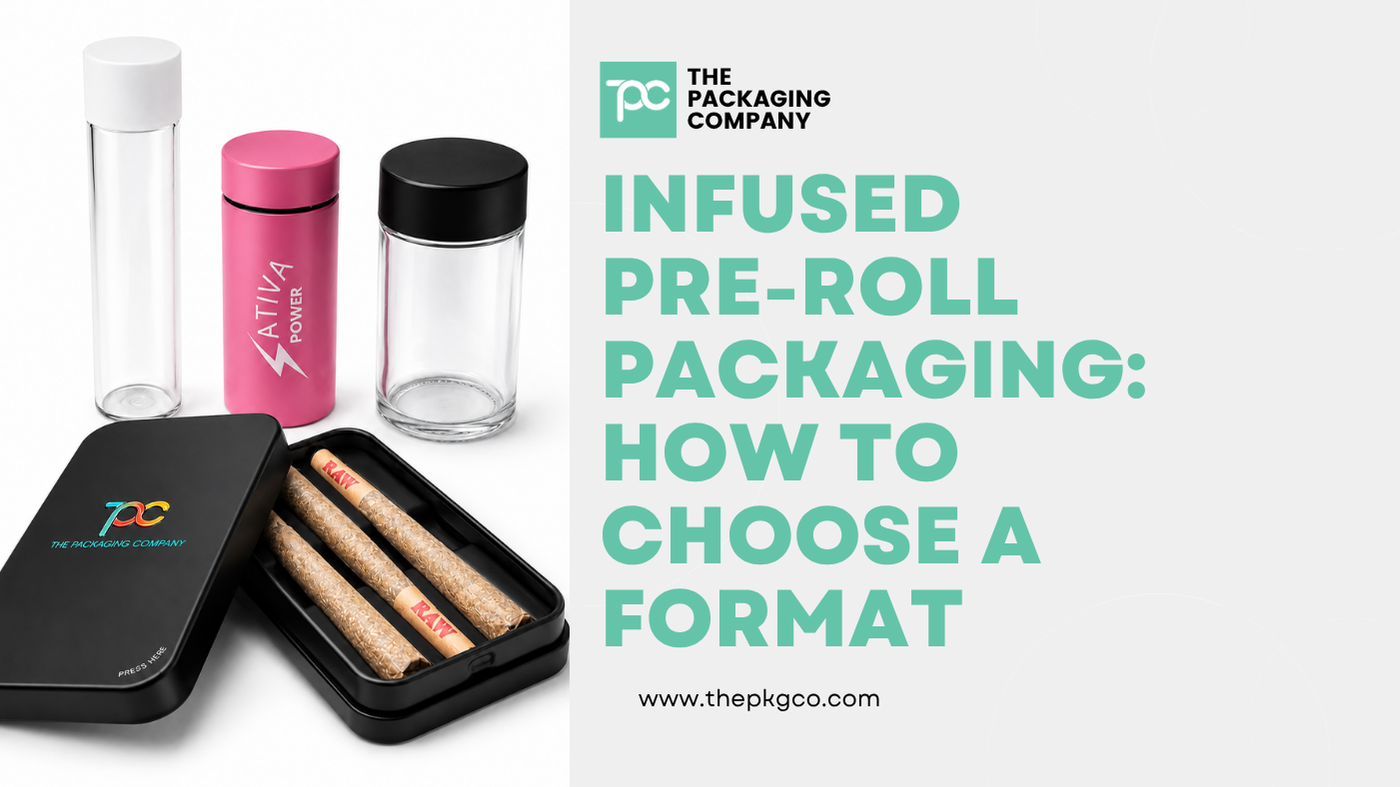
A single infused pre-roll usually needs less internal volume than a multipack, so a tube can be an efficient rigid option.
TPC offers child-resistant pre-roll tubes in glass and aluminum formats.
Glass tubes
Glass can create a premium presentation and allows the product to be visible when the decoration and state requirements permit it.
TPC offers CR Glass Tube formats with Short Cap, Standard Cap, and Aluminum Overshell Cap configurations. The aluminum overshell version still uses a plastic CR mechanism underneath the decorative aluminum shell.
Aluminum tubes
Aluminum pre-roll tubes provide rigid crush protection with a lightweight metal presentation.
TPC’s K20 is designed around single pre-roll applications, while the K29F is a multipack aluminum tube format.
For single products, the decision between glass and aluminum often comes down to presentation, product visibility, shipping considerations, brand system, and the exact pre-roll dimensions.
Why Multipacks Change the Packaging Math
Multipacks are becoming increasingly important in pre-roll retail.
Headset reported that multipacks represented 54.2% of U.S. pre-roll sales in Q1 2026. Custom Cones USA separately reported that 48.5% of pre-roll SKUs in its 2025 dataset were multipacks and that 90% of the top 100 products were multipacks.
That creates a different packaging problem from a single.
The package now needs to organize several products while controlling:
- Movement
- Crushing
- Orientation
- Empty space
- Opening experience
- Repeated closure use
A tin can become more attractive at this stage because it gives the brand a larger rigid platform and creates room for an insert when needed.
When a Tin Makes More Sense Than a Tube
Tubes are efficient for singles and narrow product configurations.
Tins become increasingly useful when the package needs to present several pre-rolls as a set.
TPC’s child-resistant tin line includes several formats for different product configurations.
The Child-Resistant Snap Tin V5 measures 74 x 58 x 20 mm and uses a corner-press closure. It is certified to 16 CFR §1700.20 and begins at 5,000 units for custom production.
The V5E extends the snap tin platform for longer product configurations.
TPC also offers hinge-lid and dual-button CR tin formats that can be evaluated around the actual pre-roll count and dimensions.
The correct tin should be chosen from filled product samples rather than a generic count recommendation.
The Insert Can Matter as Much as the Tin
Putting five pre-rolls into a large empty metal box does not automatically create premium packaging.
An insert can control:
- Spacing
- Orientation
- Product movement
- Presentation after opening
- Separation between products
But inserts add material, cost, assembly, and another component that needs to be managed.
Use one when it materially improves protection or presentation.
Do not add an insert simply because premium packaging is expected to have more pieces.
Infused Products Can Make Cleanability More Important
Some infused pre-rolls use external coatings or other product constructions that create more residue than a standard dry paper pre-roll.
That should be evaluated during sampling.
Check whether the finished product:
- Transfers residue to an insert
- Sticks to neighboring pre-rolls
- Leaves material on the package interior
- Interferes with closure surfaces
- Changes after expected storage conditions
The correct answer may be a different insert material, more spacing, a different orientation, or a different package altogether.
Build the Package Around the Product Tier
Not every infused product needs the same presentation.
A useful portfolio structure might look like:
| Product tier | Packaging approach |
|---|---|
| Value single | Efficient CR tube or flexible package |
| Premium single | Glass or decorated aluminum CR tube |
| Core multipack | Rigid multipack tube or CR tin |
| Premium multipack | Decorated CR tin with a fitted insert where useful |
| Limited drop | Rigid primary package plus secondary branding if justified |
This creates hierarchy without forcing the highest packaging cost onto every SKU.
Standardize Before the Pre-Roll Portfolio Gets Too Large
A successful infused program can expand quickly into different strains, flavors, counts, and potency tiers.
If each launch receives a different physical package, procurement complexity grows at the same time.
Before adding another structure, ask whether the new SKU can use an existing:
- Tube
- Tin
- Insert
- Artwork template
- Secondary carton
Changing graphics is usually easier to manage than changing physical packaging.
For an MSO or multi-brand operator, standardization can sometimes extend across related brands while the visible decoration remains unique.
What to Test Before Production
Before ordering 5,000 or 10,000 custom packages, load the actual finished pre-rolls into production samples.
Evaluate:
Fit.
Does the finished infused product fit without being compressed?
Movement.
Do the pre-rolls move excessively during handling or shipping?
Residue.
Does the infusion leave residue on other products or the package?
Closure.
Does the package open and close properly through repeated use?
Presentation.
Does the consumer see an organized product when the package opens?
Artwork.
Is enough usable space available for branding and required labeling?
How TPC Supports Infused Pre-Roll Packaging Programs
TPC’s child-resistant pre-roll packaging portfolio includes glass tubes, aluminum tubes, snap tins, hinge-lid tins, dual-button formats, and other custom options.
CR tin formats including the V5 and V5E generally begin at 5,000 units. Glass and aluminum pre-roll tubes generally begin at 10,000 units.
TPC combines U.S.-side engineering with direct production oversight through its wholly owned China operation.
If your brand is building an infused single or multipack program, contact TPC with the finished pre-roll dimensions, count, quantity, and artwork direction so the packaging can be evaluated around the actual product.
Frequently Asked Questions
What is the best packaging for infused pre-rolls?
The best format depends on the finished pre-roll dimensions, count, price point, child-resistant requirements, protection needs, and brand position. CR glass or aluminum tubes can work well for singles, while tins and larger rigid formats become more useful for multipacks.
Why are multipacks important for pre-roll brands in 2026?
Multipacks now represent a major share of U.S. pre-roll sales. Headset reported that multipacks accounted for 54.2% of U.S. pre-roll sales in Q1 2026 and were growing faster than singles. That makes packaging designed specifically around multipack organization and presentation increasingly relevant.
Should infused pre-rolls use tins?
Not automatically. Tins are attractive when several products need rigid protection, premium presentation, or an organized insert system. Singles and smaller configurations may be more efficiently packaged in CR tubes.
Do coated infused pre-rolls need special packaging?
They may require additional evaluation because external material can transfer to inserts, neighboring products, or package surfaces. Filled-product samples should be stored and handled under realistic conditions before production.
What is TPC’s MOQ for pre-roll packaging?
MOQ varies by format. Several CR tin formats begin at 5,000 units, while glass and aluminum pre-roll tubes generally begin at 10,000 units.
Can one package support several infused pre-roll SKUs?
Yes. A standardized physical package can often support multiple strains, flavors, or product variants while artwork and labels change by SKU. Standardization can simplify procurement and improve reorder consistency.