

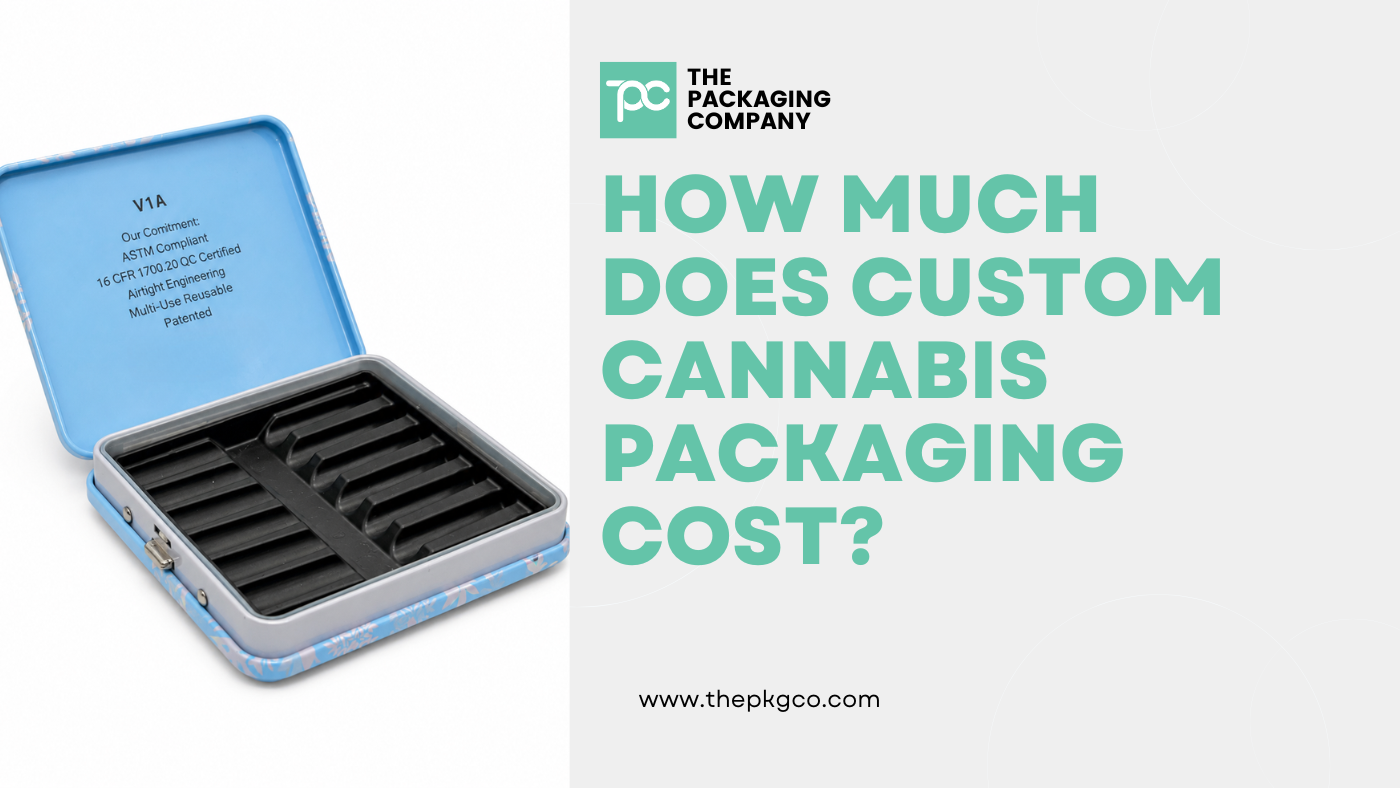
There is no useful one-line answer to the question, “How much does custom cannabis packaging cost?”
A 5,000-unit child-resistant bag program and a 50,000-unit custom tin program have completely different cost structures. Even two packages that look nearly identical can price differently because of material, decoration, closures, inserts, tooling, freight, production quantity, and how many SKUs share the same structure.
For an established cannabis brand, the better question is not simply, “What is the unit price?”
It is:
What changes in the packaging economics as our production volume moves from 5,000 units to 10,000, 25,000, 50,000, or more?
Understanding those volume thresholds makes it easier to compare quotes, decide where customization is worth paying for, and avoid optimizing a packaging program around a unit price that does not reflect the total cost of getting a finished package into production.
What Actually Determines Custom Cannabis Packaging Cost?
Quantity matters, but it is only one part of the quote.
Custom cannabis packaging pricing is usually influenced by a combination of:
- Package format
- Material
- Package dimensions
- Child-resistant mechanism
- Decoration method
- Number of print colors
- Special finishes
- Custom inserts or trays
- Existing versus new tooling
- Number of artwork versions
- Production quantity
- Quality requirements
- Secondary packaging
- Freight and logistics
That is why comparing two suppliers only by the number beside “unit cost” can be misleading.
One quote may include a custom insert, direct printing, an airtight component, and finished decoration. Another may be quoting a simpler structure that still requires additional components after delivery.
Before comparing pricing, make sure the packages being compared are actually equivalent.
What Changes at 5,000 Units?
For several child-resistant cannabis formats, 5,000 units is a realistic entry point into custom production.
TPC’s Child-Resistant Snap Tin V5 and V5E, several other tin formats, and custom CR mylar bags generally begin at 5,000 units. MOQ varies by format, so 5,000 should not be treated as a universal minimum across every package TPC supplies.
At this quantity, brands should think carefully about how much complexity they add.
The cost of setup, printing, custom components, and other fixed production activities is being spread across a relatively small number of packages.
This is where a brand can easily over-engineer a launch.
For example, a 5,000-unit production run may not need:
- A completely new structural tool
- A highly complex multi-piece insert
- Several different package structures across related SKUs
- Decoration that requires multiple specialized processes
That does not mean the package has to look basic.
A strong existing packaging platform with custom colors, direct printing, labels, hot stamping, coatings, or a well-designed secondary carton can create meaningful differentiation without requiring a completely new structure.
At 5,000 units, the highest-value question is usually:
How much of the package can we customize while keeping the underlying platform standardized?
What Changes at 10,000 Units?
Ten thousand units opens more of the child-resistant packaging portfolio.
TPC’s CR glass pre-roll tubes, aluminum pre-roll tubes, Child-Resistant Squeeze Tube, glass dropper bottle, standard CR roll-on, Square Glass Concentrate Jar, and several other formats generally begin at 10,000 units.
At this level, brands also have more room to think in terms of product families instead of individual SKUs.
Suppose a brand has four concentrate products using the same jar.
Instead of sourcing four different structures, the company may be able to purchase one physical jar platform and differentiate the products through:
- Artwork
- Labels
- Lid decoration
- Colors
- Secondary cartons
This is often more efficient than creating a new physical package for each SKU.
The packaging team should also ask whether the supplier permits artwork splits within the production program and what minimum quantity applies to each decoration version.
The answer depends on the package and production method, so artwork splits should be confirmed before planning the assortment around them.
What Changes at 25,000 Units?
At 25,000 units, packaging decisions start having a larger effect on total spend.
A difference of a few cents per unit that felt insignificant on a sample quote can become meaningful when multiplied across 25,000 packages, several SKUs, and repeated production runs.
This is where value engineering becomes more useful.
Instead of asking only, “Can we lower the price?” ask:
- Can multiple SKUs use the same package structure?
- Can we simplify the insert?
- Can two decoration processes become one?
- Are we paying for a feature customers do not notice?
- Can a standard component replace a custom component?
- Can packaging dimensions be adjusted without hurting presentation?
- Can a product family share one closure?
This is a different conversation from simply negotiating the supplier’s margin.
Good value engineering tries to remove cost that does not create enough functional, compliance, operational, or brand value.
It should not remove the features that made the package worth buying in the first place.
What Changes at 50,000 Units and Above?
Once a brand is ordering 50,000 or more units of a format, packaging becomes less like a single purchase and more like a supply program.
The conversation should expand beyond unit cost.
At this volume, procurement teams should evaluate:
- Production forecasting
- Capacity availability
- Reorder timing
- Quality consistency between runs
- Artwork change control
- Lot traceability
- Supplier redundancy
- Production inspection
- Freight planning
- Inventory exposure
A package that saves a few cents but arrives inconsistently can become much more expensive once line downtime, repacking, expedited freight, rejected components, or launch delays enter the equation.
At 50,000 units and above, the supplier relationship matters more because the packaging program is becoming part of the brand’s operating infrastructure.
A Simple Volume Framework
| Production quantity | Primary packaging question |
|---|---|
| 5,000 units | How can we customize an existing platform without over-engineering the launch? |
| 10,000 units | Can one physical structure support several SKUs? |
| 25,000 units | Where can value engineering remove unnecessary cost? |
| 50,000+ units | How do we manage this as a repeatable supply program? |
The thresholds are not pricing rules.
They are useful ways to change the questions being asked as packaging volume grows.
Tooling Can Change the Economics Completely
One of the biggest distinctions in custom cannabis packaging is whether the project uses an existing platform or requires new tooling.
Existing tooling gives a brand a proven physical starting point. Customization can then happen through color, decoration, inserts, labels, secondary packaging, and other changes that do not require creating the entire package structure from scratch.
A fully custom-engineered package is different.
The brand may need to account for:
- Engineering
- Prototype development
- Mold or tool production
- Testing
- Revisions
- Qualification
- Longer development timelines
Custom tooling makes the most sense when the expected production volume, repeat orders, brand value, or functional requirement justifies the investment.
For a single 5,000-unit launch with uncertain reorder potential, it can be difficult to justify.
For a product family expected to run hundreds of thousands of units over several years, the calculation can look completely different.
Decoration Is Often the Hidden Cost Driver
Two identical containers can have very different finished costs because of decoration.
Common decoration variables include:
- Silk screen printing
- Direct printing
- Hot stamping
- UV coating
- Custom color
- Labels
- Multiple print passes
- Special finishes
The most expensive decoration is not automatically the strongest branding choice.
A packaging team should look at the finished package from normal retail distance and ask which details actually contribute to recognition, shelf presence, and perceived quality.
Then put the money there.
Do Not Forget the Cost of Packaging Complexity
Unit cost is visible on the quote.
Complexity cost often is not.
A company running 20 SKUs across six unrelated package structures may need to manage six sets of samples, specifications, MOQs, inserts, closures, artwork templates, quality standards, and reorder schedules.
That operational burden has a cost even if it never appears as a line item on the supplier invoice.
For scaling brands and multi-state operators, packaging standardization can sometimes create more value than squeezing another cent out of an already optimized component.
What Information Produces a Better Cannabis Packaging Quote?
The quality of a quote depends heavily on the quality of the project information.
Before asking a supplier for pricing, have as much of the following ready as possible:
- Product being packaged
- Package format
- Target quantity
- Number of SKUs
- Fill volume or product dimensions
- Target market or state
- Child-resistant requirements
- Decoration expectations
- Artwork status
- Desired insert
- Launch timeline
- Existing package or reference samples
A quote based on “we need 10,000 pre-roll tins” is necessarily less precise than one based on the exact pre-roll length, count, artwork, market, insert, and required delivery date.
How TPC Approaches Cannabis Packaging Cost
The Packaging Company is a packaging engineering and sourcing company with U.S. operations and a wholly owned China operation that provides direct production oversight.
TPC works across child-resistant tins, pre-roll tubes, jars, bags, topical packaging, secondary packaging, and custom-engineered formats.
MOQ varies by format. Several CR tin and bag programs begin at 5,000 units, while many glass tubes, jars, squeeze tubes, droppers, and roll-on formats begin at 10,000 units or higher.
The right pricing conversation starts with the actual program rather than a generic per-unit target.
If your team is preparing a 5,000-unit launch or planning recurring production at 50,000 units and above, contact TPC to review the package, quantity, artwork, and production requirements.
Frequently Asked Questions
How much does custom cannabis packaging cost?
Custom cannabis packaging does not have one standard unit price. Cost depends on package format, material, child-resistant mechanism, decoration, inserts, tooling, production quantity, artwork versions, freight, and other project requirements. The most useful way to compare quotes is to make sure each supplier is pricing the same finished package specification.
Does cannabis packaging get cheaper at higher quantities?
Unit economics often improve as fixed production costs are spread across more units, but the relationship is not identical for every format. Materials, decoration processes, production methods, tooling, and artwork splits can all affect the quantity breaks. Brands should request pricing at realistic current and future production quantities rather than assuming a fixed percentage reduction.
What is the MOQ for custom cannabis packaging?
MOQ varies by package format. Several TPC child-resistant tins and CR mylar bag programs begin at 5,000 units, while many glass tubes, jars, squeeze tubes, droppers, and other rigid formats begin at 10,000 units or more. The exact MOQ should be confirmed for the package being considered.
Is custom tooling worth it for cannabis packaging?
Custom tooling is most attractive when the package solves a meaningful functional or brand problem and the expected lifetime production volume can justify development cost. An existing packaging platform is often more economical for smaller or less certain launches. Higher-volume, repeat programs can make custom engineering more practical.
How can a cannabis brand lower packaging cost without making the package look cheap?
Start by reducing unnecessary structural complexity rather than cutting visible quality. Standardize package structures across SKUs, simplify inserts, evaluate decoration processes, and use custom artwork or secondary packaging strategically. Value engineering should remove cost that the customer does not value while protecting the features that influence function, compliance, and brand presentation.
What should I send to get an accurate cannabis packaging quote?
Provide the product type, quantity, number of SKUs, dimensions or fill volume, target market, child-resistant requirements, desired packaging format, artwork status, decoration expectations, launch timing, and any existing reference package. More complete project information reduces assumptions and makes the quote more useful for an actual production decision.