



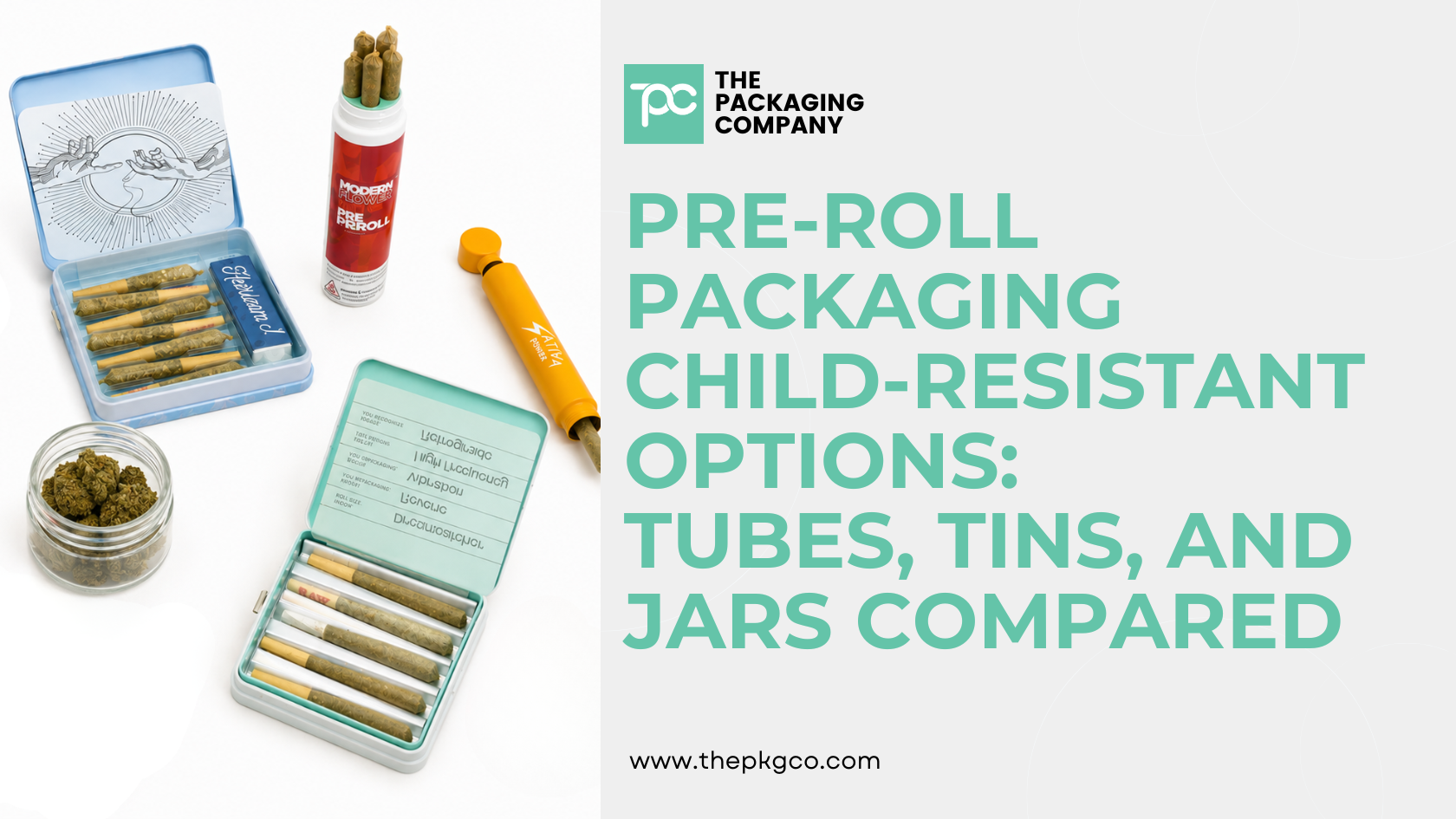
Pre-roll packaging decisions are made at the intersection of three variables that don’t always point in the same direction: what the product requires functionally, what the price point requires from a brand signal perspective, and what the budget allows per unit. Getting all three right in the same format is the goal — and it’s achievable once you understand how the available CR options actually compare.
This piece maps the primary child-resistant pre-roll packaging formats — tubes, tins, and glass jars — against the dimensions that matter for a real purchasing decision: product fit, brand signal, barrier performance, and cost tier. Including how format choice shifts as retail price point changes.
The CR Requirement for Pre-Roll Packaging
All cannabis pre-rolls sold at retail in licensed US markets require child-resistant packaging. The requirement applies regardless of product type — standard flower pre-rolls, infused pre-rolls, live resin formats, CBD pre-rolls sold through dispensaries — and regardless of price point.
Most state cannabis regulations require 16 CFR §1700.20 certification for retail pre-roll packaging. Some states accept ASTM certification for reclosable formats. Confirm your state’s specific requirement before finalizing any format, and confirm with your supplier that the specific format you’re ordering carries certification under the applicable standard with third-party test documentation.
Format 1: CR Tubes
CR tubes are the most widely deployed pre-roll packaging format in the industry. Available in plastic, glass, and aluminum with push-and-turn, squeeze-and-pull, and other certified closure mechanisms.
How they work as CR packaging: The closure mechanism — typically push-and-turn or squeeze-and-pull — requires a two-step action that young children cannot reliably execute. The tube body and cap must be dimensionally matched precisely to function correctly. A tube where the cap doesn’t engage the CR mechanism fully — because the tube diameter is slightly off or the cap has loosened over repeated use — is a CR failure at point of inspection regardless of the format’s certification.
Dimensional considerations: Tube diameter and length must match your pre-roll spec. Standard pre-rolls (typically 84mm and under, 7–8mm diameter) fit most standard tube SKUs. King-size formats (98–120mm, larger diameter) require specific tube dimensions that not all suppliers carry. Map your pre-roll dimensions to available tube specs before sampling.
Barrier performance: Plastic tubes provide adequate sealing for products with moderate shelf life expectations. Aluminum tubes provide better barrier properties and full light blocking. Glass tubes are inert and provide UV protection if tinted. For premium or terpene-sensitive pre-rolls, aluminum or glass tubes outperform plastic on barrier performance.
Brand signal: Tubes are functional and familiar. They communicate portability and practicality. At the right price point, a well-decorated tube in aluminum or glass reads as clean and deliberate. At a premium price point, a plastic tube creates a brand signal mismatch — the format communicates a different value tier than the price.
Price point alignment:
- Under $15 retail: Standard plastic CR tubes — appropriate and expected
- $15–$25 retail: Decorated plastic or aluminum tubes — still viable, aluminum reads better
- Above $25 retail: Aluminum or glass tubes minimum — plastic starts working against the price signal
Format 2: CR Snap Tins
CR tins are the premium standard for pre-roll packaging. The format has grown significantly in the past 18 months as mature cannabis markets have moved toward packaging that communicates quality before a consumer reads a label.
How they work as CR packaging: Quality CR tins use an engineered closure mechanism — not a friction-fit lid — to achieve certification. TPC’s snap tin uses a corner-press mechanism: the user presses and squeezes the two bottom corners simultaneously, releasing the upper corners so the lid can be removed. The mechanism requires specific two-handed coordination that young children cannot reliably execute, and it is designed to maintain consistent performance across hundreds of open/close cycles.
Not all CR tins are equal. Standard slide tins — tins with a panel that pushes to the side — often carry minimal or no formal certification. The closure mechanism degrades with repeated use and the seal, if present at all, is typically inadequate for terpene-sensitive products. When evaluating any tin format, request the third-party test report confirming 16 CFR §1700.20 certification before ordering.
Dimensional considerations: TPC’s standard snap tin (74mm × 58mm × 20mm) accommodates most standard pre-roll formats in 1–5 pack configurations. The extended snap tin (95mm × 57mm × 20mm) handles 100mm king-size formats and larger multi-packs. Insert trays are custom-engineered per project to match your exact pre-roll diameter and count — slots are specific to your product, not generic.
Barrier performance: A quality CR tin is fully airtight and watertight — TPC’s snap tin maintains its seal under water submersion testing. This is the highest barrier performance available in pre-roll packaging. For infused pre-rolls, live resin formats, or any product where terpene preservation is a quality claim, this barrier performance is not a luxury. It’s a product quality requirement.
Brand signal: Weight, closure sound, rigid construction — a tin communicates premium before a consumer reads anything. The brand signal of a metal tin at the shelf level is the strongest available in pre-roll packaging. Consumers keep tins after the product is gone, extending brand presence beyond the purchase. This is a brand investment with ongoing return.
Price point alignment:
- Under $15 retail: Tin is over-engineered for this price tier
- $15–$25 retail: Standard snap tin — strong format for mid-tier positioning
- $25–$40+ retail: Extended snap tin or tin jar with custom insert and full decoration — the format the price point requires
Format 3: CR Glass Jars
Glass CR jars are the format of choice for premium infused pre-roll brands — particularly live resin, rosin-infused, and high-terpene formats where the chemical profile of the product is a primary brand claim.
How they work as CR packaging: Glass CR jars use push-and-turn or squeeze-and-turn lids certified under 16 CFR §1700.20. The lid engagement geometry must maintain consistent tolerances across repeated use cycles — a lid that loosens with use creates a CR performance problem over the product’s consumer lifecycle.
Dimensional considerations: Wide-mouth jar formats hold pre-rolls in an upright, vertical orientation — a display presentation that tubes and tins don’t provide. TPC’s CR Glass Pre-Roll Jar holds 5 pre-rolls upright, allowing the consumer to see the product before removing it from the container. For infused formats where visual product presentation is part of the brand experience, this orientation is functionally different from any other format.
Barrier performance: Glass is completely inert. There is no off-gassing, no material interaction with terpenes or cannabinoids, and no UV transmission in tinted glass. For live resin, rosin, and high-terpene infused pre-rolls where terpene preservation is the primary quality claim, glass provides the cleanest barrier of any packaging material.
Brand signal: Glass communicates premium, transparency, and product confidence. A glass jar that lets the consumer see the pre-rolls before opening communicates that the brand stands behind the product visually — the packaging isn’t hiding anything. For infused pre-roll brands at premium price points, this is a powerful signal.
Price point alignment:
- Under $20 retail: Glass jar is generally over-engineered and adds unnecessary per-unit cost
- $20–$35 retail: Glass jar viable for infused or single-origin formats at this tier
- Above $35 retail: Glass jar or tin jar — the format the product and price point deserve
Format Comparison by Key Variable
| Variable | CR Tube (Plastic) | CR Tube (Aluminum) | CR Snap Tin | CR Glass Jar |
|---|---|---|---|---|
| CR standard | 16 CFR §1700.20 | 16 CFR §1700.20 | 16 CFR §1700.20 | 16 CFR §1700.20 |
| Airtight seal | Adequate | Good | Excellent / watertight | Excellent |
| UV/light blocking | No (clear) | Yes | Yes | Yes (tinted) |
| Material inertness | Partial | Complete | Complete | Complete |
| Brand signal | Functional | Clean/premium | Premium | Premium/transparent |
| Post-use consumer life | Low | Low-medium | High (consumers keep tins) | Medium |
| Recyclability | Limited | Yes | Yes (infinitely) | Yes (infinitely) |
| Decoration options | Label | Screen print / label | Full litho + emboss | Screen print / label |
| Best price tier | Under $15 | $15–$25 | $15–$40+ | $20–$40+ |
| MOQ at TPC | 5,000 | 5,000 | 5,000 | 10,000 |
Making the Decision
The format that’s right for your pre-roll is the one that passes three filters simultaneously: it fits your product dimensions, it supports your retail price point’s brand signal requirement, and it can be documented as certified to the standard your state requires.
If your format passes all three filters, sample it with your actual product before committing to production. Evaluate the closure over repeated cycles, check the airtight seal, confirm the insert fit if applicable. The sample evaluation is where dimensional specifications become real — formats that look right on a spec sheet occasionally reveal problems that only become visible with the actual product inside.
For brands evaluating format options across their pre-roll line, our CR format decision framework walks through the full four-filter system. For the complete CR pre-roll packaging overview including multi-pack configurations and infused format options, see our pre-roll packaging guide.
Contact TPC to discuss format options and start the sampling process for your specific pre-roll format.
Frequently Asked Questions
What CR format is best for a single pre-roll at $10 retail? A standard CR plastic tube. At this price point, the per-unit packaging cost needs to be minimal, and the brand signal of a plastic tube is appropriate for the value tier. Invest in a clean, well-decorated label rather than a premium format that the price point can’t support.
What CR format is best for a 5-pack infused pre-roll at $35 retail? A CR snap tin with a custom insert tray. At $35+, the packaging needs to communicate premium before the consumer reads anything. A tin provides the weight, the closure sound, the airtight seal, and the post-use brand life that this price point requires. The custom insert tray ensures the five pre-rolls present cleanly and don’t shift in transit.
Can I use the same tube for 84mm and 100mm pre-rolls? No. Tube length must match your pre-roll length with appropriate clearance for the closure to engage correctly. An 84mm pre-roll in a 100mm tube has excessive headspace that allows product movement and may affect the CR closure function. Map tube length to pre-roll length before sampling.
Do all CR tins have airtight seals? No. Standard decorative tins with friction-fit lids are not airtight. Slide tins with push-panel CR mechanisms typically are not airtight. A quality engineered snap tin — like TPC’s — creates a genuine airtight and watertight seal as a function of the closure mechanism. Always confirm airtight performance during sample evaluation, not just from the spec sheet.
What MOQ applies to pre-roll CR packaging at TPC? CR tubes and snap tins start at 5,000 units. CR glass jars start at 10,000 units. All formats are made to order with full custom decoration. Pre-production samples are standard before any production commitment.