



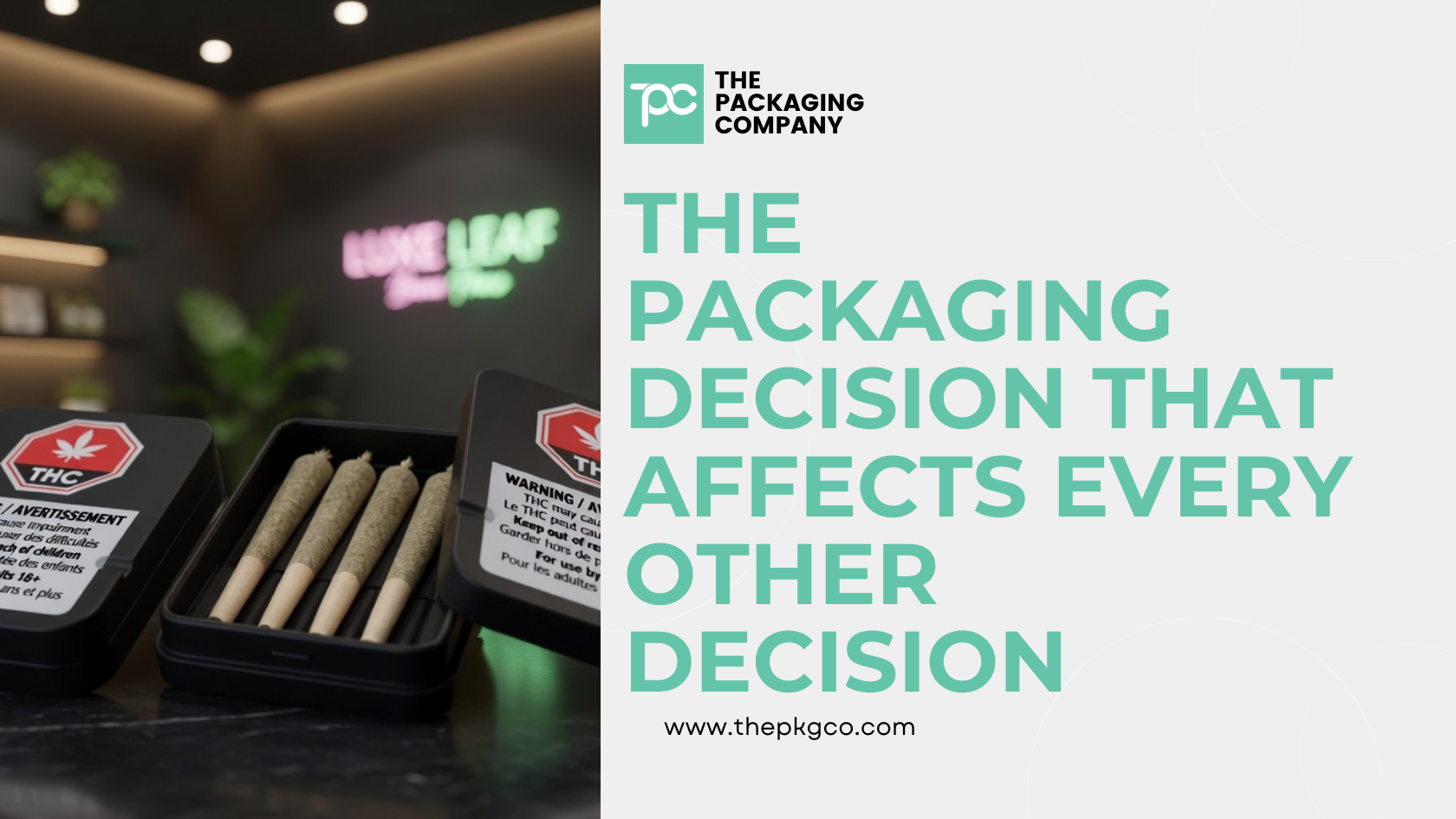
Most packaging decisions in cannabis and regulated wellness feel like they’re about the package. They’re not. They’re about everything downstream of the package — the fill line configuration, the certification documentation, the retail price point, the brand signal, the reorder timeline. Get the format right before launch and those downstream decisions fall into place. Get it wrong and you’re reworking them one by one after the fact.
The child-resistant packaging format decision is the one that matters most, because it’s the least reversible. You can change a label. You can update artwork. You can switch suppliers on a tube that looks like every other tube. Switching from a bag to a tin mid-launch, or discovering that your pre-roll doesn’t fit the format you ordered 5,000 units of, is a different category of problem.
This piece is a guided decision framework — four questions that narrow your CR format options against your actual product and positioning, in the order they should be answered. Work through them before you talk to a supplier, before you look at a catalog, and before you fall in love with a package that may or may not work for your product.
Before You Start: The One Thing That Changes Everything
The single most common mistake in CR packaging selection is starting with the package rather than the product. A brand sees a tin they like, requests a sample, and then tries to fit their pre-roll into it. Sometimes it works. Often the pre-roll is 2mm too long, or the diameter is slightly off, or the count configuration requires an insert tray that doesn’t exist for that format.
The correct sequence is: product dimensions first, format options second. Everything in this framework starts from your product — not from what looks good in a photo or what a competitor is using.
Have these numbers in front of you before you answer any of the questions below:
- Pre-roll or product length (in mm)
- Pre-roll or product diameter (in mm)
- Fill weight or volume
- Unit count per package (1-pack, 3-pack, 5-pack, etc.)
- Price point per unit at retail
That’s your starting data. Now run the framework.
Question 1: What Does Your Product Actually Need From Its Packaging?
This question is about function before format. CR packaging has to do things beyond holding the product and looking good — and the specific things it has to do are determined by what’s inside.
Does your product require an airtight seal? Cannabis flower, infused pre-rolls, live resin formats, and any product where terpene preservation is a quality or marketing claim needs an airtight seal. Mylar bags provide a reasonable seal at first use but lose seal integrity over repeated opens. Plastic tubes seal adequately for short shelf lives. Metal tins and glass jars provide the most reliable airtight seal over the product’s full retail and consumer lifecycle.
If terpene preservation matters to your product claim, your format options are tins and glass jars. That narrows the decision significantly before you’ve answered anything else.
Does your product require light blocking? UV and visible light degrade cannabinoids and terpenes over time. For products that will sit on a retail shelf for weeks — which is most cannabis retail — light exposure is a product quality variable. Metal tins and aluminum formats block light completely. Glass jars block UV but transmit visible light unless colored glass is used. Clear plastic tubes and clear bags provide no light protection.
If light protection matters, opaque formats are the filter.
Does your product need to survive shipping and handling pressure? Pre-rolls are fragile. A pre-roll that arrives at a dispensary with a bent tip or a cracked paper is a product quality failure before it’s a packaging failure. Rigid formats — tins, glass jars — provide structural protection that flexible and semi-rigid formats don’t. For delivery-first brands or brands distributing through multi-step supply chains, rigid packaging is the lower-risk choice.
Question 2: What Does Your Price Point Require From Your Packaging?
This is the question most brands skip, and it’s the one that creates the most visible problems at retail.
Every retail price point carries an implicit packaging expectation. Consumers have been trained — by years of purchasing across categories — to associate certain package types with certain value signals. A $40 pre-roll in a bag creates cognitive dissonance. A $12 pre-roll in a custom-embossed tin creates confusion of a different kind. The format has to match the price signal.
Here’s a rough alignment framework:
Under $15 retail: Bags and standard plastic tubes are appropriate and expected. Premium formatting at this price point is over-investment. The buyer is making a value decision, and the packaging should support that.
$15–$25 retail: The format transition zone. Bags still work at the lower end of this range. At $20 and above, a well-decorated tube or a standard tin starts to make more sense. The packaging shouldn’t undercut the price.
$25–$40 retail: Premium format territory. CR snap tins, glass jars, aluminum cases. The packaging needs to hold its own when a consumer picks it up and considers whether the price is justified. A bag at this price point is working against the brand.
Above $40 retail: The packaging is part of the product. Custom tins with embossing, custom interior trays, glass jars with premium closures. This is the format range where packaging becomes a brand experience rather than a compliance requirement.
Where does your retail price point land? That answer eliminates a significant portion of the format options before you’ve looked at a single product page.
Question 3: What Does Your Certification Requirement Actually Specify?
Not all CR packaging is certified to the same standard, and your state’s requirement determines which formats are even eligible.
The two relevant federal standards for CR packaging in the US are ASTM (which covers reclosable formats) and 16 CFR §1700.20 (the CPSC standard referenced in most state cannabis regulations for retail products).
Most state cannabis regulations require 16 CFR §1700.20 for products sold at retail. Some accept ASTM for reclosable formats like tins and jars. A small number have state-specific requirements that reference neither directly.
Before finalizing any CR format, confirm:
- Which standard your state requires for your specific product category
- Whether the specific format you’re considering is certified to that standard
- Whether your supplier can provide the third-party test report confirming certification
This is not a step to skip. A format that looks right, costs right, and fits your product is not a usable format if it doesn’t carry the certification documentation your market requires. And not all formats that are marketed as CR are certified to both standards — some carry ASTM only, some carry 16 CFR §1700.20 only, and some carry neither despite being labeled as child resistant.
Confirm the certification before you sample. It determines your eligible format list.
Question 4: What Does Your Volume and Timeline Require?
The final filter is operational. The right format for your product, price point, and certification requirement still has to work within your production timeline and your opening order quantity.
MOQ considerations: Most CR packaging at TPC starts at 5,000 units. For a new SKU launch where demand is unproven, 5,000 units is the right entry point — it validates the market without over-committing to inventory. For established SKUs with known velocity, higher quantities unlock better per-unit economics and reduce reorder frequency.
If you’re considering a format that requires custom tooling — a non-standard dimension, a custom insert tray, a novel closure configuration — there may be tooling costs that apply to the first run and amortize across subsequent runs. Factor this into your launch economics.
Timeline considerations: CR snap tins with custom decoration run 8–12 weeks from production authorization. CR glass jars run 6–8 weeks. CR tubes and standard jars run 4–6 weeks. CR bags run 6–8 weeks with rotogravure printing.
Add to those timelines: 2–4 weeks for sample preparation, 1–2 weeks for sample evaluation, and 2–4 weeks for decoration approval. A realistic concept-to-delivery window for most custom CR formats is 10–14 weeks when the process runs cleanly.
If your launch date is fixed, work backwards from it. The format that theoretically fits your product and price point but can’t be delivered in time isn’t the right format for this launch. It might be the right format for the next SKU, once the timeline allows.
Running the Framework: What You Should Have Now
After working through these four questions, you should have:
A product requirements filter that tells you whether airtight seal, light blocking, and structural protection are required — which eliminates formats that can’t deliver those properties.
A price point filter that tells you which format tier is appropriate for your retail positioning — which eliminates formats that are either under or over-engineered for your price.
A certification filter that tells you which standard your market requires and confirms which specific formats are eligible.
An operational filter that tells you which formats fit within your launch timeline and opening MOQ.
The formats that survive all four filters are your viable options. If more than one survives, the decision comes down to brand preference and supplier capability — at which point sampling and decoration approval take over.
If no format survives all four filters, one of your inputs needs to change: the product dimensions, the price point, the certification requirement, or the timeline. That’s a more useful discovery to make before you’ve ordered 5,000 units than after.
How TPC Supports the Format Decision
TPC’s team works with brands through this exact framework before sampling begins. We don’t send generic catalogs — we review your product specs, your price point, your certification requirement, and your timeline, and we identify which formats in our line are genuinely viable for your situation.
Our child-resistant packaging solutions guide covers the full format landscape. Our line includes CR tins, CR jars, CR tubes, CR bags, and CR topical formats — all made to order, all with full certification documentation.
Contact our team to start the format conversation with your product specs in hand.
Frequently Asked Questions
What is the most common CR format mistake brands make before launch? Selecting a format before confirming dimensional fit with the actual product. A format that looks right in photos and fits within budget is not the right format if the pre-roll is 3mm too long or the diameter requires an insert tray that doesn’t exist for that tin. Always confirm dimensions against the actual product before sampling — not after.
How do I know which CR certification standard my state requires? Check your state’s cannabis packaging regulations directly, or consult with a cannabis compliance attorney in your market. Most states reference 16 CFR §1700.20 for retail products, but requirements vary by state and product category. Confirm before finalizing any format and before placing any production order.
Can I launch with one format and switch later? Yes, but switching formats mid-brand is more disruptive than it sounds. Consumers who associate your brand with a specific format notice when it changes. Retailers who have been merchandising your product in a specific size footprint need to reconfigure. It’s better to get the format right at launch than to optimize it later — which is exactly what this framework is designed to help with.
What if my product dimensions don’t match any standard format? TPC has in-house engineering capability to develop non-standard formats. If your product dimensions require something that doesn’t exist in the standard catalog, contact our team to discuss custom format development. Custom tooling adds lead time to the initial project but results in a format specific to your product rather than a compromise.
How many units should I order for a new SKU launch? For unproven SKUs, start at MOQ (5,000 units at TPC) to validate demand before committing to higher quantities. Once the SKU has established velocity, scale the reorder quantity to reduce reorder frequency and improve per-unit economics. Ordering above MOQ on a new SKU that underperforms at retail creates a carrying cost problem that compounds over time.