



For skincare brands working with a contract manufacturer or filling partner, receiving the correct empty packaging is only one part of preparing for production.
A bottle may have the right capacity but require a different filling nozzle. A jar may match the approved design but arrive with a closure configuration the filling line has not reviewed. A squeeze tube may look correct but require a specific tail-sealing process.
These issues are best resolved before packaging arrives at the filling facility.
A practical skincare packaging filling checklist should connect three parties: the brand approving the finished product, the supplier manufacturing the empty packaging, and the filler responsible for processing and assembling the product.
Brands sourcing skincare packaging should confirm the following requirements before approving the shipment of components to a filling partner.
1. Confirm the Final Component Specification
The contract filler needs to know exactly which components will arrive—not simply the type of packaging the brand selected.
For example, describing an order as “50ml airless bottles” does not identify the full packaging configuration. Two bottles with the same nominal capacity may have different dimensions, pump assemblies, actuator shapes, or filling requirements.
The brand and packaging supplier should have an approved specification identifying the relevant components.
Depending on the format, this may include:
- Container model or reference number
- Nominal capacity and applicable dimensions
- Material and component construction
- Neck finish, opening, or filling access
- Cap, pump, dispenser, or applicator reference
- Closure or assembly configuration
- Decorated and undecorated component versions
- Relevant manufacturing tolerances
- Approved drawings or technical specification sheets
For a multi-component package, the specification should also identify which parts are supplied together and which are packed separately.
Before shipment: Confirm that the brand, supplier, and filler are all working from the same approved component specification.
2. Confirm the Fill Volume Against the Actual Container
Container capacity and finished-product fill quantity are related, but they are not always interchangeable.
A package described as 50ml should not automatically be assumed suitable for every 50ml formula and filling process without verification.
The filling team may need to consider the intended net quantity, filling temperature, formula properties, usable capacity, necessary headspace where applicable, and how the closure or dispensing system interacts with the filled product.
Before packaging is shipped, brands should provide the filler with:
- Target net fill quantity for each SKU
- Whether the filling instruction is expressed by weight or volume
- Approved container reference and nominal capacity
- Relevant formula density or filling characteristics
- Any necessary headspace or filling-level requirements
- Applicable fill-weight or fill-volume acceptance criteria
These details should be established by the brand and its formulation and filling teams.
Before shipment: Obtain confirmation from the filling partner that the selected package is appropriate for the intended fill quantity and filling method.
3. Make Sure the Packaging Fits the Filler’s Equipment
A packaging format may be acceptable for consumer use but still require special handling or equipment changes during filling.
This is why packaging selection should account for the filler’s actual production capabilities.
Airless Bottles and Pump Systems
For airless packaging, the filler should review the selected container structure, filling access, product viscosity, component assembly sequence, and any equipment or process requirements associated with the airless system.
Some airless configurations may require different filling or assembly procedures from conventional cosmetic bottles. The exact process depends on the approved packaging design.
Cosmetic Jars
For cosmetic jars, the filler may need to check container stability during handling, filling-nozzle clearance, closure application, and any liners, seals, or additional components specified for the project.
The selected jar and closure should be evaluated together, not as unrelated components.
Squeeze Tubes
For squeeze tube packaging, the filling facility should confirm that its equipment can handle the selected tube diameter, length, construction, and required filling and sealing process.
For example, many cosmetic tubes are filled through the open tail and sealed afterward. The filler must verify that its equipment and process are appropriate for the particular tube construction.
Across all formats, equipment review may include container handling, orientation, filling-nozzle compatibility, filling speed, capping or sealing equipment, and downstream labeling or packing requirements.
Before shipment: Confirm that the filler has reviewed the physical components on the intended production equipment or has an agreed qualification plan before the production run.
4. Establish Who Is Responsible for Formula and Packaging Compatibility
One responsibility should never be left unclear: who determines whether the actual skincare formula is suitable for the selected packaging?
The packaging supplier can provide information about the empty components, but physical packaging specifications do not establish finished-product compatibility.
The brand, formulator, filling partner, and qualified testing specialists should determine the necessary tests and acceptance criteria for the intended product.
Depending on the formula and packaging system, these evaluations may include:
- Compatibility with product-contact materials
- Formula stability under appropriate test conditions
- Dispensing performance with the actual product
- Closure and sealing performance
- Leakage evaluation under relevant conditions
- Filling-process suitability
- Finished-product quality and compliance requirements
If the formula has changed since the packaging was evaluated, the responsible technical team should determine whether additional assessment is necessary.
Likewise, changing packaging materials, closures, pumps, or other product-contact components may require further review.
Before shipment: Confirm who has approved the compatibility and filling assessment, which packaging configuration was tested, and whether any required work remains open.
If critical validation is incomplete, the brand and filler should agree on the appropriate hold point rather than assuming bulk filling is authorized.
5. Confirm Closure, Sealing, and Assembly Requirements
Even when the container is correct, the finished package can differ from the approved configuration if the assembly instructions are incomplete.
A skincare packaging project may include caps, pumps, actuators, liners, wipers, applicators, overcaps, or other components.
The filling partner should know how these components are intended to be handled and assembled.
Relevant questions include:
- Are closures shipped assembled or separately?
- Which components must be installed after filling?
- Does the package require a defined capping or tightening procedure?
- Are liners, seals, or tamper-evident components included?
- Does the tube require an approved tail-sealing method?
- Are there special instructions for pump or applicator assembly?
- What finished-package inspections are required?
Any applicable closing force, torque, sealing settings, or other process parameters should be established and validated for the actual component system by the responsible technical and filling teams.
Before shipment: Make sure the filler has the approved assembly instructions and understands which components will be received separately.
6. Make Sure the Filler Has the Correct Approved Samples
Catalog samples, decoration samples, and pre-production samples may look similar, but they do not always represent the same manufacturing configuration.
Before filling begins, brands should confirm that the physical samples used by the filling partner correspond to the approved production specifications.
For example, a brand may initially test a standard undecorated bottle and later approve a customized version with a different pump, cap, or component configuration.
The filler should not assume that the initial sample remains representative if any relevant component has changed.
A useful sample handoff includes:
- Approved container reference
- Relevant closure and dispenser references
- Approved pre-production sample or controlled reference sample
- Specification or drawing revision
- Identification of any changes since testing
- Confirmation of the configuration accepted by the filler
Before shipment: Confirm that the approved sample, documented specifications, and components scheduled for delivery are consistent.
7. Check Artwork Version Control and Production Coding
Packaging artwork is not only a design approval. The filler needs the correct version to avoid using mismatched containers, labels, cartons, or other printed components.
This becomes particularly important when several skincare products use similar packaging formats.
For example, a brand may launch three serums using the same bottle shape but different decoration colors and product names. If the components are not clearly identified, the filling partner may have difficulty distinguishing which packaging belongs to each formula.
Brands should confirm:
- Final artwork file name and revision
- SKU and packaging component references
- Approved print or label version
- Matching secondary packaging where applicable
- Lot or batch coding locations
- Any relevant date-code or labeling requirements
- How obsolete or unapproved versions will be controlled
Lot coding and finished-product labeling must be coordinated with the filling and quality teams according to the applicable product and market requirements.
Before shipment: Provide a final SKU-to-packaging identification list so that the filler can match every component to the correct product.
8. Align Packaging Quantities With the Filling Plan
The number of empty packages ordered may not equal the number of finished units expected after filling.
The filling partner may require additional components for equipment setup, process qualification, quality checks, or anticipated manufacturing losses.
Rather than assuming that the purchase order quantity will cover all these needs, brands should ask the filler to confirm the quantities required for each SKU.
The final handoff should identify:
- Ordered packaging quantity by SKU
- Components required for initial equipment setup
- Samples needed for testing and quality review
- Agreed allowance for filling or assembly losses
- Required finished-product quantity
- Separate quantities for caps, pumps, or other components where applicable
This is especially important when several products share a packaging format but use different printed components.
Before shipment: Reconcile the component order quantities with the filling partner’s approved production plan.
9. Confirm Delivery Timing and Receiving Requirements
A packaging shipment is only useful if it reaches the right facility, with the correct components, at a time the filler can receive and process them.
The filling partner should confirm when empty packaging is needed relative to the planned filling date.
Brands should also establish the receiving information before shipment, including:
- Correct facility name and delivery address
- Receiving contact and appointment requirements
- Required delivery date or agreed receiving window
- Carton quantities and component identification
- Packing list and shipping documentation
- Lot or production reference information where supplied
- Any agreed inspection or receiving procedures
- Process for reporting damaged, short, or incorrect shipments
Documentation requirements may vary by the supplier, shipping route, filler, and product program. The parties should agree on them in advance.
The confirmed arrival date should also leave the filler sufficient time for incoming checks before the scheduled production run.
Before shipment: Obtain written confirmation of the delivery destination, receiving requirements, and the date the components must be available for filling.
Skincare Packaging Filling Checklist: Final Handoff Review
Before releasing empty packaging for delivery, the brand should confirm that the following items have clear owners and approved references.
| Handoff Item | What Must Be Confirmed | Primary Approval Responsibility |
|---|---|---|
| Component specification | Correct container, closure, dispenser, drawings, and revision | Brand and packaging supplier |
| Fill quantity | Agreed net fill and appropriate container configuration | Brand, formulator, and filler |
| Equipment fit | Filling, handling, closing, and sealing process suitability | Filling partner |
| Formula compatibility | Required compatibility, stability, and performance assessments | Brand and qualified technical teams |
| Assembly instructions | Correct closing sequence, components, and process requirements | Brand and filling partner |
| Approved samples | Reference samples match the production configuration | Brand, supplier, and filler |
| Artwork control | Correct SKU, artwork version, and coding requirements | Brand and relevant production partners |
| Component quantities | Enough approved components for the agreed filling plan | Brand and filling partner |
| Delivery readiness | Receiving location, shipment documentation, and arrival timing | Brand, supplier, and filler |
The central question is whether each party is working with the same approved product, packaging configuration, and production instructions.
If a critical component, test, or process requirement has not been accepted by the responsible team, that issue should be resolved before the affected production activity proceeds.
How TPC Supports Skincare Packaging Projects Before Filling
The Packaging Company supplies empty packaging components for skincare, cosmetic, personal care, and beauty brands.
TPC can help brands review packaging formats, component configurations, physical samples, customization options, and packaging production requirements. Clear communication between the packaging supplier and the brand’s filling partner can help identify component-related questions before shipment.
TPC does not perform formula filling or assume responsibility for finished-product compatibility, stability testing, filling validation, sealing or leakage testing, or regulatory release. These responsibilities remain with the brand and its qualified formulation, manufacturing, filling, and testing partners.
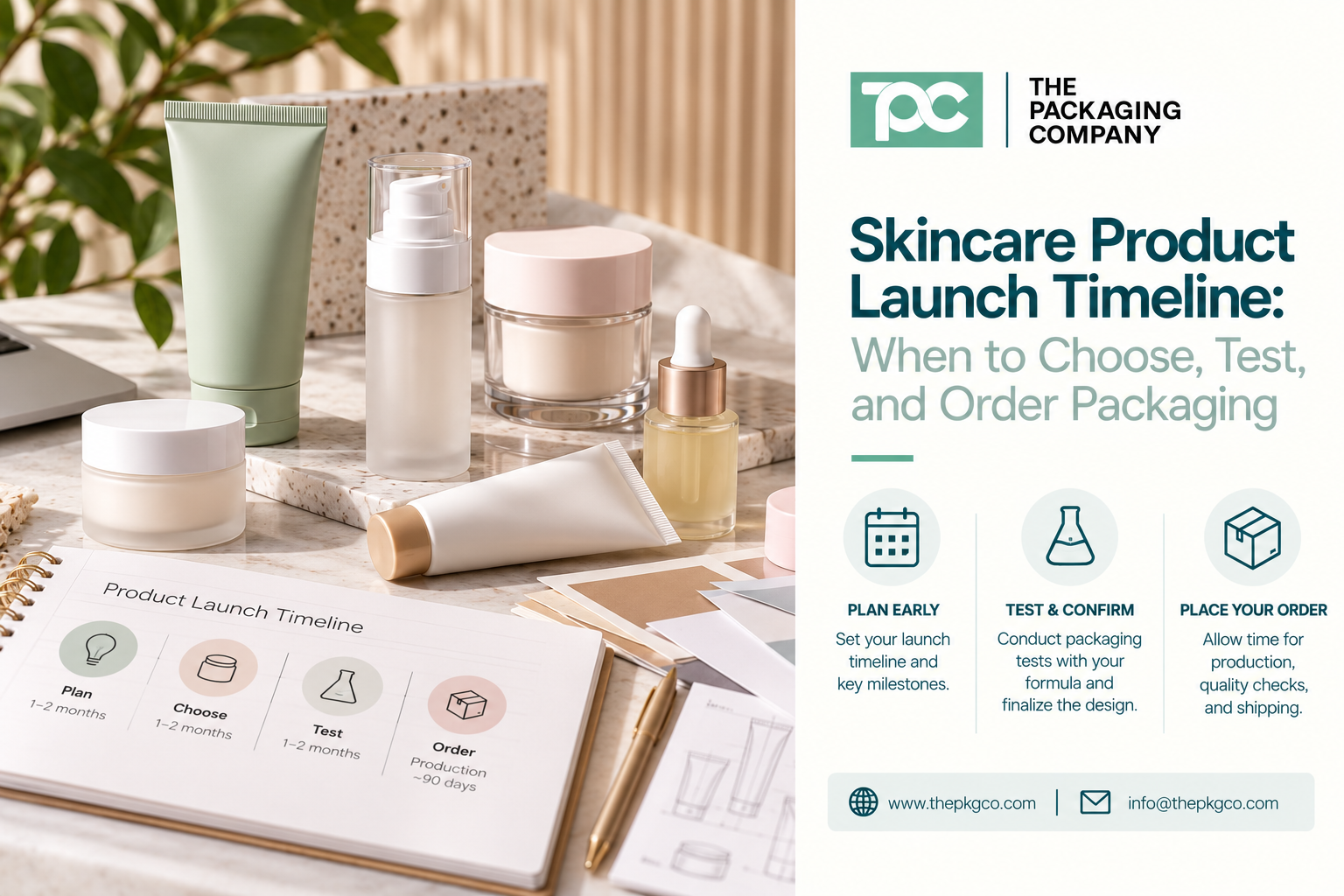
For brands still planning the earlier stages of a project, our skincare product launch timeline explains when packaging selection, testing, and bulk ordering decisions should occur.
For projects approaching production, brands can contact The Packaging Company with the approved packaging references, target capacity, quantities, component requirements, and delivery destination to review their empty-packaging supply needs.
FAQ: Preparing Skincare Packaging for a Contract Filler
What information should a skincare brand send to its contract filler?
Brands should provide the approved packaging component specifications, target fill quantity, relevant formula and handling requirements, approved samples, assembly instructions, artwork and SKU references, component quantities, and delivery details. The filler should confirm its equipment and process requirements for the selected packaging.
Who confirms that skincare packaging works with the formula?
The brand, formulator, filling partner, and qualified testing teams are responsible for determining and completing the required formula compatibility and finished-product evaluations. The packaging supplier can provide available information about the empty components but does not establish finished-product compatibility.
Can the filler use stock packaging samples for equipment testing?
Stock samples may be useful for preliminary equipment review. However, the filling partner should determine whether the samples represent the final approved configuration or whether further testing with production-equivalent components is necessary.
Why should packaging quantities be confirmed with the filler before shipment?
The filler may need additional components for equipment setup, quality checks, or process losses. Brands should reconcile ordered quantities, SKU-specific components, and expected finished-product output with the filling partner before arranging delivery.