


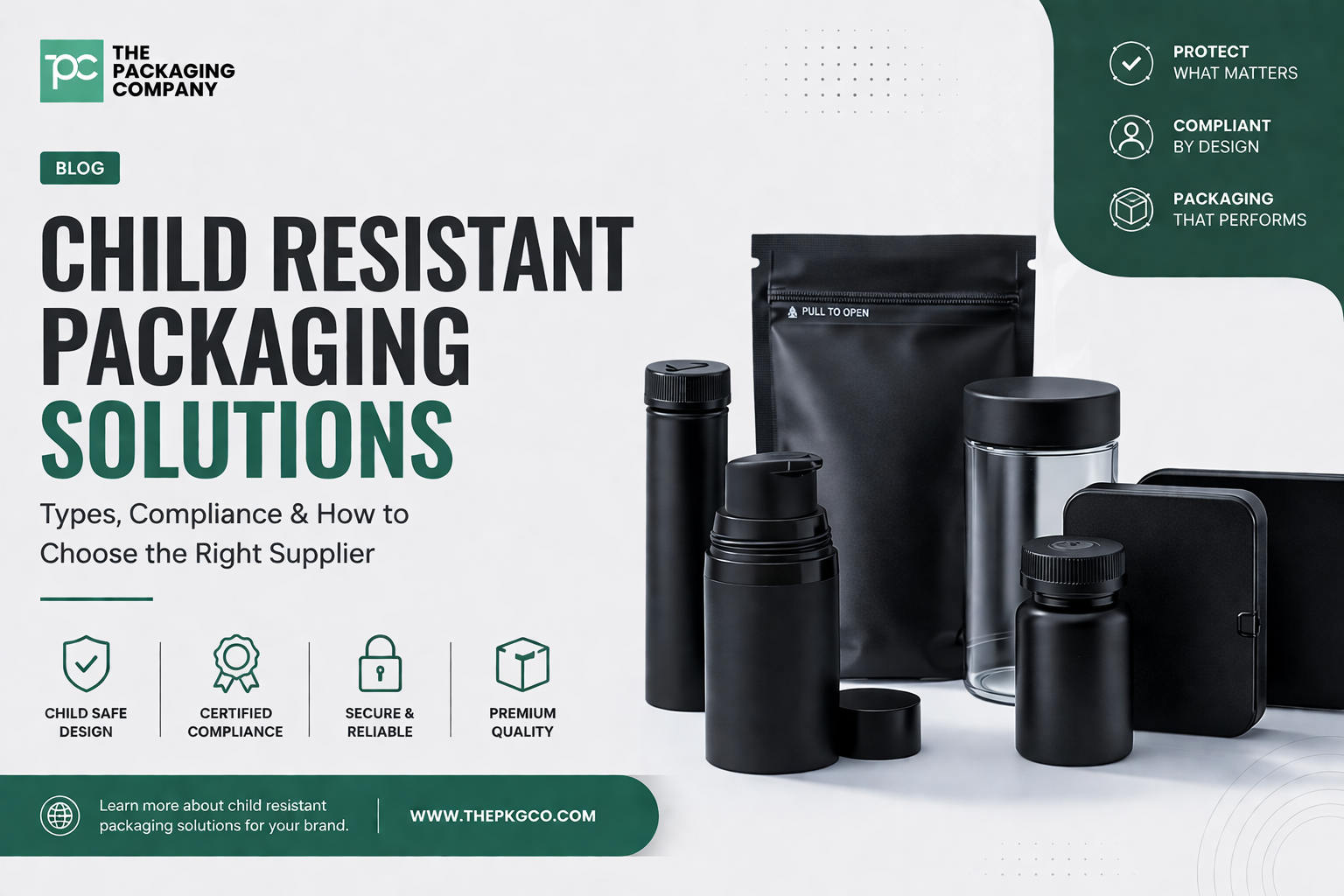
Child-resistant packaging is a legal requirement across cannabis, pharmaceutical, and regulated wellness markets in the United States. But beyond compliance, it's a product decision that affects your brand experience, your fill line efficiency, your shelf presence, and your ability to scale. This guide covers everything brands and operators need to know about CR packaging — what it is, how certification works, which formats are available, how to choose the right one, and what to look for in a supplier who can actually deliver.
Jump to a section:
- What is child-resistant packaging?
- CR certification standards explained
- How CR panel testing works
- Types of CR packaging
- CR packaging format comparison
- How to choose the right CR format
- CR packaging for cannabis brands
- CR packaging for wellness and nutraceutical brands
- What to look for in a CR packaging supplier
- Working with TPC
- Further reading
- Frequently asked questions
What Is Child-Resistant Packaging?
Child-resistant packaging refers to any container that has been specifically engineered and tested to significantly delay or prevent access by children under five years old, while remaining functional for adults. It is not a design aesthetic or a marketing label. It is a certification status earned by passing standardized third-party panel tests under federal protocols.
In regulated markets including cannabis, CBD, and over-the-counter pharmaceuticals, CR packaging is mandatory at the point of consumer sale in most US states and Canada. Selling non-certified packaging as child-resistant is a compliance violation regardless of how the label reads or what the supplier told you when you ordered it.
The term "child proof" is commonly used in the market but has no legal standing. No package can guarantee absolute prevention of access by a determined child, which is why the federal standard uses the term "child resistant" — meaningful, statistically significant resistance, not absolute protection. Brands using "child proof" language on packaging or in marketing materials should switch to "child resistant" to avoid regulatory scrutiny.
CR Certification Standards Explained
Two federal standards govern CR packaging in the United States. They are not interchangeable, and which one applies to your product determines which formats are eligible for your specific market.
ASTM Standard for Reclosable Packaging
The ASTM standard applies to reclosable packaging — containers designed to be opened, used, and resealed multiple times. It is the most commonly applicable standard for cannabis tins, jars, and other multi-use containers. Testing requires that at least 85% of children ages 42–51 months cannot open the package within a 10-minute period, and that at least 90% of adults ages 50–70 can open and close it within 5 minutes without instruction.
16 CFR §1700.20
16 CFR §1700.20 is the Consumer Product Safety Commission protocol, which applies more broadly across both reclosable and non-reclosable packaging formats. It uses similar panel methodology with specific protocol differences and is referenced by name in most state cannabis regulations for retail-sold products. Some formats carry certification under both standards.
Which Standard Does Your Market Require?
Most US state cannabis regulations require 16 CFR §1700.20 for products sold at retail. Some states accept ASTM certification for reclosable formats like tins and jars. A small number have state-specific requirements. Confirm your state's specific requirement before finalizing any format — and confirm with your supplier which standard the specific package you're ordering is certified to.
When sourcing CR packaging from any supplier, always request the third-party test documentation. A legitimate supplier will provide it within 24 hours. A claim of "child resistant" without documentation is not certification.
How CR Panel Testing Actually Works
CR certification is not a design review or a visual inspection. It is a structured behavioral test conducted with real human subjects under controlled conditions at an accredited independent laboratory.
The child panel tests whether the package resists opening by young children. Children ages 42 to 51 months are given the package and observed attempting to open it for a 10-minute period without assistance. The package passes if at least 85% of test children cannot open it within that window. This age range is used because it represents the developmental window where fine motor skills are present but not yet sufficient to reliably execute the multi-step or directional actions that CR closures require.
The adult panel tests whether adults can actually use the package. Participants ages 50 to 70 — the population most likely to experience reduced hand strength or dexterity — are given the package with written instructions only and asked to open and close it within 5 minutes. At least 90% must succeed. A package that 95% of children cannot open but that 40% of adults also cannot open fails certification.
Both panels must pass. The certification applies to the specific package format and closure mechanism that was tested — not to a product line, a supplier's brand, or a general format category. When a supplier changes the closure hardware, the material, the dimensions, or the manufacturing source, the existing certification may no longer apply.
Types of Child-Resistant Packaging
CR packaging is available across a wide range of formats. The right choice depends on your product type, fill process, retail environment, brand positioning, and certification standard required.
Child-Resistant Tins
Metal tins with engineered snap or latch closures are the premium standard for cannabis pre-roll and flower brands. A quality CR tin uses a directional snap mechanism — not a simple press-fit lid — to achieve certification. The airtight seal protects terpenes and keeps flower fresh. The rigid metal construction means pre-rolls arrive intact regardless of how they've been handled in the supply chain. Full-surface lithographic decoration, embossing, and custom interior insert trays are all available.
TPC's CR tin line includes the standard snap tin (74mm × 58mm × 20mm) for 1–5 pack configurations, the extended snap tin (95mm × 57mm × 20mm) for 100mm+ pre-rolls, the CR tin jar (90ml) for wide-mouth display formats, and the Pre-Roll Tin Case V1A for 7-pack through 28-pack configurations. These formats were engineered by TPC — they did not previously exist in the market.
Child-Resistant Tubes
CR tubes are the most widely used pre-roll packaging format in the industry. Available in plastic, aluminum, and glass with push-and-turn, squeeze-and-pull, and other certified closure mechanisms. Tube diameter and length must match your pre-roll spec precisely — an off-spec tube that doesn't close correctly is a CR failure regardless of the tube's certification status.
Child-Resistant Jars
CR jars are the standard format for cannabis flower, concentrates, and edibles requiring wide-mouth access. Available in glass, plastic, aluminum, and tin with push-and-turn or squeeze-and-turn lids. Glass CR jars are completely inert — no off-gassing, no material interaction with terpenes or essential oils — and are the preferred format for premium flower and concentrate brands where terpene preservation is a product claim. TPC's CR jar line covers 15 SKUs across the full volume range from compact topical formats through large flower and concentrate containers.
Child-Resistant Mylar Bags
CR mylar bags provide compliant packaging at a lower per-unit cost than rigid formats, making them the standard choice for bulk flower, edibles, and value-tier SKUs where cost-per-unit is the primary driver. Available in 1g through 28g formats with full custom printing in soft-touch matte, gloss, metallic, and specialty finishes. The CR slide-lock closure must be evaluated over repeated use cycles — a closure that degrades with repeated opening and reclosing will not maintain certified performance through the product's consumer lifecycle.
Child-Resistant Topical Packaging
CR formats also apply to topical products — lotions, balms, tinctures, and wellness products sold in regulated markets. TPC's CR topical line includes CR squeeze tubes with screw cap safety mechanisms, CR airless pump bottles in multiple volume configurations (15ml, 30ml, 50ml for standard dosage; 50ml, 100ml, 150ml for large dosage formats), and dispenser formats for cannabis topicals and pharmaceutical-adjacent wellness products.
Child-Resistant Pre-Roll Packaging
Pre-roll packaging sits at the intersection of CR compliance, product fragility, and brand presentation. Formats include CR tubes, tins, glass jars, and aluminum multi-packs. The right format depends on your pre-roll length and diameter, count configuration, retail environment, and brand positioning. For infused pre-rolls where terpene preservation is a claim, glass CR jars or airtight snap tins are the formats that can support it.
Browse CR Pre-Roll Packaging →
Full Pre-Roll Packaging Guide →
CR Packaging Format Comparison
| Format | Best For | Material | Airtight | Light Blocking | Custom Decoration | MOQ |
|---|---|---|---|---|---|---|
| CR Snap Tin | Premium pre-rolls, flower, edibles | Tinplate steel | Yes | Yes | Full surface lithography + embossing | 5,000 |
| CR Tube | Pre-roll singles and multi-packs | Plastic / Glass / Aluminum | Yes | Varies | Label / screen print | 5,000 |
| CR Glass Jar | Flower, concentrates, edibles | Glass | Yes | UV only (clear) | Label / screen print | 5,000 |
| CR Plastic Jar | Flower, edibles, topicals | PET / PP | Yes | No | Label | 5,000 |
| CR Mylar Bag | Bulk flower, edibles, value SKUs | Multi-layer film | No | Yes | Full surface print | 5,000 |
| CR Squeeze Tube | Topicals, lotions, wellness | Laminate / PE | Varies | No | Label | 5,000 |
| CR Airless Pump | Active-ingredient topicals | Plastic / PP | Yes | No | Label / screen print | 5,000 |
How to Choose the Right CR Packaging Format
The right format is determined by four filters applied in sequence. Work through them before evaluating any specific product.
Filter 1: Product dimensions and barrier requirements. Start with your product's physical specs — length, diameter, fill weight, count configuration. These determine which formats are dimensionally viable. Then layer in barrier requirements: does the product need an airtight seal to protect terpenes or active ingredients? Does it need full light blocking? Does it need structural rigidity to survive shipping? Any format that can't meet these functional requirements is eliminated regardless of cost or aesthetics.
Filter 2: Certification standard. Confirm which standard your state or distribution channel requires — ASTM, 16 CFR §1700.20, or both — and confirm that the specific format you're considering carries that certification with verifiable documentation. A format that looks right but isn't certified to the right standard is not an eligible option.
Filter 3: Brand positioning and price point. The format must match the product's retail price point. A $35 infused pre-roll in a mylar bag is sending contradictory signals to consumers. A $10 pre-roll in a custom-embossed tin is over-engineering the format relative to the margin. The packaging should communicate the product's value, not undercut or inflate it. For a detailed framework on this filter, see our guide to choosing your primary CR format before launch.
Filter 4: MOQ and launch timeline. The format that survives filters 1–3 still has to work within your production timeline and opening order quantity. CR tins with custom decoration run 8–12 weeks from production authorization. CR bags with rotogravure printing run 6–8 weeks. Standard tubes and jars run 4–6 weeks. If your launch date is fixed, work backwards from it. For a detailed timeline breakdown, see our custom CR packaging production timeline guide.
CR Packaging for Cannabis Brands
Every licensed US cannabis state requires CR packaging at the point of consumer sale. The requirement applies across product categories — pre-rolls, flower, edibles, concentrates, vapes, and topicals. Most states reference 16 CFR §1700.20, though requirements vary by state and product type.
For cannabis brands, the packaging decision is also a brand decision. In mature markets like California, where consumers have been buying legal cannabis for nearly a decade, compliance is the floor — not the differentiator. The brands gaining and holding shelf space are the ones whose packaging communicates premium positioning before a budtender says a word. For a deeper look at what the California market is telling brands right now, see our analysis of what cannabis brands got wrong about packaging.
Pre-roll brands should evaluate the full format spectrum — tubes, tins, and glass jars — against their specific pre-roll dimensions, count configuration, and price point. Our pre-roll packaging guide covers the comparison in detail.
Flower brands should prioritize airtight seal and light blocking alongside format aesthetics. Glass jars are the premium standard. CR mylar bags are the cost-efficient standard. The decision should reflect the SKU's price point and market positioning.
Edible brands need wide-mouth access formats — jars or tin jars — with interior configurations that present the product clearly and protect it from compression and temperature variation.
Topical brands have the widest format range. The active ingredient profile determines whether a standard laminate squeeze tube, an airless pump, or an aluminum barrier construction is the right barrier specification. For a full breakdown, see our CR squeeze tubes guide.
CR Packaging for Wellness and Nutraceutical Brands
CR packaging is not exclusive to cannabis. Supplement and wellness brands encounter CR requirements across several product categories — and increasingly encounter CR expectations from retail channels even when mandates don't apply.
Iron-containing supplements with 250mg or more of elemental iron per unit are federally required to use CR packaging under CPSC regulations. CBD and hemp-derived products sold through licensed cannabis retail channels are subject to the same CR requirements as other cannabis products in most regulated states. Major pharmacy chains frequently require CR packaging for supplement categories as a placement prerequisite, regardless of federal mandate.
For supplement and wellness brands evaluating CR packaging — whether for compliance or strategic reasons — the format options are the same as in cannabis: jars for capsules and gummies, squeeze tubes or airless pumps for topicals, mylar bags for powder formats. The compliance documentation requirements are also the same: third-party test reports, not just Certificates of Compliance, covering the specific format and the applicable standard.
For a full breakdown of CR requirements in the nutraceutical category, see our CR packaging for nutraceuticals guide.
What to Look for in a CR Packaging Supplier
The supplier decision matters more in CR packaging than in most packaging categories because the regulatory exposure sits with the brand, not the supplier. A compliance failure is your problem regardless of what a supplier told you when you ordered.
Certification documentation depth. A legitimate CR packaging supplier provides the third-party laboratory test report — not just a Certificate of Compliance — for every format they sell. The report should name the accredited testing lab, document the child and adult panel pass rates, identify the specific format and closure tested, and confirm the applicable standard. If a supplier can't produce this within 24 hours of being asked, the format's certification claim is not verifiable.
Production transparency. A supplier with genuine production oversight can tell you specifically where your packaging is made, who manages quality control at the production level, and what happens when something goes wrong mid-run. Suppliers who can't answer these questions specifically — or who redirect to a domestic address when manufacturing is overseas — are brokers with limited ability to diagnose or resolve production issues.
Reorder confirmation process. CR certification applies to the specific format as manufactured. When a supplier changes a closure mechanism, material, dimension, or manufacturing source between orders, the existing certification may no longer apply. A capable CR packaging supplier has a written reorder confirmation process that verifies the current production run matches the tested format before shipment. For a detailed breakdown of documentation requirements and how to maintain them across reorders, see our CR packaging audit-readiness guide.
Pre-production sampling. Any supplier worth working with provides samples before production commitment as a standard part of the process. Sampling is how you confirm dimensional fit on your actual product, closure performance over repeated use cycles, and decoration quality before you've committed to 5,000+ units. Suppliers who discourage sampling or charge fees that don't apply to the production order are managing their own inventory risk at your expense.
Track record in regulated markets. Suppliers who have been in cannabis, pharmaceutical, or regulated wellness packaging for years have documentation practices, compliance knowledge, and supplier relationships shaped by the actual demands of those markets. For a full list of questions to ask any CR supplier before placing a bulk order, see our 10 questions guide.
For a deeper comparison of what separates a manufacturer-level supplier from a broker in the CR space, see our guide to choosing a CR packaging supplier.
Working With TPC on CR Packaging
TPC has been engineering and sourcing CR packaging for cannabis, pharmaceutical-adjacent, and regulated wellness brands since 1994. Our founder established wholly-owned operations in China in the 1990s — one of the first Americans to do so without a required local joint venture partner — which means our China team works for TPC. They are present at the production level when your packaging runs, not reading reports about it afterward.
On the US side, TPC has in-house engineering and design capability. We've developed CR packaging formats that didn't previously exist — our snap tin line is the clearest example, engineered from scratch to meet the specific requirements of premium cannabis pre-roll brands. When a brand comes to us with a concept that doesn't match any available format, we can take it from engineering through production. Everything we produce is made to order. There is no generic stock inventory.
TPC's CR packaging line spans tins, tubes, jars, bags, and topical formats — all with full certification documentation, full custom decoration, and a sampling process that's standard before any production commitment. MOQs start at 5,000 units. Most custom decorated formats can be delivered in 90 days from project start when the process runs cleanly.
To start a conversation about your CR packaging requirements, contact our team or add products to your cart to request a quote through our RFQ system.
Further Reading: The Full CR Packaging Cluster
Compliance and Certification
- How Child-Resistant Packaging Certification Actually Works
- Certified Child-Resistant Packaging: How to Stay Audit-Ready From First Order to Reorder
- Child Proof Packaging: What Brands Need to Know About Safety and Compliance
Supplier Selection
- How to Choose a Child-Resistant Packaging Supplier for Compliance and Scale
- 10 Questions to Ask Your CR Packaging Supplier Before You Place a Bulk Order
- From Concept to Delivered Child-Resistant Packaging in 90 Days
Format Guides
- Child-Resistant Containers: Types, Regulations and Packaging Options
- Child-Resistant Jars for Cannabis and Wellness Brands
- Child-Resistant Tubes: Types, Uses and Best Options for Pre-Roll Packaging
- Child-Resistant Mylar Bags: How to Make Your Packaging Stand Out
- Child-Resistant Squeeze Tubes for Topicals
- Child-Resistant Tins: Metal Packaging Solutions for Secure Storage
- Why More Brands Are Choosing Child-Resistant Metal Tins for Portable Packaging
Pre-Roll Packaging
- Pre-Roll Packaging: Child-Resistant Requirements and Best Packaging Options
- Pre-Roll Tins for Premium Packaging: What Brands Should Check Before Custom Production
Planning and Operations
- Child-Resistant Packaging Line Planning: Matching Jars, Tubes, and Tins to Product Format and Reorder Needs
- Custom Child-Resistant Packaging Production Timeline: From Sampling to Bulk Order Approval
- Wholesale Child-Resistant Packaging: MOQ, Sample Review, and Reorder Planning
Market and Brand
- What California Cannabis Brands Got Wrong About Packaging
- Your Packaging Is Talking: What It Says About Your Brand
- How to Choose Your Primary CR Format Before You Launch
Nutraceuticals and Wellness
Frequently Asked Questions
What industries require child-resistant packaging? Cannabis and cannabis-derived products, over-the-counter pharmaceuticals, iron-containing dietary supplements above 250mg elemental iron per unit, and certain household chemicals all require CR packaging under federal or state law. Cannabis brands operating in any licensed US state should assume CR packaging is required at the point of consumer sale and confirm the specific standard their state references before finalizing packaging.
What is the difference between ASTM and 16 CFR §1700.20 for CR packaging? The ASTM standard applies to reclosable packaging and is most commonly used for cannabis tins, jars, and multi-use containers. 16 CFR §1700.20 is the CPSC standard that applies to both reclosable and non-reclosable formats and is referenced in most state cannabis regulations for retail products. Both require child panel testing (85% of children unable to open within 10 minutes) and adult panel testing (90% of adults able to open and close within 5 minutes), but with different protocol details. Always confirm which standard your market requires before sourcing.
How do I know if my packaging is actually certified? Ask your supplier for the third-party laboratory test report — not a Certificate of Compliance. The report should name the accredited testing laboratory, document the specific package format and closure mechanism tested, state the applicable standard, and show the pass rates for both the child panel and adult panel. A supplier who cannot provide this document within 24 hours has not certified the format regardless of what the product listing says.
What is the minimum order quantity for CR packaging at TPC? Most CR formats start at 5,000 units. Custom configurations and decorated formats may vary. Higher quantities unlock lower per-unit pricing. Contact TPC for current MOQ and lead time information for your specific format and volume.
Can I get samples before committing to a production run? Yes — and you should. TPC provides pre-production samples for all CR formats as a standard part of the process. Sampling is how you validate dimensional fit on your actual product, closure function over repeated use cycles, and decoration quality before committing to production. For any regulated-market packaging decision, skipping sampling is a risk that outweighs any timeline benefit.
Does TPC provide certification documentation for compliance audits? Yes. TPC provides full third-party certification documentation for all CR formats upon request, including the underlying laboratory test reports. This documentation covers the applicable standard — ASTM and/or 16 CFR §1700.20 — and is accepted by state cannabis regulatory bodies. We also provide written reorder confirmations at each production run confirming the current order matches the certified format.
What is the difference between a CR packaging manufacturer and a broker? A manufacturer-level supplier — or one with direct production oversight like TPC — can provide test report documentation traceable to the production level, has people present at the factory when your packaging runs, and can diagnose and resolve production issues directly. A broker sources from factories they don't control, with limited visibility into what happens during production and limited authority to fix problems when they occur. In the CR space, this distinction is a compliance risk as much as a quality risk.
How long does it take to get custom CR packaging from concept to delivery? For most standard CR formats with custom decoration, the realistic window is 10–14 weeks when the process runs cleanly — including sampling, decoration approval, production, and transit. Custom tooling or format development adds time. For a stage-by-stage timeline breakdown, see our custom CR packaging production timeline guide.
Does CR packaging certification expire? Certification does not expire on a calendar schedule, but it can become invalid if the format changes. Any modification to the closure mechanism, material, dimensions, or manufacturing source after the original test may mean the existing certification no longer covers current production. Building a reorder confirmation process with your supplier — written confirmation at each order that the current run matches the tested format — is the operational safeguard. For a full guide on maintaining documentation currency, see our audit-readiness guide.
Can the same CR packaging be used for cannabis and supplement products? Yes, if the format carries the appropriate certification. CR certification applies to the package, not to the contents. A CR glass jar certified under 16 CFR §1700.20 can legally be used for cannabis flower, supplement capsules, or edibles. Confirm that the specific certification standard matches the requirements of each distribution channel — cannabis retail, pharmacy, and natural channel may have different specifications.