


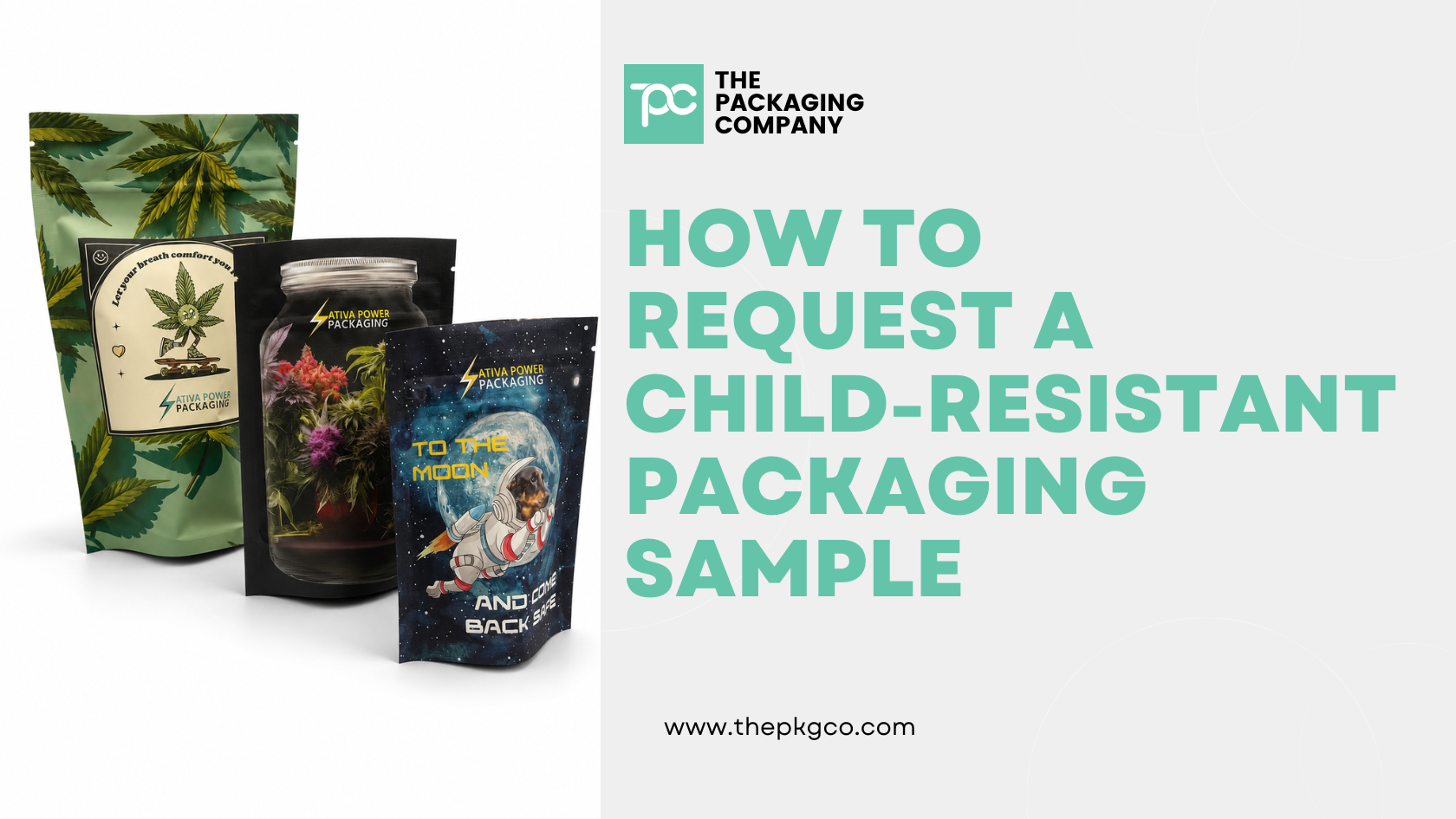
Requesting a sample is the most important step in the CR packaging procurement process. It’s the point where a format that looks right on a spec sheet either holds up under real conditions or reveals problems that would have become expensive production errors. Done correctly, the sample stage compresses timelines and prevents post-production surprises. Skipped or rushed, it’s the most common source of costly revisions after bulk orders are placed.
This guide covers what to send a supplier before requesting a sample, what the sample package should include, and how to evaluate what arrives against the variables that actually matter for CR packaging in regulated markets.
Before You Request the Sample: What to Send Your Supplier
The quality of the sample you receive is directly proportional to the specificity of the information you provide before it’s prepared. A supplier working from vague product descriptions produces samples that may look fine in a photo and fail on your actual fill line. A supplier working from precise product specifications produces samples that can be meaningfully evaluated against real production conditions.
Send these specifics before any sample is prepared:
Product dimensions. For pre-rolls: length in millimeters, diameter in millimeters, and count configuration (how many units per package). For flower: fill weight in grams and preferred container volume. For topicals: fill volume in milliliters and formulation viscosity (thin serum, standard lotion, thick balm). These are not interchangeable with approximate ranges. If your pre-roll is 98mm, say 98mm. A supplier who specs a sample for “standard pre-rolls” may send you a format that doesn’t accommodate your product.
Certification standard required. State which standard your market requires. Most licensed US cannabis markets require 16 CFR §1700.20. Some markets have additional state-specific requirements. Tell your supplier which standard to confirm documentation for before the sample is prepared, not after.
Decoration intent. Even for an undecorated sample, describe your intended decoration: lithographic print on tin, silk-screen on tube, label on glass, embossing detail. This determines whether the supplier prepares the sample in the right substrate and finish, and whether decoration-related constraints (seam placement, cap overhang zone, emboss depth) can be evaluated on the sample.
Fill line configuration. If you have an automated or semi-automated fill operation, note the capping equipment type. CR closure mechanisms require specific application pressure and orientation. A format that closes correctly by hand may not work on your fill line without adjustment.
Target retail price point. This helps the supplier confirm that the format being sampled is appropriate for the brand’s positioning, and flags if a more appropriate option exists in the catalog before sampling time is invested in the wrong format.
What the Sample Package Should Include
A sample request should produce more than a physical container. A complete sample package for CR packaging in a regulated market includes:
The physical sample. Undecorated or minimally decorated, in the exact configuration you specified: dimensions, count, insert tray (if applicable), and closure mechanism. Not a proxy or a close substitute. The specific format being considered for production.
Third-party CR certification documentation. The test report from an accredited independent laboratory confirming the specific format passed 16 CFR §1700.20 panel testing, with documented pass rates for both the child panel (at least 85%) and adult panel (at least 90%). This should arrive with the sample, not weeks later when you ask for it. A supplier who cannot provide this with the sample package is telling you something important about their documentation infrastructure.
Format specification sheet. Interior dimensions, exterior dimensions, material specification, closure torque range (for screw-cap formats), fill capacity, and any assembly or application notes. This is the document you’ll reference if questions come up at the fill line or during the decoration approval process.
Lead time and MOQ confirmation. For the specific format being sampled, at the quantity you’re planning. Lead time and MOQ can change between catalog and actual production for custom configurations. Confirm in writing at the sample stage.
If any of these elements are missing from the sample package, request them before moving to the next stage. Do not proceed to decoration approval with incomplete documentation.
How to Evaluate the Sample
Most brands spend an afternoon on sample evaluation. A thorough evaluation takes a full week and covers six specific checkpoints. The cost difference between a week of proper evaluation and a production problem discovered after delivery is not comparable.
Checkpoint 1: Dimensional Fit With Your Actual Product
Fill the sample with your actual product at your actual fill configuration. Not a proxy, not a stand-in, not an approximation. Your specific pre-rolls at your specific diameter. Your specific fill weight. Your specific count.
For tins: confirm the pre-rolls seat in the insert tray without compression and remove without damage. Confirm the lid engages the CR closure correctly without contacting the contents. A lid that partially compresses the pre-rolls before snapping shut will create compliance and product quality problems in consumer hands.
For jars: confirm fill volume matches the container at the headspace level that allows the CR lid to engage correctly.
For tubes: confirm the pre-roll or product inserts and removes smoothly. Confirm the tube length provides appropriate clearance at both ends.
Checkpoint 2: CR Closure Function Over Repeated Cycles
Open and close the closure 25 to 30 times. Evaluate the resistance at cycle 25 against the resistance at cycle 1. They should be essentially identical.
A CR closure that loosens perceptibly with repeated use is a compliance lifecycle problem. The package may have passed third-party panel testing when new. It will not maintain that performance after weeks or months of consumer use. This is the checkpoint that catches the most common CR performance failure mode, and it requires actual repeated use to evaluate. You cannot assess closure longevity from a single open and close.
Checkpoint 3: Airtight Seal Verification
Close the sample with a scented product inside. Leave it closed for 30 minutes on a clean surface. Check for odor externally.
A genuinely airtight closure produces no external odor. A closure that provides only an approximate seal will allow odor to escape, which means it is allowing air exchange and degrading the product inside. For terpene-rich cannabis products where freshness and aroma are product quality claims, this test is not optional.
Checkpoint 4: Drop and Transit Testing
Fill the sample at your actual fill configuration. Drop it from counter height (approximately one meter) onto a hard floor surface, on each face and corner. Six drops minimum.
After each drop: confirm the CR closure remains fully engaged. Confirm the insert tray (if present) holds the product in position. Confirm the exterior shows no damage that would affect retail presentation.
Products go through significant handling between your facility and the consumer. A format that fails a counter-height drop test will arrive at retail in worse condition than the test suggests.
Checkpoint 5: Physical Color Proof Evaluation (Decoration Stage)
This checkpoint happens during the decoration approval stage, not at initial sample receipt — but it belongs in the evaluation framework because skipping it is one of the most common and expensive mistakes in CR packaging production.
Do not approve decoration from a digital proof alone. Colors reproduce differently on metal, glass, and plastic than they do on screen or on paper. Request a physical color proof on the actual substrate under production-equivalent conditions. Evaluate it under the same lighting as your target retail environment — dispensary lighting is typically high-CRI LED, which affects color perception significantly.
For tins where the lid and body are decorated separately, confirm that design elements spanning the lid-body seam align correctly in the assembled package. This registration check is only visible on the physical assembled sample.
Checkpoint 6: Documentation Currency Check
Before approving the sample for production, confirm in writing with the supplier that the format being approved for production matches the tested and certified specification on file. Ask specifically: has the closure mechanism, material, or dimensional specification changed since the test report was issued?
This written confirmation is the first entry in the reorder documentation chain that should follow every subsequent production run of this format.
What to Do if the Sample Requires Revision
A sample that requires revision is not a failure. It’s the sample stage doing its job. The purpose of sampling is to find dimensional, functional, or documentation problems before they become production problems.
When revision is needed, specify the required change as precisely as the original product specification: “Slot width in insert tray needs to increase from Xmm to Ymm to accommodate pre-roll diameter without compression” is a useful revision note. “The insert tray doesn’t work” is not.
A revision round typically adds 1 to 3 weeks to the timeline depending on the nature of the change. Changes requiring new tooling (insert tray dimensions, custom closure modifications) take longer than changes to standard dimensional specifications. Factor this into your production timeline rather than skipping the revision and hoping the problem resolves itself in production.
A problem identified in a revision round costs weeks. The same problem discovered after production costs money, time, inventory, and in a regulated market, potentially compliance exposure.
TPC’s Sampling Process
TPC provides pre-production samples for all CR packaging formats as a standard part of the project process, before any bulk commitment. Samples are prepared to the specific product dimensions, count configuration, and format you provide. Third-party 16 CFR §1700.20 certification documentation is provided with the sample package.
Our CR packaging line covers tins, pre-roll tubes, jars, bags, and topical packaging formats. MOQ starts at 5,000 units and varies by format. To start the sample request process, contact our team with your product specifications.
For a full breakdown of the production timeline from sample request through bulk delivery, see our custom CR packaging production timeline guide.
Frequently Asked Questions
How long does it take to receive a CR packaging sample? Sample preparation typically takes 2 to 4 weeks from the date specifications are confirmed. Standard formats with existing tooling are at the faster end of that range. Custom configurations, non-standard dimensions, or formats requiring new insert tray tooling take longer. Factor sample lead time into your overall production timeline rather than treating it as outside the critical path.
Should I request samples from multiple suppliers simultaneously? Yes, if you’re in an active supplier evaluation. Comparing samples from two or three suppliers under the same evaluation conditions is the most reliable way to identify differences in closure quality, insert tray fit, documentation completeness, and material finish. Do not select a CR packaging supplier based on a catalog or a quote alone.
What if my product dimensions change after the sample is approved? If the change is material — pre-roll diameter, fill weight, count configuration — request a new sample before production. Small dimensional changes that seem minor on paper can significantly affect closure engagement, insert tray fit, and fill line compatibility. The additional 1 to 2 weeks for a revised sample is far less costly than a production run that doesn’t work with the updated product.
Can I use the same sample for multiple SKUs? Only if the SKUs share identical dimensions and fill configuration. A sample approved for a 98mm king-size pre-roll at 5-pack does not confirm dimensional fit for a 84mm standard pre-roll at the same count, even if both products are intended for the same tin format.
What certification documentation should arrive with the sample? The third-party laboratory test report from an accredited independent laboratory, confirming the specific format passed 16 CFR §1700.20 child panel testing (at least 85% of children unable to open within 10 minutes) and adult panel testing (at least 90% of adults able to open and close within 5 minutes). A Certificate of Compliance without the underlying test report is not sufficient documentation for a regulated cannabis market.