



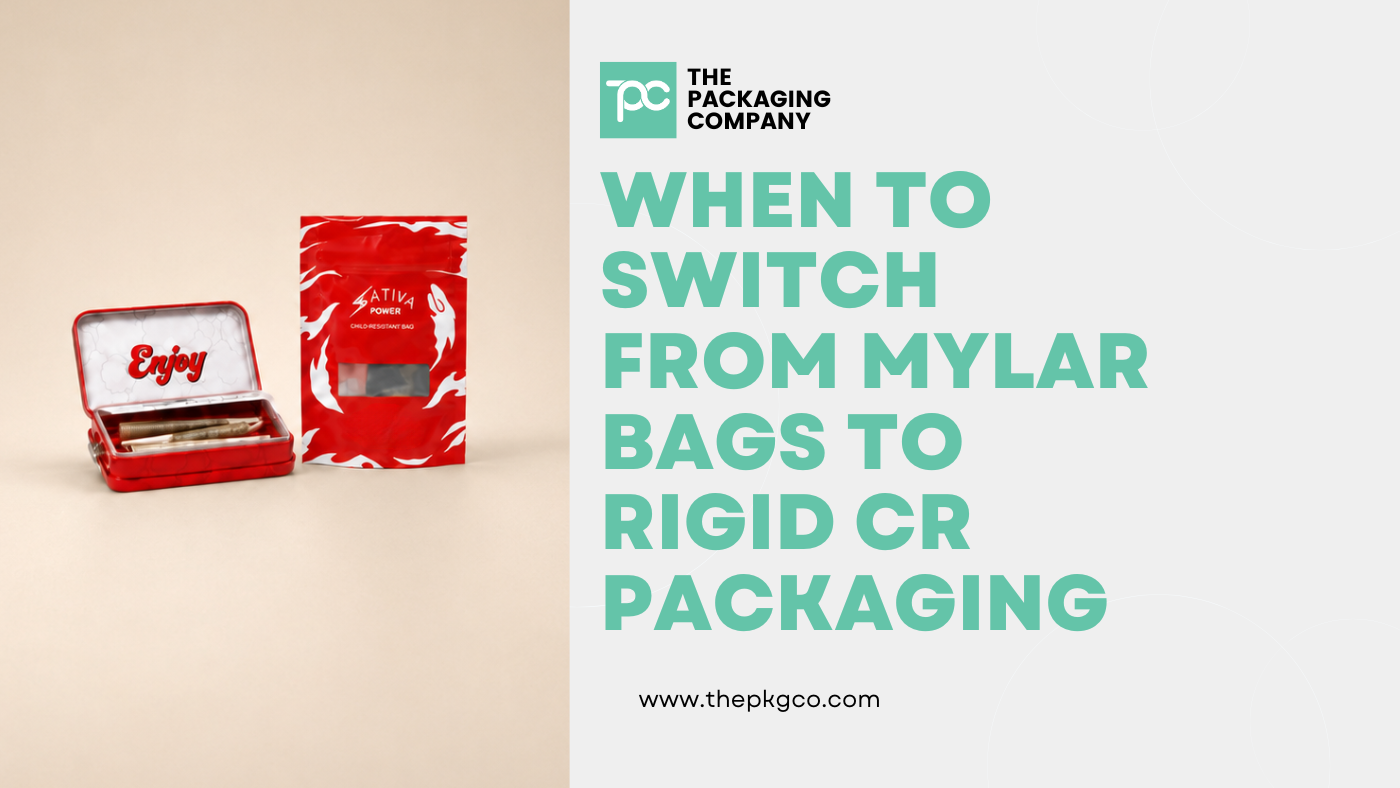
Child resistant mylar bags are popular in cannabis for a reason. They are lightweight, economical, highly printable, easy to store, and flexible enough to work across flower, pre-rolls, edibles, and other product categories.
But there is usually a point in a cannabis brand’s growth where the lowest-cost package is no longer automatically the best package.
Maybe the product has moved into a higher retail price tier. Maybe dispensary buyers are putting it next to competitors in tins and glass. Maybe an infused pre-roll line needs to feel meaningfully different from the core line. Or maybe the brand has simply outgrown packaging that was originally chosen when keeping launch costs low mattered more than creating a premium shelf experience.
The decision is not really about whether mylar bags or rigid packaging are better.
It is about whether the package still matches the economics, positioning, product requirements, and retail environment of the SKU inside it.
When Child Resistant Mylar Bags Are Still the Right Choice
Cannabis brands sometimes treat a move from flexible packaging to rigid packaging as a sign of growth. That can lead to unnecessary packaging cost.
A good child resistant bag can still be the right primary package for a mature brand.
Mylar bags make the most sense when several factors line up.
You are competing in a price-sensitive category
If the customer is primarily comparing price, strain, potency, weight, or promotional value, spending significantly more on the container may not materially improve the purchase decision.
This is especially relevant for value flower, larger flower weights, promotional products, and high-volume SKUs where packaging cost is multiplied across tens of thousands of units.
For these products, a custom printed CR bag can create strong branding without forcing the brand into a more expensive packaging platform.
You need maximum artwork space
Flexible bags offer a large printable surface relative to the package cost.
That matters when the brand relies heavily on:
- Illustration
- Large typography
- Strain differentiation
- Color-coded product families
- Detailed regulatory copy
- Promotional graphics
- Limited-edition artwork
A rigid package may create a more substantial tactile experience, but it does not automatically give the design team more usable space.
Your packaging needs to stay operationally simple
Bags are also efficient from a logistics perspective.
They ship flat before filling, use less warehouse space than most rigid formats, and can be easier to manage when a brand has many strains or frequently changing SKUs.
If a cannabis company is running dozens of short production runs, introducing a separate rigid container for every product can create more inventory complexity than commercial value.
Your customer does not expect a rigid package
Packaging should match the category.
A premium tin can make sense for a $40 infused pre-roll multipack. The same package may be unnecessary for a value-oriented product where the consumer expects a simple pouch.
The goal is not to make every SKU feel expensive. It is to make the packaging feel appropriate for what the customer is buying.
TPC’s child-resistant bag category supports made-to-order flexible packaging programs, with CR mylar bag production generally beginning at 5,000 units.
The First Trigger: Your Retail Price Has Moved Up
One of the clearest signals that a packaging change deserves consideration is a meaningful increase in the product’s retail price.
There is no universal cannabis pricing threshold where a bag suddenly becomes inappropriate. Retail prices vary by state, category, taxation, potency, and brand position.
But brands can use a simple working framework.
| Approximate retail position | Packaging question |
|---|---|
| Value / promotional | Keep packaging cost highly controlled |
| Core / mainstream | Upgrade only if the package strengthens differentiation |
| Premium | Evaluate whether flexible packaging still supports perceived value |
| Super-premium / giftable | Rigid packaging becomes much easier to justify |
The important number is not the retail price by itself.
It is the relationship between packaging cost and perceived product value.
If a package adds meaningful cost to a low-priced SKU but does little to change what the customer will pay, the economics are weak.
If a more premium package helps a brand defend a higher price point, strengthen shelf presence, improve the unboxing experience, or clearly separate a premium line from the core assortment, that additional packaging spend may be much easier to justify.
A practical cannabis example is the difference between a standard single pre-roll and an infused multi-pack.
The single may sell perfectly well in a simple CR tube or flexible pouch. A higher-priced 5-pack or 7-pack has more room for packaging to become part of the value proposition.
The Second Trigger: The Shelf Has Changed Around You
Packaging decisions are relative.
A package can work well for years and then suddenly feel dated because competitors have changed the visual standard of the category.
This happens frequently in cannabis.
Imagine a premium pre-roll brand entering a dispensary set where most comparable products are now presented in decorated tins, glass tubes, or rigid cases. The bag may still function perfectly. It may still be compliant. It may even have strong artwork.
But the package is now communicating something different because of what surrounds it.
The right question becomes:
Does our current package make us look like the product we are trying to be?
Retail buyers can be useful sources of information here.
If buyers repeatedly comment that competing products merchandise better, feel more premium, display more cleanly, or create stronger visual consistency across a shelf set, the packaging discussion has moved beyond aesthetics.
That feedback is telling you how the product is being perceived in its actual sales environment.
The Third Trigger: You Need a Premium SKU to Feel Different
One of the strongest reasons to move from child resistant mylar bags into rigid packaging is not to change the entire product line.
It is to create hierarchy within the brand.
A cannabis company may have:
- Core pre-rolls
- Infused pre-rolls
- Limited drops
- Reserve flower
- Live resin products
- Collaboration products
- Higher-count multipacks
Putting every SKU into the same packaging structure can make the line visually consistent, but it can also make products at very different price points feel too similar.
A rigid package can create a physical distinction between tiers.
For example:
Core line: Custom CR mylar bag
Premium line: Decorated child-resistant tin
Limited release: Premium tin plus secondary carton or sleeve
That approach protects packaging economics on the volume products while directing higher packaging spend toward SKUs where the customer is more likely to notice it.
This is often a better strategy than replacing every bag in the portfolio at once.
The Fourth Trigger: Your Product Needs More Physical Protection
Brand positioning is only one reason to consider rigid packaging.
The product itself may benefit.
Pre-rolls can be crushed. Glass cartridges or other components can move inside flexible packaging. Premium flower presentation can suffer if the package is compressed during transportation, warehousing, or retail handling.
Rigid packaging creates structure around the product.
That can be particularly valuable when the appearance of the product matters after opening.
For pre-rolls, a properly sized tin or tube can help maintain presentation and prevent the package from being flattened in a pocket, display case, shipping carton, or delivery bag.
The format still needs to be engineered around the actual product.
A container that is technically large enough is not automatically a good fit. Pre-roll diameter, length, count, filter style, insert design, and orientation all affect how the finished package performs.
The Fifth Trigger: Your Brand Has Enough Volume to Standardize
Rigid packaging becomes much more attractive when a brand can spread one structure across multiple SKUs.
Instead of developing five completely different packages, a company may use:
- One tin structure
- One insert platform
- Different exterior artwork
- Different labels
- Different strain identifiers
That creates manufacturing leverage.
The same physical package can support several SKUs while the decoration changes by product.
This is especially useful for parent companies and multi-brand operators trying to reduce unnecessary packaging variation.
The packaging conversation then changes from:
“What container should we buy for this SKU?”
to:
“What packaging platform can support this entire product family?”
That is a much stronger way to manage packaging at scale.
Mylar Bag vs Tin vs Jar vs Tube
When a flexible package no longer fits the product strategy, the next decision is which rigid format makes sense.
Child-resistant tins
Tins work particularly well for premium pre-roll multipacks, edibles, flower, and certain other cannabis products depending on the specific tin format.
Their biggest advantage is presentation.
Metal creates a different tactile impression from flexible film and gives the package a reusable, substantial feel.
TPC’s child-resistant tin line includes several structures designed for different product counts and applications.
The Child-Resistant Snap Tin V5, for example, measures 74 x 58 x 20 mm and uses a corner-press opening mechanism. The package is certified to 16 CFR §1700.20 and begins at a 5,000-unit MOQ for custom production.
Tins are especially worth evaluating when shelf presence and brand experience matter enough to justify a more substantial package.
Glass jars
Glass makes sense when product visibility, rigidity, chemical compatibility, or perceived quality are important.
Cannabis flower and concentrates are common applications, although the exact jar and CR closure need to be selected around the product.
Glass can create a premium presentation, but it also introduces additional weight and breakage considerations compared with flexible packaging.
For concentrate brands, smaller glass jars can be particularly effective because the product itself is compact and often sold at a higher value per gram.
Pre-roll tubes
Tubes offer a middle ground between flexible bags and larger rigid tins.
They work particularly well for singles and smaller pre-roll counts where the product benefits from crush protection but does not require a large package.
TPC offers child-resistant pre-roll tubes in glass and aluminum formats. These are distinct from topical squeeze tubes and are designed specifically around pre-roll packaging applications.
Glass tubes provide product visibility and a premium feel. Aluminum tubes create a lightweight metal presentation with strong physical protection.
A Simple Decision Framework
A cannabis brand considering a move away from child resistant mylar bags can score the SKU across six questions.
1. Is the product premium enough to support higher packaging cost?
If no, keep the bag unless another functional reason justifies the change.
2. Does packaging materially influence how the SKU competes on shelf?
If customers and buyers are comparing presentation as part of the purchase decision, rigid packaging becomes more relevant.
3. Does the product need better crush or physical protection?
If yes, evaluate tubes, tins, or jars.
4. Does the brand need clearer separation between core and premium lines?
If yes, changing packaging structure can create stronger hierarchy than artwork alone.
5. Can multiple SKUs share one rigid packaging platform?
If yes, the economics and inventory management often improve.
6. Is the brand prepared for the MOQ, lead time, and production planning involved?
Rigid packaging should be treated as a production program, not an impulse design change.
If four or more of those answers are yes, it is probably worth sampling rigid formats before the next production run.
If only one or two are yes, improving the existing flexible package may create a better return.
Do Not Switch Formats Just Because Rigid Packaging Looks Better
This is where cannabis brands can waste money.
Packaging upgrades should solve a commercial or operational problem.
Moving into a tin because it photographs well on Instagram is not enough by itself.
A format change should ideally accomplish at least one of the following:
- Support a higher retail position
- Improve shelf differentiation
- Protect the product
- Improve the customer experience
- Create clearer product hierarchy
- Standardize multiple SKUs
- Strengthen retailer presentation
- Reduce another packaging problem
If the only result is a higher packaging invoice, the switch probably does not make sense.
There are also ways to improve flexible packaging before abandoning it.
Better print quality, finishes, structure, sizing, artwork hierarchy, tactile effects, and secondary packaging can all change how a bag performs as a brand asset.
The package format should be the last decision in a chain of commercial reasoning, not the first.
How TPC Helps Brands Evaluate the Transition
The Packaging Company develops made-to-order child-resistant packaging for cannabis and regulated product companies.
Because TPC works across flexible bags, tins, glass packaging, pre-roll tubes, jars, secondary packaging, and custom-engineered formats, the conversation does not have to begin with a predetermined container.
It can begin with the product.
What are you filling?
How many units are you producing?
What does the SKU retail for?
How many products need to share the package?
What is the brand trying to communicate?
What is not working about the current package?
Those answers usually make the format decision much easier.
A brand using bags does not necessarily need to move into rigid packaging. A brand already using tins does not necessarily need a more expensive tin.
The objective is to match the packaging investment to the value it creates.
If your team is deciding whether to keep a flexible CR package or move a product family into tins, jars, or tubes, contact TPC to review the product, volume, and packaging requirements before the next production run.
Frequently Asked Questions
Are child resistant mylar bags good packaging for cannabis?
Yes. Child resistant mylar bags can be an effective primary packaging format for cannabis products when the structure and closure meet the applicable requirements. They are lightweight, highly printable, space-efficient, and generally economical compared with more complex rigid formats. They remain especially useful for value-oriented products, larger flower formats, and brands managing many SKUs.
When should a cannabis brand move from mylar bags to tins?
A move into tins makes the most sense when packaging needs to contribute more to product positioning, physical protection, or shelf differentiation. Premium pre-roll multipacks, infused products, limited releases, and higher-value product lines are common examples. The brand should also have enough production volume and margin to absorb the additional packaging cost.
Are tins better than mylar bags for pre-roll packaging?
Neither format is universally better. Bags are efficient and cost-effective, while tins provide stronger crush protection and can create a more premium physical presentation. The best choice depends on pre-roll count, retail price, product positioning, production volume, and how much the package needs to influence the customer experience.
Are glass tubes better than bags for single pre-rolls?
Glass tubes can be a strong option for premium single pre-rolls because they protect the product and create a rigid presentation without requiring a larger tin. Bags may still make more sense for price-sensitive products or brands that prioritize printing area and low packaging weight. TPC’s CR glass pre-roll tube formats generally begin at 10,000 units.
Should every premium cannabis product use rigid packaging?
No. Premium positioning can also be created through strong flexible packaging, print quality, artwork, decoration, and secondary packaging. Rigid packaging should be chosen when its additional cost creates a meaningful commercial or functional advantage. A premium product does not automatically require the most expensive container.
Can one rigid package be used for multiple cannabis SKUs?
Yes, and this is often one of the strongest reasons to develop a rigid packaging platform. Multiple strains, flavors, or product variants can sometimes share the same container while using different artwork, labels, or decoration. Standardizing the structure can simplify procurement and production while maintaining SKU-level brand differentiation.