

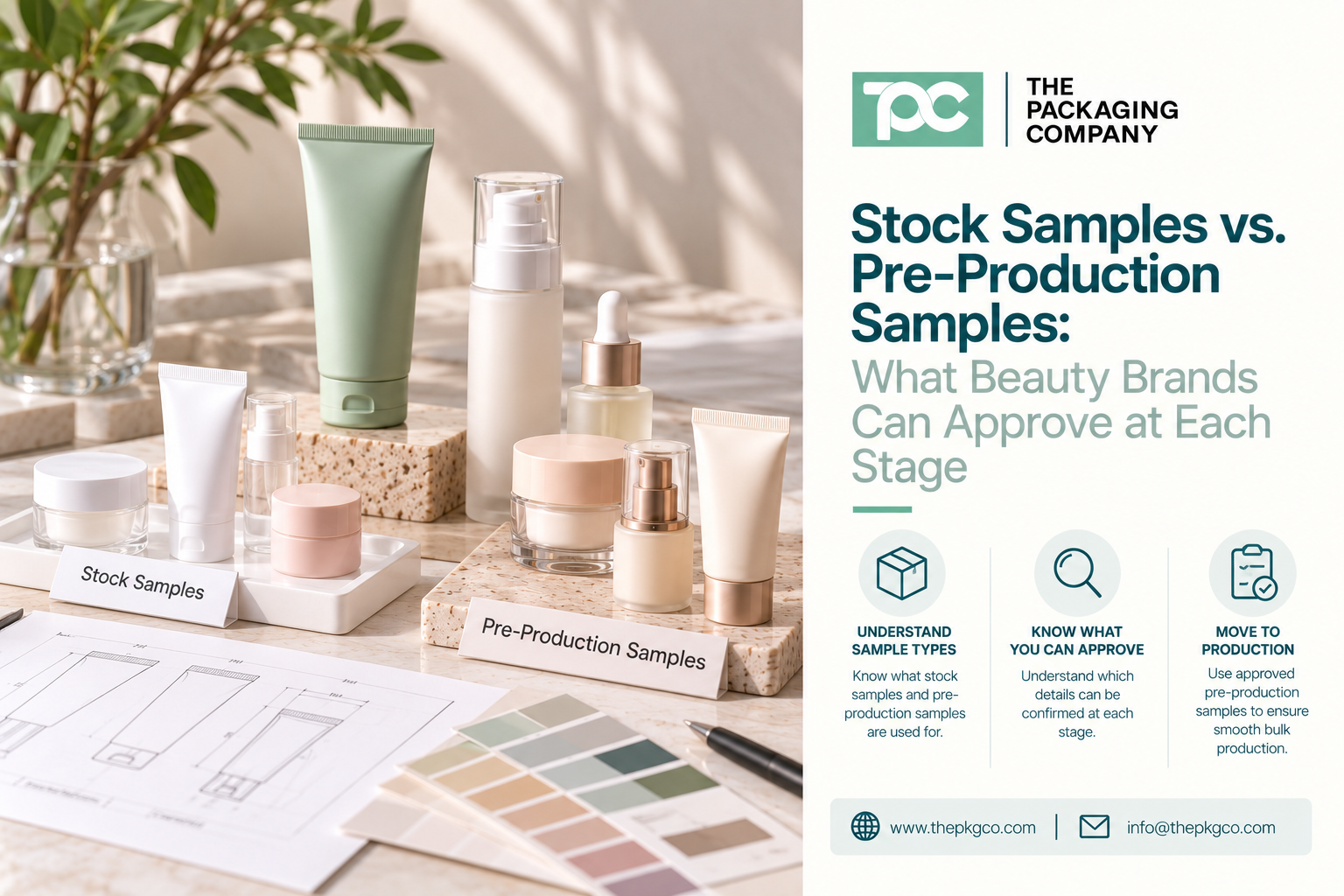
A beauty brand receives an empty bottle sample that feels right, fits the intended carton, and looks close to its product concept. Can the brand approve the custom packaging order based on that sample? Not necessarily. A stock sample can be useful for choosing a packaging direction, but it may not represent the exact color, printing, closure configuration, or components that will be manufactured for the final order. For TPC custom packaging orders, a pre-production sample (PPS) is provided after the order is placed so the brand can review the agreed production configuration before bulk manufacturing.
For brands developing custom cosmetic packaging, the important question is not simply whether a sample looks good. It is which decision that sample is sufficient to support—and which decisions still require technical review or a later approval.
Why One Cosmetic Packaging Sample Cannot Approve Everything
Packaging approval combines different questions: Is this the right container family? Does the closure work with the selected body? Can the intended formula and filling process use this configuration? Is the decoration correct? Does the finished sample match the components and specifications being ordered?
Those decisions are related, but the supporting evidence may come from different sample types and different teams. An undecorated stock jar might establish the intended silhouette and lid handling. It cannot, by itself, confirm how a custom printed logo will reproduce on the finished surface. A stock sample also cannot substitute for formula compatibility work by a qualified formulator or filling partner.
A practical approval process records what was reviewed, what was accepted, and what remains open.
TPC’s sampling and production sequence:
- Review available stock samples before ordering to select a suitable packaging direction.
- Place the order after confirming the packaging configuration, customization, quantities, and commercial requirements.
- Review and approve the PPS provided after order placement, including applicable color, printing, finish, and component specifications.
- Proceed to bulk manufacturing after PPS approval and other required production confirmations. For many custom projects, manufacturing takes approximately 90 days after PPS approval, with shipping additional.
Stage 1: What Can a Brand Approve From a Stock Sample?
A stock packaging sample generally refers to an available example of a container or component in a standard configuration. It gives the brand something physical to handle before committing to final specifications.
Depending on the sample supplied, brands may use it to make preliminary decisions about:
- Format and appearance: Whether a bottle, jar, tube, or other container family suits the product positioning.
- Physical dimensions: Initial checks of height, width, diameter, hand feel, and fit within planned secondary packaging.
- Component layout: How the cap, pump, lid, or applicator attaches and how the package is opened and handled.
- Material and finish direction: An initial impression of weight, texture, transparency, or surface feel.
- Selection for further testing: Which configuration should be sent to the formulator or contract filler for evaluation.
These are useful selection decisions. They should not be mistaken for approval of a custom manufacturing run.
What a Stock Sample Does Not Confirm
Unless it is demonstrably equivalent to the final specification, a stock sample does not confirm the final decorated color, printing position, surface treatment, custom component geometry, or production tolerances. It also does not establish finished-product compatibility simply because it can hold a test liquid.
For example, a brand may select a standard airless packaging sample for a treatment serum. That choice can narrow the format. The actual formula still needs to be evaluated with the intended dispensing system, and any later pump or bottle changes need to be considered by the responsible technical teams.
Approval at this stage: “We approve this packaging direction for further development,” not “We approve all final production details.”
Stage 2: What Does a Pre-Production Sample Actually Approve?
At TPC, a pre-production sample (PPS) is provided only after the order has been placed. The PPS serves as the reference for the agreed components and customization. The brand reviews and approves that reference before bulk manufacturing begins.
The exact PPS scope should be established with the supplier. It can include the applicable container, closure, dispenser, material, color, finish, decoration, and component assembly details.
A useful PPS review checks the sample against the approved specification, not only against earlier marketing visuals. Brands should make sure the supplier and brand agree on:
- Part numbers, capacity, dimensions, and relevant tolerances
- Material and component configuration
- Matching cap, pump, insert, liner, or applicator where applicable
- Approved artwork revision and decoration placement
- Color and finish acceptance references
- Known differences from earlier stock samples
- Any documented exceptions or open items
If the program includes several sizes, printed designs, or component combinations, the parties should define which configurations require separate approvals. One approved sample should not silently be treated as approval of every SKU.
Approval at this stage: “We accept this documented configuration as the reference for the agreed packaging manufacturing order.”
This is a manufacturing reference—not a guarantee of finished-product performance.
Stock Sample vs. PPS: Approval Comparison
| Decision | Stock sample (before order) | PPS (after order placement) |
|---|---|---|
| Choose container family or shape | Useful for initial selection | Confirm final specification |
| Review size and component feel | Preliminary review | Confirm against approved specifications |
| Approve custom color and artwork appearance | Not a final custom-decoration approval | Review and approve agreed color, finish, and decoration |
| Confirm exact bulk-production configuration | Not by itself | Yes, within the agreed PPS scope |
| Establish formula compatibility | Requires separate technical assessment | Requires separate technical assessment |
| Authorize bulk manufacturing | No | After PPS approval and all other required production confirmations |
The precise role of each sample depends on the supplier’s documented process. A sample label alone does not replace specifications, testing, or written approval.
Keep Packaging Sample Approval Separate From Formula Testing
The brand may need to begin evaluating the packaging with the actual product before the PPS is approved. That work should be planned deliberately, rather than assumed to be included in a supplier’s sample approval.
The brand, formulator, contract filler, and qualified testing partners should establish the relevant evaluations for the final formula and packaging system. Depending on the product, these may address formula/material compatibility, stability, filling-line suitability, leakage, dispensing performance, and finished-product requirements.
TPC supplies empty packaging components and can provide information about the selected packaging configuration. TPC does not perform the brand’s formula stability testing or finished-product filling validation.
If a component relevant to product contact or function changes after testing—such as a pump, closure, liner, or tube structure—the technical team should decide whether existing results remain applicable or further testing is required.
For more detailed preparation immediately before components are delivered to a filler, see what brands should confirm before skincare packaging goes to the filler.
What Happens if a Brand Changes the Design After Sample Approval?
Sample approval only protects the project when the approved reference matches what will actually be ordered.
Consider a skincare line that chooses a clear airless bottle, then changes its finish to frosted and replaces the pump actuator after the first sample review. The original stock sample may still be useful for evaluating general size, but the finish and actuator decisions now refer to a different configuration.
Typical reasons to revisit an approval include:
- A change in bottle or jar material
- A different pump, cap, closure, liner, or applicator
- A revised size, fill-capacity specification, or geometry
- Changes to custom color, finish, printing technique, or artwork
- A new production source or manufacturing method where it affects the approved requirements
- Revisions arising from the formulator or filling team’s testing
Not every change requires a full restart. However, the supplier and brand should document what changed, which approvals remain valid, and whether additional samples or tests are needed before production.
Where MOQ and Production Lead Time Enter the Sampling Decision
Sampling helps a brand select and approve packaging, but it should be connected to the planned manufacturing program.
For most TPC custom cosmetic packaging, the typical MOQ is 5,000 units per SKU per print run. Squeeze tube programs generally have a 10,000-unit MOQ. The final requirement depends on the specified product and project.
That distinction matters when a brand plans an order with multiple custom colors or printed variants. Different specifications or print runs may carry separate minimums, even if the same stock container family is used. For a deeper discussion of print-run quantities, see ordering cosmetic packaging for multiple SKUs.
For many custom projects, TPC’s typical production lead time is approximately 90 days after PPS approval. This is not a promise that initial sampling, compatibility testing, decoration development, or shipping are included in those 90 days; actual timing must be confirmed for the order.
A useful question before confirming a custom order is: If this configuration is approved, can we realistically proceed with the required quantity, artwork, testing, and production timing?
How to Record Sample Approvals Without Confusing the Next Team
A short approval record is often more valuable than a folder full of unidentified sample photos. The record should tell the brand, supplier, and filling partner which reference is current and what has been approved.
For each reviewed sample, record:
- Supplier sample reference and date received
- Container and component identifiers
- Sample type: stock sample or post-order PPS
- Specification and artwork revision, if applicable
- What is approved, conditionally accepted, or rejected
- Outstanding formula, filling, or other technical evaluations
- The decision owner and approval date
- What must happen before the next production stage
For instance, a stock tube sample might be marked: “Body size and cap style accepted for further evaluation; decoration and tail-seal qualification pending.” That is much clearer than a one-word approval with no scope.
Three Questions Before Moving From Stock Samples to a Custom Order
Before moving from a stock sample to an order and subsequent PPS review, decide what the team needs to approve next.
- What decision are we trying to make? Pre-order container selection, post-order PPS appearance approval, technical evaluation, or bulk-manufacturing sign-off?
- Will the sample represent the configuration we plan to manufacture? If not, document the differences before relying on the result.
- Who must approve it? The marketing team may own appearance; procurement may own order specifications; the formulator and filler own their technical acceptance; the brand coordinates the final sign-off.
This is the difference between selecting a promising stock sample and approving a specific post-order PPS for manufacturing.
How TPC Helps Brands Move From Samples to a Production-Ready Specification
The Packaging Company supports beauty, skincare, cosmetics, and personal care brands sourcing custom empty packaging, including bottles, airless systems, jars, and tubes. TPC can help review available formats, sample options, decoration requirements, component specifications, and manufacturing arrangements.
For a stock sample inquiry, it helps to share the target container type, capacity, formula format, preferred customization, approximate order quantity, SKU count, and the decision the sample needs to support. The brand and its technical partners should separately define any testing required with the actual formula.
If your team is planning stock sample review and post-order PPS approval for an upcoming production project, contact The Packaging Company to discuss which available packaging references and sample options fit the project.
Frequently Asked Questions About Cosmetic Packaging Samples
Is a stock packaging sample the same as a pre-production sample?
No. A stock sample is used for initial evaluation before ordering. At TPC, a PPS is provided after the order is placed so the brand can approve the agreed packaging configuration and custom details before bulk production.
Can a brand approve the final packaging color from a stock sample?
A stock sample can help a brand select a color or finish direction, but it does not approve custom decoration for production. At TPC, the agreed custom color, printing, coating, and other decoration details are reviewed on the PPS provided after the order is placed.
Does PPS approval mean the formula has passed compatibility testing?
No. PPS approval addresses the agreed packaging manufacturing reference. The brand, formulator, filling partner, and qualified testing specialists remain responsible for the required formula compatibility, stability, filling, and finished-product evaluations.
Does every SKU need a separate sample?
Not necessarily. The required approvals depend on what differs between SKUs and the supplier’s agreed production process. Different materials, sizes, components, printed designs, or finishes may require separate references or sign-offs.
When does TPC’s production lead time begin?
For many TPC custom packaging programs, the typical manufacturing lead time is approximately 90 days after PPS approval, subject to project confirmation. The PPS is provided after the order is placed; sampling, testing, and shipping should be planned separately.