


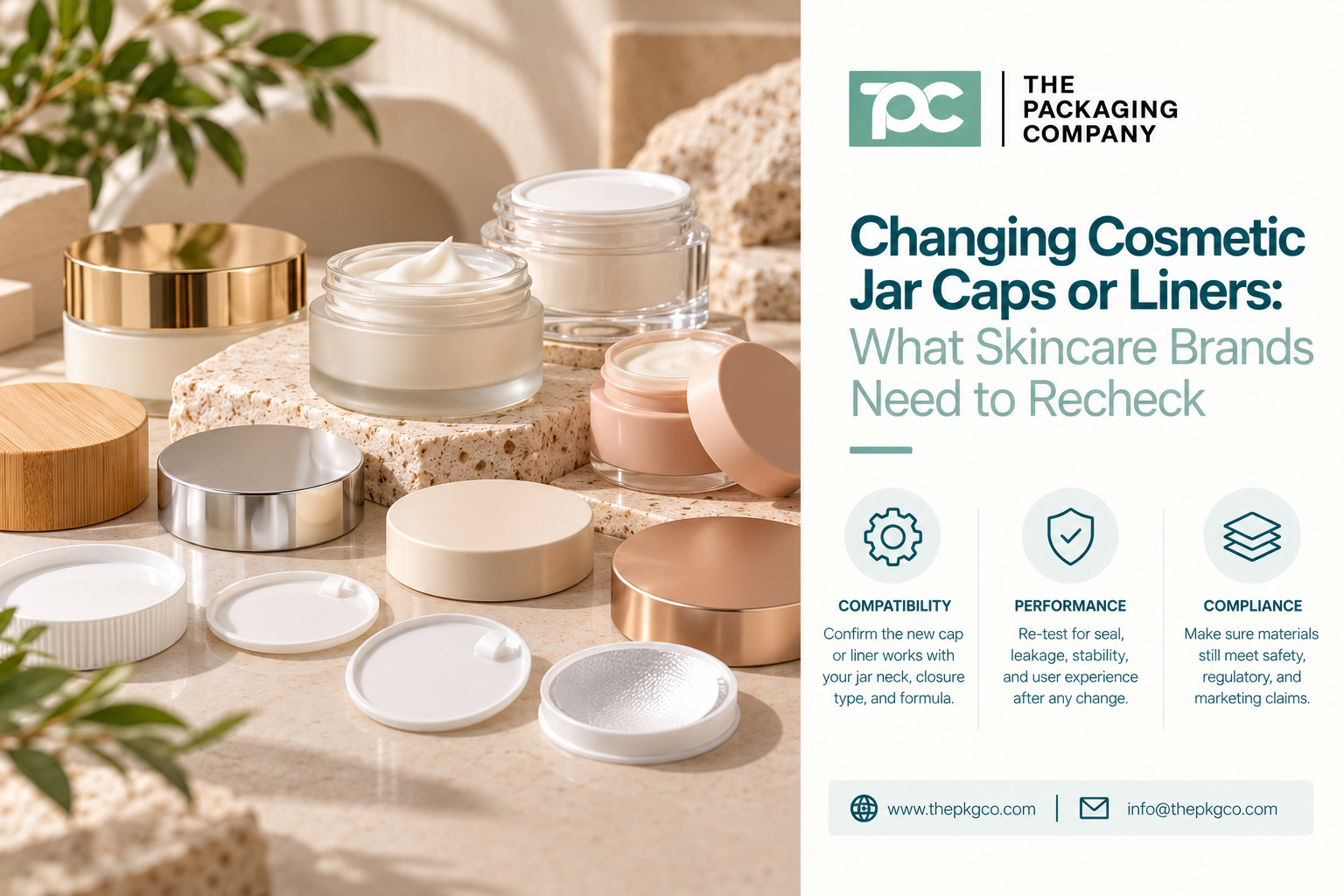
A skincare brand may want to change the cap on an existing cosmetic jar without redesigning the entire package. Sometimes the goal is a different finish or a better customer experience. In other cases, the original closure is unavailable, a supplier has changed, or a liner needs to be reconsidered for the product.
The jar body may look exactly the same after the change, but that does not guarantee the full packaging system will behave the same way. The fit between the jar finish, cap, and any liner or sealing component can affect closure performance, filling operations, leakage, and how the customer uses the product.
For skincare brands already buying cosmetic jar packaging, replacing a lid or liner is best treated as a controlled component change rather than a routine cosmetic update. Here is what the team should review before using the revised configuration in production or a reorder.
Start by Defining Exactly What Is Changing
“We are changing the jar cap” can mean several different things. The brand may be requesting a new exterior finish on the same component, selecting a different cap construction, changing the supplier, altering an inner liner, or switching to a closure that looks similar but uses different dimensions.
Those changes do not carry identical implications. A finish-only change may require a different review from a new closure geometry or liner material. Before anyone signs off, identify the component being replaced and why.
| Proposed change | What needs attention |
|---|---|
| Different cap color or decorative finish | Approved appearance, surface performance, and confirmation that underlying function is unchanged |
| New cap model or closure supplier | Jar-neck interface, fit, dimensions, application process, and finished-package performance |
| New or revised liner | Material, seating, compression, formula contact, and any relevant seal requirements |
| Adding or removing an inner sealing element | Closure configuration, filling workflow, consumer opening, and necessary revalidation |
| Changing multiple components together | Assessment of the complete revised jar-and-closure system rather than each part in isolation |
This component-change framing keeps the article separate from a first-time jar selection guide or a general quality-control checklist.
1. Confirm That the New Cap Fits the Actual Jar Finish
A cap with the same nominal diameter is not necessarily interchangeable with the one currently used. Thread profile, engagement, tolerances, skirt depth, and sealing surfaces can differ between suppliers or product families.
That means a cap that appears to screw onto a jar may still perform inconsistently during repeated opening and closing. Some mismatches are immediately visible; others only become apparent after application, storage, or use.
The packaging team should verify the supplier-approved cap-and-jar pairing and document any differences from the existing configuration. Review the actual physical components rather than deciding based on catalog dimensions alone.
Questions to resolve include whether the cap engages correctly, whether the intended closure application method remains suitable, and whether the assembled package meets the agreed functional requirements.
Important: Do not assume that a cap from another supplier can be substituted for the original simply because it has a similar appearance or nominal size.
2. Understand What the Liner Does in This Jar System
Not every cosmetic jar includes a separate liner, gasket, inner disc, or induction-sealing element. The function and location of any such part depend on the specific package design.
For jars that do use a liner or related closure component, changing it may affect how the closure seats and seals. Materials and structures can behave differently under compression or repeated use, and a liner that works in one assembly may not be appropriate in another.
Before replacing a liner, establish:
- Its role in the existing closure system
- The approved liner construction and material
- How it is retained and positioned inside the cap or at the jar opening
- Whether the revised cap changes liner contact or compression
- Whether its use involves a separate sealing operation at the filling facility
- Which formula-compatibility or performance assessments apply to the change
A liner should not be selected only by its visible diameter or thickness. The jar, closure, liner, and filling process need to be evaluated together.
3. Check Whether the Original Testing Still Applies
Brands often have stability, compatibility, leakage, or filling test records for their current packaging. When a cap or liner changes, the question is not automatically “repeat everything,” but rather: What was tested, what has changed, and which evidence remains applicable?
The brand’s formulator, filling partner, and qualified testing team should compare the original approved system with the proposed replacement. They can then decide which assessments are required to establish suitability of the revised configuration.
For example, a purely visual finish change to an otherwise identical component may have a different testing impact from changing a formula-contact liner material. A new closure design could affect leakage or repeated-use performance even if the jar body and formula remain unchanged.
Keep existing reports tied to the exact component versions they covered. Avoid treating an earlier successful test as blanket approval for a different closure assembly.
4. Review Filling-Line and Closure-Application Requirements
The cap or inner-sealing arrangement may interact with the contract filler’s equipment and procedures. A revised closure can require changes to handling, application, or inspection, depending on the package.
Before committing to the replacement, ask the filling partner whether the new component can be applied consistently using the intended process. Relevant considerations may include closure application setup, component feeding, liner placement, applicable sealing processes, and inspection criteria.
The filling partner should establish appropriate operating settings and acceptance requirements for the actual combination. TPC supplies empty packaging components; it does not certify that a replacement closure will perform on a particular brand’s filling line without the necessary review.
If the original cap is being changed to address a production issue, record the issue and the expected improvement. Otherwise it may be difficult to tell whether the replacement actually solved the problem.
5. Evaluate Leakage, Storage and Repeated Opening Where Relevant
Closure performance is not just about whether the lid feels secure at the packing station. The package may be transported, stored in different orientations, opened many times, and exposed to conditions that affect the product or its components.
The brand and its technical partners should decide which performance checks are appropriate for the revised jar assembly, including any relevant leakage, shipping, storage, and repeated-use evaluations.
Consider what changes during actual use: a jar may accumulate product around the rim, a liner may contact the formula, and a customer may not close the lid with the same force as a filling machine.
No single informal “turn it upside down” check can establish overall compatibility or storage performance. Testing should reflect the product and its intended distribution and use conditions.
6. Do Not Forget How the Cap Change Affects Appearance
Even when the jar body stays unchanged, a replacement closure can change the finished package’s height, visual proportions, perceived quality, and decoration alignment.
For a skincare brand with several jar sizes, a new lid may fit one SKU visually but make another look inconsistent. A different cap finish may also appear to be a color mismatch when placed next to existing jars in the same product line.
The brand should review the assembled product, not just an isolated lid. Where decoration or artwork is affected, identify whether the approved packaging reference needs to be updated.
These considerations complement the existing cosmetic jar packaging QA checklist; they are not a reason to duplicate that article’s complete original-production inspection procedure.
7. Keep the Old and New Component Versions Separate
Component substitutions create operational risk when the brand, supplier, and filler refer to different versions using the same description.
A purchase order that simply says “50 mL cream jar with white cap” may not sufficiently distinguish the original from its replacement. A better change record identifies the precise new part and when it becomes the approved configuration.
| Change-control record | What to document |
|---|---|
| Existing configuration | Jar, closure, and liner references currently in use |
| Proposed replacement | New cap or liner reference and supplier details as applicable |
| Reason for change | Availability, appearance, function, cost, or another documented reason |
| Impact review | Fit, technical evaluation, filling process, and customer-use considerations |
| Testing decisions | Which prior results remain applicable and which assessments must be repeated |
| Approval reference | Current agreed sample or PPS reference where required by the order |
| Changeover date | Which batches, purchase orders, or SKUs will use the new component |
This makes it easier to avoid mixing closures during a transition and helps future reorders follow the approved specification.
8. Decide How to Handle Existing Inventory and Reorders
If a brand already owns jars, caps, or liners from a previous production run, a new closure specification can create practical questions. Can any inventory be used together? Which components should remain separated? Does the brand need to update packing or assembly instructions?
Do not assume cross-compatibility between inventories. The relevant teams should decide whether original and revised components may be used together, based on the approved specifications and performance requirements.
For brands operating several jar sizes, record the change SKU by SKU. One approved substitution may not apply to every container in a matching family.
When preparing a reorder, specify the revised configuration rather than relying on the supplier to infer it from the last purchase. TPC can review available empty cosmetic jar options and component requirements, while the brand and its partners remain responsible for assessing finished-product suitability.
9. When Does the Revised Jar Need a New Production Approval?
A component change does not automatically require the same approval steps as an entirely new package. However, the supplier and brand should agree on what constitutes an altered production specification and which reference must be approved.
For TPC custom packaging projects, stock samples can help review available component directions before ordering. A pre-production sample (PPS) is provided after the order has been placed and serves as the reference for the agreed custom configuration before bulk manufacturing.
If the new closure or liner changes the packaging configuration for the next order, the team should confirm the required documentation and PPS scope. The brand must also coordinate any relevant formula and filling assessments with its own technical partners.
For a general explanation of these stages, see stock samples versus pre-production samples.
TPC’s general MOQ for many custom cosmetic packaging projects is approximately 5,000 units per SKU per print run, subject to the product specification. For many custom projects, manufacturing lead time is approximately 90 days after PPS approval; actual timing, including component changes and shipping, should be confirmed for the order.
Questions to Answer Before Replacing a Cosmetic Jar Closure
Before the brand authorizes a revised configuration, it should be able to answer these questions clearly:
- Which exact cap, liner, or inner-sealing component is changing?
- Has the supplier confirmed the revised component is intended for the selected jar?
- What previous technical and filling evidence applies to the new configuration?
- Who is responsible for any additional testing or process qualification?
- Which product SKUs and purchase orders will use the replacement?
- Which component references and approval records will control future reorders?
The Packaging Company works with skincare, cosmetic, and personal care brands sourcing custom and wholesale jar packaging. If your brand needs to revise an existing jar-and-cap configuration, contact TPC with the current jar and closure specifications, proposed changes, order quantities, and expected delivery requirements.
Frequently Asked Questions About Cosmetic Jar Cap and Liner Changes
Can I change a cosmetic jar cap without changing the jar?
Potentially, but the replacement must be evaluated against the actual jar finish, closure interface, and complete packaging requirements. Similar-looking caps are not automatically interchangeable.
Does every cosmetic jar need a liner?
No. Liner, gasket, disc, and sealing arrangements vary by jar and closure system. Whether one is needed and which construction is appropriate depend on the selected package, product, and application requirements.
Do I need to repeat formula compatibility testing after changing a liner?
The brand’s formulator and qualified testing partners should evaluate the change and decide which earlier results still apply. A change in formula-contact materials or sealing behavior may require additional assessments.
Can old caps and new caps be used with the same jar inventory?
Do not assume this. Each intended combination needs an appropriate specification and, where required, evaluation and approval before the components are mixed in production.
When does TPC provide a pre-production sample?
For TPC custom packaging orders, the PPS is provided after an order has been placed. It serves as the agreed packaging manufacturing reference, with the necessary approvals completed before bulk production.