



Cannabis packaging is not static. The formats, materials, compliance requirements, and consumer expectations that defined the category three years ago are different from what’s shaping purchasing decisions today — and the brands that understand where the market is moving have a meaningful advantage over the ones reacting to it after the fact.
This is a snapshot of what’s actually changing in cannabis packaging in 2026, why it’s changing, and what it means for brands making packaging decisions now.
The Premium Shift Is Real and Accelerating
The most visible trend across mature cannabis markets in 2026 is the movement toward premium packaging formats at mid-to-high price points. This is not a niche development — it’s a broad market signal visible in purchasing data, retail buyer behavior, and brand investment decisions across California, Colorado, Michigan, and other established markets.
The driver is simple: consumer sophistication. In markets where legal cannabis has been available for five or more years, consumers have developed real preferences. They’ve bought enough products to know when packaging quality matches product quality and when it doesn’t. The brand that puts a $35 infused pre-roll in a mylar bag is communicating something the consumer now registers — and it’s working against the brand, not for it.
The practical implication for brands: premium packaging is no longer a differentiator for the top 10% of the market. It’s becoming the expectation for anything priced above $20 at retail. Brands still operating with the packaging decisions they made in 2020 — when compliance was the story and price was the primary lever — are competing in an increasingly difficult position.
Regulatory Pressure Is Building on Multiple Fronts
State-Level Cannabis Packaging Requirements Are Tightening
Several states have updated or are in the process of updating their cannabis packaging regulations in 2026. The general direction across markets is toward more specificity — more explicit certification requirements, tighter labeling mandates, and in some cases explicit format restrictions.
California’s DCC has continued refining its packaging and labeling requirements, with ongoing updates to child-resistant standards, universal symbol placement, and track-and-trace integration. Michigan and Colorado have both updated requirements around child-resistant packaging certification documentation in the past 18 months. Brands operating across multiple states are dealing with a patchwork of requirements that are converging slowly but not yet uniform.
The operational implication: brands that maintain current, specific certification documentation for every active packaging SKU are better positioned than brands relying on general supplier assurances. An audit in California and an audit in Michigan may ask for the same documentation — the third-party test report for the specific format — but the context and scrutiny level are different.
EU PPWR Is a Near-Term Reality for Export-Oriented Brands
The European Union’s Packaging and Packaging Waste Regulation (PPWR) establishes binding recyclability requirements for packaging sold in EU markets, with key provisions taking effect progressively through 2030. For cannabis brands with any EU distribution — or wellness and nutraceutical brands operating in both markets — PPWR is not a future consideration. It’s a current packaging design constraint.
The regulation explicitly favors mono-material or easily separable packaging constructions that can enter existing recycling infrastructure without consumer disassembly. Multi-layer mixed-material packaging — the construction of most standard mylar bags, and of many cosmetic and pharmaceutical packaging formats — faces a compliance challenge under PPWR that brands need to start engineering around now rather than at the 2028–2030 deadline.
The domestic parallel is slower but moving in the same direction. Extended Producer Responsibility (EPR) legislation is active or advancing in California, Colorado, Oregon, and several other states, creating increasing financial and regulatory pressure on brands using packaging that can’t be recycled at end of life.
The Format Landscape Is Diverging
The cannabis packaging market is splitting into two increasingly distinct tiers, and the gap between them is widening.
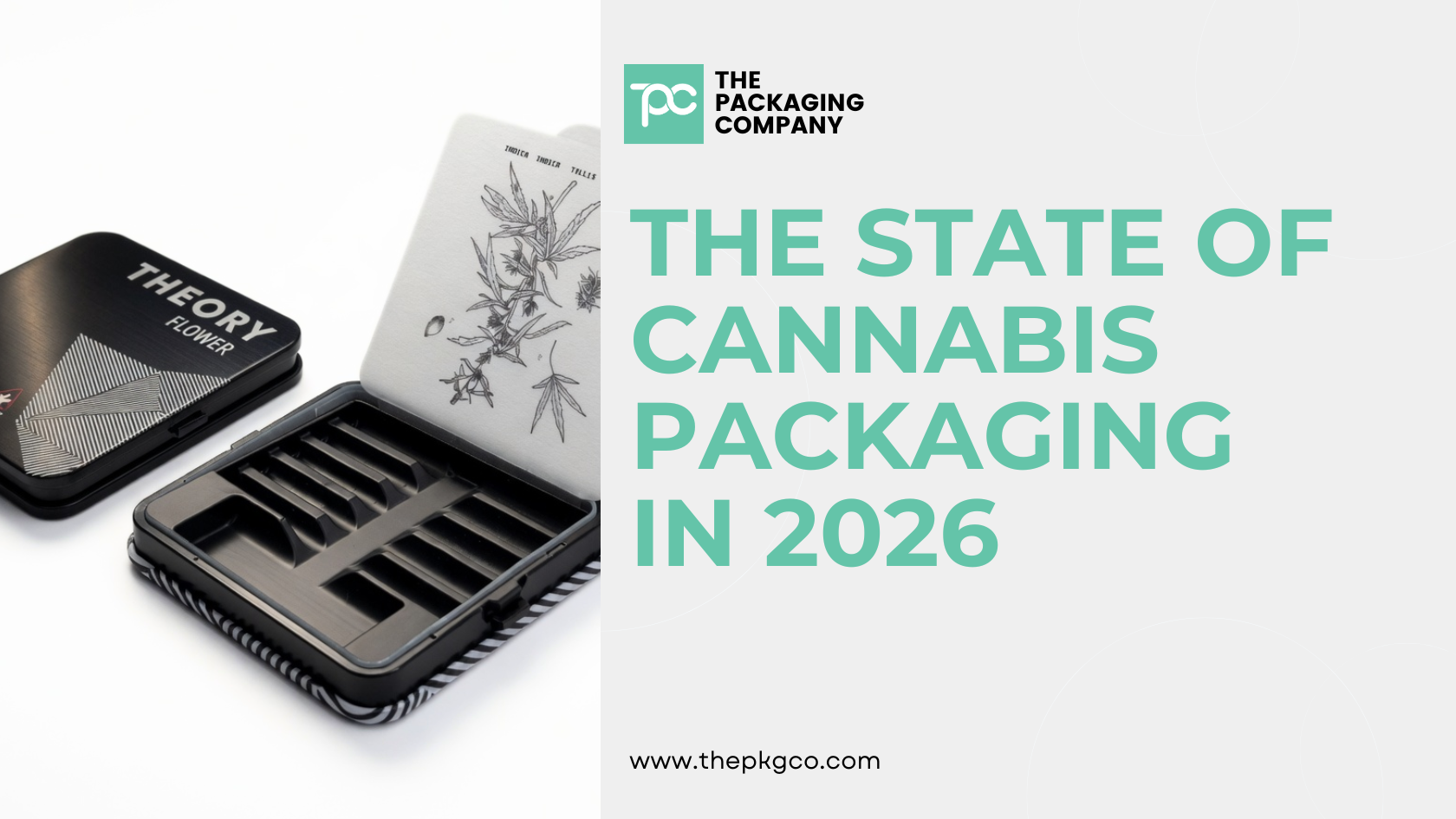
The premium tier is characterized by rigid formats — metal tins, glass jars, aluminum cases — with full custom decoration, premium closures, and packaging that communicates brand investment at the physical level. This tier is growing, driven by infused pre-roll brands, premium flower brands, and operators positioning for the top end of the retail price spectrum.
The value tier is characterized by high-volume, cost-efficient formats — mylar bags, standard plastic tubes — with custom print but limited format differentiation. This tier is also growing in volume terms, driven by market maturation, increased competition, and the ongoing proliferation of SKUs across every cannabis product category.
The middle is thinning. Brands that positioned between these two tiers — decent packaging, mid-range price point, nothing particularly distinctive about the format — are finding the competitive environment hardest. The consumer who has been buying cannabis for five years is now making clearer choices: premium for occasion or quality, value for routine. The packaging that communicates neither premium nor value is increasingly invisible.
Sustainability Is Evolving From Claim to Specification
The sustainability conversation in cannabis packaging has matured significantly in 2026. “Eco-friendly packaging” as a general claim is increasingly meaningless to buyers — both retail buyers evaluating brands for placement and consumers who have learned to read past surface-level sustainability language.
What’s replacing it is specificity. Brands making credible sustainability claims in 2026 are doing it with verifiable specifications: PCR content percentage, mono-material construction, certification under a recognized recyclability standard, or documented participation in a take-back or circular program.
The packaging formats that support credible claims without asterisks:
Metal tins and aluminum — infinitely recyclable, widely accepted in single-stream municipal programs, no quality degradation through recycling cycles. The sustainability case for metal is straightforward and verifiable.
Glass — infinitely recyclable, completely inert, no off-gassing. The sustainability case for glass is equally strong, with the caveat that weight adds to transportation emissions.
Mono-material flexible packaging — single-polymer construction that can enter standard recycling streams. Available for brands that need flexible format economics but want to make a defensible recyclability claim.
Standard multi-layer mylar bags — still the most cost-efficient flexible format, but the sustainability claim is difficult to make honestly. Multiple bonded materials cannot be separated in standard recycling infrastructure.
The practical implication for brands: if sustainability is a brand value you’re communicating to consumers or retail buyers, your packaging specification needs to support that claim at a level that survives scrutiny. Vague eco-language on a standard multi-layer bag is increasingly a liability rather than an asset.
Decoration Is Becoming a Brand Differentiator, Not Just a Compliance Requirement
The level of decoration sophistication across cannabis packaging has risen substantially in the past three years. Lithographic printing on tins, custom embossing, specialty finishes on flexible packaging, custom interior insert trays — elements that were premium differentiators in 2021 are becoming standard expectations for brands positioning above the value tier.
This creates a different problem: decoration that was distinctive two years ago is table stakes today. The brands that are standing out in 2026 are doing it through format choice and design integration — packaging where the format, the decoration, and the brand identity work together as a unified system rather than as a compliance container with a label applied.
The operational implication is that decoration decisions made early in the packaging development process — format choice, substrate selection, decoration method — have a longer-term impact on brand positioning than most brands account for when they’re focused on getting a compliant product to market for the first time.
What This Means for Packaging Decisions You’re Making Now
The trends above converge on a few practical conclusions for brands evaluating packaging decisions in 2026.
Format decisions made now have multi-year consequences. A brand that launches in a mylar bag at a $25 price point is making a format statement that will be difficult to walk back without a full SKU relaunch. Get the format right relative to your price point and positioning before the first production run.
Documentation practices that were adequate two years ago may not be adequate now. State compliance requirements are tightening, and brands that can’t produce specific test report documentation for every active SKU are increasingly exposed. Build the documentation system before you need it in an audit.
Sustainability claims need to be backed by specifications. General eco-language is a liability risk as buyer and consumer sophistication increases. If sustainability is part of your brand story, make sure your packaging specification can support it with specific, verifiable attributes.
The premium format transition is easier to make proactively than reactively. The brands making the move from bags to tins or glass jars are doing it most cleanly when they do it as a deliberate brand positioning decision — not as a crisis response to losing shelf placement at premium retail.
TPC’s CR packaging line covers the full format spectrum — tins, glass jars, tubes, bags, and topical formats — with full certification documentation and made-to-order custom decoration. For brands evaluating a format transition or launching into a new price tier, contact our team to start the conversation.
Frequently Asked Questions
What are the biggest cannabis packaging trends in 2026? The three most significant trends are the shift toward premium rigid formats at mid-to-high price points, increasing regulatory specificity around CR certification documentation, and the evolution of sustainability claims from general language to verifiable specifications. Brands that address all three are better positioned than those responding to each trend reactively.
How is EU PPWR affecting cannabis and wellness packaging decisions? PPWR establishes binding recyclability requirements for packaging sold in EU markets, with key provisions taking effect through 2030. The regulation favors mono-material or easily separable constructions over mixed-material formats like standard multi-layer mylar bags. Brands with EU distribution or wellness brands that operate in both cannabis and conventional channels should be evaluating packaging specifications against PPWR requirements now rather than approaching the deadline unprepared.
Is the premium packaging shift happening outside California? Yes. California is the most visible market because of its maturity, but the same shift is visible in Colorado, Michigan, Massachusetts, and other states that have had legal adult-use cannabis for four or more years. The pattern appears to be consistent across markets: as consumer sophistication increases with market tenure, packaging quality expectations rise correspondingly.
What is the most defensible sustainable packaging claim for a cannabis brand? Metal tins and aluminum packaging offer the clearest recyclability story — infinitely recyclable, widely accepted in standard municipal programs, no material degradation through recycling cycles. Glass is equally strong on recyclability. Mono-material flexible packaging can support a recycling claim for brands that need flexible format economics. Standard multi-layer mylar bags do not support a credible recyclability claim in standard recycling infrastructure.
When should a brand consider switching from bags to premium rigid packaging? The trigger is usually a price point or retail context that a bag can no longer support. If your product is priced above $20–25 at retail, if you’re pursuing premium retail placement, or if you’re launching an infused or specialty format that needs to communicate quality at the shelf level, the format evaluation should happen before the next production run rather than after.