



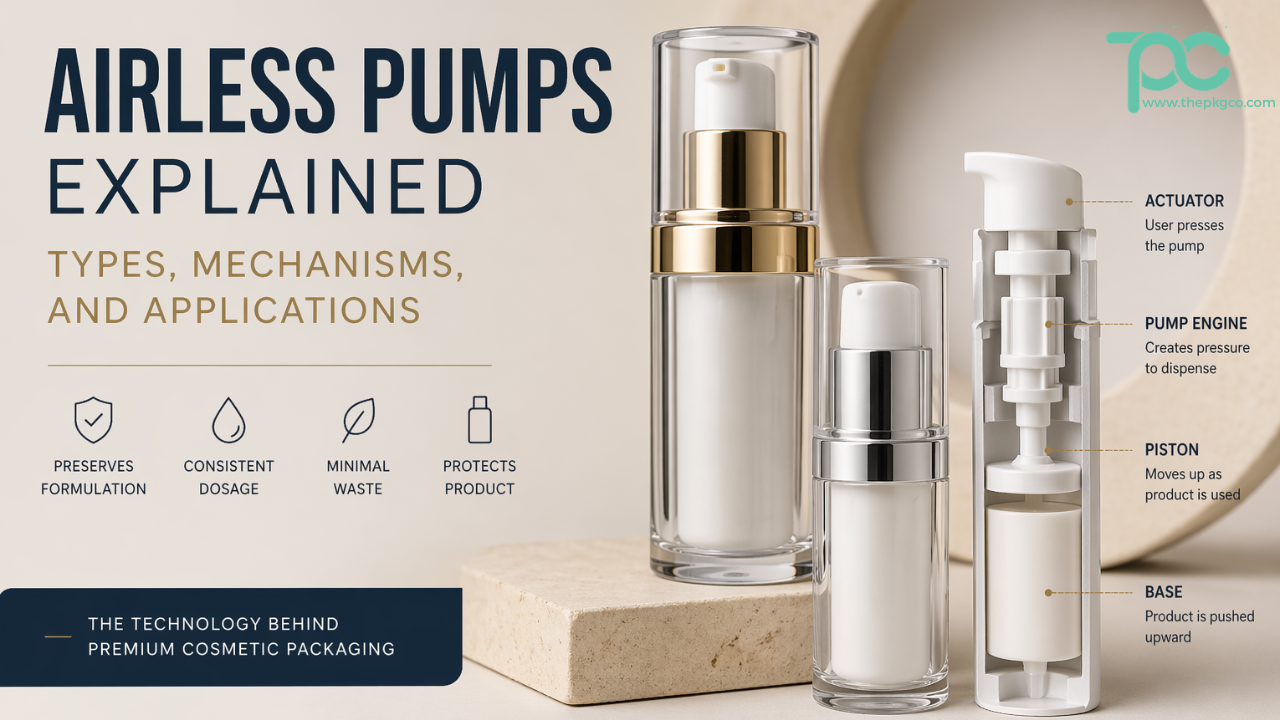
When the Pump Fails, the Product Fails
A skincare formula can be perfectly developed, clinically tested, and well-branded—but if the dispensing system fails, the entire product experience breaks down.
Common issues brands encounter:
- Inconsistent dosing
- Product not dispensing
- Air contamination affecting stability
- Excess product waste at the bottom
In most cases, the root cause is not the formula—it’s the pump system design.
Airless pumps were developed to solve these problems. But understanding how they actually work is critical when selecting the right packaging system for performance, compatibility, and scalability.
What Are Airless Pumps and How Do They Work?
An airless pump is a non-pressurized dispensing mechanism that uses a vacuum-based system to deliver product without introducing air into the container.
Unlike traditional pumps, it does not rely on a dip tube.
Core principle:
- Product is pushed upward by an internal piston
- External air is prevented from entering the container
- The system maintains product integrity throughout use
👉 This is why airless pumps are widely used in cosmetic packaging requiring protection from oxidation and contamination.
Core Components of an Airless Pump Mechanism
Understanding each component helps diagnose performance issues and evaluate quality.
1. Actuator (Pump Head)
- The external part pressed by the user
- Controls dosage output
- Designed for ergonomic use
2. Pump Engine (Internal Mechanism)
- Generates pressure to dispense product
- Controls flow rate and consistency
- Determines dosing precision
3. Piston (Base Platform)
- Moves upward as product is dispensed
- Maintains vacuum seal
- Prevents air from entering
4. Container (Outer Bottle)
- Houses the system
- Can be plastic, glass, or hybrid
5. Overcap
- Protects the actuator
- Prevents contamination and accidental discharge
👉 To see how these components integrate into full systems, refer to airless pump bottles for cosmetics, where mechanism and packaging design work together.
How Airless Pumps Work: Step-by-Step
The functionality of an airless pump is based on controlled pressure and vacuum movement.
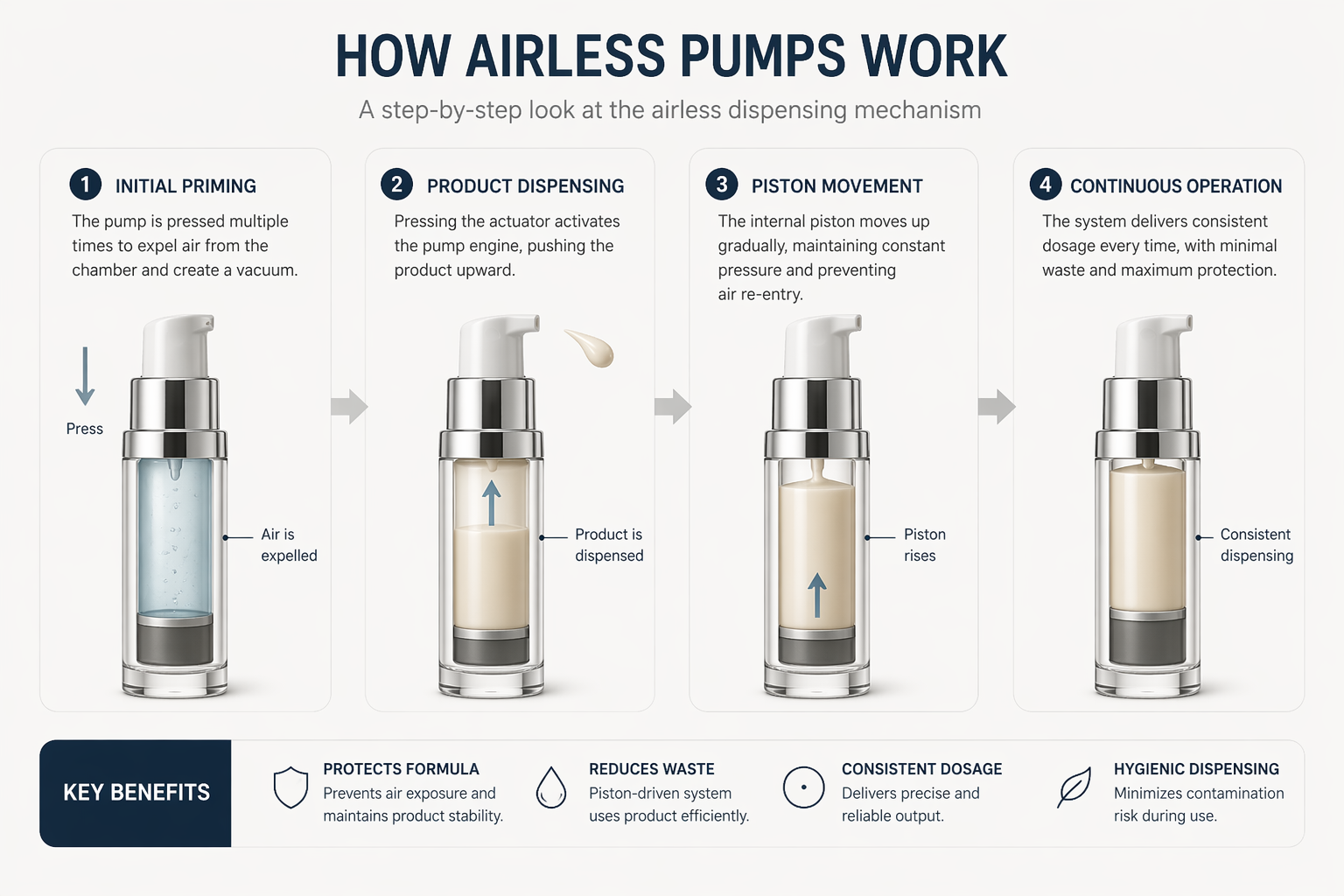
Step 1: Initial Priming
- Pump is pressed multiple times
- Air is expelled from the chamber
- Vacuum begins to form
Step 2: Product Dispensing
- Pressing the actuator activates the pump engine
- Product is pushed upward from the bottom
- No dip tube is used
Step 3: Piston Movement
- Internal piston rises gradually
- Maintains constant pressure
- Prevents air re-entry
Step 4: Continuous Operation
- System delivers consistent dosage
- Product is used almost completely
👉 This mechanism ensures minimal product waste and maximum formula protection.
Types of Airless Pump Systems
Not all airless pumps are built the same. System design varies depending on application and packaging goals. These systems are commonly used in refillable airless bottles designed for sustainable cosmetic packaging.
1. Standard Airless Pump Bottles
- Fixed internal piston system
- Non-refillable
- Most common in mass production
2. Refillable Airless Pump Systems
- Outer container + replaceable inner cartridge
- Supports sustainability strategies
👉 Often used in glass airless pump bottles, which combine premium aesthetics with functional performance. (Read our full guide on glass airless packaging →)
3. Bag-in-Bottle Systems
- Uses internal flexible pouch
- Collapses as product is dispensed
Advantages:
- High product evacuation
- Reduced contamination risk
4. Dual-Chamber Airless Systems
- Two separate compartments
- Allows mixing before dispensing
Use case:
- Active ingredient formulations
Performance Factors That Impact Airless Pumps
Selecting an airless pump is not just about appearance—it directly affects product performance.
1. Dosage Accuracy
- Controlled by pump engine design
- Critical for serums and active ingredients
2. Viscosity Compatibility
- Thick creams require stronger pump force
- Lightweight liquids require precision control
3. Air Tightness
- Determines protection against oxidation
- Essential for sensitive formulations
4. Product Evacuation Rate
- High-quality systems minimize leftover product
- Poor design leaves residue at the bottom
5. Durability & Cycle Life
- Pumps must maintain performance over repeated use
- Low-quality pumps degrade over time
Common Airless Pump Failures (and Why They Happen)
Even well-designed systems can fail if not matched correctly with product requirements.
Pump Not Dispensing
Causes:
- Not properly primed
- Air leakage in system
- Blocked actuator
Inconsistent Output
Causes:
- Incorrect viscosity compatibility
- Weak pump engine
- Internal seal issues
Product Not Reaching Bottom
Causes:
- Poor piston alignment
- Manufacturing defects
- Low-quality sealing
👉 These issues often appear in lower-quality systems or mismatched packaging selections.
Material Considerations in Airless Pump Systems
Material selection impacts both performance and sustainability. This design is widely used in glass airless pump bottles to combine premium aesthetics with functional performance.
Plastic (PP, PET)
- Most common
- Lightweight and cost-efficient
- Compatible with most pump systems
Glass + Plastic Hybrid
- Glass outer shell
- Plastic internal mechanism
👉 Often used in glass airless pump bottles to combine premium aesthetics with functionality.
Mono-Material Systems
- Designed for recyclability
- Increasingly used in sustainable packaging
Applications Across Cosmetic Product Categories
Airless pumps are widely used across different product types.
Skincare
- Serums
- Creams
- Moisturizers
Cosmetic Formulations
- Foundations
- Primers
- Liquid makeup
Sensitive Formulations
- Vitamin C
- Retinol
- Natural extracts
👉 These products benefit from reduced air exposure and controlled dispensing.
How Airless Pump Design Impacts Brand Strategy
Airless pumps are not just technical components—they influence product perception and user experience.
Key benefits for brands:
- Improved product longevity
- Cleaner dispensing experience
- Reduced contamination risk
- Enhanced premium positioning
👉 When integrated into airless packaging systems, pumps become part of a larger branding and performance strategy.
Conclusion
Airless pumps are a critical component in modern cosmetic packaging, combining engineering precision with functional design to protect formulations and improve user experience.
By understanding how airless pump mechanisms work—from piston movement to dosage control—brands can make informed decisions that align packaging performance with product requirements.
Selecting the right airless pump system is not just a technical choice—it directly impacts product quality, customer satisfaction, and long-term brand positioning.
If you’re developing a product that requires consistent dispensing and protection from air exposure, explore our airless packaging solutions or work with an experienced packaging partner to find the right system for your formulation. Contact US today!
Frequently Asked Questions About Airless Pumps
What are the advantages of airless pumps in cosmetic packaging?
Airless pumps improve product stability by preventing air exposure, ensuring consistent dosing, reducing contamination risk, and minimizing product waste.
Are airless pumps suitable for all cosmetic formulations?
Airless pumps work best for serums, creams, and formulations sensitive to oxidation. However, compatibility depends on viscosity and formulation requirements.
Why do some airless pumps fail to dispense properly?
Common causes include improper priming, air leakage, viscosity mismatch, or low-quality pump mechanisms.
What is the difference between airless pumps and traditional pump bottles?
Airless pumps use a vacuum system without a dip tube, while traditional pumps rely on a dip tube and allow air into the container, increasing contamination risk.
How do brands choose the right airless pump system?
Brands should evaluate dosage control, material compatibility, air tightness, product viscosity, and packaging design based on their formulation needs.