



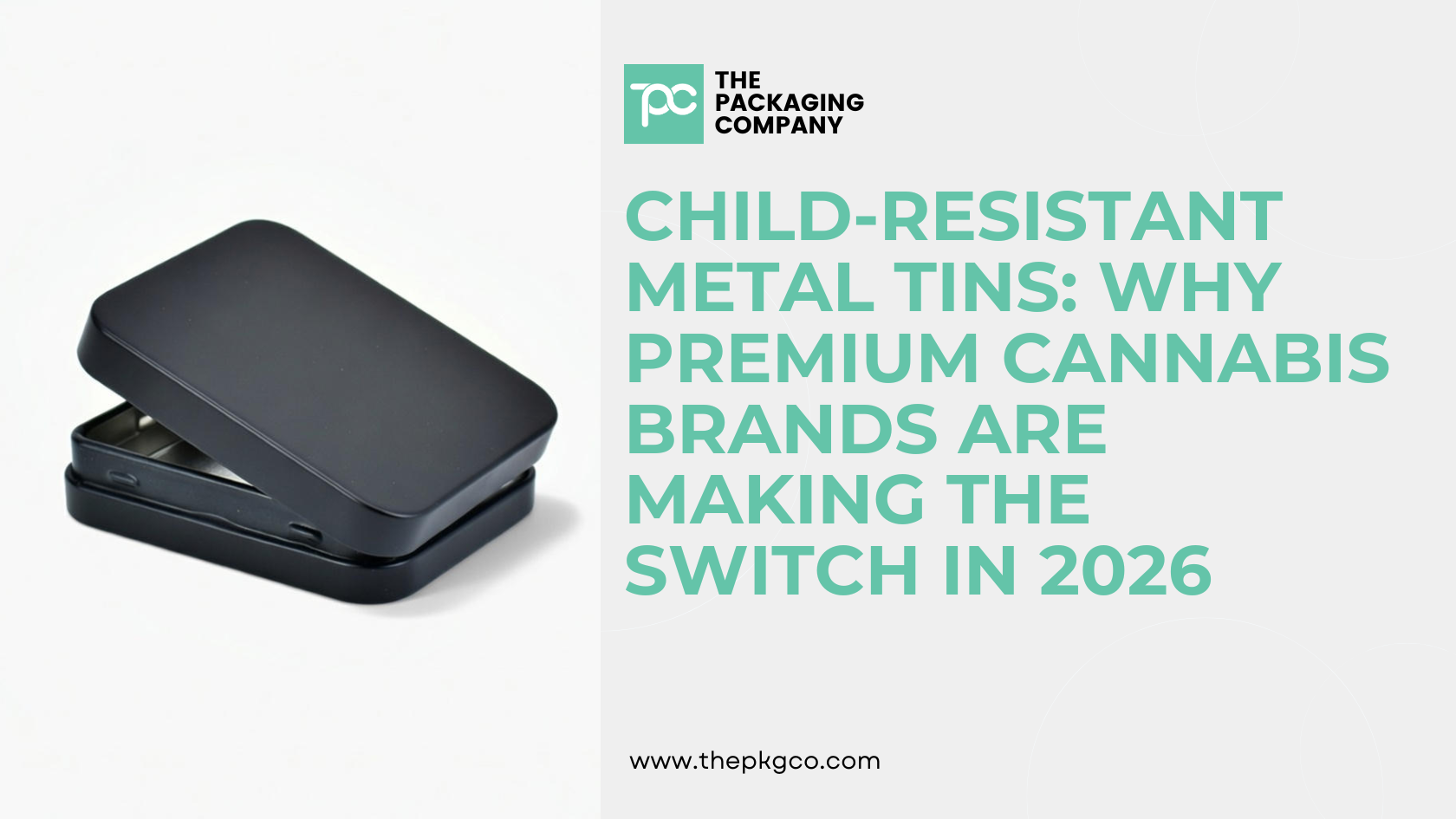
The shift is visible in dispensary display cases across California, New York, and other mature cannabis markets. Pre-roll brands that built their packaging programs on tubes and bags are making deliberate moves toward metal tins. Not because the regulations changed. Not because tins are suddenly cheaper. Because the market has changed, and the packaging that was adequate for a less sophisticated consumer base is working against brands that have grown past it.
This is a breakdown of why that shift is happening, what specifically makes a quality CR metal tin different from cheaper alternatives, and what to look for before switching formats.
What’s Actually Driving the Shift
The California cannabis market is now nearly a decade old as an adult-use market. Colorado, Oregon, Washington, and Michigan are not far behind. In mature markets, a specific consumer dynamic emerges that younger markets don’t yet show: consumers develop preferences based on accumulated experience, and those preferences increasingly include packaging quality as a component of brand evaluation.
In the early years of any regulated cannabis market, a brand’s primary packaging job is compliance. The consumer is new to legal cannabis, the dispensary environment is new, and the packaging needs to be legal and functional. That’s a low bar, and most formats clear it.
In a mature market, the consumer has bought cannabis dozens or hundreds of times. They’ve handled every format available. They’ve opened snap tins and slide tins and push-and-turn tubes and mylar bags. They have opinions. And increasingly, the opinion being expressed through purchasing behavior is that the format communicates something about the product before the product is experienced — and brands that are still in commodity formats at premium price points are creating a disconnect that works against retention and reorder.
Retail buyers are tracking this. Dispensary purchasing managers at premium California accounts are specifically asking about packaging before making new brand decisions. The question isn’t just “is it compliant” anymore. It’s “does it fit our shelf and does it communicate appropriately for the price point you’re asking us to carry it at.”
Metal tins, specifically, are the format that premium cannabis brands are converging on because they solve for both the compliance requirement and the brand signal requirement in a way that no other format does at the same level.
What Makes a Quality CR Metal Tin Different From a Cheap One
Not all metal tins are CR packaging. Not all CR tins are equal. The market has both, and the difference between them shows up in ways that matter for compliance, product quality, and brand experience.
The Closure Mechanism
A standard decorative tin uses a friction-fit or press-fit lid. It is not CR certified because it doesn’t meet the resistance threshold required by ASTM or 16 CFR §1700.20 testing. These tins can be purchased cheaply, decorated nicely, and sold into the market — but they are not legal for cannabis retail in any licensed US state.
A basic CR tin uses an external button or a slide panel mechanism to achieve CR resistance. These formats often carry certification but have two practical problems: the mechanism is visible and takes up decoration surface area, and the closure degrades with repeated use. A button that provides adequate resistance when new may not maintain that resistance after 50 open/close cycles.
A premium engineered CR tin — like TPC’s snap tin — uses the structure of the package itself to create the CR mechanism. The user presses and squeezes the two bottom corners simultaneously, which releases the upper corners and allows the lid to be removed. There is no external button, no visible mechanism hardware, and no element of the closure that degrades independently of the tin structure itself. The closure performs the same on the first open as on the five hundredth because the mechanism is the tin, not an add-on component.
This distinction is the single most important thing to evaluate when sourcing a CR tin. Ask for the 16 CFR §1700.20 test report. Open and close the sample tin 30 times and evaluate whether the resistance is consistent at the end as at the beginning. If it isn’t, the format has a compliance lifecycle problem that will show up in consumer hands long before the product is consumed.
The Seal
Standard CR tins seal adequately. Quality CR tins seal completely. TPC’s snap tin is airtight and watertight — it maintains its seal under water submersion testing. For pre-roll brands whose marketing claims include terpene preservation, freshness, or product quality, the packaging seal is a product quality variable, not just a packaging specification. A tin that leaks odor is degrading the product inside it.
Test the seal during sample evaluation: fill the tin with a scented product, close it, and check for odor escape after 30 minutes. A genuinely airtight tin produces no odor externally when closed. A tin that provides only an approximate seal does.
The Insert Tray
The interior of the tin is where brand experience actually happens at the consumer level. A tin with loose pre-rolls rattling inside it — or pre-rolls held in a generic foam insert with slots sized for a different product — delivers a different first-open experience than a tin with a custom-engineered insert that holds the specific pre-rolls seated, upright, and undamaged.
Custom insert trays for TPC’s snap tin are engineered per project — a mold is created for your specific pre-roll diameter and count. The slots are your product’s dimensions, not an approximation. When the consumer opens the tin, the pre-rolls are exactly where they should be, presented exactly as intended.
This is the detail most brands underestimate when they transition to tins. The exterior can be executed beautifully and the insert can undermine the entire investment in the first two seconds of consumer engagement.
The Decoration
A metal tin supports the most capable decoration available in cannabis packaging. Lithographic printing — offset printing applied to the metal before forming — produces saturated, sharp graphics with color fidelity that labels on plastic cannot match. Embossing adds a three-dimensional element that creates tactile premium at the shelf level. Custom colorways and specialty finishes are achievable on metal in ways that they are not on most other substrates.
For brands that have invested in identity design — a distinctive color palette, a premium logo, graphic elements that communicate something specific about the product — a tin can express that identity fully. A plastic tube with a label will always be a plastic tube with a label.
CR Tin Formats Available From TPC
TPC’s CR tin line covers the primary format requirements across the cannabis pre-roll and edible categories. Two distinct closure systems are available — the snap closure and the squeeze/hinge lid — giving brands flexibility across different product configurations, count arrangements, and price points. All formats are patented, all are made to order, and all carry CR certification with third-party documentation available before any production commitment.
Snap Closure Tins
The snap tin line uses TPC’s corner-press mechanism: no external button, no visible hardware, no component that degrades independently of the tin structure. The closure performs the same on the first open as on the five hundredth.
Child-Resistant Snap Tin — V5 (74mm × 58mm × 20mm) — 16 CFR §1700.20 certified, watertight gasket, custom insert trays. Handles standard pre-roll lengths in 1–5 pack configurations. MOQ 5,000 units.
Child-Resistant Snap Tin Extended — V5E (95mm × 57mm × 20mm) — same certification and closure as the standard snap tin, extended footprint for 100mm king-size pre-rolls and larger multi-pack configurations. MOQ 5,000 units.
Squeeze/Hinge Lid Tins
TPC’s squeeze/hinge lid tin line uses a patented squeeze-to-open CR mechanism with a hinged lid that stays connected to the tin when open. The hinged lid allows for single-handed operation and offers interior configuration flexibility across a wide range of product arrangements — pre-roll multi-packs, edible and capsule configurations, and mixed-format bundles. All formats in this line carry dual ASTM F1272 and 16 CFR §1700.20 certification.
Pre-Roll Tin Case — V1 (102mm × 98mm × 14mm) — the large-format flagship. Ultra-slim 14mm profile, wide flat cavity for 5–7 pre-rolls up to 98mm, FDA food-grade construction. Maximum print real estate on the large lid surface. MOQ 10,000 units.
Pre-Roll Tin Case — V1A (103mm × 98mm × 17mm) — 100% all-metal, fully recyclable. Deeper cavity than the V1 for brands needing more interior volume across the same wide footprint. MOQ 10,000 units.
Child-Resistant Tin Box — V4A (101mm × 63mm × 15mm) — U.S. patented, 16 CFR §1700.20 certified, slim format for 3–5 pack pre-roll programs. Narrower footprint than the V1/V1A line — strong fit for brands wanting a compact multi-pack tin that fits cleanly in pockets and retail displays. MOQ 5,000 units.
V7 Pre Roll & Edible Tin Case (102mm × 97mm × 27mm) — the highest-capacity format in the line at 27mm depth. Accommodates up to 14 pre-rolls in a double-stacked configuration, or large edible and capsule arrangements requiring significant interior volume. MOQ 5,000 units.
All formats support full custom printing on lid and body, embossing and debossing, matte/gloss/specialty finishes, custom-engineered insert trays per project, optional wax paper liners, and interior lid printing. Insert trays are engineered to your exact pre-roll diameter, count, and orientation — not generic stock inserts.
What to Check Before Making the Switch
Confirm your pre-roll dimensions against available tin formats. Length, diameter, and count configuration all determine which format is viable. Sample the filled tin — not a proxy — before approving production.
Request 16 CFR §1700.20 documentation. Not a Certificate of Compliance. The test report from the accredited laboratory, covering the specific tin and closure being produced. This is the document that matters in a compliance inspection.
Evaluate the closure over 30 open/close cycles. Consistent resistance at cycle 30 as at cycle 1 is the performance standard. Decline any format that loosens perceptibly with repeated use.
Test the seal. Fill the tin with your actual product, close it, leave it for 30 minutes, check for odor escape. A genuinely airtight tin shows none.
Spec the insert tray for your specific product. Generic insert trays are cheaper. Custom trays — built to your pre-roll’s exact diameter and count — are what the format requires to deliver the experience it’s capable of.
Approve decoration from a physical color proof. Lithographic print on metal reproduces differently than digital proofs suggest. A physical proof on the actual tin substrate under retail lighting conditions is the only reliable color approval step before production.
For a complete checklist of what to verify before custom tin production, see our pre-roll tins production guide.
TPC’s CR Tin Program
TPC developed the snap tin format from scratch — it did not exist in the market before TPC engineered it. The closure mechanism, the dimensional profile, the insert tray customization system, and the 16 CFR §1700.20 certification were all developed through TPC’s engineering process to meet the specific requirements of premium cannabis pre-roll brands.
The program is currently supporting brands in California, New York, Vermont, North Carolina, and other licensed markets. Production begins at 5,000 units with full custom decoration. The CR Production Readiness Kit — physical samples, certification documentation, format recommendations, insert guidance, and production pricing — is available for qualified projects before any bulk commitment.
For brands evaluating the switch from tubes or bags to premium CR tins, contact our team to start the conversation and request samples.
See the full CR packaging landscape, including how tins compare to other formats across compliance, barrier performance, and brand signal, in our child-resistant packaging solutions guide.
Frequently Asked Questions
Are all metal tins child resistant? No. Standard decorative tins with friction-fit or press-fit lids are not CR certified and are not legal for cannabis retail packaging. CR certification requires the closure mechanism to pass formal third-party panel testing under ASTM or 16 CFR §1700.20. Always request the test report confirming certification for the specific tin format before purchasing.
What is the difference between TPC’s snap tins and the squeeze/hinge lid tins? The snap tins (V5 and V5E) use a corner-press mechanism — pressing the two bottom corners simultaneously releases the upper corners to open the lid. There is no external button and no visible mechanism hardware, giving an uninterrupted decoration surface and durable closure performance. The squeeze/hinge lid tins (V1, V1A, V4A, V7) use a patented squeeze-to-open mechanism where the lid stays hinged to the tin when open — suited to single-handed operation and wider interior configurations for multi-pack and edible arrangements. Both systems are CR certified. The right choice depends on your pre-roll dimensions, count configuration, interior layout needs, and brand experience priorities.
Is an airtight tin actually important for cannabis pre-rolls? Yes — particularly for infused, live resin, and high-terpene formats where terpene preservation is a product quality claim. A tin that provides only an approximate seal is allowing terpene degradation over the product’s shelf life and consumer use period. TPC’s snap tin is airtight and watertight — a higher performance threshold than most CR tins can claim.
What decoration options are available for CR tins? Full lithographic printing (offset print applied to the metal before forming), embossing and debossing, custom colorways, matte and gloss finishes, specialty surface treatments, custom interior insert trays, wax paper liners, and interior branding. Lithographic print on metal produces sharper, more saturated graphics than labels on plastic or print on flexible packaging.
How long does it take to get custom decorated CR tins from TPC? 8–12 weeks from production authorization with approved artwork. This includes the decoration lead time for lithographic printing setup and production. Pre-production samples are available before production commitment and typically take 2–4 weeks to prepare. For a full timeline breakdown, see our custom CR packaging production timeline guide.
What is the MOQ for CR tins at TPC? MOQ varies by format. The snap tins (V5 standard and V5E extended) start at 5,000 units. The V4A and V7 also start at 5,000 units. The V1 and V1A large-format hinge lid tins start at 10,000 units. All formats are made to order with no catalog inventory. Pre-production samples are standard before any bulk commitment. Browse the full CR tin line for current specifications.