



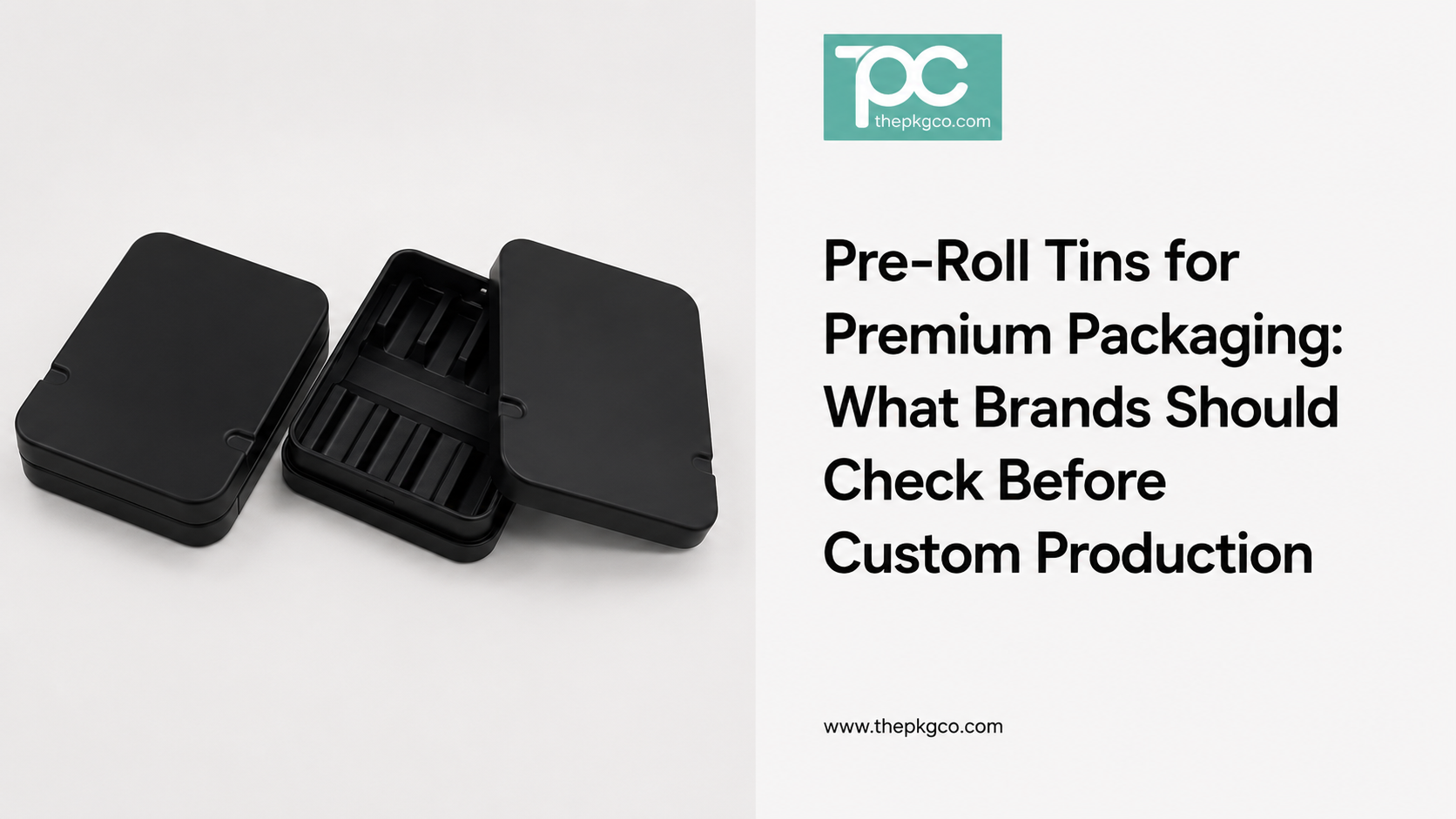
A custom pre-roll tin is one of the highest-commitment packaging decisions a cannabis brand makes. The tooling, the decoration setup, the insert tray configuration — all of it is specific to your product and your brand. Once production runs, changes are expensive. Errors that show up after delivery mean rework, delays, or writing off inventory.
The brands that avoid those outcomes don’t do it by luck. They do it by treating the pre-production phase as seriously as the production phase — running through a specific set of checks before they approve anything for manufacturing. This guide covers exactly what those checks are and why each one matters for a custom pre-roll tin specifically.
Why Pre-Roll Tins Have Less Margin for Error Than Other CR Formats
Pre-roll tins sit at the intersection of more variables than almost any other CR packaging format. The tin has to accommodate a precise product dimension (pre-roll length and diameter), function as a certified CR package (closure mechanism must perform to standard), protect fragile contents through the supply chain (rigid construction, airtight seal), present the brand at a premium level (full custom decoration, insert tray configuration), and do all of this consistently across a production run that may be 5,000 to 50,000 units.
Each of those requirements has its own failure mode. A tin that fits the pre-roll but doesn’t snap shut correctly fails CR. A tin with a perfect closure but a poorly matched insert tray delivers damaged product. A tin with great print quality but a color that shifted from the proof costs the brand credibility at retail.
The pre-production checklist that follows is structured around catching each of these failure modes before production, not after.
Check 1: Pre-Roll Dimensional Fit
This is the first check and the one most often rushed. The tin interior dimensions must accommodate your specific pre-roll format — not a generic pre-roll — with enough clearance that the lid engages correctly and the contents don’t shift or compress.
Length. Confirm your pre-roll length against the tin’s interior length. Standard pre-rolls (84mm and under) fit the standard CR snap tin (74mm × 58mm × 20mm interior). King-size pre-rolls (98mm–120mm) require the extended snap tin (95mm × 57mm × 20mm). If your pre-roll length is borderline, confirm with a physical sample — not a spec sheet — because manufacturing tolerances on pre-roll length can vary across production batches.
Diameter. Pre-roll diameter affects how many units fit in the insert tray and how tight the fit is. A diameter that’s tighter than expected can make pre-rolls difficult to remove without damaging them. A diameter that’s looser means product movement in transit, which affects the presentation when the customer opens the tin.
Count configuration. The insert tray is designed around a specific count and diameter combination. A 5-pack tray for standard 84mm pre-rolls is a different tool than a 3-pack tray for king-size. Confirm your exact count and dimension before insert tray tooling is finalized — tray tooling is one of the harder changes to make after production has started.
Headspace and lid engagement. After the pre-rolls are in the tray, confirm that the lid engages the CR closure mechanism without compressing the contents. If the pre-rolls sit proud of the tray and contact the lid before the closure snaps, the CR mechanism will be partially engaged and may not perform correctly in testing or in the consumer’s hands.
The only reliable way to check all of this is with a physical sample filled with your actual product. Dimensional checks on spec sheets catch obvious mismatches. Physical samples catch the tolerance interactions that specs don’t reveal.
Check 2: CR Closure Function
The closure is the compliance-critical element of the tin. Before approving any pre-roll tin for production, evaluate the closure function specifically — not just the tin construction generally.
Snap engagement. The closure should snap shut with a clear, consistent resistance. It should not close with a light press (too easy — may not pass CR testing) or require excessive force (too hard — adult usability failure). Test the snap across 20–30 open/close cycles. The resistance at cycle 25 should be essentially the same as at cycle 1.
Directional resistance. A properly engineered CR snap tin requires a specific directional motion to open — typically a squeeze-and-lift or a directional press. This directional requirement is what creates child resistance. A closure that opens with simple vertical pressure is not performing to the CR standard regardless of what the certification document says.
Airtight seal. After closing the tin, check whether the seal is airtight. A simple test: place a scented product inside, close the tin, and check for odor escape after several minutes. For terpene-rich infused pre-rolls where airtight preservation is a product quality claim, a seal that leaks is a brand problem as well as a product quality problem.
Fill line compatibility. If you’re running an automated or semi-automated fill operation, confirm that the tin and closure are compatible with your capping equipment. CR snap closures require specific pressure application that standard capping equipment may not be configured for. A tin that closes correctly by hand but requires excessive force on a fill line creates production bottlenecks and potential closure damage at scale.
Check 3: Insert Tray Specification
The insert tray is the interior packaging element that most brands underspecify — and where some of the most visible quality failures happen. When a customer opens a premium pre-roll tin and finds product lying loose or unevenly seated, the packaging has failed the brand regardless of how good the exterior looks.
Material and cut quality. Insert trays for pre-roll tins are typically EVA foam, pulp, or thermoformed plastic. Each material has different characteristics for product grip, vibration absorption, and visual presentation. EVA foam provides the most secure grip and the most premium tactile feel. Pulp is more sustainable and recyclable. Thermoformed plastic is more precise dimensionally but can look clinical rather than premium. Choose based on your brand positioning and product protection requirement.
Slot dimensions. Each slot in the insert tray should hold a pre-roll firmly upright without compression. If the slot is too tight, insertion and removal damages the pre-roll. If it’s too loose, the pre-roll tips or rattles. Confirm slot dimensions against your actual pre-roll diameter with a physical sample.
Brand integration. The insert tray is a second brand touchpoint — the surface a customer sees when they open the package. Whether it’s a custom color, a branded logo debossed into the foam, or a custom shape cut for a specific product format, treat the tray as a design element rather than just a functional component. The brands whose unboxing moments get photographed and shared are almost always the ones who thought about the inside of the tin as carefully as the outside.
Wax paper liner. An optional wax paper liner between the product and the tin interior adds both a barrier layer and a brand surface. If you’re using a liner, confirm its dimensions and print registration before approving the full kit.
Check 4: Decoration Approval
Custom decoration on a pre-roll tin is a multi-step approval process, and each step has its own failure mode. The sequence matters.
Digital proof → physical color proof → production approval. A digital proof shows layout, typography, and relative color relationships. It does not accurately represent how colors will look on metal under retail lighting. A physical color proof on the actual substrate is the only reliable way to approve color before production. Brands that approve decoration from digital proofs alone frequently receive production tins where the color is noticeably different from what they expected.
Color accuracy on metal. Lithographic printing on tinplate produces different color behavior than print on paper or plastic. Saturated colors, gradients, and photography all reproduce differently on metal. Dark colors on metal can appear richer than expected. Light colors, particularly pastels, can appear washed out without the right ink layering. Review the physical proof under the same lighting conditions as your target retail environment — dispensary lighting is typically cool and high-CRI, which affects color perception significantly.
Embossing and texture. If your decoration includes embossed elements — logo, text, surface texture — confirm the depth and definition on the physical sample. Embossing that looks crisp on the tooling diagram can appear subtle on the finished tin depending on metal gauge and press depth.
Lid vs. body decoration alignment. On a snap tin, the lid and body are printed separately and assembled after decoration. Confirm that the design elements that span the lid-body seam align correctly in the assembled tin. This is a registration check that only becomes visible in the physical assembled sample.
Text legibility at size. Pre-roll tins have limited surface area. Compliance text required by state regulations — THC content, warnings, producer information — must be legible at the size it appears on the physical tin, not just on the digital file. Print and read the physical proof at arm’s length under retail lighting before approving.
Check 5: Drop and Transit Testing
A premium pre-roll tin that arrives at retail with dented corners, scratched surfaces, or shifted closures has failed before the consumer ever touches it. Transit testing before production commitment confirms that your specific tin configuration — decorated, filled, with insert tray — survives the handling conditions of your supply chain.
Drop test. Fill a sample tin with your actual product at the final fill configuration. Drop it from counter height (approximately 1 meter) onto a hard surface — concrete or tile — on each face and corner. The CR closure should remain engaged after each drop. The insert tray should hold the pre-rolls in position. The decoration should show no damage that would affect retail presentation.
Stack and compression test. Tins will be stacked and compressed in shipping cartons. Fill a sample carton at the planned stack depth and apply representative shipping weight. After 24–48 hours, inspect the bottom-layer tins for lid deformation or closure engagement changes.
Temperature and humidity variation. If your distribution includes cold storage, warm delivery vehicles, or humid environments, test the tin across the relevant temperature and humidity range. Metal tins are generally resistant to temperature variation, but insert tray materials — particularly foam — can change dimensionally under extreme conditions.
Check 6: Certification Documentation for Your Specific Configuration
The final pre-production check is documentation — confirming that the specific tin configuration you’re approving for production is covered by valid third-party CR certification.
If you’re using a standard TPC tin format with a standard insert configuration, the existing certification documentation covers your production run. If you’ve specified a custom insert depth, a custom closure torque, or any other modification to the standard format, confirm with your supplier whether those changes require retesting before production.
Request the third-party laboratory test report for the specific tin format and closure being used. The report should cover both the child panel pass rate (≥85%) and the adult panel pass rate (≥90%) under ASTM F1272 and/or 16 CFR §1700.20 as required by your market. File this documentation in your packaging compliance register before the first production run ships.
For a detailed breakdown of what CR certification documentation should include and how to maintain it across reorders, see our audit-readiness guide for certified CR packaging.
TPC’s Pre-Roll Tin Line
TPC’s CR tin line for pre-roll packaging includes:
Child-Resistant Snap Tin — 74mm × 58mm × 20mm. Standard pre-roll lengths up to ~84mm. 1–5 pack configurations. Full lithographic decoration, custom insert trays, optional wax paper liner. MOQ 5,000 units.
Child-Resistant Snap Tin Extended — 95mm × 57mm × 20mm. King-size and 100mm+ pre-roll formats. Extended multi-pack configurations. Same decoration and insert tray options as standard. MOQ 5,000 units.
CR Tin Jar — 90ml wide-mouth format. Infused pre-rolls, upright display orientation. Premium brand presentation at opening. MOQ 5,000 units.
Pre-Roll Tin Case V1A — Higher-count configurations for 7-pack, 14-pack, and 28-pack formats.
Pre-production samples are standard for all tin formats before any production commitment. Browse the full CR tins collection or contact TPC to discuss your specific pre-roll format and start the sampling process.
For the broader CR packaging format overview, see our child-resistant packaging solutions guide.
Frequently Asked Questions
What pre-roll length fits in the standard CR snap tin? The standard CR snap tin (74mm × 58mm × 20mm) accommodates pre-rolls up to approximately 84mm in length. For 98mm–120mm king-size pre-rolls, the extended snap tin (95mm × 57mm × 20mm) is the correct format. Confirm with a physical sample using your actual pre-roll before approving production, as pre-roll length tolerances vary across production batches.
How many pre-rolls fit in a snap tin? The count depends on the insert tray configuration and pre-roll diameter. Standard configurations support 1–5 pre-rolls in the standard snap tin and up to 5+ in the extended format. The insert tray is tooled specifically for the count and diameter combination you specify. Confirm your exact pre-roll dimensions and count before tray tooling is finalized.
How do I know if the CR closure will pass compliance testing? Request the third-party laboratory test report for the specific tin format and closure you’re ordering. The report confirms that the closure passed both the child panel test (≥85% of children unable to open in 10 minutes) and the adult panel test (≥90% of adults able to open and close in 5 minutes) under the applicable standard. Do not rely on a Certificate of Compliance alone — request the underlying test report.
Can I approve decoration from a digital proof? A digital proof is useful for layout and typography review but is not sufficient for color approval. Colors reproduce differently on metal than on screen or paper. Always request a physical color proof on the actual tin substrate under your target retail lighting conditions before approving decoration for production.
What is the typical lead time for custom-decorated pre-roll tins? Custom-decorated CR snap tins typically run 8–12 weeks from artwork approval and production deposit to delivery, depending on decoration complexity and run quantity. Factor this lead time into your launch timeline and build a reorder trigger that accounts for it — waiting until you’re low on inventory to reorder will create a production gap.
What MOQ applies to custom pre-roll tins at TPC? MOQ starts at 5,000 units for standard formats with custom decoration. Pre-production samples are available before production commitment. Contact TPC for current pricing, lead times, and available insert tray configurations for your specific pre-roll format.