



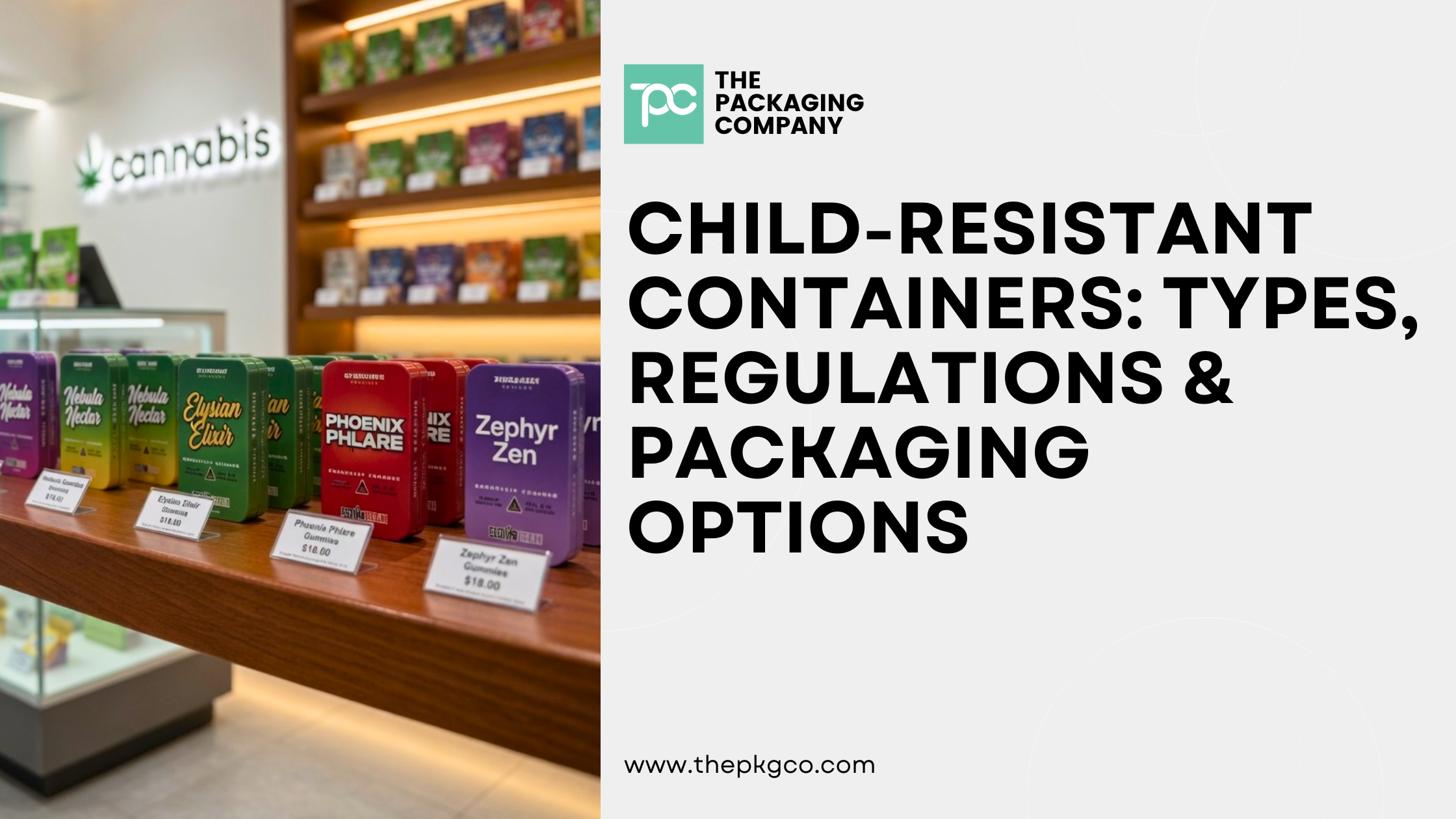
Child-resistant containers are one of the most searched and least understood categories in regulated-product packaging. Brands know they need them. Fewer know exactly what makes a container legally CR, which standard applies to their product, or how different container formats compare across compliance, cost, and brand experience.
This guide covers all of it — what CR containers are, how federal regulations define them, which formats exist, and how to choose the right option for your product and market.
What Makes a Container “Child-Resistant”?
A child-resistant container is any packaging that has been engineered and tested to meet federal certification standards for resistance to opening by young children, while remaining accessible to adults. The term is a legal classification — not a design style, not a marketing claim, and not something a supplier can self-certify.
To qualify as child-resistant, a container must pass third-party panel testing under one of two federal protocols:
ASTM F1272 governs reclosable packaging — containers designed to be opened, used, and resealed multiple times. This is the standard most commonly applied to cannabis tins, jars, and other multi-use containers. It requires that at least 85% of test children ages 42–51 months cannot open the package within a 10-minute window, and that at least 90% of adults ages 50–70 can open and close it within 5 minutes without instruction.
16 CFR §1700.20 is the Consumer Product Safety Commission standard, covering both reclosable and non-reclosable packaging. It uses similar panel methodology with specific protocol differences and is the standard required by most state cannabis regulations for retail-sold products. Some containers are certified to both standards.
The critical thing to understand: a container that looks CR, feels CR, or is marketed as CR is not compliant unless the supplier can provide third-party test documentation confirming it passed one of these protocols. Always ask for the documentation before purchasing.
Who Needs Child-Resistant Containers?
CR containers are required by law for any brand selling regulated products to end consumers in US licensed markets. This includes:
Cannabis and hemp-derived products — Every licensed US cannabis state requires CR packaging at the point of consumer sale. Pre-rolls, flower, edibles, concentrates, vapes, and topicals all fall under this requirement. Specific standards vary by state — many require 16 CFR §1700.20 compliance specifically.
Over-the-counter pharmaceuticals — Federal law under the Poison Prevention Packaging Act (PPPA) requires CR packaging for most OTC drug products. The CPSC enforces this and can require recalls of non-compliant products.
Dietary supplements and wellness products — Certain supplement formulations and regulated wellness products require CR packaging depending on ingredient classification and intended market.
Household chemicals — Products containing hazardous substances above certain concentration thresholds require CR packaging under federal and state law.
If you are selling any of these products at retail in a licensed market and your packaging has not passed a formal CR certification panel, you are out of compliance regardless of what the label says.
Types of Child-Resistant Containers
CR containers are available across a wide range of formats. The right choice depends on your product type, your retail environment, and your brand positioning.
Child Resistant Tins
CR tins are the premium standard for cannabis pre-roll and flower brands. A quality CR tin uses an engineered snap or latch mechanism — not a friction-fit lid — to achieve certification. The metal construction creates an airtight seal that protects terpenes and keeps product fresh, while the rigid format protects fragile contents through the supply chain.
CR tins support full-surface custom decoration, including lithography, embossing, and custom interior tray configurations. They are available in standard snap, extended snap, tin jar, and pre-roll case formats. MOQ starts at 5,000 units.
Child Resistant Tubes
CR tubes are the most widely deployed pre-roll packaging format in the cannabis market. They are available in plastic, glass, and aluminum with push-and-turn, squeeze-and-pull, and other certified closure types. Tube diameter and length must be matched precisely to product dimensions — an off-spec tube that doesn’t close correctly is a CR failure regardless of certification status.
Child Resistant Jars
CR jars are the standard format for cannabis flower, concentrates, and edibles that require wide-mouth access. Available in glass, plastic, and tin with push-and-turn or squeeze-and-turn lids, CR jars balance product visibility with compliant closure. Glass CR jars offer superior terpene protection and are the preferred format for premium flower and concentrate brands.
Child Resistant Mylar Bags
CR mylar bags are flexible, multi-layer bags with certified reseal closures — typically a slide-lock or zip mechanism that meets ASTM or CPSC panel testing requirements. They provide compliant packaging at a lower per-unit cost than rigid formats, making them the dominant choice for value-tier cannabis SKUs, bulk flower, edibles, and multi-gram formats.
Child Resistant Topical and Dispensing Containers
CR packaging also applies to topicals, tinctures, and wellness products sold in regulated markets. This category includes CR-closure bottles, dropper bottles, pump dispensers, and squeeze tubes designed for lotions, oils, and balm formulations. The closure mechanism must meet certification standards even when the primary format is a standard cosmetic or pharmaceutical container.
Browse CR Topical Packaging at TPC →
CR Container Formats: Key Differences at a Glance
| Format | Best For | Material | Airtight | Custom Decoration | Entry MOQ |
|---|---|---|---|---|---|
| CR Tins | Pre-rolls, flower, edibles | Tinplate / Aluminum | Yes | Full surface | 5,000 |
| CR Tubes | Pre-rolls (singles, multi-pack) | Plastic / Glass / Aluminum | Yes | Label / full | 5,000 |
| CR Jars | Flower, concentrates, edibles | Glass / Plastic / Tin | Yes | Label / lid print | 5,000 |
| CR Mylar Bags | Bulk flower, edibles, value SKUs | Multi-layer film | No | Full surface print | 5,000 |
| CR Topical | Tinctures, lotions, balms | Plastic / Glass | Varies | Label | 5,000 |
How to Choose the Right CR Container
Start with your product. The product’s physical dimensions, fragility, and barrier requirements determine which container formats are even viable. A concentrate needs a wide-mouth jar. A 120mm pre-roll needs an extended tube or tin. A bulk 14g flower SKU needs a bag or a large jar. Format follows product — not brand preference.
Confirm your regulatory standard. Most state cannabis regulations specify 16 CFR §1700.20 for retail products, but requirements vary. Check your state’s specific packaging regulations before finalizing any container. Your supplier should be able to tell you immediately which standard each format is certified to.
Match format to brand positioning. The container is a brand signal before it is anything else. A rigid, weighty tin communicates premium before a consumer reads a word. A mylar bag communicates value and function. Neither is wrong — both need to match what the product is and what the brand is charging for it.
Validate before you commit. CR containers should be sampled and tested on your actual product and fill line before a full production run. Dimensional tolerances that look fine on a spec sheet can create closure problems at scale. A supplier that won’t provide samples before production is a red flag.
What to Look for in a CR Container Supplier
Not every company selling CR packaging is manufacturing it. Many are brokers — intermediaries who source from third-party factories, mark up the product, and have limited ability to troubleshoot compliance, dimensions, or documentation when problems arise.
A direct manufacturer controls the process end to end: engineering, certification, production, decoration, and quality control. For regulated-market brands where a compliance failure is a business risk, that distinction matters significantly.
TPC has manufactured CR containers for cannabis, pharmaceutical-adjacent, and regulated consumer product brands for over 25 years from our Long Beach, CA facility. We operate under GMP standards, certify to both ASTM F1272 and 16 CFR §1700.20, and provide full documentation on request. MOQs start at 5,000 units across our full CR container line.
Browse all CR containers at TPC or contact our team to discuss your specific requirements.
Frequently Asked Questions
What is the legal definition of a child-resistant container? A child-resistant container is any packaging that has passed third-party panel testing under ASTM F1272 or 16 CFR §1700.20, confirming it significantly resists opening by children under five while remaining accessible to adults. The classification is earned through testing, not design intent.
Are all CR containers certified to the same standard? No. ASTM F1272 applies to reclosable packaging. 16 CFR §1700.20 is the CPSC standard applied to both reclosable and non-reclosable formats. Many state cannabis regulations specifically require 16 CFR §1700.20. Always confirm which standard a container is certified to before purchasing.
Can I use a non-CR container if I add a CR label? No. A CR label on a non-certified container does not create compliance. CR certification is a property of the physical package and its closure mechanism, not of the label printed on it. Selling non-certified packaging as CR is a regulatory violation.
What is the minimum order quantity for CR containers? At TPC, most CR container formats start at 5,000 units. This MOQ applies across tins, tubes, jars, and bags. Custom configurations may vary.
How do I request certification documentation from my supplier? Ask specifically for the third-party panel test report from an accredited testing laboratory. The report should identify the specific package format, the closure mechanism tested, the applicable standard (ASTM F1272 or 16 CFR §1700.20), and the pass result for both the child panel and adult panel. TPC provides this documentation on request for all CR formats.
What happens if my CR packaging fails a state compliance inspection? Consequences vary by state but typically include product recall, suspension of operations pending correction, and financial penalties. In severe cases, license review can follow. The risk underscores why working with a manufacturer who can provide documentation — not just a claim — is essential.