



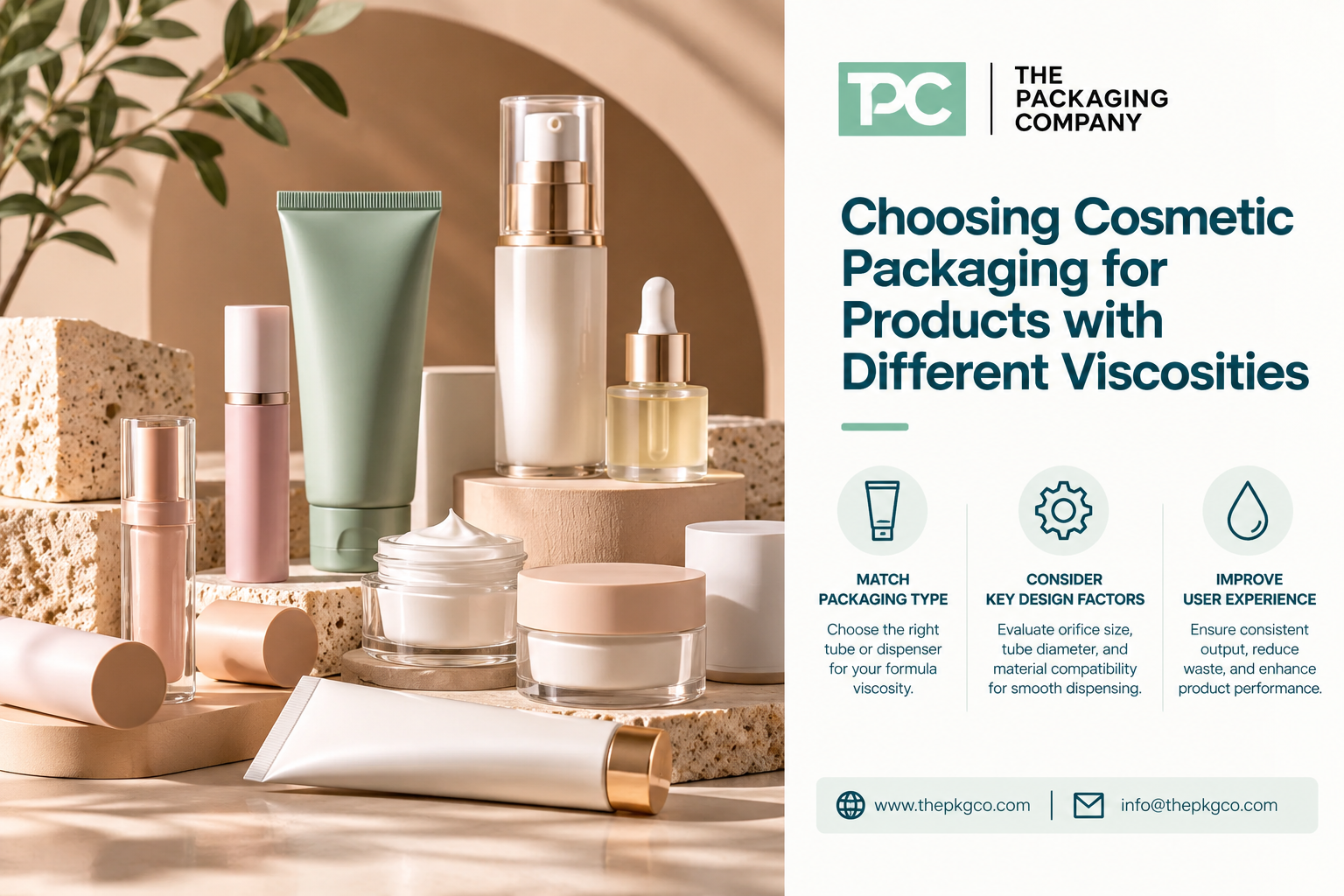
A watery facial toner, a lightweight serum, a body lotion, and a dense cleansing balm may all be sold under the same skincare brand. But putting them into matching containers is not always the best packaging decision.
Formula thickness affects how easily product moves through a pump, flows from a dropper, exits a tube, or can be removed from a jar. Packaging that looks appropriate on a product rendering may be frustrating to use—or difficult to fill—if the actual formula does not behave as expected.
When comparing cosmetic packaging for different viscosities, beauty brands should start with the intended consumer experience and then narrow the container, dispensing system, and closure around the formula. The goal is not to assign every “thin” formula to a bottle and every “thick” formula to a jar. It is to make an informed shortlist and validate it using the finished formulation.
For a broader overview of available packaging formats, explore TPC’s skincare packaging solutions.
What Does Viscosity Mean for Cosmetic Packaging?
Viscosity describes a fluid’s resistance to flow. A watery toner generally flows readily, while a concentrated cream may resist movement unless pressure is applied. That distinction matters because the container controls how the consumer accesses and dispenses the product.
But cosmetic formulations do not always behave like simple liquids. A gel can appear thick at rest and become easier to dispense when squeezed. A lotion can change its apparent viscosity with temperature, mixing, or shear. Some products contain suspended particles, waxes, or structured ingredients that can interfere with narrow outlets even when the formulation can otherwise flow.
This is why a description such as “medium viscosity” is a useful starting point, not a universal packaging specification. Two formulas called “thick creams” may perform differently in the same pump.
Brands should ask their formulator for relevant flow characteristics and intended use conditions rather than relying solely on a visual description or one viscosity number.
Start by Comparing the Dispensing Method, Not Just the Container
Consider the customer applying a product on an ordinary morning. Will they pour several drops onto a cotton pad, dispense one small pump, squeeze out a ribbon of cream, or scoop a small amount from a wide-mouth jar?
Those actions point toward different packaging systems. They also reveal the likely dispensing problems that should be evaluated before selecting a final container.
| Formula behavior | Packaging worth evaluating | Critical selection question |
|---|---|---|
| Very fluid toner or liquid serum | Suitable bottles, dispensing caps, selected droppers or pumps | Can the user release the intended quantity without dripping or uncontrolled flow? |
| Light gel or fluid emulsion | Pump bottles, selected airless systems, appropriately designed tubes | Does the outlet produce consistent flow with the actual formula? |
| Medium-weight lotion or cream | Lotion pumps, selected airless bottles, squeeze tubes | Are priming, pressure, dose and product evacuation acceptable? |
| Rich cream, dense mask or balm | Cosmetic jars, suitable squeeze tubes, purpose-designed airless jars or dispensing systems | Can the consumer access the product comfortably without excessive force or blockage? |
These are shortlist suggestions, not formula-compatibility approvals. The correct format depends on the finished formula and exact component configuration.
When Lower-Viscosity Products Need Controlled Flow
Very fluid products can be easy to fill and pour, but ease of flow is not always a benefit once the consumer opens the package. If the outlet releases too much formula, the product may drip, splash, or feel difficult to control.
A facial toner, for example, may be suited to a bottle with an opening or closure that matches the intended application. A lightweight facial oil may be evaluated with a suitable dropper assembly. A fluid serum intended for small portions may benefit from a compatible treatment pump or dispensing system.
Brands reviewing dropper bottles or other cosmetic bottles should compare more than nominal capacity. Useful questions include whether the opening allows good portion control, whether the closure prevents leakage, whether the chosen materials are appropriate for the ingredients, and whether the consumer can apply the intended amount reliably.
Why a Small Opening Is Not Always the Answer
A narrow opening may help regulate the flow of a very fluid product, but it may not work for every formula or intended dose. An outlet that is excessively restrictive can make use inconvenient. Conversely, a large opening can release an unexpectedly large volume when the container is tilted or squeezed.
The right opening size depends on the actual dispensing design and formula—not on the assumption that smaller always means better.
Pump Selection for Lotions, Serums and Emulsions
Pumps can make a skincare product feel easier to use, especially when the brand wants customers to dispense a repeatable portion without pouring. However, the bottle and pump should be evaluated as one assembled system.
For a lotion pump or treatment pump, the filling and formulation teams may need to consider:
- Flow through the pump: Can the formula travel through the inlet, pump chamber, and actuator without excessive resistance?
- Priming: How many actuations are needed before the first product is delivered?
- Output: Does each full actuation deliver an appropriate quantity for the product’s intended use?
- Consistency: Does the dose remain reasonably repeatable through the package’s usable life?
- Clogging and residue: Does product build up or dry around the outlet after repeated use?
- Evacuation: How much usable product remains when dispensing becomes difficult?
Formula composition matters alongside thickness. Product particles, oils, solvents, fragrances, pH, and other formulation properties can affect compatibility with pump-contact materials or the dispensing mechanism.
If output size is a key purchasing consideration, TPC’s separate guide to airless pump bottle dosage and output discusses how to evaluate dose consistency. This article focuses instead on choosing between packaging families.
How Viscosity Affects Squeeze Tube Packaging
Squeeze tubes are often considered for cleansers, creams, lotions, gels, and other products that consumers prefer to dispense by applying pressure to the container.
For a tube, formula viscosity interacts with the flexibility of the tube body, the dispensing orifice, and the closure or applicator. A thicker cream may require the consumer to squeeze harder through a restrictive opening. A fluid formula may escape too readily through an oversized outlet.
The same nominal-capacity tube can also feel different depending on its diameter, length, wall construction, and how much product remains inside it.
When reviewing cosmetic squeeze tubes, brands should ask the supplier about available body and dispensing configurations, then ask the formulator and filler to evaluate how the actual product moves through the selected package.
For example, a gel cleanser designed to produce a modest amount per use may require a different dispensing opening from a rich hand cream that users apply in larger portions. A targeted treatment may need an applicator designed for a smaller application area. There is no single orifice size that fits all cosmetic tubes or formulas.
Before committing to a design, evaluate ease of squeezing, dispensing control, product residue at the outlet, cap performance, and suitable tail filling and sealing.
When Cosmetic Jars May Be Better Than Pumps
A jar is not merely a more traditional alternative to a pump bottle. For certain rich or structured formulas, a wide-mouth opening may give consumers easier access than forcing the product through a narrow dispensing pathway.
Dense moisturizers, masks, cleansing balms, and some thicker treatment products are common reasons for brands to evaluate cosmetic jars.
Jars also change the product experience. Consumers can see and access the formula directly, but the brand must consider whether fingertip or spatula application is appropriate, how the lid and any inner seal perform, and whether repeated opening meets the product’s quality and use requirements.
A jar is not automatically necessary for a thick product, and it does not automatically solve product stability or compatibility concerns. It can be the right choice when the desired application method, formula texture, and closure system work together.
For brands that want the accessibility of a cream format but prefer a dispensing mechanism, an appropriately engineered airless jar may also be worth reviewing.
Are Airless Bottles Suitable for Every Formula Thickness?
No. Airless packaging is available in different structures and dispensing configurations, but compatibility is specific to the selected system.
Some airless pump bottles are useful for selected serums, emulsions and creams. Other mechanisms may not dispense a high-viscosity formulation effectively, particularly if the outlet, internal pathway, pump design, or product rheology creates excessive resistance.
Brands choosing airless packaging should review the appropriate pump design and output, filling approach, priming behavior, evacuation and the intended application dose. A richer cream might be suited to one system and incompatible with another—even when both products are marketed as “airless.”
Airless construction should also not be treated as a substitute for formula stability or packaging compatibility testing. The actual formula must be reviewed with the materials and components in its final configuration.
Three Product Examples: Same Brand, Different Packaging Decisions
Example 1: A Watery Toner
The consumer wants to apply a fluid product without an accidental spill. A compatible bottle and controlled opening may be an appropriate starting point. The team should test pouring or dispensing behavior, closure leakage and material compatibility with the finished toner.
Example 2: A Medium-Viscosity Moisturizer
The consumer wants a practical amount with a simple press. The brand might evaluate a suitable lotion pump, airless bottle or tube. The choice depends on the formula’s flow properties, desired portion size, pump output, filling requirements and user experience.
Example 3: A Dense Cleansing Balm
The product is structured and intended to be scooped. A jar may provide the most intuitive access. A dispensing package should not be ruled out without testing, but it would need to handle the actual product reliably and match the brand’s application goals.
These comparisons demonstrate why using a visually identical container across every skincare SKU can create unnecessary limitations. Packaging can still form a cohesive brand family while using different delivery systems for different formulations.
What to Test Before Confirming the Packaging Format
Appearance alone cannot establish whether packaging works with a product. Before final approval, the brand and its technical partners should test the actual formula with representative components and the intended filling process.
A useful evaluation plan may include:
- Dispensing at first use: Record priming, squeezing effort, dripping or dose behavior.
- Dispensing after repeated use: Check for changes as the pack empties, clogs or accumulates residue.
- Relevant temperatures: Consider how the formula’s flow characteristics change under expected conditions.
- Formula and component contact: Evaluate the required stability and material-compatibility criteria, including seals and dispensing components.
- Fill and closure process: Confirm that the filling partner can handle the chosen container, nozzle, assembly and seal design.
- Leakage and handling: Check the complete closed packaging system under applicable storage and transport conditions.
- Approved specification: Record exactly which pump, cap, jar, tube or other configuration passed the relevant assessments.
For teams approaching bulk production, the companion article Before Skincare Packaging Goes to the Filler covers the operational handoff between packaging supplier, brand and contract filler.
What to Share With a Cosmetic Packaging Supplier
Brands do not need to arrive with every technical answer already finalized. But a better initial packaging recommendation is possible when the supplier understands the formula and intended use.
Useful starting information includes the product category, approximate texture or available viscosity information, target fill quantity, intended application method, preferred container formats, any special dispensing needs, and whether a formulator or filling partner has already identified restrictions.
The Packaging Company supplies empty cosmetic packaging components to beauty, skincare and personal care brands. TPC can support the review of available containers, dispensing options, component specifications, sampling and custom manufacturing requirements. It does not conduct finished-formula stability testing or filling validation. Those activities are the responsibility of the brand, formulator, filling partner and qualified testing specialists.
Before choosing a bottle, jar, tube or airless system for your next product, contact The Packaging Company to discuss suitable empty-packaging options and the component information your technical team needs to evaluate.
FAQ: Cosmetic Packaging and Formula Viscosity
What is the best cosmetic packaging for a thick cream?
Jars, appropriately designed squeeze tubes and certain purpose-built pumping or airless systems may be worth evaluating. The best choice depends on the cream’s actual flow behavior, desired dispensing method and testing results.
Can an airless pump bottle hold high-viscosity formulas?
Some airless systems may be suitable for certain thicker products, but compatibility is not universal. Pump structure, flow path, output and formula rheology must be evaluated using the actual product. An airless jar may be another option for a rich cream.
Do thin cosmetic serums always need dropper bottles?
No. Droppers are one option, but a compatible pump, dispensing cap or another bottle closure may provide a better user experience depending on dose, formula chemistry and application method.
Does packaging compatibility mean the same thing as viscosity compatibility?
No. Viscosity affects product flow and dispensing. Broader packaging compatibility includes the interaction of the formula with container and closure materials, along with stability, leakage, filling and finished-product performance.
Who should test cosmetic packaging with the real formula?
The brand’s formulator, filling partner and qualified testing teams should establish and perform the applicable evaluations with the actual formula and packaging configuration. TPC supports empty-packaging sourcing and component selection rather than finished-product validation.