



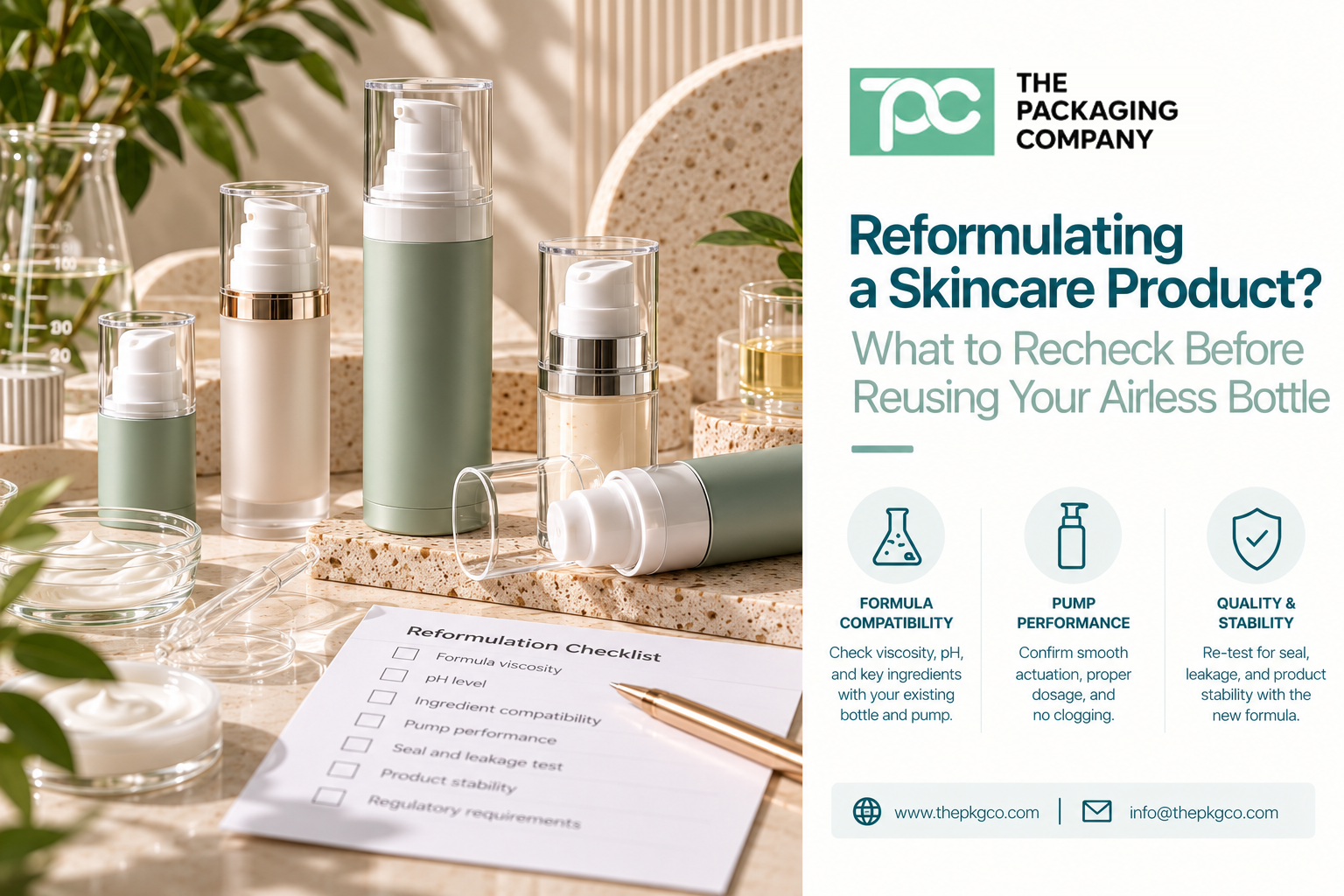
A skincare brand may want to keep its existing airless bottle when updating a serum or moisturizer. The packaging already has an approved appearance, an established supplier, and a place in the product line. Keeping the same container can seem more straightforward than selecting a new one.
But reformulating a product can change how it performs in the same airless packaging. A new thickener, oil blend, active ingredient, preservative system, or other formula adjustment may affect dispensing, material contact, stability, or the filling process. Even when the packaging components remain unchanged, the previous testing may not answer every question about the new formula.
For brands sourcing airless packaging, the practical task is to identify what changed in the product, determine what prior evidence is still relevant, and ask the formulator and filling partner what needs to be evaluated again before reusing the same bottle.
Why an Approved Airless Bottle May Need Another Review
A bottle approval reflects a particular packaging configuration and the conditions under which it was evaluated. It does not automatically establish that every future formula will work in the same system.
The bottle, pump, actuator, internal product-contact surfaces, and filling procedure all affect product behavior. The formula is another critical part of that system.
For example, a moisturizer may become noticeably thicker after a texture adjustment. Its package can remain visually identical, yet dispensing may feel different. A serum with a newly added solvent or fragrance may also create new material-compatibility questions, even if its apparent viscosity changes very little.
The decision should therefore begin with a comparison between the previously evaluated formula and the revised one—not with the assumption that the container is either automatically approved or automatically unsuitable.
1. Document the Formula Changes Before Reusing the Package
The technical team should first describe the reformulation precisely enough to assess which packaging requirements it might affect.
Changes worth discussing with the formulator include:
- Viscosity and rheology: Whether the product’s flow behavior changes under pumping, storage, or temperature exposure
- Oils, solvents, or fragrance components: Whether product-contact compatibility needs additional review
- Active ingredients, acids, or other formulation changes: Whether stability or contact-material assumptions may be affected
- Particles or suspended ingredients: Whether they could affect the selected dispensing path
- Product density: Whether the intended net fill quantity and container capacity need to be reconsidered
- Filling conditions: Whether processing temperature, handling, or assembly requirements have changed
Not every reformulation involves all these factors. The brand’s formulator should identify which properties changed and which are relevant to the selected packaging system.
2. Recheck Pump Performance With the Revised Formula
The same airless pump may deliver a different consumer experience if the product’s flow behavior changes. That does not always mean replacing the pump, but it means the new product should be evaluated using the intended configuration.
Consider how the formula moves through the system when the customer begins using it and as the container empties.
Priming and First Use
Does the pump begin dispensing in an acceptable number of actuations? Does it restart consistently after the product has been stored or unused? A formulation change could affect how readily product enters the dispensing mechanism.
Output and Dose
Even where the pump has a nominal output specification, the actual delivered quantity and experience should be considered with the revised formula. Confirm that the resulting dose is appropriate for how the product is intended to be applied.
Evacuation and Residue
The consumer should be able to use the package as intended through its applicable usable life. Product consistency, adhesion, and dispenser performance can influence residual product and the point at which dispensing becomes difficult.
These are reasons to establish relevant performance criteria with the testing team, not to assert that thicker formulas always require one specific pump.
TPC’s separate airless pump bottle dosage and output guide provides a more detailed overview of testing output and priming. Here, the concern is what must be revisited because the formula changed.
3. Do Not Treat Similar Viscosity as Proof of Compatibility
A reformulated serum can feel almost identical to the previous version and still raise new packaging questions. Formula compatibility involves more than whether product travels through the pump.
Packaging-contact materials may need review when ingredients or their concentrations change. Depending on the product, technical teams may need to examine interactions involving the bottle interior, piston or product pathway, seals, closure components, or other relevant surfaces.
A new fragrance system, ingredient combination, or processing condition could affect the applicability of prior compatibility data. The formulator and qualified testing partners must determine what testing is needed for the revised product.
Conversely, a formula change that is well understood and does not affect key packaging interactions may be assessed differently. The responsible teams should document that rationale instead of relying on assumptions.
4. Revisit Filling and Assembly Requirements With the Contract Filler
An airless packaging configuration that has worked well on a filling line may still need reassessment after a significant formula change. Filling performance can depend on the finished product’s flow behavior and processing conditions.
Relevant questions for the contract filler include:
- Can the revised formula be filled consistently using the intended equipment and process?
- Is the applicable filling temperature or handling process different?
- Does the new product behavior affect filling accuracy, trapped air, or priming considerations?
- Are existing closure or pump-assembly procedures still suitable?
- Does the finished unit need additional checks before the next production run?
Different airless constructions can have different filling and assembly requirements. The filler should review the specific bottle and process rather than apply a generic rule to all airless systems.
For the broader operational handoff, see what brands should confirm before skincare packaging goes to the filler.
5. Decide Which Earlier Tests Can Still Be Used
When the brand wants to retain its current bottle, the most useful starting material may be the records from its original product validation.
Collect the earlier reports and specifications, then connect each result to the exact formula and packaging configuration that was tested. This allows the technical team to judge whether the previous evidence remains applicable.
| Previous evidence | Question after reformulation |
|---|---|
| Pump output and priming review | Could the changed formula affect delivery or first-use behavior? |
| Stability and material compatibility | Are the previous contact-material and product-stability conclusions still relevant? |
| Filling-process qualification | Can the revised formula run through the existing process and assembly steps? |
| Leakage and storage evaluation | Could formula or processing changes affect the finished package under use and distribution conditions? |
| Usable capacity and dose assumptions | Have density, intended dose, or fill requirements changed? |
| Approved packaging specification | Are the bottle, pump, actuator, and other components genuinely unchanged? |
This is a change-impact review, not a universal retesting checklist. The brand’s qualified technical partners should define the tests, sample plan, acceptance criteria, and approvals that apply to its product.
6. Know the Difference Between a Formula Change and a Packaging Change
These two situations may lead to different decisions, even when they happen within the same product update.
Scenario A: Formula changes, packaging components stay the same. The team reviews whether the existing packaging remains suitable for the reformulated product. Revalidation may be needed even though there is no new bottle design.
Scenario B: Formula changes and the pump or bottle specification changes. The team must evaluate the revised formula and the altered packaging assembly. Existing packaging approvals may not cover the new component configuration.
Scenario C: The brand changes packaging but not the formula. This is primarily a packaging-system change, but the brand still needs to determine the formula compatibility and technical assessments required for the new container.
Keeping these distinctions clear makes it easier to assign responsibilities and avoid unnecessary or overlooked approvals.
7. Should the Brand Keep the Current Airless Bottle or Select Another System?
There is no automatic reason to replace an airless bottle simply because the formula was revised. But there is also no basis to assume the original system remains suitable without reviewing the changes.
A decision to retain the bottle should be supported by evidence that the revised formulation and intended filling process meet the team’s performance and compatibility criteria.
If the product becomes difficult to prime, dispenses inconsistently, leaves unacceptable residue, or raises new material-compatibility concerns, the brand may need to reconsider the pump output, relevant components, filling process, or container format.
Where a different packaging configuration is needed, evaluate available options from the main Airless Packaging category and confirm the revised system with the appropriate technical partners.
For brands comparing multiple cosmetic packaging formats after a substantial texture change, TPC also has a broader guide to cosmetic packaging for products with different viscosities, which addresses bottles, tubes, jars, and dispensing systems.
8. Coordinate Packaging Reorders With the Formula Revision
Brands often maintain detailed records of bottle sizes, pump part numbers, finishes, and approved packaging artwork. When a formula changes, the brand also needs a clear record of which formulation version will be filled into which packaging specification.
If the current packaging is retained, the purchase order and internal change record should refer to the correct approved packaging configuration. If a component changes, the supplier and brand should establish the revised specification and any necessary approvals.
A useful change record includes:
- Original and revised formula identifiers
- Existing bottle, pump, cap, and other component references
- Any proposed packaging changes
- Which prior tests remain applicable and which require follow-up
- Approvals from the formulator, filling partner, and relevant brand teams
- Which production lots or reorders will use the updated formula
This helps prevent confusion when an existing bottle is used for multiple formula versions or a transition occurs while older components remain in inventory.
9. How TPC’s Sample and PPS Process Applies
The Packaging Company supplies empty airless bottles and related cosmetic packaging components. TPC can help brands review available specifications and sourcing options, but it does not carry out the brand’s finished-formula stability testing, filling qualification, or complete product validation.
For a project involving a new custom packaging order, TPC’s normal process is to review available stock samples before ordering and provide the pre-production sample (PPS) after the order has been placed. The brand approves the agreed custom packaging reference before bulk manufacturing proceeds.
If the formula changes but the current packaging is being reordered unchanged, the brand should not assume either that it needs a new PPS or that its previous formula testing is sufficient. Confirm the order’s approval requirements with TPC, and let the formulator and filling partner determine the necessary technical reassessment.
For many TPC custom cosmetic packaging projects, the general MOQ is 5,000 units per SKU per print run, subject to the exact product configuration. Typical manufacturing lead time is approximately 90 days after PPS approval for applicable custom programs, with shipping and other project timing confirmed separately.
Before Reusing an Airless Bottle: A Change-Impact Checklist
Rather than repeat every original production test automatically, align the team on these decisions first.
- Identify the formula revision. What ingredients, properties, or processing conditions have changed?
- Confirm the existing packaging specification. Are the bottle and dispensing components actually identical to those previously evaluated?
- Review previous test records. Which conclusions depend on properties that have changed?
- Assign technical responsibility. Who determines and performs any additional formula, packaging, and filling assessments?
- Review dispensing and user experience. Can the updated product be delivered at an acceptable dose throughout intended use?
- Document the decision. Is the existing bottle accepted for the revised formula, conditionally accepted, or replaced?
- Update production references. Can the supplier, brand, and filler all identify the approved formulation and packaging versions?
The decision to reuse a bottle should be based on the revised product’s actual requirements—not solely on the fact that the original version was successful.
Support for Skincare Brands Updating an Established Product
Formula updates are a normal part of skincare product development. They do not always require a packaging redesign, but they may change what needs to be checked before the next production run.
Brands seeking to keep their existing airless packaging can start by collecting the current bottle and pump specification, describing the planned formula change, and involving the formulator and filling partner early. If a different dispensing or packaging configuration is necessary, TPC can help review available empty-packaging options.
Contact The Packaging Company to discuss your existing airless bottle configuration, target quantity, and any packaging-component changes under consideration.
Frequently Asked Questions About Reformulation and Airless Packaging
Can I keep the same airless bottle after changing my skincare formula?
Possibly. The brand’s technical team should determine whether the previous packaging remains suitable for the revised product. The decision depends on what changed in the formula and the results of any necessary compatibility, dispensing, and filling evaluations.
Does unchanged viscosity mean my old pump testing is still valid?
Not necessarily. Similar viscosity does not establish unchanged material compatibility, product stability, or all aspects of pump performance. The formulator and qualified testing partners should review the specific changes and applicable evidence.
Do I have to repeat every packaging test after reformulating?
There is no universal answer. The appropriate scope depends on the nature of the formulation change, the packaging system, the prior test records, and the brand’s applicable technical and regulatory requirements.
Does changing the formula mean TPC needs to make a new PPS?
Not automatically. TPC provides PPS after order placement for applicable custom packaging projects. If the packaging configuration is unchanged, confirm the order’s approval requirements with TPC; the brand’s technical partners remain responsible for determining whether new formula and filling assessments are required.
Who is responsible for validating the reformulated product in its airless bottle?
The brand, formulator, contract filler, and qualified testing specialists are responsible for the relevant formula-compatibility, stability, filling, and finished-product performance evaluations. TPC supports sourcing and specifications for empty packaging components.