



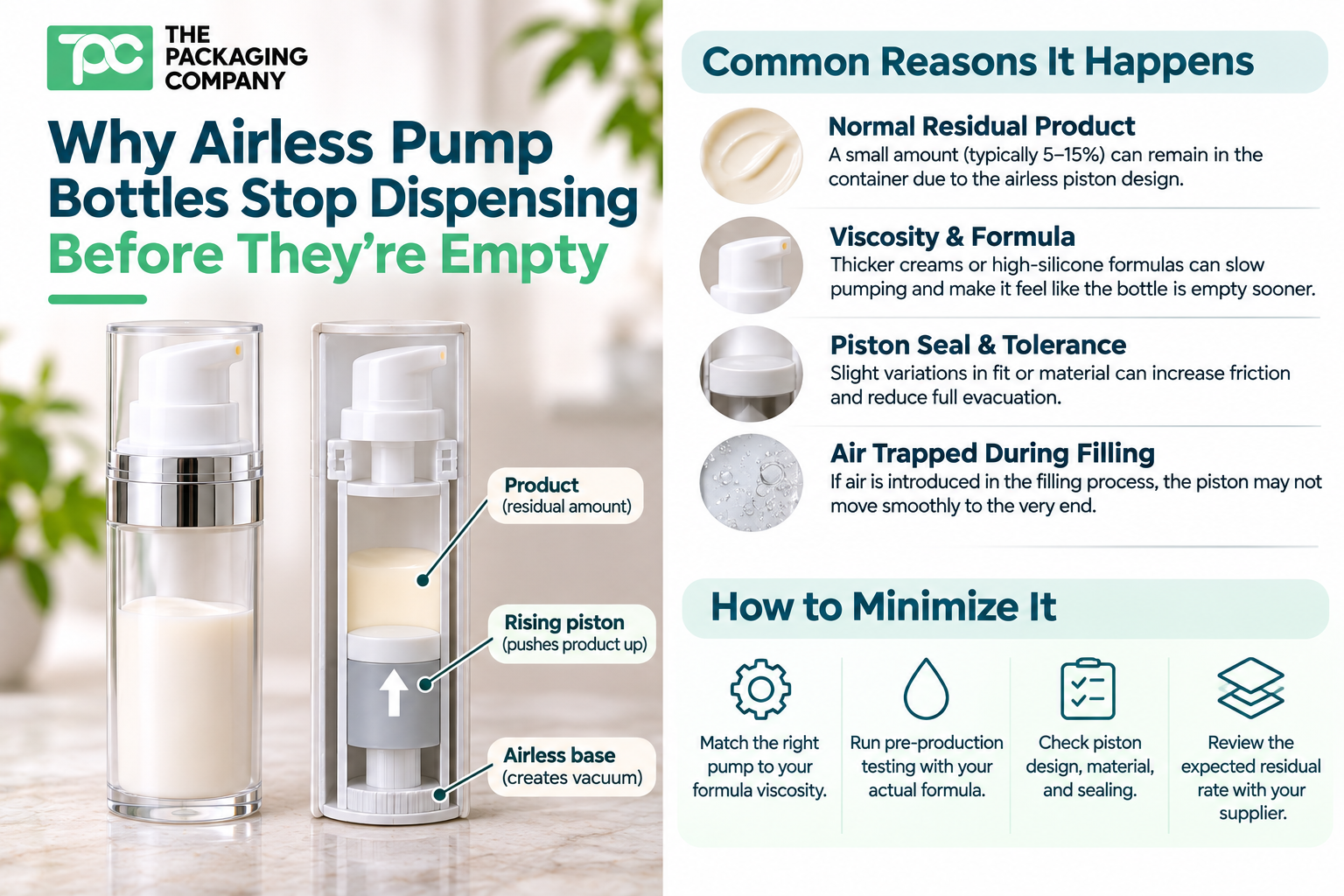
A customer presses the pump on a skincare bottle, but nothing comes out. The bottle still feels heavy, and the customer assumes the pump has failed. For a skincare brand, this can mean complaints, unnecessary returns, or questions about whether the package delivers the quantity promised on the label.
Not every airless pump bottle is designed to evacuate every trace of formula. However, a large amount of product left behind—or a pump that stops earlier than expected—deserves investigation.
Brands should assess residual product, end-of-use dispensing, and filling compatibility before committing to bulk production.
Why “Empty” and “No Longer Dispensing” Are Different
In many piston-based airless systems, pressing the pump helps move an internal piston upward as product is dispensed. The design limits air entering the product chamber, but the internal geometry does not guarantee complete product removal.
Some formula may remain around the pump inlet, shoulders, internal surfaces, or other areas the mechanism cannot effectively clear.
A small residual amount may be expected. Premature loss of dispensing while substantial usable formula remains is a different issue.
For skincare brands evaluating airless packaging, the practical question is not whether the bottle contains literally zero residue. It is how much of the filled product can be dispensed under realistic conditions.
Four Reasons Product Can Remain Inside an Airless Pump Bottle
1. The Piston Reaches the Limit of Its Travel
In piston-based designs, the piston can only travel as far as the container and pump geometry allow.
Depending on the design, some product may remain in a space that the piston cannot displace.
Packaging buyers should ask the supplier about the specific system’s end-of-use behavior rather than assuming all airless bottles perform the same way.
2. The Formula Does Not Flow Easily Into the Pump
Viscous creams, gels, or formulas that change texture during storage may not move toward the pump inlet as consistently as lower-viscosity products.
Product can cling to internal surfaces or remain in pockets.
Brands should test the actual finished formula. Water-based demonstrations do not reliably predict how a thick skincare product will behave.
3. Air Is Trapped During Filling or Assembly
Air pockets introduced during filling or assembly can interfere with the dispensing cycle.
If an otherwise suitable package behaves inconsistently across samples, review the filling method, fill quantity, assembly instructions, and initial priming procedure with the contract filler and packaging supplier.
4. The Pump Loses Consistent Output Near the End
An airless pump may work normally for most of the bottle’s use and then produce smaller or irregular doses.
Possible factors include formula flow, component fit, nozzle obstruction, or the internal dispensing mechanism.
The symptom alone does not identify the cause. Brands need repeatable sample testing before selecting a remedy.
How to Measure Product Left Behind Before Production
Rather than judging by how heavy a bottle feels, create a simple dispensable-product test using several representative samples of the intended package and finished formula.
Step 1: Record the Starting Quantity
Weigh the empty packaging and the filled, assembled package using a consistent method.
Record the actual net fill mass.
Step 2: Prime According to the Supplier’s Instructions
Note the number of strokes before the first consistent dose appears.
Keep priming measurements separate from end-of-use measurements so the results can be compared accurately.
Step 3: Dispense Under a Defined Routine
Use complete pump strokes, a consistent interval, and the intended storage orientation.
Repeat the procedure with multiple samples rather than relying on one bottle.
Step 4: Document When Output Becomes Unreliable
Record reduced output, intermittent dispensing, and the point at which no usable dose can be obtained under the agreed test method.
This helps distinguish normal end-of-use behavior from premature dispensing failure.
Step 5: Determine Residual Formula
Work with the packaging supplier or testing laboratory to measure the formula remaining after the test, using an appropriate disassembly and weighing procedure.
One useful comparison is:
Evacuation percentage = (Dispensed product mass / Initial net fill mass) × 100
The result represents the measured evacuation performance for that formula, packaging configuration, and test method.
It should not be treated as a universal performance claim for all airless pump bottles.
What to Ask Your Supplier When Evacuation Is Lower Than Expected
When a significant amount of product remains inside an airless bottle, skincare brands should provide their packaging supplier with clear testing information.
This may include the packaging specifications, formula type, fill quantity, sample lot, dispensing observations, and measured residue.
Questions worth discussing include:
- Is the packaging a piston-based system or another airless dispensing design?
- What residual-product behavior has been observed with comparable formulas?
- Does the recommended fill quantity match the package and filling method?
- Could a different pump or bottle configuration improve performance?
- What tests should the brand and filling partner repeat before production approval?
If the problem appears after changing a skincare formulation, the updated formula and packaging should be evaluated together.
Our article on airless bottle compatibility after reformulation explains why formulation changes can affect packaging performance.
For broader pump problems, including first-use priming and blockage, refer to our existing airless pump bottle troubleshooting guide.
Make End-of-Use Performance Part of Packaging Approval
For skincare brands, a bottle’s appearance and first pump are only part of the customer experience.
The package must also perform acceptably through its final usable doses.
Before approving production, brands should establish a realistic and documented acceptance criterion for the finished formula and test it using representative samples.
A packaging supplier should be able to help identify the specifications and sample testing requirements needed to evaluate the selected dispensing system.
Brands comparing new packaging options can explore TPC’s airless pump bottle collection or review our complete range of airless packaging solutions.
The Packaging Company works with skincare and cosmetic brands to evaluate packaging configurations, sample requirements, customization options, and wholesale production needs.
Contact The Packaging Company to discuss airless packaging for your next skincare product.
Frequently Asked Questions
Should an Airless Pump Bottle Dispense Every Last Drop?
Not necessarily. Some residual formula may remain because of the pump and bottle geometry or the properties of the formulation. The relevant benchmark is the measured evacuation performance agreed upon for the specific product and package.
Does a Bottle That Still Feels Heavy Always Have a Defective Pump?
No. Bottle components contribute to the weight, and the packaging may retain a small amount of formula. Brands should measure the remaining product before concluding that the pump is defective.
Can a Thicker Skincare Formula Leave More Residue?
It can, depending on the formulation and dispensing design. The actual formula should be tested in the proposed package because viscosity alone cannot predict dispensing performance.