



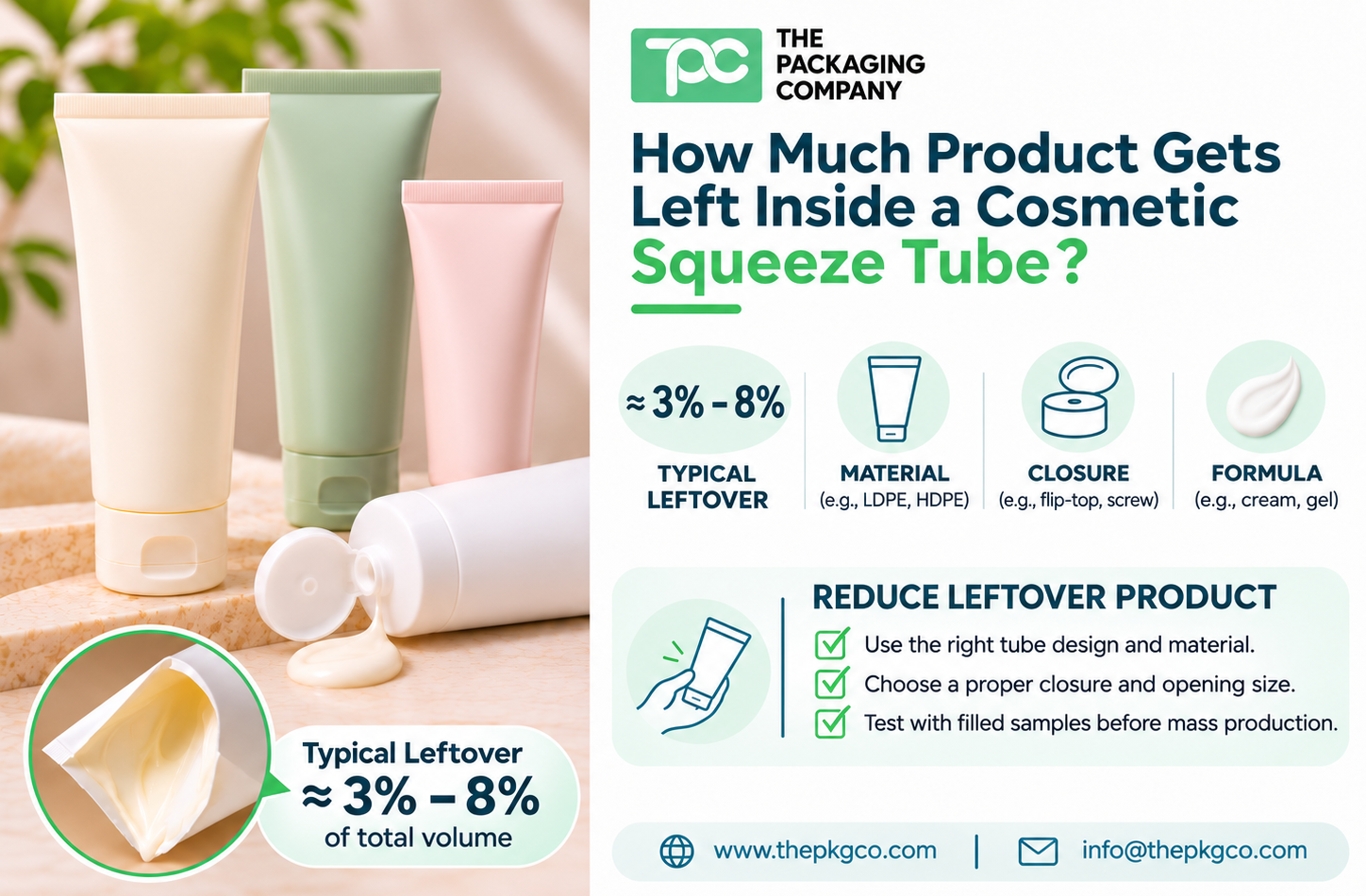
A tube labeled 50ml may hold the intended fill quantity, but that does not necessarily mean every milliliter can be dispensed during normal use. Depending on the formulation and packaging design, some product may remain along the tube walls, near the shoulder, or around the dispensing opening.
For brands developing creams, lotions, gels, and other skincare products, evaluating product residue during packaging selection can help improve the customer experience and identify potential dispensing issues before bulk production.
Why Does Product Remain Inside Cosmetic Squeeze Tubes?
Squeeze tubes dispense products through pressure applied to a flexible container body. As customers use the product, the tube gradually collapses or changes shape, pushing the remaining formula toward the opening.
However, product evacuation is not always complete.
Some formulations adhere to the interior walls, while others accumulate in areas that are difficult to compress. The amount left behind can depend on the interaction between the tube’s construction, its dimensions, the product’s viscosity, and the way consumers squeeze it.
This means two cosmetic squeeze tubes with the same nominal capacity may provide different end-of-use experiences when filled with the same formula.
How Tube Material Influences Product Evacuation
Tube material can affect how easily the container compresses and how it behaves after repeated use.
Flexible Plastic Cosmetic Tubes
PE-based plastic cosmetic tubes are commonly used for skincare creams, lotions, and gels. Their flexibility allows users to apply pressure to different areas of the container to move product toward the dispensing opening.
However, wall thickness, tube geometry, and the specific material construction can influence how much force is required and how the tube recovers after squeezing.
A highly flexible tube is not automatically the best option for every formula. The complete container and product combination should be tested.
Aluminum Cosmetic Tubes
Aluminum tubes often retain their compressed shape rather than springing back after use. This behavior may help users progressively move the remaining product toward the opening.
However, product residue can still occur, particularly near folds, shoulders, and areas where the tube cannot be compressed easily.
The appropriate material should therefore be selected based on formula requirements, usability, protection, and product presentation—not on an assumption that one material always delivers better evacuation.
Does Formula Viscosity Affect How Much Product Is Left?
Yes. The way a formulation flows under pressure can significantly influence how easily it exits the tube.
For example:
- Lightweight lotions: May flow relatively easily toward the dispensing opening.
- Thick creams: May require greater squeezing force and can remain attached to interior surfaces.
- Dense balms and pastes: May require a more carefully selected dispensing opening and tube construction.
- Gel formulations: Can behave differently depending on their viscosity and flow properties.
Even products within the same category may behave differently because of their individual formulations.
Brands should conduct dispensing tests using the actual product rather than relying exclusively on water-based testing or empty packaging samples.
How Tube Shape and Dimensions Affect Dispensing
The physical design of a squeeze tube can influence how easily users reach the remaining product.
Two tubes may hold the same volume while having different diameters and body lengths. These differences change how the tube is held, compressed, and emptied.
Important design considerations include:
- Tube diameter: Influences grip, body shape, and squeezing behavior.
- Body length: Affects how product moves toward the opening as the tube empties.
- Shoulder geometry: May create areas where product accumulates.
- Tube wall construction: Influences flexibility and the force needed to dispense the formula.
- Dispensing opening: Must be appropriate for the product’s flow characteristics.
These factors should be evaluated together. A design that performs well with a lightweight lotion may not provide the same results with a dense cream.
Explore TPC’s cosmetic squeeze tubes to compare available tube formats, materials, capacities, and applicator styles.
How Can Brands Measure Product Left Inside a Squeeze Tube?
Rather than relying entirely on visual inspection, skincare brands can use a simple gravimetric test to compare how much product remains in different packaging samples.
Step 1: Prepare Comparable Samples
Fill each tube design with the same formulation and a controlled fill mass. Use multiple samples per design to account for variation in filling and dispensing.
Step 2: Record the Starting Weight
Weigh each filled tube, including its closure, and record the result. Separately establish the empty packaging tare weight using the same component configuration.
Step 3: Simulate Normal Consumer Use
Dispense the product using a consistent procedure until the tube can no longer deliver a practical amount through normal squeezing.
Use the same dispensing method, orientation, and stopping criteria for every sample. This makes the results more comparable.
Step 4: Weigh the Remaining Product
Weigh the tube again after dispensing. The difference between its final weight and the empty package tare provides an estimate of the product remaining inside.
Calculate the residual product percentage using:
Residual Product (%) = (Remaining Product Mass / Initial Product Fill Mass) × 100
For example, if a tube initially contains 50g of product and 3g remains after testing, the residual percentage is 6%.
This is an illustrative calculation, not a typical or guaranteed residue rate for cosmetic squeeze tubes.
Step 5: Compare the Results
Review the residual percentage across the tested samples, along with dispensing force, user handling, and any leakage or closure issues observed.
A tube with a lower residual percentage may offer a better end-of-use experience, provided it also meets the brand’s other packaging requirements.
Why Product Residue Matters for Skincare Brands
Product left inside a cosmetic squeeze tube may seem like a minor packaging detail, but it can influence how customers perceive the product’s value.
If customers struggle to dispense the final portion of an expensive cream or treatment, they may feel they are not receiving full use of the product they purchased.
For premium skincare brands in particular, the dispensing experience should remain convenient throughout the product’s use—not just when the tube is new.
Reviewing product evacuation during development can also help packaging and formulation teams identify opportunities to adjust the tube design before production begins.
What Should Brands Check Before Approving Bulk Production?
When reviewing custom cosmetic tubes, buyers should request samples and evaluate:
- The amount of formula remaining after simulated normal use.
- Dispensing consistency as the tube becomes nearly empty.
- Whether users can comfortably compress the tube body.
- Product accumulation near the shoulder and dispensing opening.
- Changes in tube appearance after repeated squeezing.
- Compatibility between the formulation and packaging components.
Testing should use production-representative samples whenever possible, because material construction, fill process, and final component specifications may affect results.
TPC offers PCR/PE cosmetic squeeze tubes and other customizable tube formats for skincare applications. Brands can review different configurations and request samples before finalizing their packaging selection.
Frequently Asked Questions About Cosmetic Squeeze Tubes
Do cosmetic squeeze tubes always leave product inside?
Some residual product is common, but the amount varies depending on the formula, tube construction, dimensions, and dispensing method. Brands should test their actual formulation to understand the expected residual amount.
Which tube material leaves the least product behind?
There is no universally best material. Flexible plastic and aluminum tubes behave differently during use, but product evacuation also depends on the formula, tube shape, and dispensing opening. Comparative testing is the most reliable approach.
Does tube size affect the amount of product remaining?
Tube diameter, length, and shoulder geometry can influence how product moves through the container. Two designs with the same capacity may perform differently during dispensing.
How can a skincare brand test dispensing efficiency?
Fill comparable tube samples with the intended formula, record the initial product mass, simulate normal dispensing, and measure the product remaining. Comparing residual percentages can help identify differences between designs.
Can custom cosmetic tube designs improve product evacuation?
Potentially. Changes to tube dimensions, material construction, and dispensing components may improve usability for a particular formulation. Any proposed design should be validated through sample testing before bulk production.
Choose Cosmetic Squeeze Tubes Based on Actual Product Performance
The right cosmetic squeeze tube should protect the formulation, support the intended product presentation, and allow customers to use the contents conveniently.
For skincare brands, evaluating residual product during sample approval provides useful information that may not be visible from a packaging specification sheet alone.
The Packaging Company supplies custom cosmetic squeeze tubes for skincare, beauty, and personal care brands, with different materials, capacities, and dispensing configurations available for bulk production.
Planning your next skincare packaging project? Explore our Squeeze Tube Packaging Collection or contact TPC to discuss your formulation, review available packaging options, and request samples for testing.