

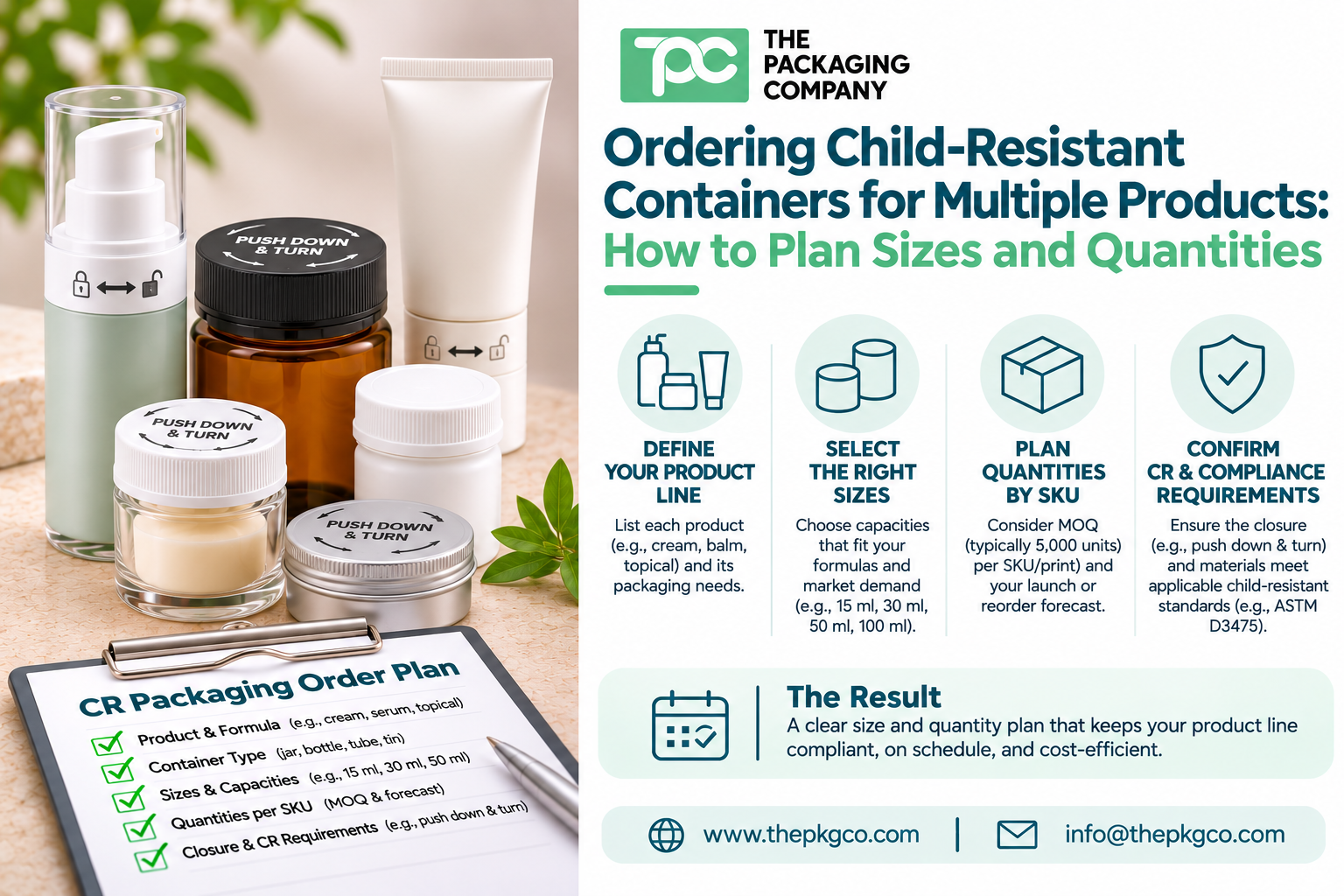
A product line may require glass jars for one SKU, child-resistant tubes for another, and pump bottles for topical applications. Although these products belong to the same collection, their packaging requirements and inventory needs can differ considerably.
For purchasing teams, the priority is to plan each container order around actual product demand while keeping packaging specifications and replenishment schedules organized.
1. Map Each Product to Its Required Container
Before requesting quotations, create a packaging list for every product in the collection. This helps prevent confusion when several SKUs use similar-looking containers with different capacities or closures.
For example, a product line might include:
- Product A: 30ml child-resistant glass jar for a concentrated topical product.
- Product B: 60ml child-resistant squeeze tube for a lotion or cream.
- Product C: 15ml child-resistant airless pump bottle for a targeted treatment.
- Product D: Larger child-resistant jar for a separate product format.
Each product should have its own packaging reference, target capacity, closure specification, and estimated purchasing quantity.
TPC offers several child-resistant container formats, including jars, tubes, bottles, and other specialty packaging. Available capacities and configurations depend on the selected product.
2. Separate Packaging Demand From Product Forecasts
One common purchasing mistake is ordering the same number of containers for every product simply because the products belong to the same collection.
In practice, sales demand may vary substantially between SKUs.
Consider a brand forecasting the following annual product demand:
| Product | Annual Forecast | Quarterly Average |
|---|---|---|
| Topical Cream A | 24,000 units | 6,000 units |
| Serum B | 12,000 units | 3,000 units |
| Balm C | 8,000 units | 2,000 units |
Illustrative planning example only; these figures are not TPC order minimums.
Although the products launch together, their packaging consumption rates are different. Ordering identical quantities for every SKU could create excess inventory for slower-moving products.
Purchasing teams should compare expected product demand with supplier minimum order quantities, available storage, and the planned production schedule.
3. Understand How Different Container Formats Affect Order Quantities
Not all child-resistant packaging formats have identical production requirements.
A glass jar, plastic bottle, and squeeze tube may use different manufacturing processes, components, and decoration methods. As a result, buyers should not assume that the minimum order quantity for one container automatically applies to another.
For many custom packaging projects, TPC’s typical minimum is approximately 5,000 units per SKU or print run, while squeeze tube projects generally require 10,000 units. Actual requirements must be confirmed for each selected child-resistant product.
When comparing quotations, ask whether quantities are calculated separately for each size, decoration design, or container configuration.
This is especially important when several products use similar packaging but require different artwork or closure assemblies.
4. Avoid Excess Inventory When Managing Multiple SKUs
Excess packaging inventory ties up capital and creates additional storage requirements. However, ordering too little can interrupt filling schedules or delay replenishment.
For child-resistant containers, brands should also consider whether their selected packaging configuration is likely to remain unchanged throughout the product’s lifecycle.
Keep a Record of Approved Packaging Configurations
Maintain the container SKU, material, capacity, closure reference, decoration specifications, and applicable child-resistant documentation for each product.
This information helps the purchasing team identify the correct packaging during repeat orders and avoid accidentally substituting a different component.
Review Demand Before Every Reorder
Compare actual sales and packaging consumption against the original forecast. A product that sells faster than expected may require more frequent replenishment, while slower-moving products may not justify additional packaging inventory.
Separating inventory decisions by SKU gives buyers better control over working capital.
5. Coordinate Child-Resistant Packaging Orders With Filling Partners
Container availability is only one part of a successful production schedule. Brands should also consider how packaging arrives at the filling facility and whether the approved components match the filling equipment.
Before confirming a bulk order, coordinate the following:
- Approved container and closure configurations for each SKU.
- Packaging quantities required for each filling run.
- Expected filling dates and receiving arrangements.
- Allowance for filling-line setup, testing, and normal production loss.
- Inspection requirements when the packaging arrives.
For products requiring child-resistant packaging, the complete packaging system should also be reviewed against the applicable regulatory requirements.
Changes to the closure, container, or other tested components should not be treated as interchangeable without reviewing their compliance implications.
6. Prepare a Consolidated Packaging Request
When sourcing several products from one supplier, a consolidated request can make the quotation process more efficient.
Instead of sending separate inquiries without context, prepare a list showing all proposed container formats and quantities.
Include the following information for each SKU:
- Product type: Cream, serum, balm, oil, or another application.
- Container format: Child-resistant jar, tube, bottle, or other format.
- Capacity: Required fill volume and preferred dimensions.
- Material: Glass, plastic, aluminum, or another suitable option.
- Decoration: Colors, printing, labeling, or custom finishes.
- Quantity: Estimated initial order and anticipated reorder volume.
- Destination market: The market where the packaged product will be distributed.
A consolidated request does not necessarily mean all products can share one production minimum. It allows the supplier to evaluate the complete project and clarify requirements for each packaging configuration.
Frequently Asked Questions About Ordering Child-Resistant Containers
Can different child-resistant container sizes be combined to meet one MOQ?
Not necessarily. Minimum order quantities may apply separately to each container size, design, or decoration run. Buyers should confirm whether quantities can be combined for their specific products before placing an order.
Should brands order the same quantity of containers for every product?
No. Quantities should reflect expected sales, product demand, supplier minimums, and inventory capacity. Products with different sales volumes may require different purchasing and replenishment schedules.
Can one brand use child-resistant jars, tubes, and bottles in the same collection?
Yes. Different products may require different packaging formats. Brands can maintain a coordinated appearance through colors and decoration while selecting a suitable child-resistant system for each application.
What information is needed to order wholesale child-resistant containers?
Buyers should prepare container type, material, capacity, estimated quantity, decoration requirements, intended application, destination market, and any relevant child-resistant compliance requirements.
How should brands manage repeat orders for child-resistant packaging?
Maintain approved container and closure specifications for each SKU. Review current inventory, forecast demand, confirm component availability, and allow sufficient time for manufacturing, inspection, and delivery.
Plan Child-Resistant Packaging Around the Entire Product Line
Ordering child-resistant containers for multiple products requires more than choosing the right jar, bottle, or tube. Buyers need to understand how each packaging configuration affects order quantities, inventory investment, and filling schedules.
By organizing packaging specifications and demand forecasts at the SKU level, brands can make more informed purchasing decisions while maintaining consistency across their product collections.
The Packaging Company supports brands sourcing wholesale child-resistant containers and custom child-resistant packaging for bulk production.
Explore our Child-Resistant Packaging Collection or contact our packaging team to discuss container options, production quantities, and sample requirements for your next project.