



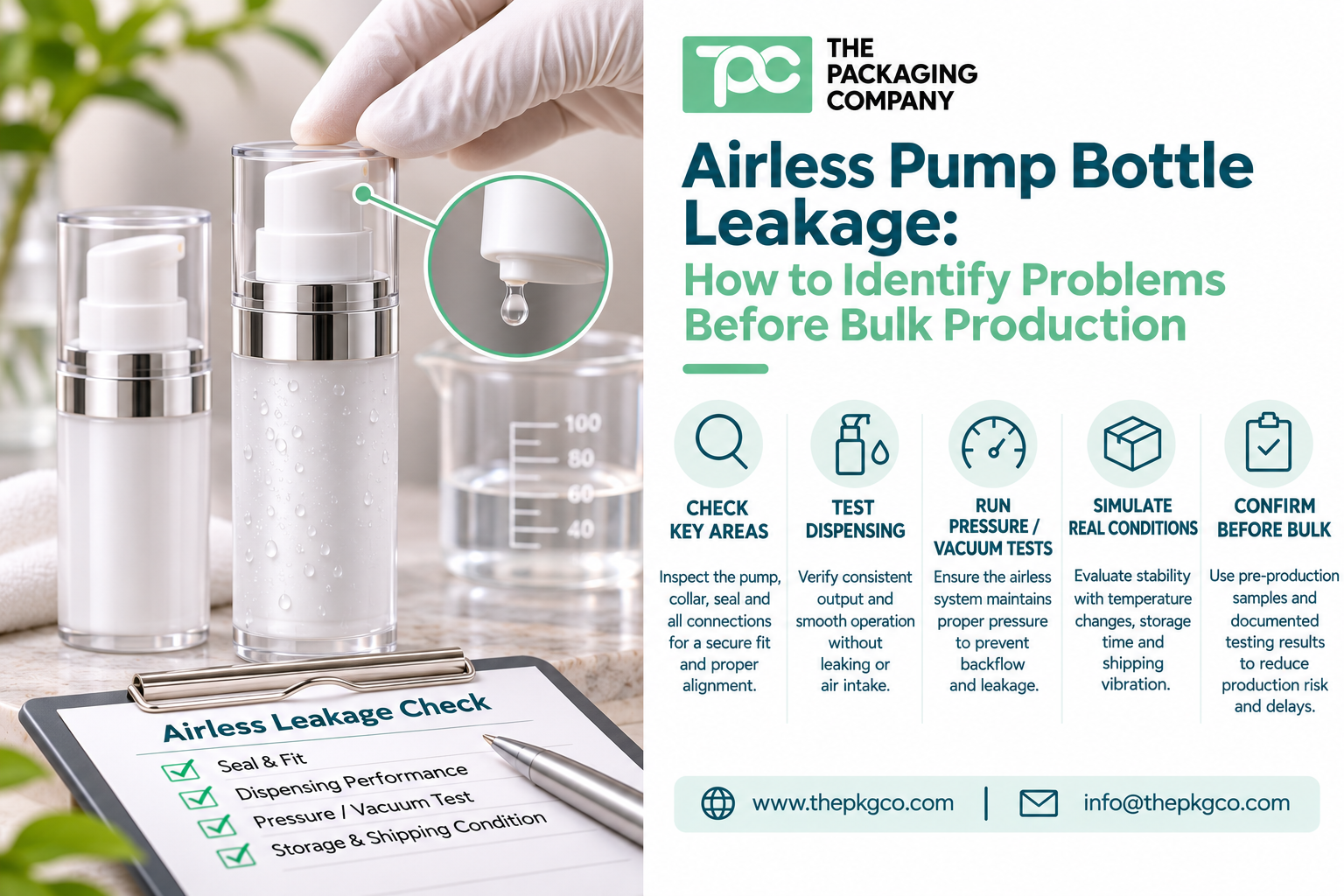
An airless pump bottle can look flawless during a packaging presentation but still develop leakage problems during filling, shipping, storage, or consumer use.
For skincare brands preparing to place a wholesale packaging order, identifying potential leakage risks during sample evaluation can help avoid costly production changes and product complaints.
Leakage does not always indicate that the bottle itself is defective. The issue may involve component assembly, sealing surfaces, formula compatibility, filling conditions, or transportation stress.
Understanding where a problem originates is the first step toward selecting a reliable packaging configuration.
Why Airless Pump Bottle Leakage Happens
Airless packaging is designed to dispense product through a controlled mechanism, but it is not automatically leak-proof.
Different components must work together to maintain the intended seal and dispensing performance.
Potential causes of airless pump bottle leakage include:
- Incorrectly assembled pump components.
- Damaged or improperly seated seals.
- Incompatible bottle and pump connections.
- Formula-related compatibility issues.
- Excessive or unsuitable filling conditions.
- Component movement during transportation.
- Manufacturing defects or dimensional variation.
Identifying the source of leakage early allows brands to distinguish between component defects, filling issues, and packaging compatibility concerns.
A systematic evaluation is more useful than rejecting an entire packaging design after observing one unsuccessful sample.
1. Identify the Exact Leakage Location
The first step is determining where the product escapes.
Inspect the dispensing nozzle, pump head, neck or collar, seals, and bottle body.
For example, product residue around the dispensing opening may have a different cause from leakage between the pump assembly and the bottle.
Record when the leakage appears.
Does it occur immediately after filling, during repeated dispensing, after storage, or following transportation?
These observations help the supplier narrow down potential causes.
Brands should also photograph the affected area and retain the sample identification information.
This creates a clearer record for investigating recurring issues.
2. Test With the Intended Skincare Formula
A packaging sample may perform well during a basic water test but behave differently when filled with the actual skincare product.
Formula viscosity, ingredients, and dispensing characteristics can influence pump operation and sealing performance.
For example, a lightweight serum may flow differently from a thicker cream or lotion.
When possible, conduct airless bottle leak testing using the intended formula, planned fill volume, and representative filling conditions.
Brands should coordinate with their packaging supplier and filling partner to confirm:
- The formula used during testing.
- The planned fill volume.
- The filling and assembly procedure.
- The packaging components being evaluated.
- The conditions under which leakage will be assessed.
Testing with representative conditions provides more useful information than relying on appearance alone.
3. Inspect Seals and Component Assembly
A properly designed airless bottle can still experience leakage if its components are assembled incorrectly.
Check that the pump, seals, and connecting components are installed according to the manufacturer’s specifications.
A documented inspection process is an important part of airless packaging quality control, particularly when multiple components are assembled before filling.
During evaluation, inspect:
- Seal placement and condition.
- Pump-to-bottle connection.
- Visible gaps between components.
- Assembly consistency across samples.
- Changes in fit after repeated handling.
If a component is replaced or modified, the revised assembly should be evaluated before production approval.
Even small dimensional differences can affect how components fit together.
4. Simulate Storage and Transportation Conditions
Packaging that performs correctly during initial filling may experience different stresses during distribution.
Temperature changes, vibration, orientation, and handling can influence package performance.
Depending on the product and distribution route, sample evaluation may include:
- Upright and inverted storage.
- Repeated dispensing.
- Temperature exposure.
- Transportation or vibration simulations.
- Inspection after a defined observation period.
Cosmetic packaging leak testing should reflect the intended formula, packaging configuration, and distribution conditions rather than relying on a single generic test.
The appropriate test methods and acceptance criteria should be established with the packaging supplier and qualified testing team.
No single informal test can guarantee leak-free performance in every shipping environment.
5. Evaluate Multiple Samples Before Making a Decision
One leaking sample does not necessarily mean every bottle in the production batch will fail.
However, it should not be ignored.
Brands should investigate whether the issue is isolated or repeatable.
For example, if several samples leak at the same connection point under similar conditions, the pattern may indicate an assembly or component compatibility problem.
If only one sample is affected, additional inspection may help determine whether the cause was handling damage or an individual defect.
Record the sample quantity, test conditions, and observed results.
A consistent evaluation method helps brands and suppliers make better decisions before bulk production.
6. Establish Clear Approval Criteria
Before confirming a wholesale order, buyers should agree on what constitutes acceptable packaging performance.
The approval process should identify the exact bottle, pump, seal, and component specifications being evaluated.
It should also document the formula, fill volume, testing conditions, and any relevant performance requirements.
A practical approval checklist includes:
- Confirming the complete packaging configuration.
- Reviewing component and seal specifications.
- Testing with representative formula and filling conditions.
- Documenting leakage observations.
- Establishing clear pass/fail criteria.
- Investigating any failed samples.
- Confirming whether revised samples require additional approval.
Working with an experienced airless pump bottle manufacturer can help brands clarify component specifications, sample evaluation requirements, and production approval criteria.
This is particularly important when packaging designs are customized or when components are sourced from different production batches.
Reducing Leakage Risks Before Bulk Production
Preventing leakage problems starts with selecting compatible components and evaluating the complete packaging assembly.
For skincare brands, testing should extend beyond the bottle’s appearance to include pump operation, sealing performance, formula compatibility, and realistic handling conditions.
Documenting these requirements before bulk production can help purchasing, product development, and filling partners work from the same approved specifications.
The Packaging Company offers wholesale airless packaging options for skincare and cosmetic brands evaluating different bottle sizes, dispensing systems, and customization requirements.
Explore our airless pump bottles for skincare packaging and read our related article on changing an airless pump on an existing bottle when evaluating component substitutions.
Preparing for an airless packaging order? Contact The Packaging Company to discuss available bottle configurations, request samples, and review packaging specifications before production.
Frequently Asked Questions
Can an airless pump bottle still leak?
Yes. Airless dispensing helps control product delivery, but leakage can still occur because of damaged seals, incorrect assembly, component incompatibility, or unsuitable filling and transportation conditions.
How do you test an airless pump bottle for leakage?
Testing may include checking component seals, evaluating filled samples in different orientations, repeated dispensing, and appropriate transportation or temperature simulations. The methods should reflect the intended formula and distribution conditions.
Should airless pump bottles be tested with the actual skincare formula?
Yes, whenever practical. Formula viscosity and ingredient compatibility can affect dispensing and sealing performance. Testing with the intended formula provides more useful information than appearance checks alone.
What causes an airless pump bottle to leak during shipping?
Potential causes include component movement, inadequate sealing, assembly defects, temperature-related changes, and transportation stress. The exact cause should be investigated using representative filled samples.
What should buyers do if an airless pump bottle sample leaks?
Record the leakage location, sample identification, formula, and test conditions. Ask the supplier to investigate the failure and confirm corrective actions before approving bulk production.