


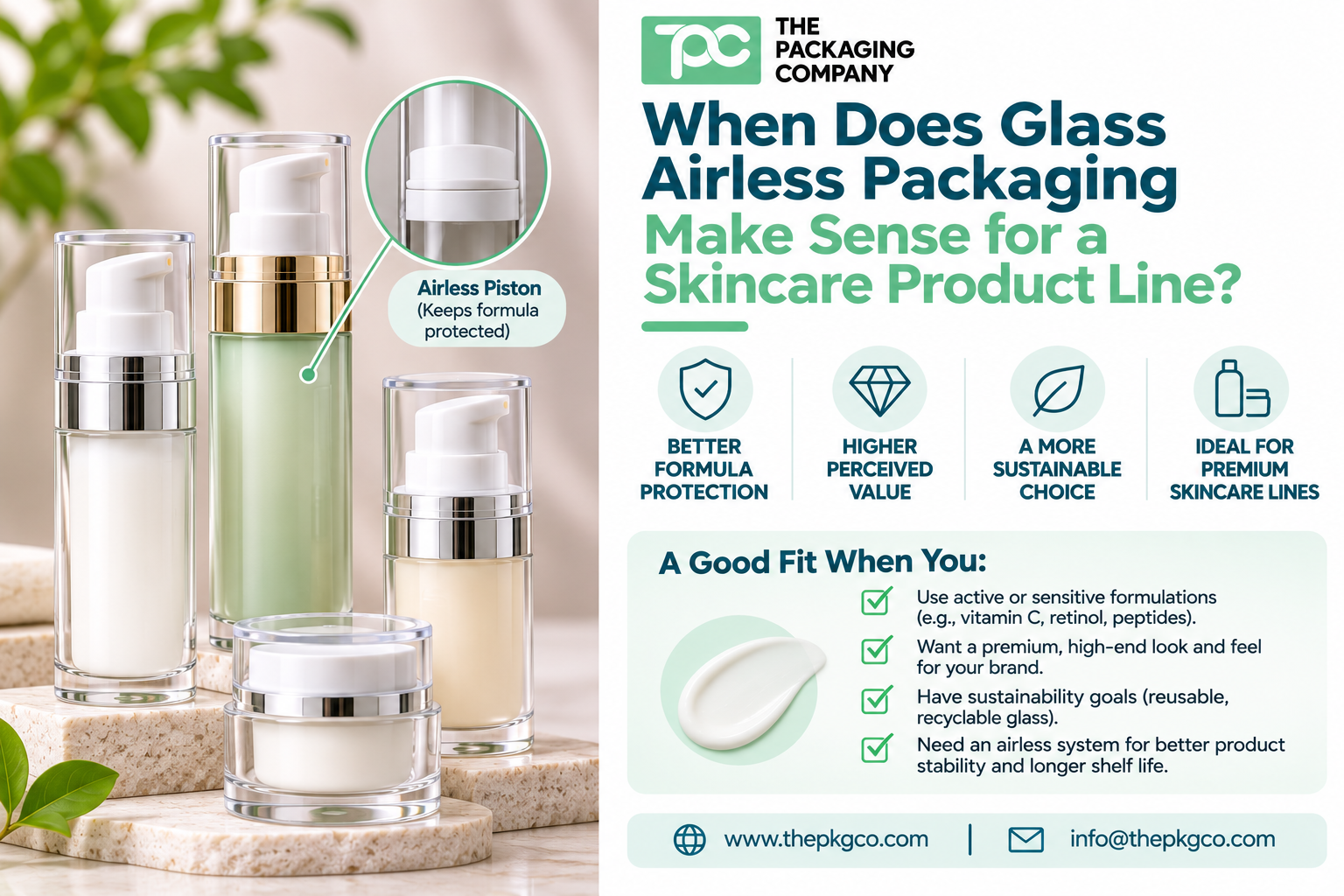
A glass airless bottle may be a strong fit for a premium facial serum, but the same format may not be necessary for every moisturizer, treatment, or travel product in a collection.
The decision should begin with a practical question: Will glass packaging create enough value for this particular product to justify its cost and handling requirements?
1. When Glass Packaging Supports a Premium Price Point
Glass airless pump bottles are worth considering when packaging presentation plays an important role in how customers evaluate a product.
For example, a skincare brand selling a $120 facial treatment may have more room to invest in premium components than a brand selling an everyday $20 moisturizer.
Glass can contribute to a substantial, high-end feel, particularly when paired with carefully selected finishes, decoration, and coordinated secondary packaging.
However, a higher-cost bottle does not automatically create a higher-value product. Brands should determine whether the packaging supports their intended retail price, customer expectations, and competitive positioning.
2. Calculate the Total Packaging Cost, Not Just the Bottle Price
When comparing glass airless packaging with plastic airless alternatives, the unit quotation is only one part of the purchasing decision.
Additional considerations include:
- Decoration: Custom finishes, printing, and color requirements.
- Secondary packaging: Cartons, protective inserts, and shipping materials.
- Transportation: Freight costs associated with package weight and volume.
- Handling: Potential damage or replacement costs throughout distribution.
- Order quantity: The effect of minimum order quantities on inventory investment.
For purchasing teams, the more useful comparison is the landed packaging cost per finished unit.
This provides a clearer picture of how different materials may affect product margins before an order is approved.
3. Consider Where and How the Product Will Be Sold
Premium Retail and Professional Skincare
For products sold through premium retailers, spas, or professional skincare channels, glass can reinforce an upscale presentation and support the brand’s positioning.
The appearance and physical feel of the packaging may contribute to the overall customer experience, particularly for products positioned as signature treatments.
Direct-to-Consumer Ecommerce
For ecommerce brands, packaging must also perform throughout fulfillment and delivery.
Glass airless bottles may require additional protective packaging to reduce the risk of damage during parcel transportation. These requirements should be considered alongside product photography, presentation, and customer unboxing expectations.
Travel and Everyday Products
For products frequently carried in handbags, luggage, or gym bags, lighter packaging may offer greater convenience.
Brands developing travel-oriented products should evaluate whether glass is consistent with the way customers will use the product.
4. Decide Which Products Actually Need Glass
A skincare collection does not need to use the same packaging material across every SKU to maintain a consistent brand identity.
Consider a three-product skincare line:
- Premium facial serum: Glass airless packaging to emphasize its flagship position.
- Daily moisturizer: PP airless pump bottle to balance functionality and packaging cost.
- Travel treatment: A compact, lightweight airless bottle designed for convenience.
These products can still share a coordinated visual identity through colors, printing, logos, and packaging finishes.
This strategy allows brands to invest more heavily in packaging where it has the strongest commercial justification.
Explore TPC’s Glass Airless Pump Bottles category to review available styles for premium skincare applications.
5. Review the Product Configuration Before Making a Final Decision
After determining that glass makes sense commercially, the next step is to identify a suitable packaging configuration.
Brands should review capacity, pump output, available decoration, and the compatibility of the complete dispensing system with their formula.
For example, TPC offers a Refillable Glass Airless Pump Bottle in 15ml, 30ml, and 50ml sizes. This product includes options for PP or PCR inner inserts, allowing brands to evaluate different material configurations.
Physical samples should be tested with the intended formulation before approving bulk production. Formula compatibility, filling performance, leakage, and dispensing consistency should be confirmed by the brand and its filling partner.
6. A Practical Decision Framework for Skincare Brands
Before selecting glass airless packaging, evaluate the proposed product against four commercial considerations:
- Brand positioning: Does the product need a premium packaging presentation?
- Product margin: Can the selling price support the complete packaging cost?
- Distribution: Can the packaging be shipped and handled efficiently?
- Product-line strategy: Is glass necessary for the entire collection or only selected SKUs?
If glass supports the product’s positioning while meeting budget and distribution requirements, it may be an appropriate investment.
If the additional cost does not support a meaningful business objective, other airless materials may provide a more practical solution.
Frequently Asked Questions About Glass Airless Packaging
Is glass airless packaging suitable for every skincare product?
No. Glass airless packaging may be appropriate for premium serums, moisturizers, and treatments, but suitability depends on the product’s positioning, usage, distribution requirements, and formula compatibility.
Does glass airless packaging cost more than plastic airless packaging?
Glass airless configurations may involve higher component, shipping, or handling costs. The actual difference depends on the selected design, decoration, order quantity, and transportation requirements. Buyers should compare complete landed costs.
Can a skincare brand use glass airless bottles for only one product?
Yes. Brands can select glass for premium or flagship products while using other airless formats across the remaining collection. Coordinated colors and decoration can maintain a consistent brand identity.
What sizes are available for glass airless pump bottles?
Available sizes vary by product. TPC offers certain glass airless pump bottle configurations in 15ml, 30ml, and 50ml sizes. Buyers should confirm available capacities and customization options for the selected design.
What should brands prepare before requesting a glass airless packaging quote?
Prepare the target bottle capacity, estimated order quantity, number of SKUs, preferred decoration, product application, and any special dispensing requirements. These details help suppliers recommend suitable packaging options.
Choosing the Right Glass Airless Packaging Supplier
Glass airless packaging should support both the product’s presentation and its commercial requirements. Before proceeding with production, skincare brands should evaluate the design, total packaging cost, intended distribution channels, and available product configurations.
The Packaging Company works with skincare and cosmetic brands sourcing glass airless pump bottles and other custom packaging solutions for bulk production.
Ready to review packaging options for your skincare line? Browse our Glass Airless Packaging Collection or contact our team to discuss product options and request samples.