



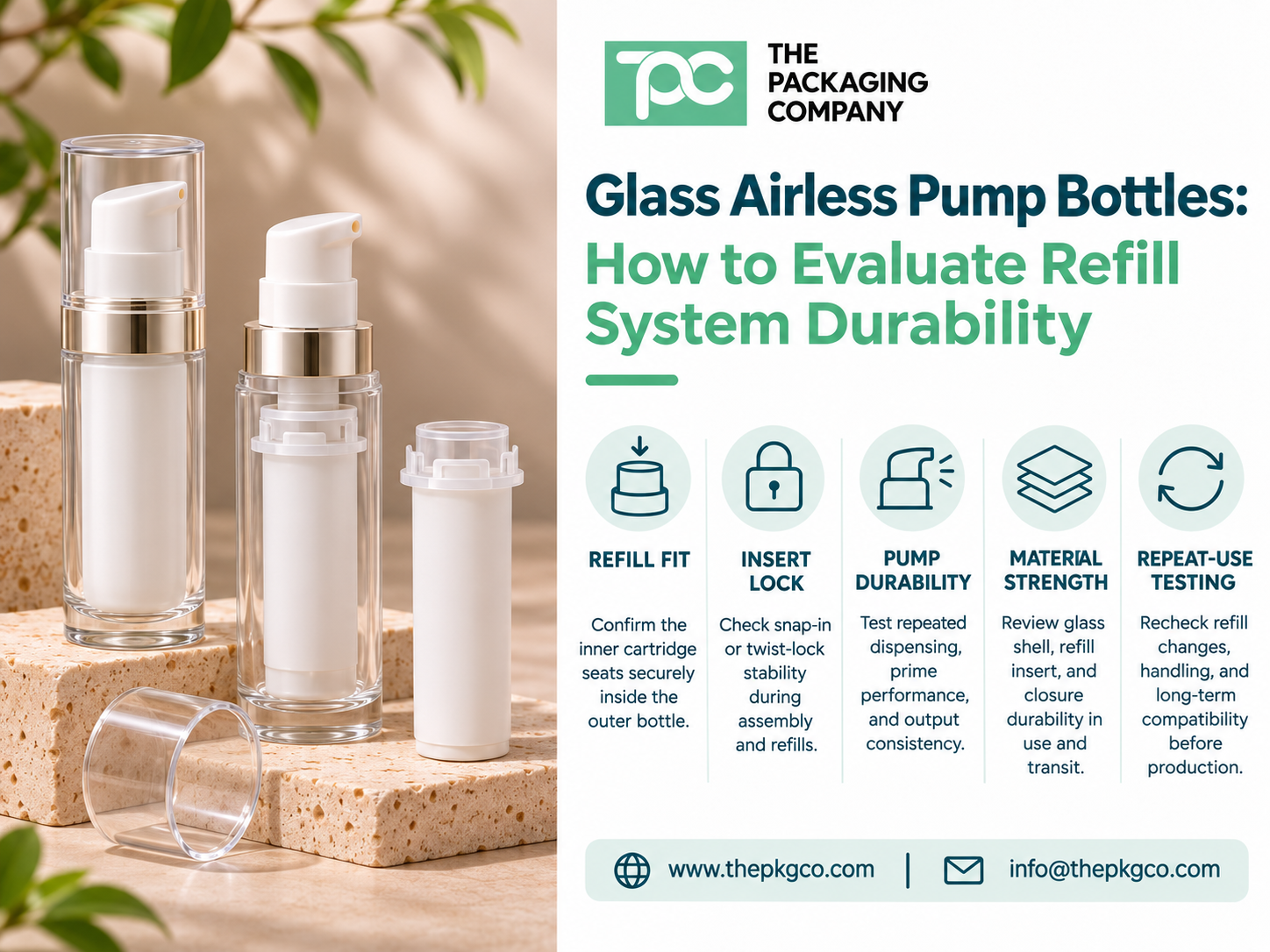
Glass Airless Pump Bottles: How to Evaluate Refill System Durability
Refillable packaging is becoming an important consideration for skincare brands looking to combine premium presentation with a more reusable packaging design. Refillable glass airless bottles offer the appearance of luxury glass packaging alongside the controlled dispensing benefits of an airless system.
However, choosing a refillable design involves more than selecting an attractive bottle.
A refillable system must remain functional after the inner container has been removed and replaced. If the cartridge becomes loose, the pump no longer aligns correctly, or the replacement process is difficult, the packaging may create problems for both the brand and its customers.
For skincare brands sourcing glass airless pump bottles, evaluating refill-system durability before bulk production can help identify these issues early and establish clear expectations for future refill orders.
Understanding How a Refillable Glass Airless System Works
A refillable glass airless bottle typically consists of several components that work together to protect and dispense the formula.
Depending on the design, these may include:
- Outer glass bottle: Provides the external appearance and may be retained for repeated use.
- Inner refill container: Holds the skincare formula and is replaced when empty.
- Airless dispensing mechanism: Controls product delivery through the pump system.
- Retention or locking components: Keep the refill container positioned securely inside the outer bottle.
The durability of an airless bottle refill system depends on how these components interact during repeated cartridge replacement, rather than the performance of any individual component alone. Not every glass airless bottle uses the same construction. Some designs allow the inner container to be removed independently, while others require a more complete replacement assembly.
Before choosing a refillable glass airless bottle, brands should confirm which components are intended to be reused and which must be replaced with each refill.
This distinction affects packaging costs, consumer instructions, component inventory, and future reorders.
Why Refill-System Durability Matters
A refillable bottle may perform well during initial product testing but develop problems after repeated cartridge changes.
For example, a refill container may fit securely during the first installation but gradually become less stable if the retention mechanism wears or becomes damaged.
Similarly, a pump assembly that operates correctly with the original cartridge may become misaligned if a replacement cartridge is not installed consistently.
These issues can affect the customer experience even when the outer glass bottle remains in excellent condition.
For skincare brands positioning their products as premium refillable packaging, the durability of the complete assembly is just as important as the visual quality of the glass.
1. Evaluate Cartridge Fit and Retention
One of the first areas to examine is how the inner refill container fits inside the outer glass bottle.
The cartridge should remain properly positioned during normal handling and dispensing, while still allowing removal according to the manufacturer’s intended procedure.
During sample evaluation, check whether:
- The refill cartridge fits securely without excessive movement.
- The locking or retention mechanism engages consistently.
- The cartridge can be removed without damaging surrounding components.
- Reinstallation produces the same fit as the original assembly.
- The pump remains correctly aligned after the cartridge is replaced.
For example, if the inner cartridge shifts when the pump is pressed, the movement may affect dispensing consistency or create an undesirable packaging experience.
Brands should evaluate multiple samples rather than relying on a single assembled bottle.
2. Test Repeated Refill Removal and Installation
A refillable glass airless bottle should be evaluated beyond its first use.
Repeated removal and installation can reveal issues that are not visible during an initial sample inspection.
A practical evaluation may involve removing and reinstalling the inner container multiple times while observing the condition of the retention features and surrounding components.
Pay attention to:
- Increasing difficulty when removing or inserting the cartridge.
- Looseness after repeated replacement.
- Wear on plastic locking components.
- Changes in pump alignment.
- Cracks, deformation, or other visible damage.
There is no universal number of refill cycles that guarantees durability for every design.
Instead, brands should discuss the intended usage expectations with the packaging manufacturer and agree on appropriate sample-evaluation criteria.
For a skincare product intended to support repeated refill purchases, this evaluation is particularly important.
3. Confirm Pump Performance After Cartridge Replacement
A refillable bottle must do more than hold a replacement cartridge securely. It must also maintain consistent dispensing performance.
After installing a new refill container, test whether the pump operates as intended.
Important observations include:
- Whether the pump primes correctly.
- Whether the dispensing output remains consistent.
- Whether the pump head remains securely attached.
- Whether the cartridge and pump assembly remain aligned.
- Whether product residue or leakage appears around component connections.
Brands should also evaluate the packaging with the intended skincare formula whenever practical.
Formula viscosity, filling conditions, and the specific dispensing mechanism can influence performance.
For example, a lightweight serum and a thicker skincare cream may behave differently when dispensed through the same pump configuration.
Testing with a representative formula helps determine whether the selected glass airless packaging is suitable for the intended application.
4. Examine Component Compatibility and Replacement Consistency
Refillable packaging often involves multiple components that must remain compatible across future production orders.
A refill cartridge that looks similar to the original may not necessarily have identical dimensions or connection features.
Small differences in component specifications can affect how securely the refill fits or how the pump operates.
Before approving a refillable system, brands should confirm:
- The exact cartridge model and dimensions.
- The compatible pump and outer bottle specifications.
- Whether multiple bottle sizes share the same refill components.
- Whether replacement cartridges are available for future production.
- How component revisions will be communicated and approved.
This is especially relevant for brands planning multiple skincare SKUs using a coordinated packaging design.
If different products require different cartridge sizes or dispensing systems, those differences should be documented before the packaging program is finalized.
5. Consider the Consumer Refill Experience
The durability of a refillable glass airless bottle also depends on how consumers interact with the packaging.
A refill system may perform well during controlled testing but still create frustration if customers cannot easily understand how to replace the cartridge.
During evaluation, consider whether the replacement process is intuitive and whether the refill can be installed correctly without specialized tools.
Brands should review:
- How customers identify the refill-release mechanism.
- Whether the cartridge can be removed comfortably.
- Whether the replacement process requires excessive force.
- Whether the cartridge locks into position clearly.
- Whether written or visual refill instructions are necessary.
The goal is to provide a consistent experience while reducing the risk of incorrect assembly.
For premium skincare packaging, an easy-to-use refill system can contribute to a more positive customer experience and support future refill purchases.
6. Review Durability Before Approving Bulk Production
Before placing a wholesale order, brands should establish clear expectations for the complete packaging assembly.
A production-representative sample should include the outer glass bottle, inner cartridge, pump, and all required connecting components.
The evaluation should reflect the actual configuration intended for production.
A useful pre-production checklist includes:
- Confirming which components are reusable and which are replaceable.
- Testing cartridge installation and removal.
- Inspecting retention features after repeated use.
- Checking pump performance with replacement cartridges.
- Reviewing compatibility with the intended skincare formula.
- Confirming dimensional specifications for future refill orders.
- Documenting sample approval criteria and any required changes.
If a component is modified after sample approval, the brand should determine whether additional evaluation is needed before proceeding with bulk production.
This helps prevent differences between approved samples and production packaging.
Choosing Glass Airless Packaging for a Refillable Skincare Line
Refillable glass airless packaging can be an attractive option for skincare brands seeking premium presentation and a reusable outer container.
However, the long-term value of the packaging depends on more than the glass finish.
Cartridge retention, pump compatibility, component durability, and the consumer replacement process all influence whether the refill system will perform consistently.
Brands should evaluate the complete assembly, document approved specifications, and confirm replacement-component availability before committing to bulk production.
At The Packaging Company, we work with beauty and skincare brands sourcing wholesale cosmetic packaging, including glass airless and refillable airless options.
Explore our glass airless pump bottles or browse our broader airless packaging collection to compare packaging configurations for your next skincare project.
Planning a refillable skincare packaging line? Contact The Packaging Company to discuss available glass airless options, request samples, and review the component specifications relevant to your product.
Frequently Asked Questions
Are all glass airless pump bottles refillable?
No. Glass airless bottles are available in different configurations. Some feature replaceable inner containers, while others are designed as complete packaging units. Confirm the refill mechanism and component construction before ordering.
How many times can a glass airless bottle be refilled?
There is no universal refill-cycle limit. Durability depends on the bottle design, materials, retention mechanism, and handling conditions. Brands should request product-specific durability information and evaluate samples based on their intended use.
What should buyers check when evaluating a refillable glass airless bottle?
Buyers should evaluate cartridge fit, repeated removal and installation, pump performance, component wear, and compatibility with the intended skincare formula. Testing should include the complete packaging assembly rather than the glass exterior alone.
Can the same refill cartridge fit multiple glass bottle sizes?
Not necessarily. Refill cartridges must match the dimensions and mechanical specifications of the intended bottle and pump assembly. Confirm compatibility for each size and configuration with the manufacturer.
Can refillable glass airless bottles be customized?
Depending on the selected packaging design, customization options may include colors, decoration, finishes, and certain component configurations. Brands should confirm available options, sample requirements, and production specifications before placing a wholesale order.