



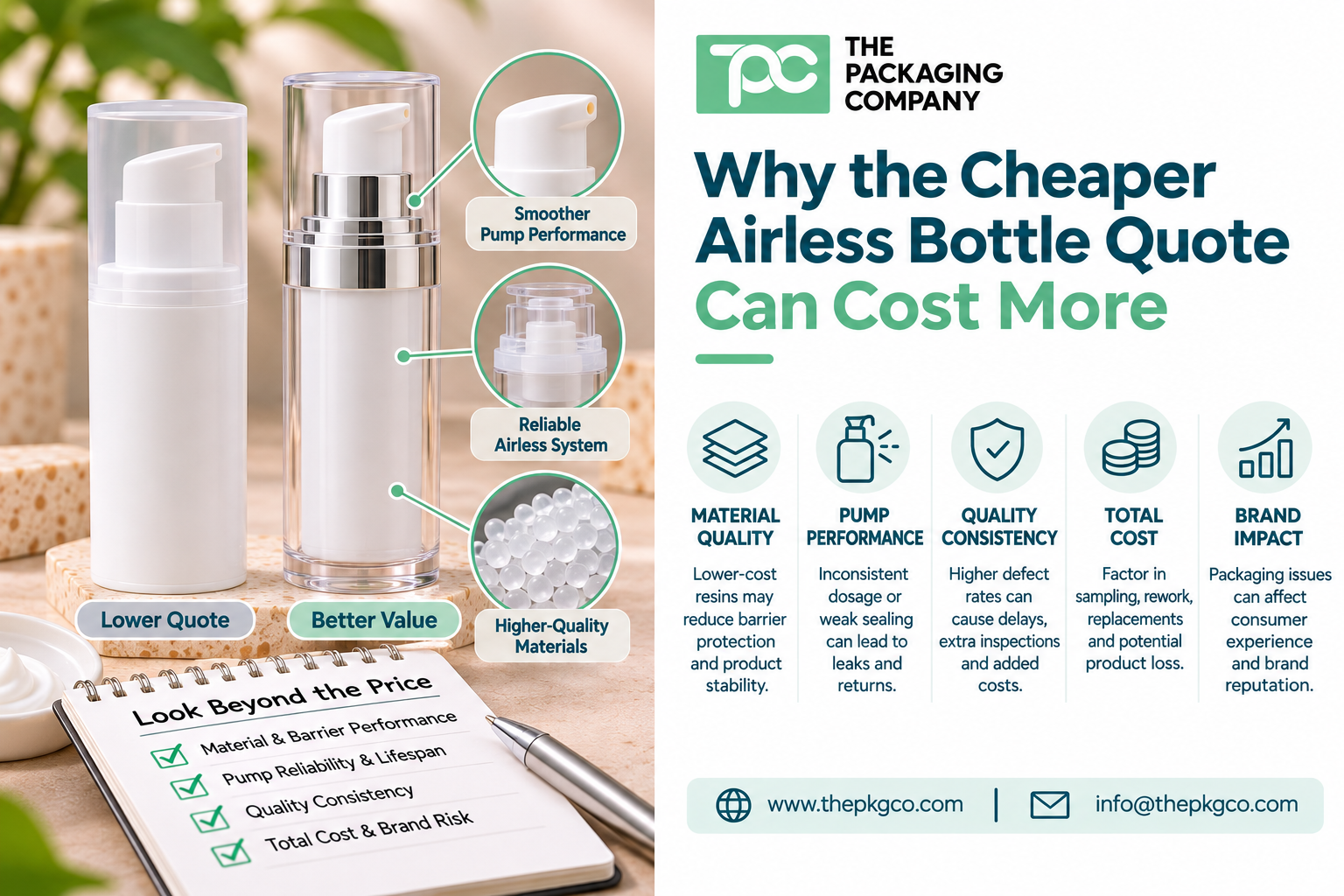
A skincare brand requests prices for 5,000 custom 30 mL airless bottles. Supplier A responds with a unit price of $0.82. Supplier B quotes $1.08. At first glance, Supplier A appears to offer the better deal.
But when the purchasing team checks the line items, Supplier A’s price covers only the bottle body. The pump assembly, decoration, setup charges, and freight appear separately. Supplier B’s higher unit price includes more of the finished packaging. The lower advertised price may not be the lower project cost.
That is the problem with comparing an airless bottle quote by unit price alone. For skincare brands preparing a wholesale order, the right comparison is the cost of receiving the same approved packaging configuration, at the same quantity, on a comparable delivery basis.
Below is an illustrative two-supplier example followed by a practical way to compare the costs and specifications without confusing a cheaper component price with a better complete-package quotation.
Two Airless Bottle Quotes for the Same 30 mL Project
Assume a skincare brand needs 5,000 finished 30 mL airless pump bottles for a serum launch. Its intended package includes a bottle body, an operating pump and actuator, an overcap, and custom decoration. The brand has asked both suppliers for the same destination and a comparable delivery estimate.
Illustrative example only: All prices below are hypothetical for explaining quotation structure. They are not TPC prices, supplier offers, current market averages, or guaranteed production costs. Taxes, customs duties, and other unspecified charges are excluded. The quotes still require a technical specification review before they can be considered equivalent.
| Quotation line item | Supplier A | Supplier B |
|---|---|---|
| Advertised base price per unit | $0.82 | $1.08 |
| Scope of base unit price | Bottle body only | Bottle, pump assembly, actuator, overcap, and printing |
| Base price for 5,000 units | $4,100 | $5,400 |
| Pump, actuator, and overcap | +$1,200 | Included |
| Custom printing | +$700 | Included |
| Setup and sample charges | +$300 | +$200 |
| Estimated freight to the same destination | +$850 | +$750 |
| Illustrative total | $7,150 | $6,350 |
| Illustrative effective cost per unit | $1.43 | $1.27 |
Supplier A’s advertised unit price is $0.26 lower. Yet after the listed items are added, its hypothetical project total is $800 higher. That is a meaningful difference for an order of 5,000 units, before considering any charges or qualifications not represented in the example.
Neither quotation should be approved from this table alone. The buyer must still confirm that the two suppliers are offering equivalent airless systems, customization, acceptance criteria, and delivery obligations. An apparent saving is not useful if the resulting package does not meet the product requirements.
1. Check Whether the Unit Price Covers the Complete Airless System
Unlike a basic empty container, an airless pump bottle depends on multiple components working together. In a purchasing discussion, “30 mL airless bottle” might refer to a complete ready-to-fill assembly, a component set with assembly required, or only part of the proposed configuration.
Before comparing prices, ask each supplier to itemize what is included. Depending on the design, that can mean the bottle body, internal mechanism or piston, pump, actuator, overcap, and any other required components. Confirm whether components are supplied assembled, and whether a different option or finish affects the price.
The comparison must also identify the same actual capacity and configuration. Two airless packages can have a similar appearance while using different mechanisms or component materials. If one quote is for a mono-material PP design and another for a different construction, the buyer is comparing two product specifications, not just two suppliers.
For available formats, explore TPC’s airless packaging range before finalizing which system each supplier should quote.
2. Normalize Quantity, MOQ, and Customization Scope
The example uses 5,000 units for both quotations. That matters because a price calculated at 10,000 pieces is not directly comparable with a price calculated at 5,000. Ask whether the quoted quantity applies to each SKU, bottle size, color, and print variation—or whether the supplier has combined several variations to reach the stated price.
For many TPC airless packaging projects, the general MOQ begins around 5,000 units per SKU or print run, although the precise minimum depends on the configuration and customization. Confirm project-specific quantities rather than assuming every option can be ordered under identical terms.
Next, identify which finishes and decoration processes the unit price covers. A plain stock-color component and a custom-colored, printed component may require different processes and charges. Ask whether color matching, artwork preparation, printing, special finishing, or tooling are already included, and which costs are one-time versus recurring.
A useful comparison separates a one-time setup expense from the price that will apply to a repeat order. Two suppliers can have similar first-order totals but very different economics on future orders.
3. Ask What the Sample and Approval Charges Actually Include
The $300 and $200 charges in our example are only placeholders. In a real quotation, the buyer should know whether the amount covers available stock samples, shipping of sample components, custom sample development, setup, or other approval work.
At TPC, available stock samples are reviewed before placing an order. For a custom order, a pre-production sample (PPS) is typically reviewed after the order has been placed and before bulk manufacturing. The quotation should make clear any applicable sample, development, and approval charges.
Do not assume that a sample viewed in a catalog establishes suitability for the actual skincare formula. The brand and its formulation or filling partners should review the filled-package system and required performance, including pump operation, priming, output, and compatibility where relevant.
Our airless packaging supplier sampling checklist explains those evaluations in detail. The present comparison focuses on whether their cost and approval sequence have been reflected in each price.
4. Compare the Same Pump and Dispensing Requirements
A lower-priced quotation is not automatically a substitute for the other if the pump systems differ. An airless package intended for a serum, cream, or other skincare product must be assessed against the actual formulation and dispensing expectations.
When reviewing the quotes, identify the pump model, expected output per actuation if specified, operating mechanism, applicable component materials, and the sample or testing requirements. If the proposed designs are different, have the technical team determine whether both are acceptable before treating them as interchangeable options.
For a detailed explanation of this technical review, see Airless Pump Bottle Dosage & Output. A quotation comparison does not need to repeat the full test procedure; it needs to establish that the same approved performance is included in the price.
5. Turn Freight Quotes Into a Comparable Delivered Cost
Supplier A’s $850 and Supplier B’s $750 freight figures make the example easy to compare, but real quotations often use different delivery terms. One supplier might quote from its factory, while another includes transportation to a specified port or destination.
Confirm the named delivery point, applicable Incoterm where relevant, and which party pays for international freight, insurance, customs clearance, duties, taxes, domestic delivery, and any other necessary charges. Ask for the shipping assumptions in writing, including shipment size or packing method when those factors affect the estimate.
If one quote is FOB and another is DDP, adding the stated freight charge without reviewing responsibility for the remaining costs can produce a misleading comparison. Normalize both quotations to the same receiving point and a clearly defined cost scope before making a purchasing decision.
The total in the example should therefore be read as an illustrative subtotal of the listed charges, not a guaranteed landed cost.
6. Look at Reorders, Not Only the First Purchase Order
A one-time development or tooling charge may be important on the first order but absent from later orders. Conversely, decoration, special components, or freight may remain recurring expenses. For a skincare brand selling several SKUs, this affects both cash planning and long-term consistency.
Ask whether the approved pump and bottle design will be available for reorders, whether custom components can be sourced consistently, and how changes will be communicated. Confirm what happens to any customer-funded tooling, artwork setup, or custom color standard if the order is repeated.
Keep this question separate from generic supplier evaluation: the point is to understand whether the quoted price will still apply when the brand orders its next 5,000 units, or when it adds another SKU using the same packaging family.
For broader procurement planning across multiple products, TPC’s guide to cosmetic packaging MOQs and print runs covers a different part of that decision.
A Quote Comparison Worksheet for Your Purchasing Team
Once the two suppliers have clarified their scope, create one line for each cost or specification and mark whether the item is included, separately charged, excluded, or still unconfirmed. You do not need a complex procurement system to catch the most important differences.
| Compare on the same basis | What the buyer should record |
|---|---|
| Final packaging specification | Exact bottle, pump, actuator, overcap, and other components; approved design and materials |
| Quantity and scope | Order quantity per SKU, size, color, print run, and MOQ |
| Decoration | Artwork, printing, color matching, finishes, setup, and any recurring decoration costs |
| Samples and approvals | Stock sample costs, PPS or development charges, approval steps, and who handles testing |
| Technical acceptance | Required pump operation, output, compatibility assessment, and agreed specifications |
| Production timing | Approval dependencies, production schedule, and estimated shipment timing |
| Delivery basis | Destination, delivery term, freight, duties, taxes, and exclusions |
| Reorder economics | Recurring unit cost, tooling ownership, setup reuse, and component availability |
| Final comparison | Total of comparable included costs divided by the same usable unit quantity |
If a line is blank on one quotation, do not assume the missing item is free. Mark it “not confirmed” and request a clarification. That is often more useful than trying to choose a winner based on an incomplete price sheet.
Which Airless Bottle Quote Is Actually the Better Deal?
In the hypothetical example, Supplier B costs $6,350 for the listed scope versus Supplier A’s $7,150. On those assumptions alone, Supplier B is less expensive by $800. The conclusion changes if one price leaves out a requirement, includes a noncomparable specification, or uses different delivery obligations.
The right decision is therefore not “always choose the higher unit price” or “always choose the cheapest total.” It is to compare equivalent configurations, confirm what the purchasing team will actually receive, and ask the technical team to approve the proposed packaging before selecting on cost.
If your brand is gathering quotes for custom airless pump bottles or wholesale airless packaging, share the intended bottle capacity, quantity, decoration, pump requirements, destination, and current project specifications with TPC. Our team can help review suitable airless bottle options and prepare a project-specific quotation. Contact The Packaging Company to discuss your order.
Frequently Asked Questions About Airless Bottle Quotes
Why can two airless bottle quotes have different unit prices?
They may cover different components, quantities, decoration methods, sample charges, or delivery terms. Check whether each price includes the complete approved bottle and pump assembly before comparing the unit figures.
Does an airless packaging quote always include the pump and actuator?
Not necessarily. A quotation should identify the complete component scope. Ask the supplier to specify whether the pump, actuator, overcap, internal mechanism, and any required assembly are included in the quoted unit price.
Should I compare supplier prices per unit or total project cost?
Use both, but normalize the complete project cost first. Include all required components and charges on a consistent quantity and delivery basis, then divide the comparable total by the order quantity. Also confirm technical equivalence and any exclusions.
Are sample and pre-production approval costs always included?
No. Ask which sample, development, setup, and approval charges are included or billed separately. For TPC custom projects, available stock samples can be reviewed before ordering, while a PPS is typically approved after order placement and before bulk manufacturing.
What should I send TPC for an airless packaging quotation?
Share the required capacity, approximate quantity per SKU or print run, desired bottle and pump configuration, decoration needs, intended product type, target destination, and any relevant approved drawings or sample requirements. Include questions about components or costs that other suppliers have listed separately.