


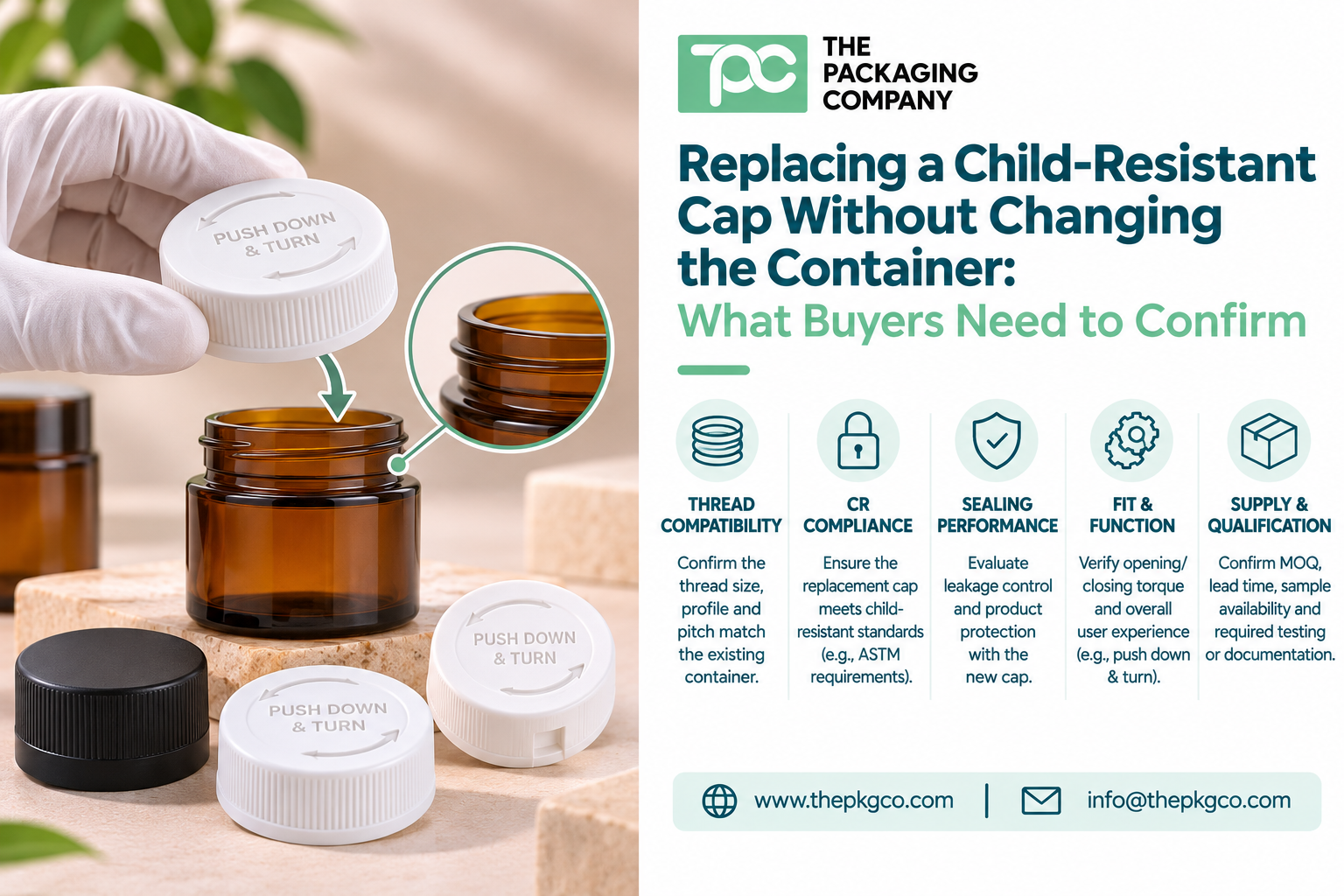
A skincare or regulated-product brand may be satisfied with its existing jar or bottle but still need a different cap. The original closure could be unavailable, a new supplier may offer a better finish, or the brand may want to adjust how the package opens. Keeping the container sounds like a small change. For child resistant cap replacement, however, the question is not only whether the new cap screws on.
A child-resistant (CR) package works as an assembled system. The container finish, closure mechanism, liner or seal where used, filling process, and documented test configuration can all matter. A replacement cap that looks and feels similar to the current one should not be treated as interchangeable until the relevant checks are complete.
For buyers managing custom child resistant packaging, the practical goal is to keep the container and brand presentation that already work while establishing whether a proposed closure change is technically suitable and properly supported by the applicable evidence. Here is what to confirm before approving the substitution.
First, Define Exactly What Is Being Replaced
Before requesting samples or a quotation, ask whether the proposal changes only the cap color or decoration, the closure material, the inner liner, the actual closure mechanism, or the cap supplier. Those scenarios may have different implications even when the outside of the pack looks nearly identical.
Record the existing jar or bottle part number, capacity, neck-finish specification, closure model, material, liner if any, and the reason for the change. Do the same for the proposed replacement. If you cannot identify the original configuration precisely, start by reconciling supplier drawings and approved production samples rather than relying on a photo or a nominal diameter.
Some changes may be predominantly decorative; others affect the closure’s functional design. Neither category should be presumed acceptable without reviewing the actual package specification.
1. Confirm That the New Cap Fits the Existing Container
Two caps may share a labeled size but differ in thread geometry, engagement depth, tamper-evidence features, fit tolerances, or the way the child-resistant mechanism engages with the container. The supplier should verify the exact container-and-closure combination, not merely confirm that both are described as the same diameter.
Review the jar or bottle finish, cap dimensions, required engagement, any liner or sealing surface, and the completed assembly. With physical samples, check whether the cap seats consistently, engages as designed, and can be opened and resecured through the intended method. A test fit on one empty sample is useful for initial screening, not conclusive proof of performance in production.
For buyers who need to change the container as well as the cap, start with the Child-Resistant Packaging category to review complete packaging formats rather than trying to combine unrelated components.
2. Establish What the Existing Child-Resistant Test Evidence Actually Covers
This is the most important difference between an ordinary cosmetic cap substitution and a change to a child-resistant closure. A report or supplier statement associated with the original package does not automatically establish that a different cap performs the same way on the same container.
Ask for the test report or other applicable supporting evidence for the exact configuration being proposed. The review should identify the closure model and size, manufacturer, container model and materials, relevant liner or sealing components, opening instructions, and any specified assembly conditions. Then compare those details with the product you intend to purchase.
For products subject to the U.S. Poison Prevention Packaging Act (PPPA), the CPSC describes child-resistant and adult-use testing under its special-packaging FAQ and 16 CFR § 1700.20. These requirements apply to particular regulated substances and packages, not to every product sold in a child-resistant container. Cannabis and other regulated products may also have separate state-specific requirements.
Do not assume every cap change requires an entirely new test, or that no new evaluation is necessary. Ask the qualified testing or regulatory party to determine whether existing evidence supports the proposed combination and what additional assessment or testing, if any, is needed. The CPSC does not pre-approve or endorse individual package designs.
Our article on keeping CR packaging documentation audit-ready explains why maintaining clear configuration records matters beyond the first order.
3. Check the Opening Mechanism and How Users Reclose the Package
Changing from one push-and-turn design to another—or replacing a cap that has a different engagement or release feature—can alter the experience of opening and reclosing the container. That matters for repeat-use packs, where the package must continue to work as intended after the consumer first opens it.
Confirm how the replacement is supposed to operate, whether the opening instructions change, and whether the cap consistently reengages with the original container. A cap that feels harder to open is not necessarily more child-resistant; an easier cap is not necessarily unsuitable. Performance must be evaluated against the applicable standard, not assumed from subjective feel.
For filled product, the brand should also consider whether residue around the finish, repeated opening, or routine handling might interfere with the mechanism over time. These are questions for the complete package evaluation, not reasons to assert compliance based only on a supplier sample.
4. Review Sealing, Liners, and Product Contact
A replacement CR cap may alter more than the opening motion. Depending on the design, a different liner, gasket, inner disc, or sealing geometry may affect leakage protection or material compatibility. Not every CR package has a separate liner, so inspect the actual construction before specifying a change.
For creams, oils, tinctures, concentrates, and other products, ask the formulation and filling partners to evaluate relevant product-contact materials and the finished package under the conditions of intended use. When necessary, assess leakage, storage orientation, product residue on sealing surfaces, and compatibility with the actual formulation.
Do not assume a different liner is harmless because it fits inside the new cap. Nor should the packaging supplier be asked to guarantee finished-product stability based only on empty-component dimensions.
5. Check the Filling and Capping Process Before Bulk Production
The existing container may still work on the filling line, while the new closure requires a different feeding, orientation, application, or inspection setup. Some systems have specific application conditions, including torque ranges or other process controls. The correct settings depend on the particular assembled system.
Before approving a large run, ask the filler whether the proposed cap is compatible with its equipment. Confirm who will establish the acceptable application conditions and how the line will verify consistent engagement and closure integrity. Any process change should be evaluated using the intended container, closure, and product.
If the replacement is intended to resolve an existing line problem, ask for the complaint or rejection data that prompted it. Otherwise, the team may substitute a new part without addressing the actual cause.
6. Review Opening Instructions, Decoration, and Brand Consistency
Keeping the jar or bottle does not mean the consumer-facing artwork can automatically stay unchanged. A cap with a different opening motion may require different instructions or other labeling review, depending on the product and jurisdiction. The brand should ask its regulatory and artwork teams to confirm what must be updated.
Color, finish, embossing, and decoration also deserve an approval check. Compare the replacement closure with the approved container and the rest of the product line, particularly when multiple SKUs need consistent branding. Decoration should never obscure functional opening directions or interfere with the mechanism.
For an existing multi-format child-resistant product line, document whether the cap change affects one SKU or multiple combinations. A shared visual identity does not make every container-and-closure combination technically equivalent.
7. Confirm the Supplier’s Exact Replacement Specification
A quote for a “compatible child-resistant cap” is not specific enough for a controlled production change. Request the proposed closure’s model and revision, material, finish, liner or seal where applicable, intended matching container, and relevant documentation. Ask whether the cap is an existing production option or a custom component with additional tooling, artwork, or approval requirements.
Also confirm the order quantity for the actual cap configuration, customization requirements, sample availability, and estimated production timing. These may differ from the original cap, even if the container remains the same. TPC’s general packaging MOQ begins around 5,000 units per SKU and print run for many configurations, but the exact cap and decoration requirements must be quoted for the project.
Available stock samples can help buyers review initial fit before placing an order. For custom production, the pre-production sample (PPS) is normally reviewed after the order is placed and before bulk manufacturing. That packaging approval sequence does not replace any needed regulatory, formula, filling, or distribution evaluation.
For a practical request checklist, see what to send when requesting CR packaging samples.
Which Checks Belong to Which Team?
It helps to assign responsibilities before the sample review. The packaging supplier can provide component specifications and relevant packaging records, but the brand, filler, and qualified compliance specialists may need to evaluate the assembled package and finished product.
| Question to resolve | Evidence or action | Primary partners |
|---|---|---|
| Will the cap fit the current container? | Exact part references, drawings, physical fit review | Packaging supplier and brand packaging team |
| Does the CR evidence support this combination? | Review of report scope and any required additional evaluation | Qualified compliance/testing specialists and brand |
| Will sealing and product contact remain suitable? | Appropriate liner, compatibility, and leakage evaluation | Brand, formulator, filler, and supplier |
| Can the filling line apply it consistently? | Equipment review, process settings, and trial where needed | Contract filler |
| Are opening instructions and artwork still correct? | Regulatory and artwork review | Brand regulatory and marketing teams |
| Can the new version be reordered consistently? | Approved specifications, revision control, MOQ, and sourcing confirmation | Procurement and packaging supplier |
Some tasks require several parties. The table is a starting point for ownership, not a substitute for the product-specific compliance and quality plan.
Before You Approve the New Cap: A Buyer Checklist
- Identify the existing parts. Record the exact container, original cap, and any sealing components.
- Describe the reason for replacement. Is it supply continuity, decoration, usability, cost, or a functional problem?
- Obtain the proposed cap specification. Confirm the precise model, revision, material, and matching container.
- Review CR documentation scope. Have the responsible specialist evaluate whether the evidence supports the intended combination.
- Check the filled-package requirements. Include sealing, formulation, opening and reclosing, and filling-line operation where relevant.
- Confirm consumer-facing details. Review opening directions and artwork implications.
- Approve and control the revised version. Separate old and new component references, record approvals, and confirm sourcing before reordering.
A child resistant cap replacement can be a practical way to maintain an established container design, but the unchanged jar is only one part of the decision. Buyers should establish that the proposed closure fits the intended package, functions as required, and is supported by the right technical and compliance records before committing to bulk production.
If your team is considering a CR closure change, start with the container and cap specifications you currently use, plus the reason for the substitution. TPC can review relevant child-resistant packaging options and discuss component sourcing and sampling requirements for the project.
Frequently Asked Questions About Replacing Child-Resistant Caps
Can I put a different child-resistant cap on the same jar?
Possibly, but matching the nominal size is not enough. Ask the supplier to confirm the exact jar-and-cap fit and have the responsible specialists review the child-resistant evidence, sealing performance, and intended filling process for the proposed configuration.
Does an existing CR test report automatically cover a replacement cap?
No. A report describes a tested configuration and set of conditions. The responsible regulatory or testing party should compare that scope with the replacement cap and decide whether the evidence is sufficient or further evaluation is needed. That does not mean every change automatically requires an entirely new test.
What if the new cap comes from a different supplier?
Request the new supplier’s precise model, drawing, material and sealing-component specifications, and relevant test documentation. Treat supplier substitution as a controlled change; an apparently similar cap may differ in function or fit. The new combination and production process may need additional qualification.
Can we approve the new cap using empty stock samples?
Stock samples are useful for initial fit and handling review before an order. They do not, by themselves, establish suitability for the filled product or compliance of the final package. For custom work, the production approval process may also involve a pre-production sample after order placement.
What should I send TPC when asking for a replacement CR cap?
Provide the current container and cap part numbers or specifications, container capacity and finish, photographs, required product use, expected quantity, decoration needs, and the reason for changing the closure. Any existing CR report details and filling requirements can help the team identify the right questions and options.