



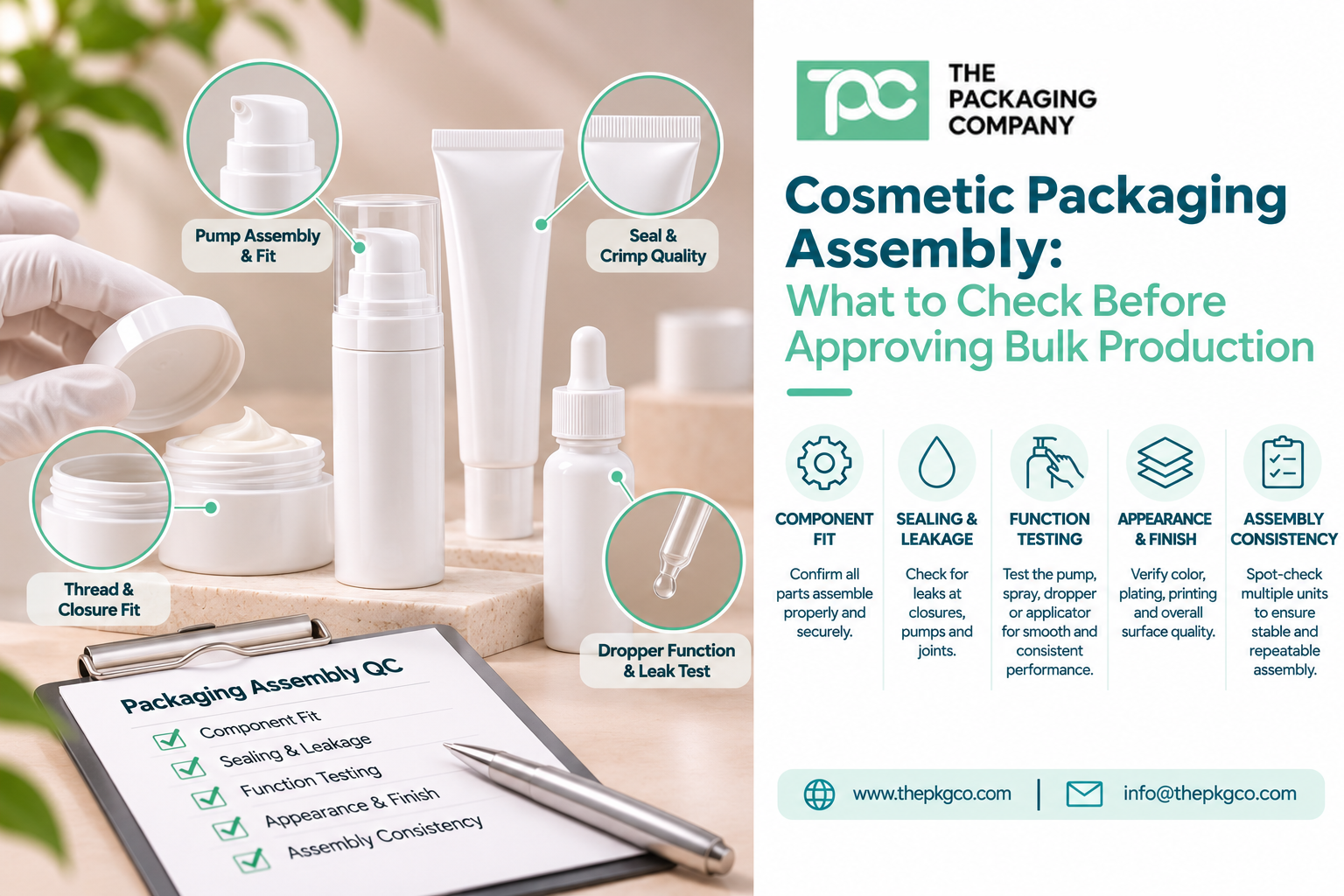
Cosmetic packaging quality control should begin before a brand approves bulk production—not only after finished packaging arrives. A cosmetic bottle, jar or tube can look correct on its own and still create problems when its components are assembled. A cap may feel too loose, a pump may not seat consistently, or a liner may not compress as intended.
For skincare brands and packaging buyers, pre-production inspection should establish what acceptable component fit, appearance and performance look like. Cosmetic packaging assembly tolerances describe permitted dimensional variation, but they must be evaluated alongside how the complete package functions.
Why cosmetic packaging quality control matters before bulk production
Packaging components are manufactured with allowable dimensional variation. Even when each part meets its own drawing, the combination of a container, closure, liner, pump or actuator can produce different results if mating dimensions and assembly conditions are not evaluated together.
The objective is not to eliminate all variation. It is to establish which dimensions and performance characteristics matter, agree on acceptable limits and verify that representative assemblies work as intended.
Common cosmetic packaging defects to watch for
Potential defects include crooked or loose closures, uneven lid alignment, displaced liners, pumps that do not actuate consistently, visible finish defects and leakage under relevant test conditions. The same visible symptom can have different causes, so inspection should distinguish cosmetic appearance issues from functional failures.
Agree with the supplier which defects are critical, major or minor for the intended product and how each will be assessed. A packaging defect should not be accepted or rejected solely on the basis of a generic checklist without an approved standard.
Which packaging components and interfaces should be inspected?
Container neck and closure fit
Review the neck finish, threads or snap-fit features, closure engagement and sealing surfaces. Check whether caps seat consistently and whether the opening and closing experience is appropriate for the product. For threaded components, an agreed torque specification may be relevant; the correct value depends on the specific components and should not be assumed.
Pumps, actuators and dispensing components
For airless pump bottles and other pump formats, confirm that the selected pump and actuator are compatible with the container design. Evaluate seating, actuation, dispensing consistency and any applicable sealing requirements using the complete assembly.
Jar lids, liners and inner cups
Cosmetic jar packaging may involve multiple contact surfaces. Review lid engagement, liner placement and compression, and the fit of any removable inner cup. A small dimensional change can affect how parts align or seal, so the complete approved configuration matters.
Squeeze tube caps and applicators
For tubes, review the neck-to-cap interface, orifice, hinge or thread function and dispensing behavior. A closure that looks correct may still be unsuitable for the formula or filling process. Our squeeze tube packaging category provides an overview of available packaging formats.
Cosmetic packaging inspection checklist before production approval
A practical cosmetic packaging inspection plan should connect approved drawings and samples to measurable acceptance criteria. The checklist below can be adapted for bottles, jars, airless packaging and squeeze tubes.
- Approved drawings: part numbers, revision levels, critical dimensions and specified tolerances.
- Component matching: confirmation that every cap, pump, liner or applicator matches the intended container configuration.
- Assembly method: relevant torque, pressing or other assembly requirements where applicable.
- Functional tests: opening, closing, dispensing, sealing and repeated-use checks appropriate to the product.
- Appearance standards: agreed criteria for alignment, finish, color and visible defects.
- Sampling and acceptance: documented inspection methods, sample quantities and pass/fail criteria agreed with the supplier.
- Change control: a process for approving changes to components, tooling, material or filling conditions.
Packaging component tolerances and cosmetic packaging quality standards
There is no single tolerance value suitable for every cosmetic packaging component. Acceptable limits depend on the material, manufacturing process, component geometry, assembly method and required function.
Ask the supplier to identify critical-to-function dimensions and the associated inspection method. Where a fit concern exists, review dimensional measurements alongside functional testing. A dimension within tolerance is useful evidence, but the final assembled package must still perform as required.
Cosmetic packaging testing with the actual formula and filling process
Stock and pre-production packaging samples are useful at different stages of assessing appearance, fit and the approved configuration. They cannot establish every aspect of filled-package performance. Formula viscosity, fill level, filling equipment, handling and distribution conditions may change how an assembly behaves.
Coordinate testing with the filling partner before approving the final packaging specification. Depending on the project, this may include dispensing trials, leakage checks, handling tests and inspection of filled production samples.
Questions to ask your cosmetic packaging supplier
Before committing to a bulk order, ask for the current component specification, the agreed sample or approval reference, inspection criteria for critical features and confirmation of the intended assembly configuration. If several SKUs share a container or closure, confirm that the same component combination has been evaluated for each relevant formula and fill condition.
Keep the approved specifications and change history accessible to procurement, product development, quality and the filling partner. This reduces ambiguity when production begins or components are reordered.
Approve the complete package—not just individual parts
Effective cosmetic packaging quality control includes both component inspection and functional checks. Record any corrective actions and confirm that the approved samples, drawings and inspection standards correspond to the final production configuration.
Cosmetic packaging quality control is most effective when it connects dimensions, assembly and functional performance. Reviewing critical component interfaces before production approval helps brands identify fit problems earlier and establish clearer expectations for bulk inspection.
The Packaging Company supports cosmetic and skincare brands sourcing packaging for production-scale orders. Explore our custom cosmetic packaging options and discuss your component specifications, samples and production requirements with our team.