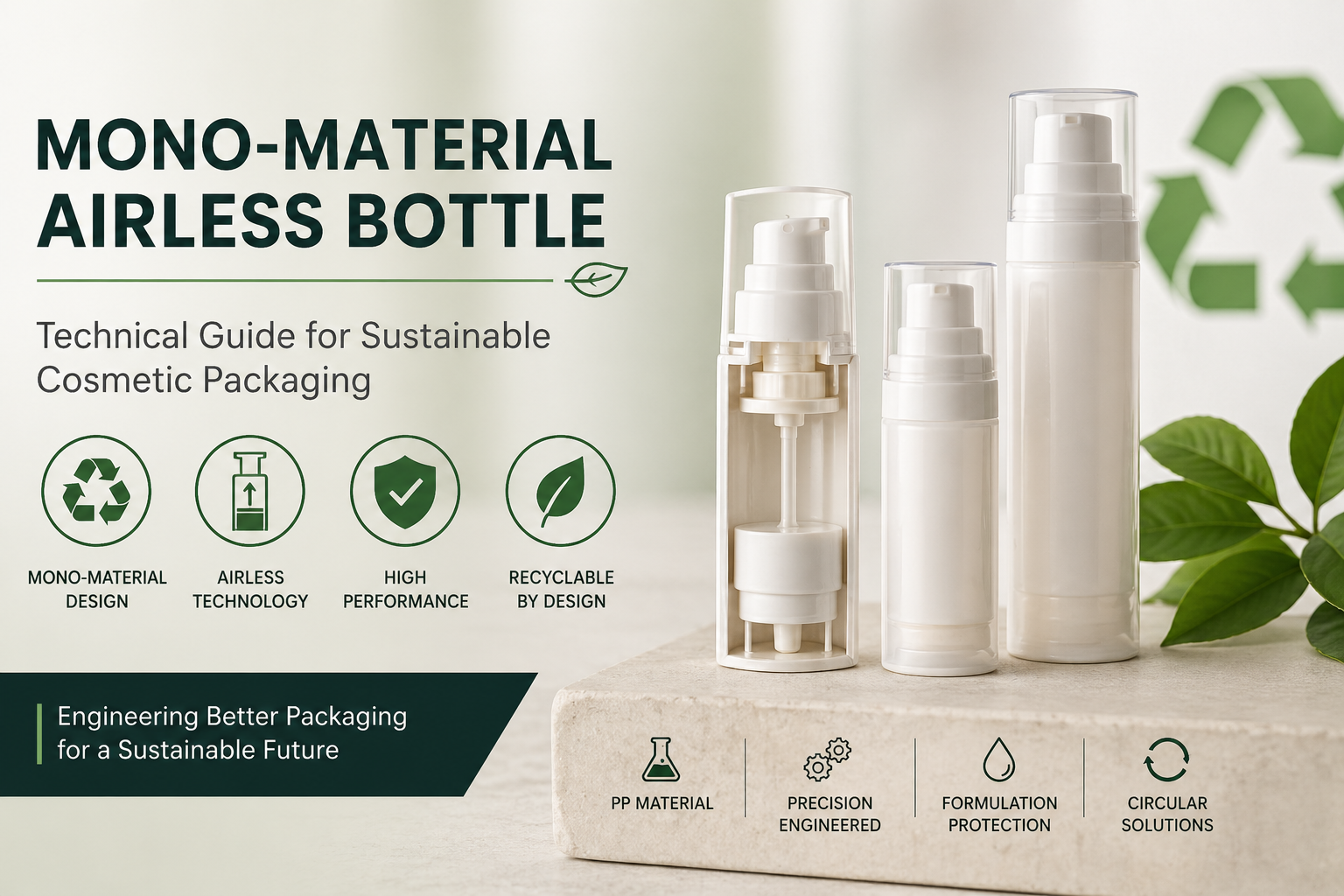
Introduction: When “Recyclable” Isn’t Actually Recyclable
A cosmetic brand launches a new serum in what appears to be eco-friendly packaging. The label claims recyclability, yet post-market audits reveal the packaging is being rejected at recycling facilities. The root cause isn’t poor intention—it’s poor material architecture.
Most conventional airless pump bottles for cosmetics rely on mixed materials: metal springs, elastomers, and layered plastics. These combinations make recycling nearly impossible at scale.
Mono-material airless bottles aim to fix that—but their success depends entirely on technical execution. This article explores the engineering, material science, and performance considerations behind mono-material airless systems, with a focus on how they integrate into modern cosmetic packaging strategies.
What Defines a Mono-Material Airless Bottle (From an Engineering Perspective)?
A mono-material airless bottle is engineered so that all functional components belong to a single polymer family, typically polypropylene (PP). This includes:
- Outer bottle structure
- Internal piston
- Pump housing (springless or plastic-based mechanism)
The objective is not just material simplification—it’s system compatibility across the entire lifecycle: manufacturing, usage, and recycling.
Technical Requirement:
Every component must maintain performance integrity without introducing incompatible materials.
This constraint drives innovation in design, particularly in replacing traditional mechanical elements.
Internal Mechanism: Airless Dispensing Without Metal Components
Traditional airless pump bottles for cosmetics rely on metal springs and dip tubes. Mono-material systems eliminate these elements and instead use a vacuum-driven piston mechanism.
Core Functional Flow:
- Actuator is pressed
- Internal chamber creates negative pressure
- Piston rises uniformly
- Product is dispensed without air re-entry
Engineering Implications:
- Requires precise sealing between piston and bottle wall
- Demands consistent internal pressure control
- Eliminates oxidation and contamination risks
This design is particularly valuable for formulations sensitive to oxygen exposure, such as vitamin C serums or retinol-based products.
Material Science: Why Polypropylene (PP) Is the Default Choice
Polypropylene dominates mono-material airless design due to its balance of mechanical and chemical properties.
Key Characteristics:
- High chemical resistance (compatible with active ingredients)
- Flexural durability (supports repeated pump cycles)
- Lightweight with structural stability
Manufacturing Benefits:
- Suitable for injection molding with tight tolerances
- Enables integrated component design (reducing part count)
- Compatible with PCR (post-consumer recycled) material integration
From a recycling standpoint, PP (#5 plastic) is widely accepted, making it the most practical choice for mono-material systems.
Engineering Challenges Unique to Mono-Material Systems
Designing a mono-material airless bottle requires solving problems that traditional multi-material systems bypass.
1. Achieving Airtight Seals Without Elastomers
Instead of rubber seals:
- Engineers rely on precision-fit geometry
- Surface finishing becomes critical to prevent leakage
2. Replacing Metal Springs
Without springs:
- Pump systems use plastic flex components or air pressure chambers
- Maintaining consistent rebound force is a key challenge
3. Managing Friction Between Identical Materials
Since both piston and bottle are PP:
- Friction must be optimized through micro-texturing or lubrication strategies
- Incorrect balance leads to either leakage or dispensing resistance
4. Compatibility With Existing Filling Lines
Mono-material airless bottles often require:
- Bottom filling systems
- Vacuum-assisted filling
- Adjustments in production workflows
Integration With Refillable Airless Bottle Systems
Mono-material design aligns closely with the growing demand for refillable airless bottles, but the technical integration is not always straightforward.
Key Considerations:
- Refill systems must maintain airtight performance after multiple uses
- Component wear becomes a factor (especially piston sealing)
- Refill cartridges must match the same material family to preserve recyclability
Engineering Trade-Off:
- Fully mono-material + refillable design increases complexity
- Requires modular architecture without introducing mixed materials
Practical Insight:
Some brands adopt a hybrid approach:
- Outer shell is reusable
- Inner cartridge is mono-material and replaceable
This approach balances sustainability with functional reliability.
Formulation Compatibility: Matching Product to System Design
Not every cosmetic formula performs equally in mono-material airless systems.
Best-Fit Formulations:
- Serums (low to medium viscosity)
- Creams with stable emulsions
- Oxygen-sensitive active formulations
Potential Challenges:
- High-viscosity products (require stronger actuation force)
- Oil-heavy formulas (may affect piston movement)
- Particle-based products (risk clogging the pump system)
Required Testing:
- Viscosity range validation
- Pump force measurement
- Dispensing consistency over lifecycle
- Shelf-life testing in airless conditions
Manufacturing and Quality Control Considerations
From a production standpoint, mono-material airless bottles require tighter control compared to standard packaging.
Tooling Requirements:
- High-precision molds
- Multi-component integration within a single material system
Assembly Complexity:
- Even without mixed materials, assembly precision increases
- Airtight sealing must be verified at scale
Quality Control Focus:
- Leak testing (critical for airless performance)
- Pump cycle durability (500–1000 cycles minimum)
- Dimensional accuracy for piston movement
Performance Benchmarks for Supplier Evaluation
For cosmetic brands sourcing mono-material airless bottles, technical validation is essential.
Key Metrics to Request:
- Actuation force (N)
- Output per stroke (ml)
- Air ingress test results
- Material certification (cosmetic-grade PP)
- Confirmation of mono-material construction
Warning Signs:
- Hidden mixed materials in pump components
- Inconsistent dispensing performance
- Lack of lifecycle testing data
Environmental Engineering Perspective: Beyond “Recyclable”
Mono-material airless bottles are designed to improve real-world recyclability, not just theoretical claims.
System-Level Benefits:
- Easier sorting in recycling facilities
- Reduced contamination rates
- Higher likelihood of material recovery
Carbon Efficiency:
- Simplified material stream reduces processing steps
- Supports integration of PCR materials
Future Outlook:
- Compatibility with chemical recycling technologies
- Integration into closed-loop packaging systems
Use Case: Transitioning From Standard to Mono-Material Packaging
A mid-sized skincare brand currently uses traditional airless pump bottles for cosmetics with mixed materials. Challenges include:
- Sustainability compliance in EU markets
- Increasing consumer scrutiny on packaging claims
- Rising costs for complex components
Technical Transition:
- Switch to PP mono-material airless system
- Redesign pump mechanism to eliminate metal spring
- Optimize formulation viscosity for new dispensing system
Result:
- Improved recyclability compliance
- Reduced component complexity
- More consistent product evacuation
Where Mono-Material Airless Technology Is Evolving
Innovation in this space is driven by both regulatory pressure and material science advancements.
Key Developments:
- Improved springless pump designs for consistent performance
- Higher PCR content integration without compromising structure
- Lightweighting strategies to reduce material usage
- Advanced refillable architectures aligned with mono-material principles
Final Thoughts: Technical Simplicity, Engineered Precision
Mono-material airless bottles represent a shift from component-based engineering to system-based design. Every detail—from material selection to internal geometry—must be optimized to maintain performance without relying on multiple materials.
For cosmetic brands, this means:
- Better alignment with sustainability goals
- More control over packaging lifecycle impact
- Increased need for technical validation during sourcing
Exploring Mono-Material Airless Solutions for Your Next Product?
If you’re evaluating mono-material airless bottles alongside airless pump bottles for cosmetics or considering integration with refillable airless bottles, the key is aligning packaging design with formulation and production requirements from the beginning.
We support brands with:
- Engineering-reviewed specifications
- Material and compatibility consultation
- Pre-production sampling (PPS)
- Scalable manufacturing coordination
Contact US to discuss how mono-material airless packaging can be engineered to meet your product and sustainability goals.