



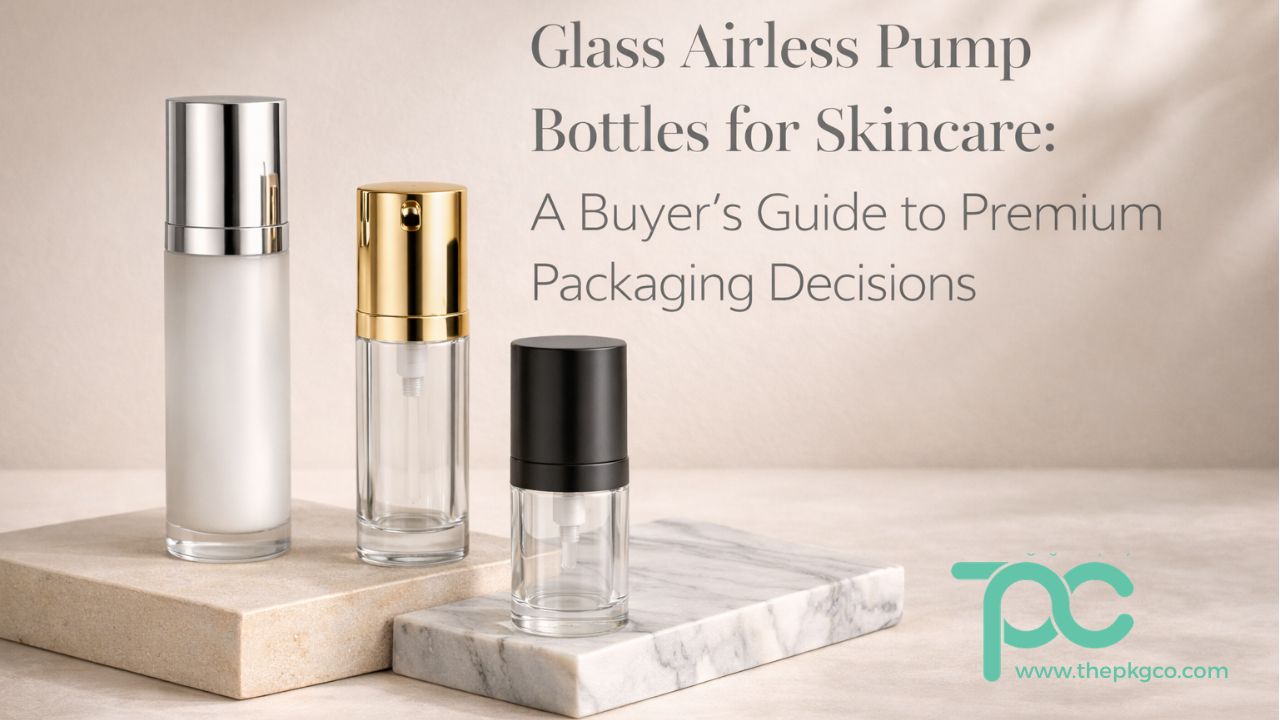
When Packaging Needs to Justify a Premium Price
A skincare product can have a high-quality formula, strong branding, and effective marketing—but if the packaging feels lightweight or generic, the perceived value drops instantly.
This is where many brands hit a ceiling.
They want to position their product as premium, but standard airless pump bottles do not align with that goal. At the same time, switching to glass raises new concerns:
- Will it affect functionality?
- Can it still support airless dispensing?
- Is it practical for production and shipping?
Glass airless pump bottles are often seen as the solution—but choosing the right design requires a clear understanding of both performance and brand positioning.
Buyer Summary: Review the Complete Packaging System
A glass airless pump bottle should be reviewed as a complete component set, including the outer glass body, inner airless chamber, pump output, actuator, collar, cap, decoration area, fill capacity, and production requirements.
Stock samples used for an initial review of size, construction, component fit, and dispensing function. Custom-decorated or pre-production samples are normally developed after order confirmation as part of the approved production process.
What Defines a Glass Airless Pump Bottle?
A glass airless pump bottle combines two essential elements:
- Outer glass shell → premium look and feel
- Inner airless system (usually plastic) → functional dispensing mechanism
Unlike standard bottles, airless systems use a piston-based vacuum mechanism instead of a dip tube, protecting the formula from air exposure.
Key takeaway:
Glass airless bottles are not fully glass systems.
They are hybrid packaging solutions designed to balance aesthetics and functionality.
When Glass Airless Packaging Is the Right Choice
Glass airless bottles are not for every product or brand. They are most effective when aligned with specific business goals.
Ideal use cases:
1. Premium skincare lines
Products positioned above mid-market pricing benefit from packaging that reinforces value.
Examples:
- Anti-aging serums
- Clinical skincare products
- Luxury moisturizers
2. Brand differentiation in crowded markets
When multiple brands offer similar formulations, packaging becomes a key differentiator.
Glass creates:
- stronger shelf presence
- higher perceived quality
- better unboxing experience
3. Retail-focused products
Glass packaging performs well in:
- retail displays
- boutique environments
- high-end eCommerce
Less suitable for:
- Mass-market products with tight margins
- Travel-size or portable products
- Brands prioritizing lightweight logistics
Glass vs Plastic Airless Bottles: What Actually Matters
Choosing between glass and plastic is not just about appearance—it directly impacts cost, logistics, and customer experience.
Visual & Brand Perception
Glass:
- Premium, heavy, high-end
- Associated with luxury skincare
Plastic:
- Lightweight, functional
- More common in mass-market products
Performance & Functionality
Both glass and plastic airless bottles can use similar piston-based dispensing systems, but actual performance depends on the pump construction, inner chamber, component tolerances, formula viscosity, and testing.
- Outer material: affects weight, shelf presentation, shipping, and perceived value.
- Inner airless system: affects priming, evacuation, dosage, and dispensing consistency.
- Formula and filling process: affect compatibility, leakage risk, and real-world performance.
Material choice influences brand positioning and logistics, while the complete airless system determines dispensing performance.
Durability & Logistics
Glass:
- Fragile → requires protective packaging
- Higher shipping cost
Plastic:
- Impact-resistant
- Easier for large-scale distribution
Cost Structure
Glass airless bottles:
- Higher unit cost
- Higher shipping cost
- Higher perceived value
Plastic airless bottles:
- Lower cost
- Better for scaling volume
Types of Glass Airless Pump Bottle Designs
Not all glass airless bottles are the same. Understanding the variations helps you select the right option.
1. Double-Wall Glass Design
- Inner airless chamber protected by outer glass shell
- Creates a “floating” product look
Best for: Luxury skincare brands focused on visual impact
2. Thick Base Glass Bottles
- Heavy base for stability and premium feel
- Often used in high-end serums
Best for: Retail display and luxury positioning
3. Refillable Glass Airless Systems
- Glass outer shell + replaceable inner cartridge
Best for: Brands combining premium + sustainability
👉 These are often used alongside refillable airless bottles as part of a long-term product strategy.
What to Review in a Glass Airless Pump Bottle Sample
A sample should be reviewed as a complete packaging system rather than only as a glass bottle. The outer glass shell creates the visual presentation, but the inner chamber, pump, actuator, collar, and cap determine how the packaging functions during filling and consumer use.
Sample review checklist
- Bottle capacity, dimensions, weight, and stability
- Glass thickness, base appearance, and overall balance
- Inner airless chamber and piston construction
- Pump priming, output, and dispensing consistency
- Actuator comfort and dispensing direction
- Collar alignment and cap fit
- Decoration area, artwork scale, and logo placement
- Color and finish consistency across glass and plastic components
- Formula compatibility, filling, stability, leakage, and dispensing tests
Stock samples can help a brand narrow the packaging direction, but they may not represent the final color, decoration, or pre-production configuration.
Pump, Actuator, Collar, and Cap Direction
The upper components strongly affect how a glass airless bottle looks and performs. Two bottles with similar glass bodies can present very differently depending on the pump output, actuator shape, collar height, cap style, and component finish.
Pump output
Pump output should be considered in relation to the formula, intended dosage, and number of pumps expected per use. A higher or lower output is not automatically better; the appropriate direction depends on the product and application.
Actuator
Review the actuator shape, finger surface, dispensing opening, press force, and dispensing direction. These details affect both usability and the visual profile of the finished bottle.
Collar
The collar visually connects the glass body with the pump. Standard plastic, color-matched, metallic, matte, or decorated collars can create different brand presentations.
Cap
Confirm the cap shape, height, fit, removal force, and color or finish. The cap should protect the actuator while keeping the complete bottle visually balanced.
Decoration Planning for Glass Airless Pump Bottles
Glass airless bottles support a wide range of premium decoration directions, although available methods depend on the bottle structure, component materials, artwork, production quantity, and technical feasibility.
Decoration should be planned across the complete component set. The glass body, pump, collar, and cap may use different materials and production processes, so color and finish should be reviewed together rather than approved separately.
Key decoration review points
- Printable area: confirm artwork size, orientation, and safe spacing around curved surfaces.
- Color matching: review how the selected color appears across glass, plastic, and metallic components.
- Glass direction: choose between clear, frosted, coated, or colored-glass effects based on the brand position.
- Component finishes: evaluate matte, gloss, soft-touch, metallic, printing, or hot-stamp details as a complete set.
Common finishing and decoration options
- Frosted or clear glass
- Color coating or colored-glass effects
- Screen printing
- Hot stamping
- UV coating
- Matte, glossy, metallic, or soft-touch component finishes
Brands should review the final artwork, Pantone direction, logo placement, and component colors together before pre-production approval.
Compatibility with Skincare Formulations
Glass airless bottles may be considered for serums, lotions, creams, and treatment products, but packaging compatibility cannot be determined by the outer glass material alone. The formula primarily interacts with the inner chamber, pump, seals, and dispensing components.
Potential applications
- Serums
- Creams
- Lotions
- Anti-aging and treatment formulations
Factors that require additional review
- High-viscosity formulas that may require a different pump output or pathway
- Formulas that are sensitive to specific plastics, seals, or component materials
- Filling temperature, filling speed, headspace, and priming requirements
- Leakage, evacuation, stability, and dispensing performance over time
Brands should complete formula compatibility, filling, stability, leakage, pump priming, and dispensing tests before approving bulk production. For additional technical context, review common airless pump bottle performance considerations.
MOQ, PPS, and Bulk Production Planning
Switching to glass airless packaging affects sourcing, decoration, testing, freight, and production planning—not only product design.
Minimum order quantity
Most custom glass airless pump bottle projects begin at approximately 5,000 units per SKU per print run. Final MOQ may vary based on bottle design, capacity, component colors, decoration method, refillable structure, custom tooling, and other project requirements.
Stock samples and pre-production samples
Stock samples may be available for an initial review of size, materials, component construction, cap fit, and dispensing function. Custom-decorated or pre-production samples are developed after order confirmation as part of the approved production process.
Pre-production sample approval
Before approving bulk production, confirm the bottle specifications, component set, pump output, artwork, colors, finishes, decoration placement, and approved pre-production sample. Formula compatibility, filling, stability, leakage, and dispensing tests should also be completed.
Production timing
Production lead time is typically approximately 90 days after pre-production sample approval. Final timing depends on the selected packaging, component availability, decoration method, testing, and order details.
Shipping and fulfillment
- Glass requires additional protective packaging and careful handling.
- Higher package weight can increase freight and fulfillment costs.
- Brands should review drop protection, case packing, pallet configuration, and breakage risk.
Brand positioning strategy
Glass packaging should align with the product price, target audience, retail environment, and long-term packaging strategy. Using glass without a clear premium position can add cost without creating enough commercial value.
Common Mistakes When Choosing Glass Airless Bottles
1. Choosing the bottle only for aesthetics
A premium glass body does not replace the need to review pump performance, component fit, compatibility, logistics, and cost.
2. Reviewing only the outer glass shell
The inner chamber, pump, actuator, collar, cap, and seals are equally important to the final user experience.
3. Treating a stock sample as the final custom approval
A stock sample can help narrow the format, but final colors, decoration, artwork, and pre-production configuration still require approval.
4. Ignoring filling and formula testing
Packaging should be tested with the actual formula and filling process before bulk production approval.
5. Underestimating freight and breakage planning
Glass packaging can require stronger secondary packaging, different case packs, and a larger logistics budget.
6. Failing to align packaging with price positioning
Premium packaging should support a product strategy that can absorb the added component, decoration, and freight costs.
How Glass Airless Bottles Fit Into a Larger Packaging Strategy
Most successful brands don’t rely on a single packaging type.
Instead, they build a system:
- Glass airless bottles → premium or hero-product line
- Refillable airless bottles → refill and sustainability strategy
- Standard airless packaging → scalable or supporting SKUs
This approach creates flexibility across product tiers, price points, launch plans, and markets. Brands building a larger bottle, jar, and tube system can also review TPC’s custom cosmetic packaging support.
Conclusion
Glass airless pump bottles are not only a packaging upgrade. They are a production and positioning decision that affects component selection, decoration, formula testing, freight, pricing, and customer experience.
For skincare brands targeting the premium segment, glass airless packaging can create a stronger shelf presence and perceived value. The best result comes from reviewing the complete airless system—not only the outer glass—and confirming the pump, cap, decoration, MOQ, testing, and production path before bulk approval.
Glass Airless Pump Bottle FAQ
Are glass airless pump bottles made entirely from glass?
No. Most glass airless pump bottles use an outer glass body with an internal airless chamber, pump, piston, seals, and other components made from plastic or mixed materials.
Can I request a glass airless pump bottle sample before ordering?
Stock samples may be available for an initial review of bottle size, construction, component fit, and dispensing function. Custom-decorated or pre-production samples are developed after order confirmation.
What is the MOQ for custom glass airless bottles?
Most projects begin at approximately 5,000 units per SKU per print run. Final MOQ depends on the bottle, capacity, component colors, decoration, tooling, and customization requirements.
What should a brand test before approving bulk production?
Brands should complete formula compatibility, filling, stability, pump priming, dispensing, leakage, evacuation, and component-fit testing before bulk production approval.
Can glass airless bottles be customized?
Depending on the bottle and project, options may include color coating, frosting, screen printing, hot stamping, UV coating, component color matching, metallic finishes, and other decoration methods.
Planning a Glass Airless Pump Bottle Project?
Share your preferred capacity, formula type, estimated quantity, decoration direction, and production timeline. Our team can help review available glass airless packaging options, stock samples, component details, and the next steps for custom production.