


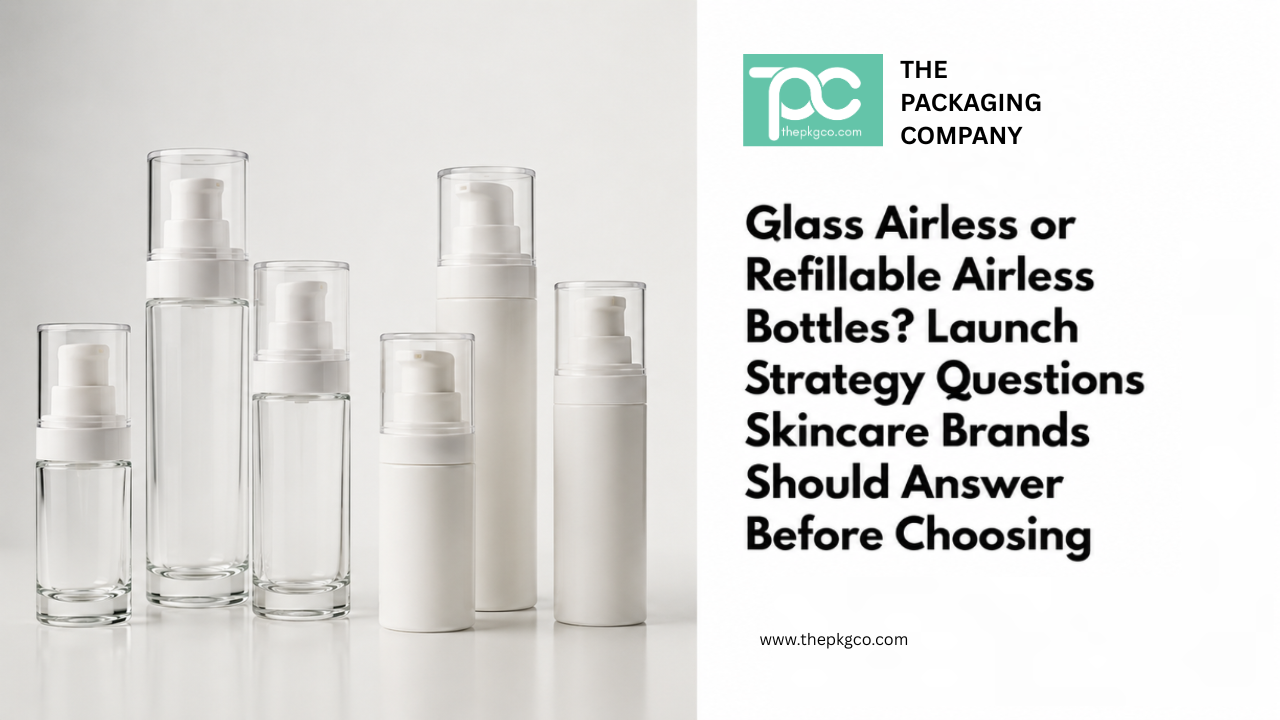
Glass airless bottles and refillable airless bottles can both support premium skincare packaging, but they solve different business problems. One may be better for a high-end single-product launch. The other may be better for a brand building a refill system, repeat-purchase model, or long-term sustainability story.
The mistake is treating this decision as a simple product comparison. For skincare brands, the better question is not only “Which bottle looks better?” The better question is: “Which packaging model fits our launch strategy?”
This guide compares glass airless and refillable airless bottles from a launch planning perspective, including price point, customer education, refill logistics, shipping risk, and when brands should avoid overbuilding too early.
Why This Is a Launch Strategy Decision
Airless packaging is commonly used for serums, moisturizers, treatment creams, eye products, and active skincare formulas. Brands choose airless containers because they can support controlled dispensing, cleaner application, and a premium user experience.
But once a brand is choosing between glass airless pump bottles and refillable airless bottles, the decision becomes bigger than bottle style.
It affects pricing, product education, shipping, inventory, refill planning, customer behavior, and reorder strategy.
Question 1: Are You Launching One Hero Product or a Long-Term System?
If the brand is launching one premium hero product, glass airless may be the simpler choice. It can create a high-end feel without requiring customers to understand a refill process.
If the brand is building a long-term product system, refillable airless may be worth reviewing. A refill model can support repeat purchases and a stronger sustainability message, but it requires more planning.
Ask:
- Is this a single hero product launch?
- Will customers reorder the same formula often?
- Does the brand want to sell refills later?
- Can the team support refill inventory and instructions?
- Will the customer understand the refill system?
For many brands, glass is easier for the first premium launch. Refillable packaging makes more sense when the business model supports it.
Question 2: What Price Point Does the Product Need to Support?
Glass airless bottles can support a premium price point because they often feel heavier, more refined, and more substantial in the hand. This can be useful for higher-end skincare products where packaging is part of perceived value.
Refillable airless bottles can also support premium pricing, but the value story is different. The customer is not only buying the formula. They are buying into a packaging system.
Brands should ask:
- Will the package help justify the product price?
- Is the customer paying for a premium first-use experience?
- Is the customer expected to buy refills later?
- Can refill pricing make sense compared with the original product?
- Does the product margin support the packaging model?
Question 3: How Much Customer Education Is Required?
Glass airless packaging is familiar. Customers understand how to use a pump bottle. They do not need much education beyond normal product instructions.
Refillable airless packaging may require more explanation. Customers need to understand how to remove the refill, insert the new unit, dispose of the empty refill, and avoid damaging the outer bottle.
Customer education may need to appear on:
- Product page
- Carton
- Insert card
- Email flow
- Refill product page
- Retail display
If the refill process is not clear, customers may not repeat the purchase even if they like the sustainability idea.
Question 4: Can Your Team Manage Refill Logistics?
Refillable airless packaging is not only a packaging choice. It creates an inventory and fulfillment system.
Brands need to manage the outer bottle, refill unit, refill packaging, SKU setup, pricing, instructions, storage, and reorder timing.
Before choosing refillable airless packaging, brands should ask:
- Will the refill be sold separately?
- Will the refill need its own carton or label?
- How will refill inventory be managed?
- Will retailers accept the refill format?
- How will customers know when to buy a refill?
- Can the brand support refill reorders consistently?
If these questions are not answered, refillable packaging may create more complexity than the launch is ready to handle.
Question 5: How Important Is Shipping and Breakage Risk?
Glass can support premium positioning, but it may add shipping weight and breakage risk. This matters for e-commerce brands, subscription models, and products shipped individually to customers.
Brands choosing glass should review:
- Outer carton protection
- Inner packing requirements
- Breakage testing
- Shipping cost impact
- Retail handling conditions
- Customer unboxing experience
Refillable systems may also require careful shipping review, especially if the outer component and refill unit are shipped separately or if the refill needs protection during delivery.
Question 6: Is Sustainability a Core Brand Promise or a Supporting Message?
Refillable airless packaging can support a stronger sustainability story, but only if the system is actually used by customers. If customers do not understand or reorder the refill, the packaging story becomes weaker.
Glass airless packaging may support a premium and durable feel, but it is not automatically the best sustainability choice. Shipping weight, breakage, components, and recyclability should still be reviewed.
Brands should ask:
- Is sustainability central to the brand identity?
- Will customers participate in a refill system?
- Can the brand explain the refill process clearly?
- Does the refill model reduce unnecessary packaging over time?
- Is the sustainability claim specific and realistic?
The right choice depends on whether sustainability is a core business model or a secondary packaging message.
Question 7: Are You Overbuilding Too Early?
Some brands want to launch with the most advanced packaging system immediately. That can work for established brands, but early-stage launches should be careful.
A refillable system may require higher MOQ, more SKUs, more education, more inventory planning, and more customer support. If the brand has not proven product demand yet, this can create unnecessary complexity.
Glass airless may be a simpler way to launch a premium product first. Once the product has repeat demand, the brand can review whether a refillable system makes sense for the next stage.
Brands should ask:
- Have we proven repeat purchase demand?
- Do we know customers want a refill model?
- Can we manage refill inventory?
- Will the added complexity delay launch?
- Would a premium glass launch be simpler first?
When Glass Airless Bottles May Be the Better Choice
Glass airless bottles may be better when the brand wants a premium single-product launch with a familiar user experience.
They may fit when:
- The product is positioned as premium or luxury
- The brand wants weight and shelf appeal
- The launch does not need a refill system yet
- The product will be sold as a complete finished unit
- Customer education should stay simple
- The brand can manage shipping protection
When Refillable Airless Bottles May Be the Better Choice
Refillable airless bottles may be better when the brand has a clear repeat-purchase strategy and can support the refill process operationally.
They may fit when:
- The product is used regularly
- Customers are likely to reorder
- Sustainability is central to the brand
- The brand can explain the refill system clearly
- The team can manage refill inventory
- The packaging system supports long-term brand loyalty
Launch Strategy Checklist
Before choosing glass or refillable airless packaging, skincare brands should confirm:
- Whether the launch is one hero product or a long-term refill system
- Target price point
- Customer education needs
- Refill logistics
- Shipping and breakage risk
- Sustainability role in the brand story
- MOQ and inventory planning
- Repeat purchase expectations
- Retail or e-commerce sales channel
- Whether the brand is overbuilding too early
Final Recommendation
Glass airless and refillable airless bottles can both support premium skincare launches, but they fit different strategies. Glass airless bottles are often better for a premium single-product launch where simplicity, weight, and shelf appeal matter. Refillable airless bottles are better when the brand has a clear repeat-purchase model, refill logistics, and customer education plan.
For brands comparing airless containers, glass airless packaging, refillable airless systems, or airless packaging solutions, The Packaging Company can help review materials, MOQ, sampling, decoration options, and production requirements for upcoming skincare launches.
FAQ: Glass Airless vs Refillable Airless Bottles
When should a skincare brand choose glass airless bottles?
Glass airless bottles may be a strong choice for premium single-product launches where weight, shelf appeal, and a familiar pump experience matter.
When should a brand choose refillable airless bottles?
Refillable airless bottles may be better when the brand has repeat purchase demand, refill logistics, customer education, and sustainability as part of the business model.
Are refillable airless bottles always more sustainable?
Not automatically. Refillable packaging supports sustainability goals only when customers understand and use the refill system, and when the full packaging structure is planned carefully.
Are glass airless bottles harder to ship?
Glass can add weight and breakage risk, so brands should review carton protection, shipping tests, and e-commerce handling before production.
Should new skincare brands launch refillable packaging right away?
Not always. Some brands should first prove product demand with a simpler premium package, then move into refillable systems once repeat purchase behavior is clearer.