



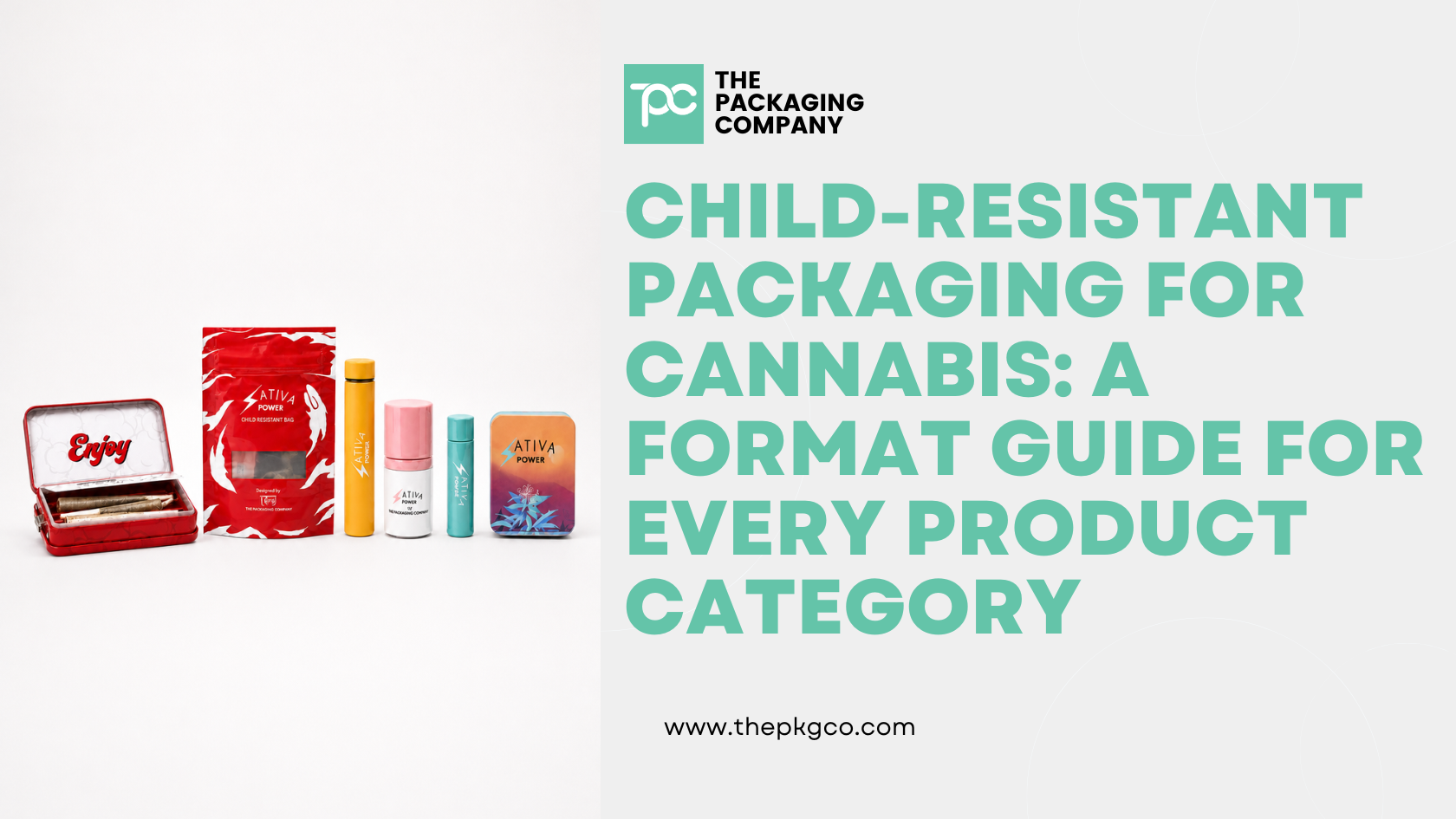
The most common packaging mistake in cannabis is treating CR packaging as a single category. It is not. The CR format that works for a 3.5g flower eighth is the wrong format for a live resin cartridge. The format that works for a 10mg gummy pack is wrong for a pre-roll multi-pack. The format that works for a CBD topical balm has nothing to do with the format that works for concentrates.
Every cannabis product category has its own set of format requirements driven by the physical properties of the product, the barrier performance the formulation needs, the retail presentation the price point demands, and the specific state compliance requirements that apply to that category. Getting the format right means starting with the product, not with the catalog.
This guide maps the primary CR packaging formats to the specific requirements of each major cannabis product category.
Pre-Rolls
Pre-rolls are the most format-diverse category in cannabis packaging. Singles, 2-packs, 5-packs, 7-packs, and beyond, across standard lengths, king-size, and infused formats, each with different dimensional and presentation requirements.
For singles and small counts (1 to 3 units): CR tubes are the standard format. Glass tubes with push-and-turn caps are the premium option for single pre-rolls, providing full product visibility and a clean, minimal retail presentation. Aluminum tubes offer full light blocking and an airtight seal at a similar price point. Plastic push-and-turn tubes are the volume standard for accessible price points.
The tube diameter and length must match the pre-roll dimensions precisely. A tube that is too loose allows the pre-roll to move, which damages the tip in transit. A tube that does not engage the CR closure correctly because the pre-roll sits proud of the fill line is a compliance failure.
For multi-packs (3 to 14 units): CR tins are the premium format and increasingly the expected format for multi-packs priced above $20 retail. TPC’s snap tin line (V5 at 74x58x20mm for standard lengths, V5E at 95x57x20mm for king-size) and squeeze/hinge-lid tins (V1 through V7) cover the full range of pre-roll count configurations with custom-engineered foam or tray inserts per project.
For infused pre-rolls: The airtight seal matters more here than in any other pre-roll format, because terpene preservation is a direct product quality variable. TPC’s snap tins are airtight and watertight by design. Glass CR jars with push-and-turn lids are the alternative for brands where upright display of the product itself is part of the retail experience.
Flower
Bulk flower packaging is the highest-volume segment in the cannabis market and the format where the value-versus-premium split is most visible.
CR mylar bags are the dominant format for flower at value and mid-tier price points. Available from 1g through 28g, foil-laminate construction blocks UV light and provides oxygen and moisture barrier. The slide-lock CR closure must be evaluated over repeated cycles. Standard matte, gloss, soft-touch, and specialty finishes are available. For brands at the value and mid-tier, bags are the economically correct choice. For brands above $25 retail per eighth, bags create a price-signal mismatch that works against the brand.
CR glass jars with push-and-turn lids are the premium standard for flower brands at craft and premium price points. Glass is completely inert, provides UV blocking in amber variants, and communicates quality through material and weight in a way that bags cannot. For single-origin, craft, and top-shelf flower where terpene expression is a brand claim, glass is the packaging that can support it. The glass jar body is fully recyclable; the CR lid is a separate component.
CR tins are an increasingly common premium option for flower brands wanting metal’s light-blocking and airtight properties with full lithographic decoration capability.
Browse CR Bags | Browse CR Jars
Edibles
Edibles packaging must satisfy CR requirements while also meeting the state-specific requirements that apply specifically to the edibles category. Many states require opaque packaging for edibles, mandate individual piece markings, and have specific rules around packaging that resembles conventional food products. Confirm state-specific edibles requirements before finalizing any format.
CR jars are the most common format for gummies, capsules, and confection-format edibles requiring wide-mouth access. Glass CR jars communicate quality and allow product visibility (where state regulations permit). Plastic CR jars provide the cost-efficient standard for high-volume SKU. Tin jars (ASTM certified, 90ml capacity) are appropriate for edibles positioned at the premium tier where the post-use tin becomes a brand presence object in the consumer’s home.
CR mylar bags work well for edible formats sold at value price points, for larger fill counts, and for powder or shake edible formats where bag access is preferable to a jar opening.
CR tins are underused in the edibles category relative to the brand work they can do. For premium or limited-edition edible SKUs, a custom-configured tin with an interior insert holding the product in individual compartments creates a retail moment that no bag or jar achieves. Brands selling craft chocolates, high-end gummies, or occasion-format edibles at premium price points should evaluate tin formats seriously.
Note: TPC’s Glass Cream Jars and Plastic Cream Jars are specifically for creams and topical formulations and are not appropriate for edibles. The correct jar formats for edibles are in the CR Jars category.
Browse CR Jars | Browse CR Tins
Concentrates
Concentrates are one of the most packaging-specific cannabis categories. The product is viscous to semi-solid, highly sensitive to temperature and material interaction, and typically sold in small volumes (0.5g to 2g). The packaging has to protect those properties throughout storage and the consumer use period.
Glass concentrate jars are the standard format for wax, shatter, rosin, live rosin, and similar extract products. Glass is the right material for concentrates because it is completely inert. No off-gassing, no interaction with terpene compounds, no material migration that affects product purity over time. Silicone containers are widely used in the category for certain concentrate types, but glass is the premium standard.
TPC’s Square Glass Concentrate Jar is available in 5ml, 7ml, and 9ml volumes, certified to 16 CFR §1700.20, with an airtight liner inside the cap. The square profile provides a distinctive shelf presence relative to the round jars that dominate the category. Full customization is available including silk screen, UV coating, and hot stamp. MOQ 10,000 units.
For concentrate brands where the presentation format matters as much as the container, an outer secondary packaging element (a small branded box or sleeve) can elevate the product’s retail presence without changing the primary container. This is where secondary packaging or custom outer boxes become relevant for a concentrate brand. Contact TPC to discuss secondary packaging options for concentrate programs.
CR tin jars (ASTM certified, 90ml) are an alternative for concentrate brands where a metal container is preferred for the airtight seal and premium presentation.
Vapes
Vape packaging compliance varies more by state than any other cannabis category because some states require CR packaging on the individual retail unit while others satisfy the CR requirement at point of sale through a CR exit bag. Confirm your specific state’s current requirement before finalizing format decisions for vape products.
For states requiring individual unit CR packaging: Compact CR tins with custom foam inserts hold single cartridges or disposable devices in a premium retail presentation. CR mylar bags accommodate multi-pack configurations and are the cost-efficient option for value-tier single units. CR tubes work for slim disposable formats where the tube dimensions accommodate the device.
For point-of-sale CR exit bag states: CR mylar bags sized for the specific hardware format are the standard. The exit bag must still carry 16 CFR §1700.20 certification with third-party documentation. Treating the exit bag as a generic operational supply rather than a certified packaging element is a documentation gap that creates compliance exposure.
Browse CR Bags | Browse CR Tins
Topicals
Cannabis topicals (creams, balms, lotions, serums, and similar formulations) require CR packaging when sold through licensed cannabis retail channels. The format options differ from flower, pre-roll, and edible formats because the product is a formulation that must be dispensed rather than consumed directly.
CR squeeze tubes with push-and-turn screw caps are the standard format for lotion, cream, and balm topicals. TPC’s CR Squeeze Tube is available in 30ml, 60ml, and 90ml with 3-layer or 5-layer aluminum laminate construction or all-plastic. ASTM F1702 certified. MOQ 10,000 units per size.
CR airless pump bottles provide dose-precise dispensing and eliminate air exposure per pump, which matters for oxidation-sensitive actives. TPC offers CR airless pump bottles in standard, large format, and mono-material configurations, all certified to 16 CFR §1700.20.
CR roll-on bottles work for cannabis topical oils and balm formulations where direct applicator delivery is the intended use.
CR glass dropper bottles are appropriate for cannabis-infused tinctures and sublingual oils sold through licensed retail channels.
Note: TPC’s Glass Cream Jar and Plastic Cream Jar are appropriate for cream and topical formulations. They are not appropriate for flower, edibles, or concentrates.
Tinctures and Sublinguals
Cannabis tinctures and sublingual oils are sold in regulated markets and require CR packaging. The format is almost exclusively a glass dropper bottle with a push-and-turn CR dropper cap.
The 30ml volume is the standard retail format for cannabis tinctures. Amber glass is the preferred material for formulations where cannabinoid and terpene stability over shelf life is a priority. The CR cap and glass bottle are certified as a system, not independently. The cap must match the specific bottle neck finish.
TPC’s Full CR Cannabis Packaging Line
TPC’s CR packaging line covers the full range of cannabis product categories:
CR Tins for pre-rolls, flower, edibles, and vape multi-packs.
CR Tubes for single pre-rolls and small multi-packs.
CR Jars for flower, edibles, and concentrates including the Square Glass Concentrate Jar.
CR Bags for flower, edibles, and vape exit bags.
CR Topical Packaging for topicals, tinctures, and wellness formulations.
All formats are made to order, certified to 16 CFR §1700.20, and include third-party test documentation. Pre-production samples are standard before bulk commitment. MOQ varies by format.
For a format-level overview of the full CR packaging landscape, see our child-resistant packaging solutions guide. To discuss your specific product category and format requirements, contact our team.
Frequently Asked Questions
Does every cannabis product category require CR packaging? Yes. Every licensed US cannabis market requires CR packaging for all cannabis product categories at the point of consumer sale. This includes flower, pre-rolls, edibles, concentrates, vapes, and topicals. The specific certification standard and any additional category-specific requirements (opaque packaging, individual piece markings, etc.) vary by state.
What is the best CR format for cannabis concentrates? Glass is the standard material for concentrates because it is completely inert, with no interaction with terpene compounds or active ingredients. TPC’s Square Glass Concentrate Jar is available in 5ml, 7ml, and 9ml, certified to 16 CFR §1700.20. Tin jars are an alternative for brands wanting a metal container. Plastic is generally not recommended for premium concentrate products because of potential terpene sorption over extended product contact.
Can I use the same CR bag format for both flower and edibles? If the fill configuration and state compliance requirements are compatible across both products, yes. In practice, flower and edibles often have different state-specific packaging requirements (including different opacity, labeling, and individual piece requirements for edibles) that may require different formats or at minimum different label designs on the same format.
What vape packaging format do I need if my state requires individual unit CR packaging? A CR format that the specific hardware can fit within and that carries 16 CFR §1700.20 certification for the format and closure combination. Compact CR tins with custom foam inserts are the premium option. CR mylar bags are the cost-efficient option. Confirm which state standard applies and request third-party documentation before committing to production.
What is the difference between CR topical packaging and CR jars for cannabis? CR topical packaging is specifically designed for formulations that are dispensed, including creams, balms, lotions, serums, and oils. This category includes squeeze tubes, airless pumps, roll-ons, and dropper bottles. CR jars for cannabis are for products that are accessed directly from a wide-mouth container, including flower, concentrates, and edibles. TPC’s Glass Cream Jar and Plastic Cream Jar are specifically for creams and topicals and are not appropriate for flower, concentrates, or edibles.