



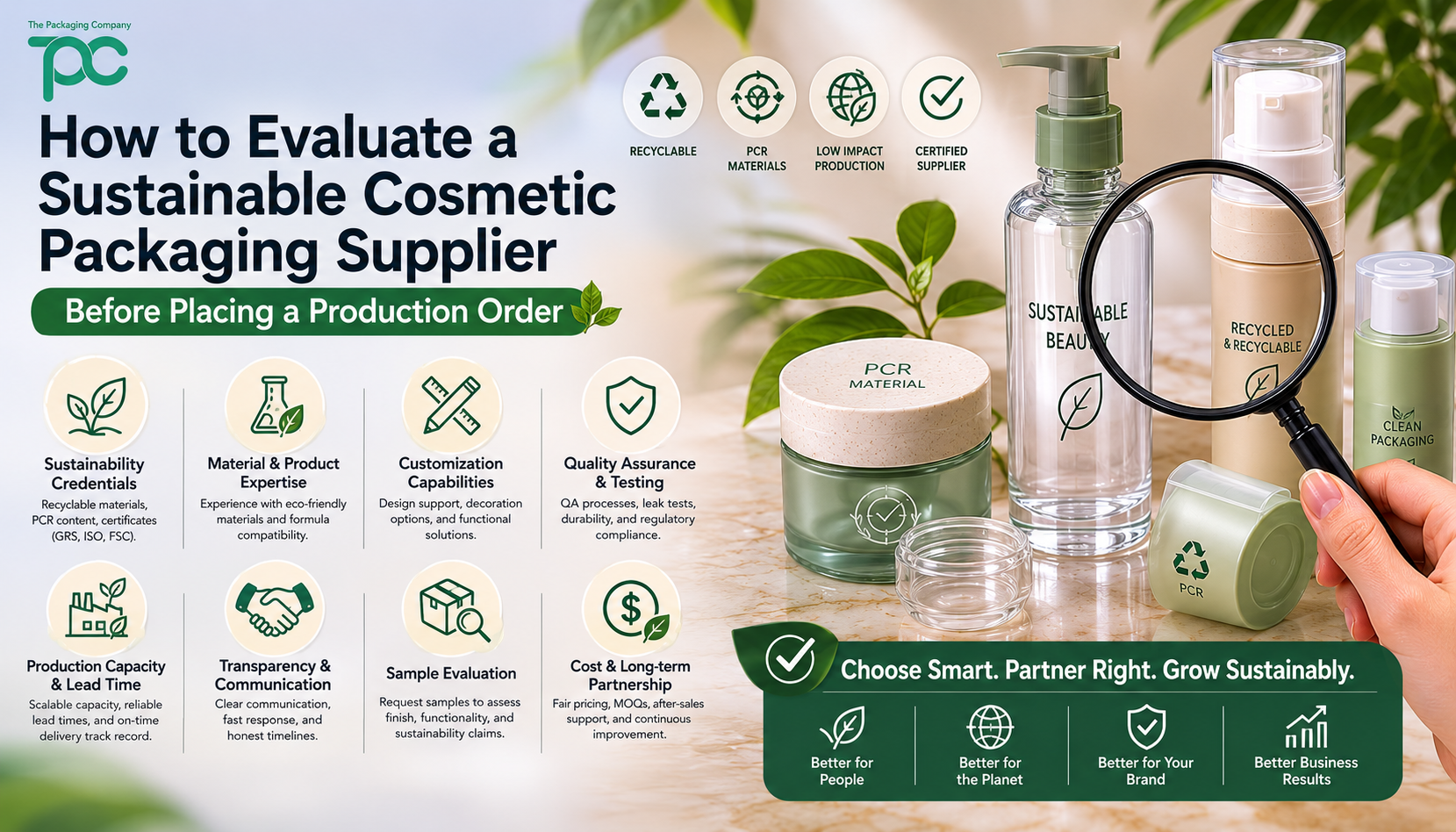
Many beauty brands want sustainable packaging, but choosing the right supplier is more complicated than picking a package labeled recyclable, refillable, PCR, or eco-friendly. A package still needs to protect the formula, support the brand design, meet production requirements, and arrive on time.
This is why choosing a sustainable cosmetic packaging supplier should be treated as a production decision, not only a marketing decision. The wrong supplier may offer attractive sustainability language but limited material clarity, unclear MOQ, weak decoration support, or poor production communication.
For skincare, cosmetics, and personal care brands, the goal is not just to find packaging that sounds sustainable. The goal is to find a supplier that can explain the material structure, provide realistic options, support sampling, and help the brand move from concept to production with fewer risks.
Start with the Packaging Goal Before Asking for Options
Sustainable cosmetic packaging can mean different things depending on the brand. Some brands want to reduce virgin plastic. Some want recyclable packaging. Some want refillable systems. Others want mono-material packaging, PCR materials, or lower packaging weight.
Before comparing suppliers, brands should define the main sustainability goal clearly. This helps avoid vague conversations and makes it easier to compare packaging options.
- Do you want PCR cosmetic packaging?
- Do you want recyclable packaging where accepted?
- Do you want refillable packaging?
- Do you want mono-material packaging?
- Do you want reduced packaging weight?
- Do you need documentation for internal approval?
- Do you need packaging for airless bottles, jars, tubes, or another format?
A supplier can only recommend the right packaging if the brand knows which sustainability priority matters most.
Ask the Supplier to Explain the Full Material Structure
A strong sustainable cosmetic packaging supplier should be able to explain what each component is made from. This is especially important for multi-component packaging such as pumps, jars, tubes, caps, closures, and airless systems.
Instead of asking only whether a package is sustainable, brands should ask specific material questions:
- What material is used for the main container?
- What material is used for the cap, pump, closure, or actuator?
- Is the package mono-material or mixed-material?
- Does the package contain PCR material?
- What PCR percentage is available?
- Can components be separated?
- Does the decoration method affect recyclability?
If a supplier cannot clearly explain the material structure, the brand may have difficulty supporting sustainability claims later.
Verify PCR Claims Before Production
PCR cosmetic packaging can help brands reduce reliance on virgin plastic, but PCR options should be reviewed carefully before ordering. PCR material can affect color consistency, surface appearance, decoration results, MOQ, and lead time.
Before selecting PCR packaging, brands should ask the supplier:
- What percentage of PCR material is available?
- Is the PCR content used in the full package or only certain components?
- Can the supplier provide material details or documentation?
- Will PCR affect color consistency?
- Can the package still support custom printing or finishing?
- Does PCR affect MOQ or production timeline?
- Are samples available for formula and decoration testing?
PCR packaging can be a strong option, but it should be reviewed through both sustainability and production performance. A recycled-content package still needs to look finished, work with the formula, and meet the brand’s launch timeline.
Review Recyclable Packaging Claims Carefully
Recyclable cosmetic packaging is not only about the main material. The full package structure matters. A bottle, jar, or tube may use a recyclable material, but mixed components, labels, coatings, pumps, or decorative finishes can make the recycling story less simple.
Brands comparing a recyclable cosmetic packaging supplier should ask:
- Which parts of the package are recyclable?
- Does the package use mixed materials?
- Does the label or decoration affect recyclability?
- Can the customer separate the components?
- Is the material commonly accepted in recycling streams?
- What wording should the brand use for customer-facing claims?
This helps brands avoid broad or unclear sustainability language. Specific claims are usually stronger than general claims such as “green” or “eco-friendly.”
Check Whether Sustainable Options Fit the Formula
Sustainable packaging still needs to protect the product. This is especially important for skincare, cosmetics, personal care, and active formulas.
Brands should test packaging with the actual formula before full production. Formula compatibility testing can help identify issues such as leakage, swelling, discoloration, odor transfer, pump failure, decoration damage, or product instability.
This step is especially important for formulas with:
- Oils
- Fragrance
- Acids
- Sunscreen ingredients
- Active skincare ingredients
- Botanical extracts
- High alcohol content
- Thick or high-viscosity textures
A package that meets a sustainability goal but fails compatibility testing is not production-ready.
Confirm Decoration Compatibility Early
Sustainable packaging still needs to look like a finished brand product. Decoration should be reviewed early because some sustainable materials may have decoration limits.
Common decoration methods include:
- Silk screen printing
- Hot stamping
- Labels
- Matte coating
- Glossy coating
- Custom color
- Embossing or debossing when available
Brands should ask whether the decoration method affects recyclability, durability, cost, MOQ, or lead time.
For example, a package may support PCR material but have limitations for exact color matching. Another package may be recyclable in structure, but the selected label or coating could affect the final sustainability story. A supplier should help explain these trade-offs before production.
Ask About MOQ Before Choosing the Final Package
MOQ is one of the most important practical details when choosing sustainable packaging. Some sustainable options may require higher order quantities, especially custom colors, PCR materials, specialty finishes, custom molds, or decorated components.
Before ordering, brands should confirm:
- MOQ for stock sustainable packaging
- MOQ for PCR packaging
- MOQ for custom decoration
- MOQ for custom color
- MOQ for custom molds or specialty structures
- MOQ differences between packaging formats
This helps brands avoid choosing packaging that looks good strategically but does not fit the launch budget or production plan.
Review Sampling and Approval Steps
Sampling is where brands confirm whether the supplier’s recommendation works in real production conditions. A digital mockup or catalog image is not enough.
Before placing a production order, brands should review:
- Material feel
- Color consistency
- Formula compatibility
- Decoration quality
- Print or label durability
- Pump, cap, or closure function
- Leakage resistance
- Shipping performance
- Customer usability
Brands should also confirm whether the supplier can provide stock samples, decorated samples, or pre-production samples. The right sample process depends on the level of customization and the risk level of the product.
Ask for Documentation and Production Details
A reliable sustainable cosmetic packaging supplier should be able to provide more than a price quote. Brands may need specifications, material information, decoration guidelines, carton details, and production timelines for internal approval.
Useful information to request includes:
- Material specifications
- Package dimensions
- Capacity details
- PCR percentage information, if applicable
- Decoration area
- Sample approval details
- Production lead time
- Reorder timeline
- Packaging and carton information
Documentation is especially important when multiple teams are involved, such as product development, design, purchasing, marketing, and contract filling partners.
Evaluate Supplier Communication
A strong supplier should be able to explain materials, limitations, MOQ, decoration options, sampling, production timeline, and documentation clearly.
Brands should be cautious if a supplier only uses broad terms like eco-friendly, recyclable, sustainable, or green without explaining the packaging structure.
A reliable supplier should help answer questions such as:
- What makes this package more sustainable?
- What are the production trade-offs?
- What documentation is available?
- What decoration options are realistic?
- What should be tested before production?
- What is the reorder plan?
- What are the risks with this option?
Supplier communication matters because sustainable packaging often involves trade-offs. A good supplier helps brands understand those trade-offs before the order is placed.
Use Sustainability Claims Carefully
Beauty brands should be careful with sustainability language. Claims such as eco-friendly, recyclable, sustainable, or zero waste should be supported by accurate packaging details.
Instead of relying on broad language, brands can use more specific wording such as:
- Made with PCR material
- Designed with mono-material construction
- Refillable packaging system
- Recyclable material where accepted
- Reduced mixed-material components
- Lightweight packaging design
Specific language is usually more credible than general sustainability claims. It also helps customers and retail partners understand what the packaging actually offers.
Supplier Evaluation Checklist
Before choosing a sustainable cosmetic packaging supplier, brands should confirm the following:
- The supplier can explain the full material structure
- PCR percentage and material details are clear
- Recyclability claims are specific and realistic
- The packaging works with the actual formula
- Decoration options are compatible with the material
- MOQ fits the launch and reorder plan
- Samples are available for testing
- Production lead time matches the launch schedule
- Documentation is available for internal review
- The supplier communicates trade-offs clearly
Final Recommendation
Choosing a sustainable cosmetic packaging supplier requires more than comparing price and appearance. Beauty brands should review material transparency, PCR claims, recyclable packaging details, decoration compatibility, MOQ, formula compatibility, documentation, sampling, and production support.
The right supplier should help brands choose packaging that supports sustainability goals while still working for the formula, customer experience, brand design, and launch timeline.
For brands comparing sustainable cosmetic packaging, PCR options, recyclable packaging, and airless packaging solutions, The Packaging Company can help review materials, decoration options, MOQ, sampling, and production requirements. Brands preparing a new packaging project can speak with our packaging team for support.
FAQ: Sustainable Cosmetic Packaging Supplier
What should I look for in a sustainable cosmetic packaging supplier?
Look for material transparency, clear PCR information, recyclable packaging knowledge, decoration support, sampling, MOQ clarity, production communication, documentation, and formula compatibility guidance.
What questions should I ask before ordering sustainable cosmetic packaging?
Ask what materials are used, whether PCR content is available, whether the packaging is mono-material or mixed-material, what decoration options are compatible, what MOQ applies, and whether samples are available for testing.
Is PCR cosmetic packaging always the best sustainable option?
No. PCR cosmetic packaging can support recycled-content goals, but the best option depends on the formula, decoration needs, color expectations, MOQ, production timeline, and packaging format.
Can sustainable cosmetic packaging still look premium?
Yes. Sustainable cosmetic packaging can still support premium finishes, custom colors, labels, printing, and strong shelf appeal, but decoration compatibility should be tested before production.
Why is sampling important for sustainable cosmetic packaging?
Sampling helps brands confirm material feel, decoration quality, formula compatibility, color consistency, closure function, and production readiness before placing a full order.