


A child-resistant jar seems straightforward until you’re deep into a sourcing decision and realize how many variables actually matter: material, closure mechanism, volume, certification standard, fill compatibility, decoration method, and how the whole thing performs after 50 opens rather than just the first one.
Brands that order bulk without working through these questions tend to discover the ones they missed at the worst possible time — when product is in the jar, labels are printed, and something about the package doesn’t work the way it was supposed to.
This guide covers the buying considerations that matter before you commit to a CR jar format — for cannabis flower, concentrates, edibles, topicals, and regulated wellness products.
What Makes a Jar “Child-Resistant”
The term ” child-resistant ” is a certification status, not a design description. A jar qualifies as CR when it has passed third-party panel testing under one of two federal standards:
ASTM F1272 — the standard for reclosable packaging. Testing requires that at least 85% of children ages 42–51 months cannot open the package within 10 minutes, and that at least 90% of adults ages 50–70 can open and close it within 5 minutes.
16 CFR §1700.20 — the CPSC standard, referenced in most state cannabis regulations for retail products. Uses similar panel methodology with specific protocol differences. Many state regulations require this standard by name.
The closure mechanism is what earns the certification — not the material, not the shape, not the size. A push-and-turn lid, squeeze-and-turn lid, or other engineered closure must perform within the standard’s parameters across repeated use cycles, not just at initial opening.
When evaluating any CR jar from any supplier, request the third-party laboratory test report. The report should name the testing lab, the specific format and closure tested, the applicable standard, and the actual panel pass rates. A Certificate of Compliance without underlying test data is not certification documentation.
Material: The Decision That Drives Everything Else
CR jars are available in four primary materials. The right choice depends on your product, your retail environment, your brand positioning, and your sustainability requirements.
Glass
Glass is the premium standard for cannabis flower, concentrates, and any formulation where material inertness matters. Glass does not off-gas, does not interact with terpenes or active ingredients, and creates no static charge that could pull trichomes from flower. For live resin, rosin, and high-terpene flower where the chemical profile is a core product claim, glass is the honest choice.
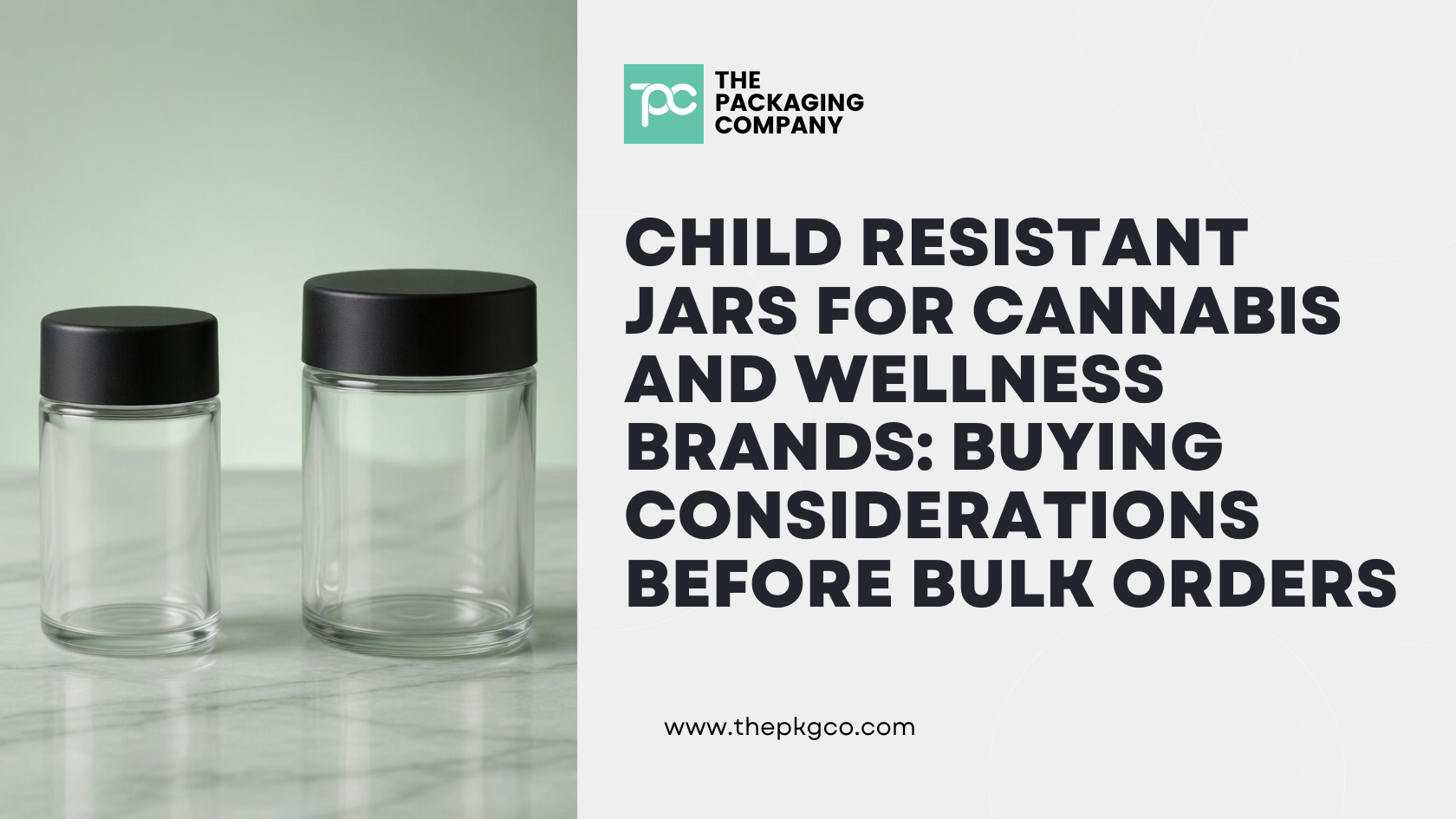
Glass CR jars from TPC are certified under 16 CFR §1700.20, are FDA food-grade, and are 100% recyclable. The wide-mouth format allows easy access and product visibility. The push-and-turn CR lid engages cleanly and consistently. For concentrate packaging specifically, glass eliminates the material interaction risk that plastic jars carry at low concentrations of certain terpene compounds.
The tradeoffs: glass is heavier (shipping cost impact at volume), breakage risk in the supply chain requires more careful handling, and MOQ is typically higher than plastic alternatives. For premium-tier SKUs where the product justifies the packaging investment, these tradeoffs are usually acceptable.
Plastic (PET/PP)
Plastic CR jars — typically PET or PP — are the cost-efficient standard for flower, edibles, and topicals where volume and margin targets are the primary drivers. They’re lighter than glass, more resistant to breakage, and available in a wider range of sizes and colorways.
The push-and-turn or squeeze-and-turn closure mechanisms used in certified plastic CR jars perform reliably at scale. The key variable to evaluate is wall thickness and material quality — thinner-walled plastic jars degrade faster with repeated use and may not maintain the tight closure tolerances that CR certification depends on over the product’s retail shelf life.
For cannabis flower, plastic jars carry one functional limitation that matters for high-end SKUs: PET in particular can carry a faint odor over time, and some terpene compounds interact with plastic at the molecular level. For value-tier flower SKUs this is typically irrelevant. For premium or single-origin flower where the terpene profile is a differentiator, glass is the better choice.
Aluminum
Aluminum CR jars combine the premium tactile feel of metal with the lightweight properties of non-ferrous construction. They’re fully opaque (complete light blocking), fully recyclable, and carry a premium in-hand weight that communicates quality without the fragility of glass.
Aluminum jars work well for topicals, balms, and concentrate formats where light protection and material barrier properties matter but where glass breakage risk is a concern. Custom decoration options for aluminum include anodizing, screen printing, and custom colorways that hold up well over the product lifecycle.
Tin
The CR tin jar format — like TPC’s 90ml CR Tin Jar — provides a wide-mouth jar form factor in tinplate steel with a certified CR lid. Tin jars offer the strongest combination of airtight seal, light blocking, and recyclability across any CR jar material, and they support the most robust decoration options including lithographic printing and embossing.
For infused pre-rolls, premium flower, and edible formats where brand experience at opening matters, the tin jar format creates a presentation moment that plastic and even glass can’t match.
Volume Configuration: Matching Size to Product
CR jar volume selection is a function of product weight or volume, not preference. Getting it wrong means either dead space that allows product to move and degrade, or insufficient interior volume that prevents the lid from closing correctly.
Common CR jar volume configurations and their typical applications:
Small format (30ml–60ml) — concentrates, topicals, small-batch flower (1g–3.5g), travel-size wellness products. These formats require a precisely sized insert or fill level to prevent product migration. For concentrates specifically, a smaller jar with a tight fill tends to present better than a larger jar at low fill levels.
Mid format (90ml–120ml) — standard eighths (3.5g), half-eighths, larger concentrate formats, edible confections. The most commonly requested range for cannabis flower across regulated markets.
Large format (200ml+) — quarter ounce (7g) and above, bulk flower for dispensary house SKUs, large edible formats, topical products in retail sizes that require CR compliance.
Confirm interior volume against your actual fill level — with allowance for headspace — before ordering. A jar that holds exactly 3.5g of flower at maximum fill but leaves no headspace for the lid to engage correctly is a production problem.
Closure Mechanism and Repeated-Use Performance
The CR closure is the most important functional element of the jar. It must pass certification testing, but it also must continue to perform after a consumer has opened and closed the package 20, 30, or 50 times over the product’s use period.
Push-and-turn is the most common CR lid mechanism for jars. The consumer pushes down on the lid while turning counterclockwise to open. The engagement geometry between lid and jar must maintain consistent tolerances across the production run — a lid that opens too easily after a few uses is a compliance problem even if it passed certification when new.
Squeeze-and-turn requires simultaneous lateral pressure and rotation. It provides stronger resistance than standard push-and-turn and is commonly used where 16 CFR §1700.20 compliance requires additional resistance margin.
When sampling a CR jar format, evaluate the closure over multiple cycles — not just the first open. The mechanism should engage and disengage consistently at cycle 1, cycle 10, and cycle 25. If the closure loosens perceptibly with use, it will not maintain its certified performance over the product’s retail and consumer use lifecycle.
Decoration: What’s Actually Possible on Each Material
Decoration capability varies significantly by jar material, and misaligned expectations here are a common source of late-stage project problems.
Glass jars support screen printing directly on the glass surface, frosted or colored glass options, and pressure-sensitive label application. Screen printing on glass is durable and premium but requires minimum quantities for setup. Labels on glass look clean when applied correctly but can peel in humid conditions — relevant for products stored in bathrooms or used with wet hands.
Plastic jars support label application, in-mold labeling for integrated decoration, and sometimes direct print depending on the material. High-quality pressure-sensitive labels with UV coating are the most common decoration approach and can achieve strong visual results at accessible quantities.
Aluminum jars support anodizing (color finish applied to the aluminum surface), screen printing, and shrink sleeve application. Anodized aluminum with screen-printed logo and text reads as genuinely premium at retail.
Tin jars support lithographic printing applied directly to the metal before forming — the highest-quality decoration option available for any jar format. Embossing, spot colors, and custom interior configurations are all achievable. Lithographic tin decoration requires setup and is best suited for runs where the investment is amortized across meaningful quantity.
What to Confirm Before Placing a Bulk Order
Certification documentation. Request the laboratory test report for the specific jar and closure you’re ordering. Confirm it covers the standard your state requires (ASTM F1272 or 16 CFR §1700.20).
Dimensional fit for your product. Confirm interior volume against your actual fill weight or volume with appropriate headspace. If you’re using an insert or secondary packaging inside the jar, confirm that the insert fits with the lid engaged.
Closure performance over use cycles. Sample the jar and evaluate the closure at 10+ open/close cycles before committing to production quantity.
Fill line compatibility. If you’re running an automated fill line, confirm that the jar format and the CR lid are compatible with your filling and capping equipment. CR lids often require specific torque or pressure application that standard capping equipment isn’t configured for without adjustment.
Lead time and sampling process. CR jars at TPC are available for pre-production sampling before any bulk commitment. For any regulated-market packaging decision, sampling before production is not optional — it is the difference between knowing your packaging works and hoping it does.
TPC’s CR Jar Line
TPC’s child-resistant jar collection spans glass, plastic, aluminum, and tin formats — 15 SKUs across the full volume range from compact topical jars through large-format flower and concentrate storage. All formats are certified under 16 CFR §1700.20 and available with full custom decoration. MOQ starts at 5,000 units.
Browse TPC’s CR Jar collection →
For brands evaluating the full CR packaging landscape across formats, see our child-resistant packaging solutions guide. To discuss your specific product and format requirements, contact our team.
Frequently Asked Questions
What is the difference between child-resistant jars and child-proof jars? These terms are used interchangeably in the market, but only one has legal meaning. “Child-resistant” is the federally defined certification standard under ASTM F1272 and 16 CFR §1700.20. “Child-proof” implies absolute protection that no package can guarantee and is not a legal classification. For compliance purposes, use “child-resistant” and reference the applicable certification standard.
Which CR jar material is best for cannabis flower? Glass is the best material for premium flower where terpene preservation is a brand claim. It is completely inert, provides full light blocking, and creates no material interaction with sensitive terpene compounds. Plastic CR jars are appropriate for value-tier flower where cost-per-unit is the primary driver. For mid-tier SKUs, both materials are viable depending on brand positioning.
Do I need different CR jars for different states? The physical jar doesn’t change by state, but the certification standard required may vary. Most state cannabis regulations require 16 CFR §1700.20 for retail products. Some accept ASTM F1272. Confirm your specific state’s requirements before finalizing a format. TPC can provide documentation for both standards depending on the format.
Can CR jars be used for concentrates? Yes. Glass CR jars are the preferred format for concentrates — the inert surface eliminates material interaction risk with terpene compounds at any concentration. Silicone-lined glass CR jars are also available for formats where a non-stick interior surface is required. Confirm that the lid mechanism creates an airtight seal adequate for your concentrate’s consistency before ordering.
What decoration options are available for CR jars at TPC? Decoration options vary by material. Glass supports screen printing and label application. Plastic supports label application and in-mold labeling. Aluminum supports anodizing and screen printing. Tin supports lithographic printing and embossing. TPC’s team can advise on the best decoration approach for your specific format and run quantity during the quoting process.
What MOQ applies to CR jars at TPC? MOQ starts at 10,000 units for standard formats. Custom configurations and decorated formats may vary. Pre-production samples are available before any bulk commitment.