



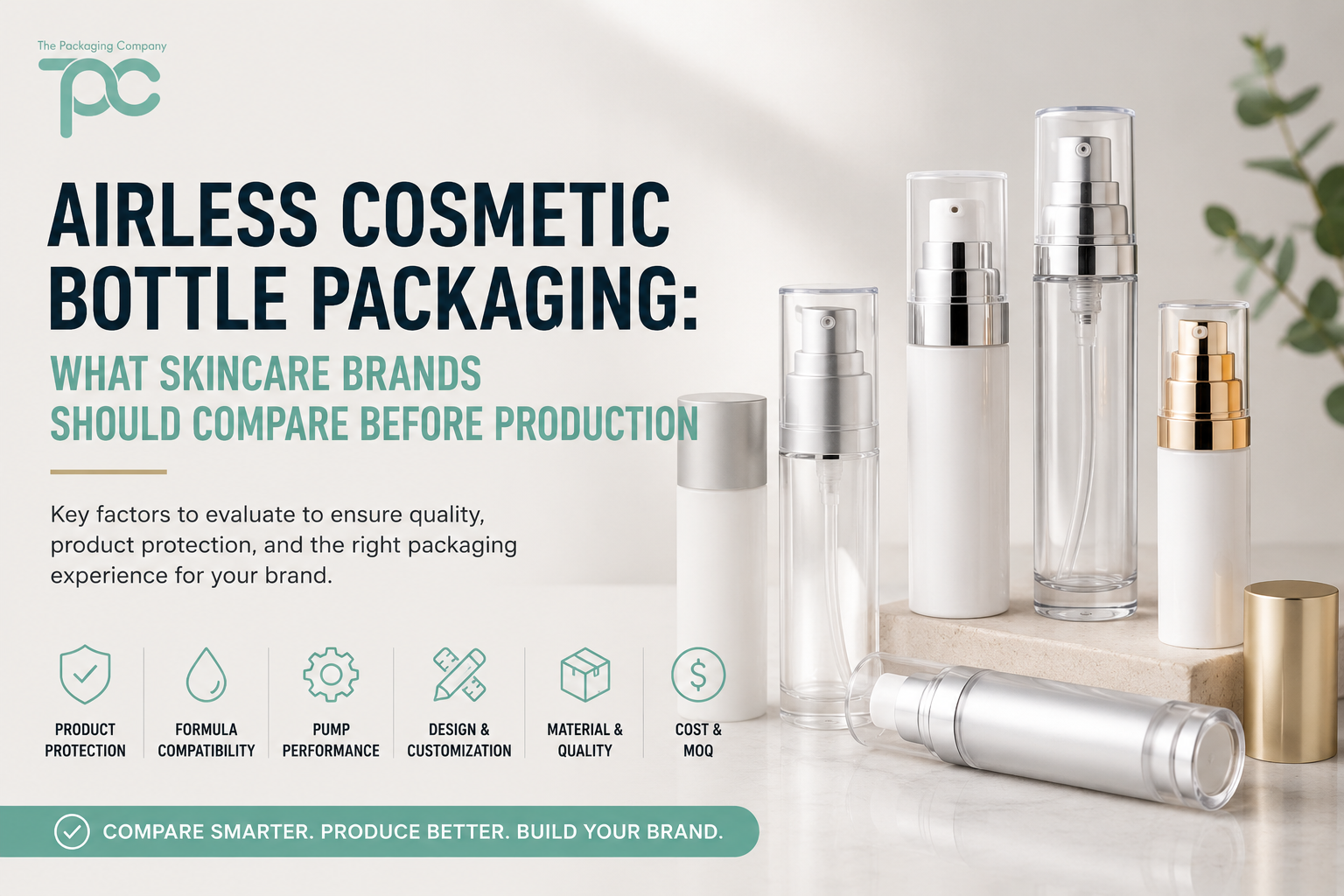
A skincare brand may choose an airless cosmetic bottle because it looks clean, modern, and premium. But before production starts, the bottle needs to do more than match the brand mood board. It has to work with the formula, dispense correctly, support decoration, meet MOQ requirements, and hold up during filling, shipping, and customer use.
This is where many packaging mistakes happen. A brand approves a bottle based on appearance, then later discovers the pump output is wrong, the formula is too thick, the decoration does not hold well, or the packaging timeline does not match the launch date.
For skincare brands comparing airless cosmetic bottle options, the best decision comes from reviewing the full packaging system before production. This guide explains what to compare so brands can choose airless containers that support the product, customer experience, and production plan.
What Is an Airless Cosmetic Bottle?
An airless cosmetic bottle is a packaging system designed to dispense product through a pump without relying on a traditional dip tube. Many airless bottles use a piston or vacuum-style mechanism that pushes the formula upward as the product is used.
This packaging format is commonly used for skincare products such as serums, lotions, moisturizers, eye creams, sunscreens, and treatment products. Compared with standard pump bottles or open jars, airless packaging can support cleaner dispensing, controlled output, and reduced product waste.
Brands comparing airless pump bottles for cosmetics should think about the bottle as a complete system: pump, actuator, bottle body, piston, cap, decoration, material, and formula compatibility.
Compare the Formula First
The formula should guide the packaging decision. A bottle that works well for a lightweight serum may not work for a thick cream, gel lotion, or sunscreen formula.
Before choosing an airless container, brands should review formula viscosity, texture, active ingredients, oil content, fragrance level, and expected use. If the product is too thick for the pump, it may dispense slowly or clog. If it is too thin, it may dispense too quickly or feel messy.
Common product fits include:
- Facial serums
- Eye creams
- Moisturizers
- Treatment lotions
- Sunscreens
- Primer products
- Active skincare formulas
The safest approach is to test the actual formula with the selected airless cosmetic bottle before confirming production.
Compare Pump Output and Dosage
Pump output affects how customers experience the product. If one pump gives too much formula, the product feels wasteful. If it gives too little, customers may need multiple pumps, which can make the packaging feel inconvenient.
Different skincare products need different output levels. An eye cream may need a small, controlled dose. A facial moisturizer may need a medium output. A body product may require more product per pump.
Before production, brands should ask:
- How much product dispenses per pump?
- Does the output match the intended application?
- Does the formula dispense smoothly after repeated use?
- Does the pump need priming before first use?
- Will customers understand how to activate the pump?
This step is especially important for premium skincare, where customer experience can affect repeat purchases and product reviews.
Compare Airless Containers by Material
Airless containers for cosmetics can be made with different materials and structures. The right choice depends on product positioning, sustainability goals, decoration needs, and budget.
PP airless bottles
PP airless bottles are common for skincare and personal care products. Depending on the structure, PP can support lightweight packaging and may be used in mono-material packaging designs.
PET or mixed-material airless bottles
Some airless bottles use multiple materials for appearance, performance, or structural reasons. These can provide more design flexibility but may be more complex from a recycling standpoint.
Glass airless bottles
Glass airless pump bottles can support a more premium skincare positioning. They are often used when the brand wants more weight, a high-end feel, or stronger shelf presentation.
PCR or recycled-content options
Some brands may want recycled-content packaging to support sustainability goals. PCR options can be useful, but brands should review color consistency, decoration compatibility, and production requirements.
Compare Standard, Refillable, and Specialty Airless Options
Not every airless cosmetic bottle is designed for the same business model. Some are best for single-use packaging. Others are designed around refill systems, replaceable cartridges, or more premium components.
Refillable airless bottles can be a strong option for skincare brands building a sustainability-focused product line or repeat-purchase refill program. They may also help support a more premium customer experience.
However, refillable systems require more planning. Brands need to think about refill unit design, customer instructions, shipping, storage, cost, and long-term reorder behavior.
For brands that need a simpler launch, a standard airless bottle may be more practical. For brands building a higher-end product system, refillable or specialty airless containers may be worth reviewing.
Compare Decoration and Branding Options
Decoration can change how an airless cosmetic bottle feels to the customer. A basic bottle can look premium with the right finish, and a strong bottle can look weak if the decoration is poorly executed.
Common decoration options include:
- Custom color
- Silk screen printing
- Hot stamping
- Labeling
- Matte finish
- Glossy finish
- Frosted effect
- Metallic collars or caps
Before production, brands should confirm whether the decoration method works with the bottle material and shape. Curved surfaces, narrow print areas, coatings, and cap materials can all affect the final result.
For premium skincare, small details matter. Logo placement, color consistency, cap alignment, and finish durability can all affect how the product is perceived.
Compare Filling and Production Requirements
Airless cosmetic bottle packaging often has specific filling requirements. If the product is not filled correctly, the pump may not prime well, trapped air may affect dispensing, or the fill level may appear inconsistent.
Brands should confirm the filling process before production, especially if using a contract manufacturer. The packaging supplier and filling partner should understand how the bottle is assembled, filled, capped, and tested.
Before confirming the order, ask:
- Can the filling partner work with this bottle structure?
- Is bottom filling or top filling required?
- Does the product need special handling during filling?
- Will the bottle be tested after filling?
- Are there instructions for priming or first use?
Compare MOQ, Sampling, and Lead Time
Production planning matters just as much as bottle selection. A packaging option may look perfect, but if the MOQ is too high or the lead time is too long, it may not fit the launch plan.
Brands should compare:
- MOQ for stock airless bottles
- MOQ for custom color
- MOQ for custom decoration
- Sampling timeline
- Production timeline
- Shipping timeline
- Reorder availability
For growing skincare brands, it is important to choose packaging that supports both the first launch and future reorders. A beautiful bottle is not useful if it cannot be produced consistently when the product starts selling.
Compare Packaging Based on Product Positioning
The best airless cosmetic bottle should match the product’s position in the market.
A clinical serum may need a clean white or silver airless bottle with minimal decoration. A luxury moisturizer may need a heavier bottle, frosted finish, or metallic accent. A sustainable skincare line may need refillable, mono-material, or PCR options. A professional spa product may need a larger airless container with a practical pump and durable finish.
Packaging should support the product story without creating unnecessary cost or complexity.
Brands reviewing airless packaging solutions should compare the bottle’s appearance, function, cost, and production fit together rather than choosing based on one factor alone.
Final Recommendation
An airless cosmetic bottle can be a strong packaging choice for skincare brands, but the right option should be selected through a full production review. Formula fit, pump output, material, decoration, filling process, MOQ, and lead time all matter.
For brands comparing airless containers cosmetics packaging, the best bottle is not only the one that looks premium. It is the one that works with the formula, supports the customer experience, and can be produced consistently at scale.
The Packaging Company works with skincare, cosmetic, and personal care brands to review airless containers, custom decoration options, sampling needs, and wholesale packaging requirements for upcoming product launches and line expansions.
FAQ: Airless Cosmetic Bottle Packaging
What is an airless cosmetic bottle?
An airless cosmetic bottle is a packaging system that dispenses product through a pump without using a traditional dip tube. Many airless bottles use a piston or vacuum-style mechanism to push the formula upward as the product is used.
What products are best for airless cosmetic bottles?
Airless cosmetic bottles are commonly used for serums, moisturizers, eye creams, treatment lotions, sunscreens, primers, and active skincare formulas that need controlled dispensing and a cleaner application experience.
Are airless containers better than regular cosmetic bottles?
Airless containers are better when the formula needs controlled dispensing, reduced product waste, or a more premium user experience. Regular cosmetic bottles may be better for simple, stable, or high-volume formulas that do not need airless dispensing.
Can thick creams work in airless cosmetic bottles?
Some thick creams can work in airless bottles, but the pump system must match the formula viscosity. Brands should test the actual formula with the selected bottle before production.
What should skincare brands compare before ordering airless bottles?
Brands should compare formula compatibility, pump output, material, decoration options, MOQ, filling requirements, sampling timeline, production lead time, and reorder availability.