



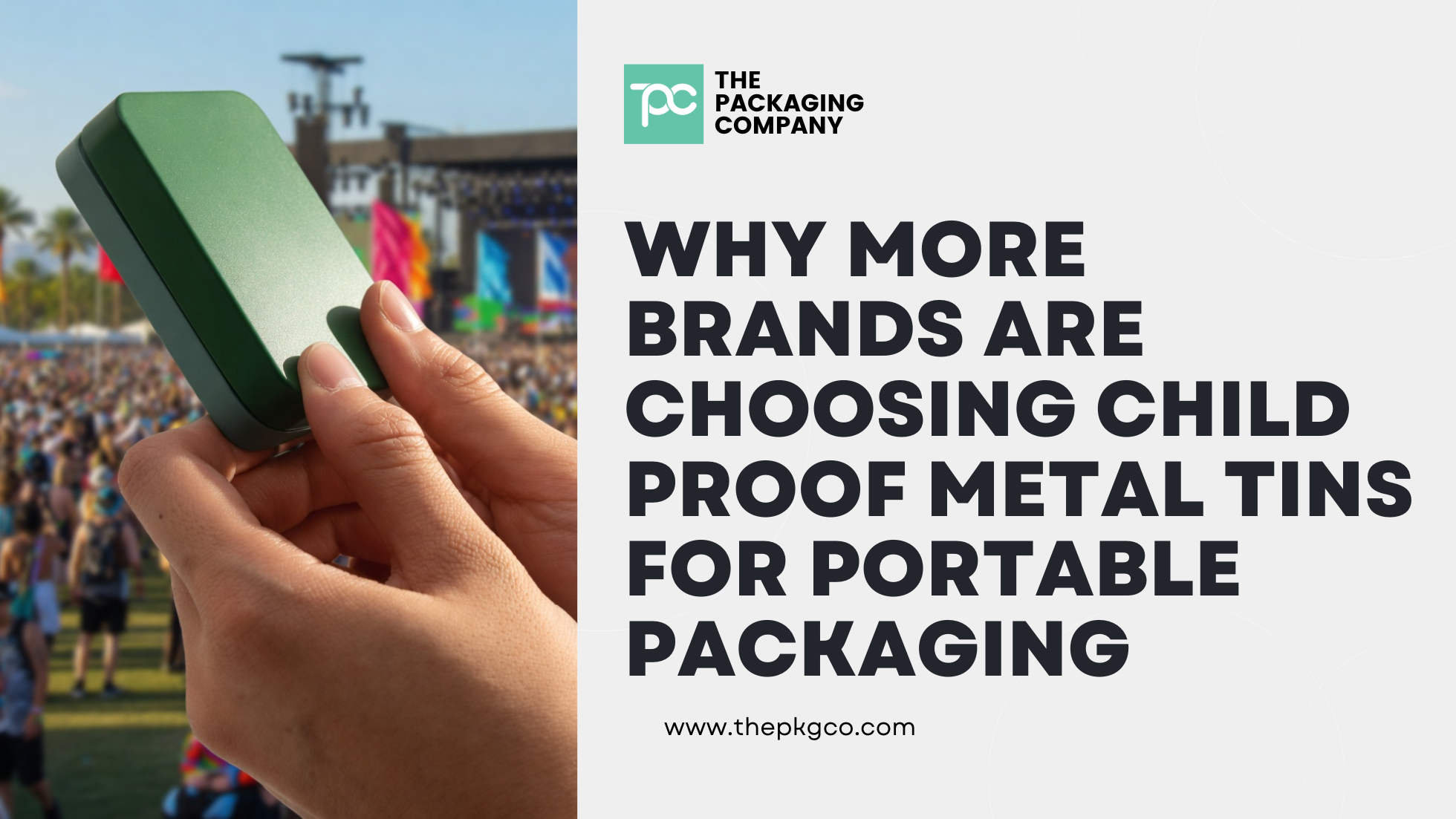
Something is shifting in the cannabis packaging market. After years of plastic tubes dominating the pre-roll category and mylar bags dominating flower, a growing number of brands — particularly in California and other mature markets — are moving toward premium metal tins as their primary retail format.
It is not a coincidence. The brands making this move are responding to real signals: from retail buyers who notice what moves faster off the shelf, from consumers who keep the packaging after the product is gone, and from a market that has cycled through enough low-cost formats to know what a step up actually looks like.
This piece breaks down exactly why metal CR tins are gaining ground, which use cases they are genuinely best for, and what brands should evaluate before making the switch.
The Problem With “Good Enough” CR Packaging
Most CR packaging is designed to meet the compliance minimum. It passes the panel test. It holds the product. It ships. That’s where the design intention stops.
The result is packaging that communicates nothing except compliance. A clear plastic push-and-turn tube tells a consumer that the brand met the legal requirement. It doesn’t tell them anything about the product quality, the brand identity, or why this particular pre-roll is worth more than the one next to it.
In the early years of regulated cannabis markets, that was acceptable. Compliance itself was the story. Now, in markets like California where consumers have been buying legal cannabis for nearly a decade, compliance is the floor — not the differentiator. Brands competing in mature markets need their packaging to do something more than contain the product legally.
Metal tins do something more.
What a Metal Tin Communicates Before the Package Is Opened
The half-second between a consumer picking up a package and deciding to engage with it further is where packaging either earns its keep or fails. This is the moment that premium metal tins consistently win.
Weight is the first signal. A metal tin has physical mass that a plastic tube or mylar bag simply cannot replicate. When a consumer picks up a tin, the weight communicates density, quality, and deliberateness — before they’ve registered anything else about the product.
The closure is the second signal. A properly engineered CR snap tin closes with a tactile click that is satisfying in a way that a plastic cap clicking onto a tube is not. That sound and sensation are subconscious brand signals. They communicate that the closure was designed with intention — that someone thought about what it would feel like to use this package, not just whether it would hold together.
The surface is the third signal. A tin offers a rigid, full-surface decoration canvas that shows lithographic printing at its best. Deep colors, sharp graphics, embossed logos, and custom colorways all read significantly better on metal than on plastic or film. The package looks considered because it is considered.
None of this is accidental. The brands choosing metal tins in 2026 understand that in a dispensary environment where a budtender is presenting multiple options to a customer, the package that looks and feels the most premium creates a purchase inclination before any product education has happened.
The CR Mechanism: Why Not All Tins Are Equal
“Child proof metal tin” is a phrase that gets applied loosely in the market, and it covers a wide range of actual products — some of which are genuinely CR certified and some of which are not.
The CR mechanism in a metal tin is entirely a function of the closure engineering. A standard decorative tin uses a simple press-fit or friction lid that holds by material tension alone. It is not child-resistant. A genuine CR tin uses an engineered mechanism — a directional snap, a squeeze-and-lift latch, or a two-step action — that requires specific motor coordination to operate. That mechanism is what the panel testing certifies.
The quality of the closure tooling determines how consistently the mechanism performs across a production run and over repeated use cycles. A well-engineered CR snap tin should close and open the same way on the 500th use as it does on the first. A poorly tooled closure degrades — the mechanism loosens, the snap loses its resistance, and the package that passed certification testing at the factory no longer performs to standard in the consumer’s hands.
This is the difference between cheap slide tins and engineered CR tins. Slide tins — the kind with a simple panel that pushes to one side — often carry no formal CR certification at all. Those that do carry minimal certification frequently rely on a mechanism that degrades with use. They also typically fail at the airtight seal, which affects product quality for any cannabis format where terpene preservation matters.
TPC’s CR tin line uses engineered snap closures that are certified under ASTM F1272 and tested for consistent performance across repeated use cycles. The closure is the product — not an afterthought to the decoration.
Use Cases Where Metal Tins Win
Premium Pre-Roll Multi-Packs
The strongest commercial case for metal tins in cannabis is the premium pre-roll multi-pack — 3-packs, 5-packs, and dogwalker configurations where the brand is charging a price that needs to be justified at retail.
A $35 five-pack of infused pre-rolls in a clear plastic tube is fighting itself. The packaging communicates a price point that contradicts the product positioning. The same five-pack in a custom-decorated CR snap tin with a custom insert tray arrives at retail looking exactly like what it is — a premium product at a premium price.
The insert tray matters here as much as the tin itself. A well-designed insert holds each pre-roll in its own slot, upright and separated, so the consumer sees an organized, intentional presentation when they open the package. That experience sticks. It is the unboxing moment that gets photographed, shared, and associated with the brand.
Infused and Live Resin Formats
For infused pre-rolls — live resin, rosin, diamond-infused — the packaging carries a specific responsibility: protecting the terpene profile that justifies the price premium. The airtight seal on a quality CR tin is significantly more reliable than the reseal on a plastic tube or mylar bag.
Tins also block light entirely, which matters for UV-sensitive terpene compounds. A tin that has been sitting on a retail shelf for two weeks has provided the same UV protection as a tin that arrived yesterday. Clear plastic provides none.
Edibles Requiring Portable CR Packaging
The edibles category has a specific challenge that metal tins solve well: the need for packaging that is both genuinely CR compliant and small enough to be carried portably without looking like a prescription bottle.
A well-designed CR tin in a compact format — the 74mm × 58mm × 20mm snap tin, for example — fits in a pocket or bag, has a closure that holds reliably without being opened accidentally, and presents the brand at a premium level that most edible packaging doesn’t approach. For confection formats — chocolates, gummies in a branded configuration — the tin jar format with a wide-mouth opening also allows for a presentation approach that a bag or tube simply cannot.
Portable Wellness and Nutraceutical Products
The same arguments that apply to cannabis apply to regulated wellness and nutraceutical formats that require CR compliance. Supplement brands, CBD topical brands, and dispensary-sold wellness products that need CR packaging have the same interest in a format that communicates quality — and in many of these categories, the metal tin is genuinely novel because plastic bottles have dominated for so long.
A CR tin for a high-end CBD topical balm or a nutraceutical capsule format creates an immediate visual differentiation from every competitor in a plastic bottle.
The Sustainability Argument
Metal tins have a legitimate sustainability story that plastic cannot match.
Tinplate steel is infinitely recyclable. Unlike multi-layer plastics, which degrade in quality through each recycling cycle, metal loses none of its properties when recycled. Tin is also widely accepted in standard single-stream municipal recycling programs — consumers don’t have to find a specialty drop-off or mail-in program to recycle the package.
Beyond recyclability, tins are reused. Consumers keep tins. They use them for storage, for organization, as desk accessories. The packaging lives beyond the product in a way that a plastic tube or a mylar bag never does — and every day the tin sits on a consumer’s shelf is a brand impression that cost nothing after the initial purchase.
For brands making sustainability claims to retail buyers — particularly in the natural channel, the wellness space, or markets where packaging sustainability is increasingly part of the purchasing decision — a metal tin is one of the few formats that can support those claims without caveats.
What to Evaluate Before Making the Switch
Closure mechanism and certification. Confirm that the tin you’re sourcing carries formal third-party certification under ASTM F1272 or 16 CFR §1700.20, and request the test documentation. Not all metal tins are CR certified. Not all that claim to be have the documentation to prove it.
Dimensional fit for your product. Map your pre-roll length, diameter, and count configuration to the available tin dimensions before anything else. A 100mm king-size pre-roll needs the extended snap tin format. A 5-pack of dogwalkers needs a different interior volume than a 5-pack of 1g pre-rolls. Confirm dimensional fit with samples before committing to a production run.
Insert tray configuration. The interior of the tin is a design decision, not just a functional one. A custom insert tray that holds pre-rolls upright and separated is a different brand experience than loose product rattling inside a tin. Work with your supplier to specify the interior configuration as part of the packaging design.
Decoration scope. Identify what decoration elements matter for this SKU — surface print, embossing, custom colorways, lid versus body differentiation — and confirm what the supplier can actually execute before you design to a specification they can’t meet.
MOQ and sampling. TPC’s CR tin line starts at 5,000 units with pre-production samples available before any production commitment. For any brand switching from an existing format, sampling the tin with your actual product is essential — not just to validate dimensional fit but to confirm the closure operates correctly on your fill line and that the decoration meets your brand standards in the physical package, not just on a digital proof.
TPC’s CR Tin Line
TPC offers a full range of CR metal tins for cannabis, edible, and regulated wellness brands, all engineered with certified snap closures and full custom decoration capability.
The Child-Resistant Snap Tin (74mm × 58mm × 20mm) handles standard pre-roll configurations from singles to 5-packs. The Extended Snap Tin (95mm × 57mm × 20mm) accommodates 100mm formats and larger multi-packs. The CR Tin Jar (90ml) provides a wide-mouth format for infused pre-rolls, edibles, and topicals where product presentation inside the container is part of the brand experience.
All formats support lithographic printing, embossing, and custom interior insert trays. MOQs start at 5,000 units.
Browse the full CR tins collection or contact TPC to discuss your specific format and start the sampling process.
For brands evaluating the full CR packaging landscape before making a format decision, the child resistant packaging solutions guide covers all available formats with a comparison framework. If cost-efficient CR packaging at volume is the priority alongside or instead of tins, see our guide to wholesale child-resistant packaging and our child resistant mylar bags guide.
Frequently Asked Questions
Are all metal tins child-resistant? No. CR status requires formal third-party panel testing under ASTM F1272 or 16 CFR §1700.20. Standard decorative tins with friction-fit or simple press lids are not child-resistant regardless of the material. Always request certification documentation for the specific tin format you are sourcing.
What is the difference between a CR snap tin and a slide tin? A CR snap tin uses an engineered closure mechanism — a directional snap or latch — that requires a specific two-step or directional action to open. A slide tin uses a simple panel that pushes to one side and typically provides no meaningful child resistance. Most slide tins do not carry formal CR certification, and those that do often rely on mechanisms that degrade with repeated use.
Do metal tins protect terpenes better than plastic tubes? Yes, for two reasons. First, a properly engineered CR tin creates an airtight seal that is more reliable than the reseal on most plastic CR tubes. Second, metal is completely opaque, blocking UV light that degrades terpene compounds over time. For infused or live resin pre-rolls where terpene expression is a core product claim, metal tins offer meaningfully better protection than plastic.
Can I get custom decoration on a CR tin? Yes. TPC’s CR tins support full-surface lithographic printing, embossing, custom colorways, and custom interior insert tray configurations. Decoration is quoted per project based on run quantity and design complexity.
What size tin do I need for 100mm pre-rolls? The Extended CR Snap Tin (95mm × 57mm × 20mm) accommodates 100mm king-size pre-rolls and larger multi-pack configurations. The standard Snap Tin (74mm × 58mm × 20mm) is sized for standard pre-roll lengths up to approximately 84mm.
Are metal tins recyclable? Yes. Tinplate steel is infinitely recyclable and widely accepted in standard single-stream municipal recycling programs. Unlike multi-layer plastics, metal retains its material properties through the recycling process and can be recycled repeatedly without quality degradation.
What MOQ do CR tins require at TPC? TPC’s CR tin line starts at 5,000 units for standard formats. Custom configurations, interior tray specifications, and full decoration are available from the MOQ floor. Pre-production samples are available before any production commitment.