



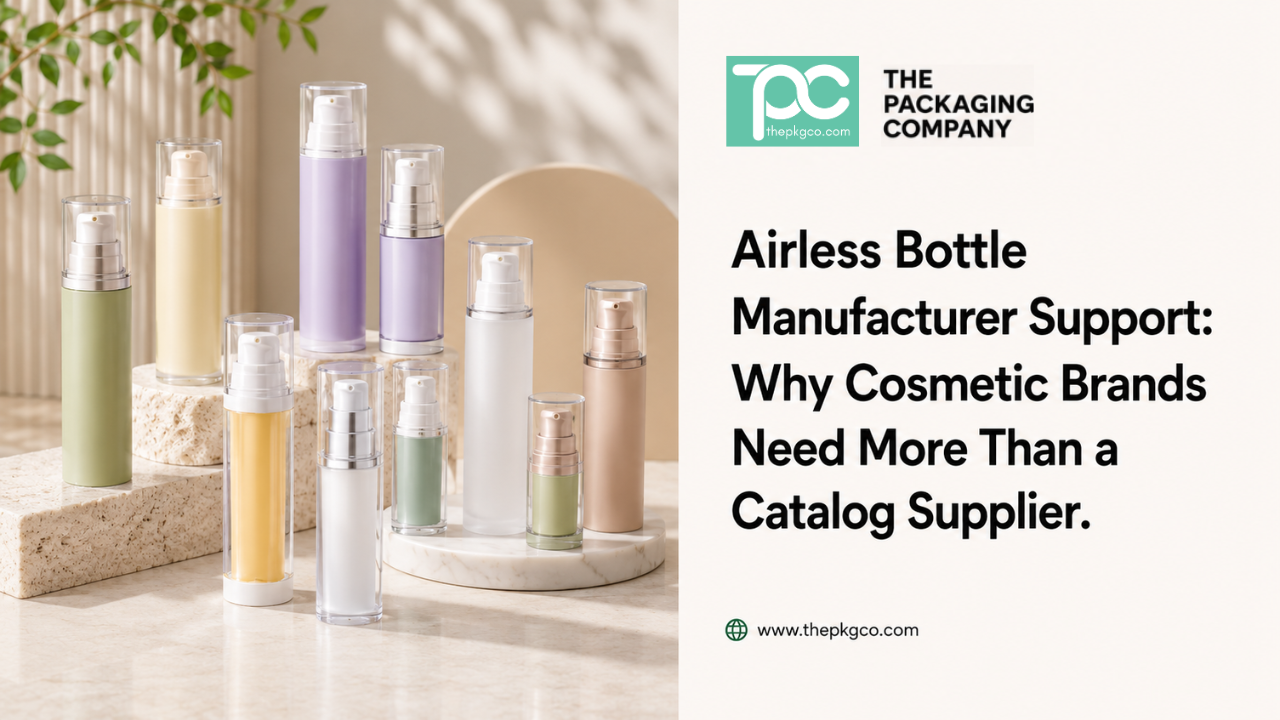
There are many ways to source airless bottles. A cosmetic brand can browse a catalog, request a quote from a broker, or contact an overseas factory directly. These options may work for simple projects, but they often have limits when a brand needs custom decoration, pump performance, production consistency, and support across bulk orders.
For skincare and cosmetic brands, working with an airless bottle manufacturer should mean more than choosing a bottle from a product list. Airless packaging depends on component fit, pump performance, formula compatibility, decoration control, packing quality, and reorder consistency.
This article explains how The Packaging Company supports airless bottle projects differently from a basic catalog supplier or one-time factory contact.
The Problem With Treating Airless Bottles Like Simple Stock Packaging
Airless bottles may look simple from the outside, but the packaging system is more technical than a standard bottle. The pump, actuator, cap, bottle body, inner piston, decoration, and carton packing all need to work together.
A catalog supplier may show attractive product photos, but product photos do not always answer the questions that matter during production:
- Will the pump output match the product use case?
- Will the actuator feel consistent across bulk production?
- Can the same color and finish be repeated on reorder?
- Will the decoration hold up during handling and shipping?
- Will the selected airless pump packaging work with the actual formula?
- Can the supplier support changes before production starts?
For brands sourcing airless pump bottles wholesale, these details matter because the packaging must perform across thousands of units, not only in one sample photo.
Why Airless Bottle Manufacturing Needs Production Support
Airless packaging is commonly used for serums, moisturizers, eye creams, sunscreens, lotions, and treatment formulas. These products often need a cleaner dispensing experience and a more polished presentation than basic packaging can provide.
But choosing the right bottle is only one part of the process. Brands also need production support that can help confirm:
- Airless bottle format
- Pump system and output
- Formula dispensing behavior
- Cap and actuator fit
- Decoration method
- Custom color or finish
- MOQ and production timeline
- Carton packing and shipping protection
- Reorder consistency
Without this support, a brand may approve a good-looking sample but still run into problems when the order moves into bulk production.
What TPC Actually Provides for Airless Bottle Projects
The Packaging Company is not only a source for packaging options. TPC supports brands through packaging selection, customization review, production coordination, and order planning.
For airless bottle projects, this means helping cosmetic and skincare brands review the package as a complete system. The bottle body, pump, cap, decoration, and formula-use expectations should all be considered before production approval.
TPC supports brands with:
- Airless bottle format review
- Custom decoration planning
- Sample coordination
- MOQ review
- Production communication
- Quality and packing expectations
- Wholesale order support
- Reorder planning
This is especially important for brands developing airless pump bottles for cosmetics, where packaging has to support both product performance and brand presentation.
What Brands Should Consider When Sourcing Airless Bottles
When sourcing airless bottles, the first quote or product photo should not be the only deciding factor. Airless packaging includes pump, cap, actuator, bottle, decoration, and packing details that all need to work together in bulk production.
Before moving forward with a supplier, cosmetic brands should confirm how the packaging partner controls pump performance, decoration quality, component consistency, packing standards, and reorder support.
Important points to confirm include:
- Whether sample quality can be repeated in bulk production
- Whether pump output stays consistent between samples and production units
- Whether the pump, actuator, cap, and bottle components fit correctly
- Whether decoration colors and finishes can match the approved sample
- Whether packing standards protect pumps, caps, and decorated surfaces during shipping
- Whether communication is clear when production changes or quality questions appear
- Whether the same components can be repeated for future reorders
For cosmetic brands, these details can affect launch timing, packaging consistency, and customer experience. This is why airless bottle sourcing should be reviewed as a full production process, not only as a price comparison.
Why a Catalog Supplier May Not Be Enough
A catalog supplier can be useful when a brand only needs a standard bottle with minimal customization. But many skincare launches require more than a standard format.
Brands may need:
- Custom color matching
- Logo printing or hot stamping
- Matte, glossy, frosted, or metallic finishes
- Different bottle sizes across a product line
- Pump output review
- Carton packing support
- Reorder consistency
When a brand is building a more serious skincare product line, the packaging partner should help manage these details instead of only providing a product code and a price.
Made-to-Order Support for Airless Packaging
TPC works with brands on made-to-order packaging projects rather than only pushing generic stock inventory. This matters because cosmetic packaging often needs to reflect a specific brand identity, formula type, and launch plan.
For airless packaging, made-to-order support can include:
- Selecting the right airless bottle style
- Reviewing bottle size and pump type
- Planning custom decoration
- Confirming color direction
- Coordinating samples
- Preparing production details
- Supporting bulk order planning
Brands comparing airless packaging solutions should think about whether they need a simple stock item or a packaging partner that can help manage the full production path.
Airless Pump Fit and Output Matter
Airless pump packaging depends heavily on pump performance. A bottle may look correct visually, but the customer experience depends on how the pump works during actual use.
Brands should review:
- How much product dispenses per pump
- How many pumps are needed for priming
- Whether the actuator feels smooth
- Whether the formula leaves residue around the pump
- Whether output stays consistent after storage
- Whether the pump feels appropriate for the product price point
These details are especially important for serums, eye creams, moisturizers, sunscreens, and treatment formulas where customers expect a controlled and clean dispensing experience.
Decoration Control Is Part of the Manufacturing Conversation
For many beauty brands, the bottle is also part of the brand story. Airless bottles may need custom color, printing, hot stamping, frosted finishes, matte finishes, metallic accents, or coordinated caps.
Decoration should be reviewed before production because it affects both appearance and consistency.
Brands should confirm:
- Color reference
- Logo placement
- Printing method
- Finish type
- Cap and actuator color
- Decoration durability
- How the design will be repeated on reorder
A strong airless pump bottle manufacturer should help brands think through decoration as part of production, not as a separate last-minute design step.
Why China-Side Production Oversight Matters
TPC’s service model includes US-side support and China-side production coordination. This structure helps bridge the gap between brand expectations and overseas manufacturing execution.
For airless bottle projects, China-side oversight can help with:
- Factory communication
- Production scheduling
- Sample coordination
- Decoration review
- Quality expectations
- Packing and shipment coordination
This is different from placing an order with a factory and hoping the production run matches the sample. Airless packaging has too many small parts for brands to rely only on a catalog photo or a low quoted price.
What This Means for Cosmetic and Skincare Brands
For cosmetic and skincare brands, the right airless bottle partner can help reduce risk before launch. This matters whether the brand is preparing one hero product, a full skincare set, or a wholesale reorder.
TPC can help brands think through:
- Which airless bottle format fits the product line
- How decoration should be planned
- How MOQ affects launch planning
- How pump output supports customer use
- How packing protects the final product
- How reorders can stay consistent
The goal is not just to source a bottle. The goal is to build packaging that supports the product, the brand, and the production process.
When Brands Should Work With TPC
TPC is a strong fit for brands that need more than a generic airless bottle listing. This includes brands that are preparing custom packaging, wholesale orders, new skincare launches, or multi-SKU product lines.
Brands should consider working with TPC when they need:
- Airless bottle project support
- Custom decoration options
- Wholesale production planning
- Sampling before bulk order
- MOQ guidance
- Airless pump bottle manufacturer support
- Production coordination
- Reorder consistency
For brands that only need a small quantity of generic packaging, a catalog supplier may be enough. For brands preparing a serious cosmetic or skincare launch, working with a production partner can create better long-term results.
Final Recommendation
Airless bottles are not just simple containers. They are packaging systems that depend on pump fit, decoration control, component consistency, formula-use expectations, packing quality, and reorder planning.
Cosmetic brands need more than a catalog supplier when sourcing airless bottles for a product launch. They need a packaging partner that can help connect design, sampling, production, and wholesale order support.
The Packaging Company works with cosmetic and skincare brands to review airless pump bottles, custom airless packaging, MOQ, sampling, decoration, and production needs. Brands preparing an airless bottle project can speak with our packaging team to discuss the best direction before production.
FAQ: Airless Bottle Manufacturer Support
Is TPC an airless bottle manufacturer?
TPC supports airless bottle manufacturing projects through packaging selection, customization review, sample coordination, production communication, and wholesale order planning for cosmetic and skincare brands.
Why should brands use more than a catalog supplier for airless bottles?
Airless bottles require pump fit, decoration control, formula-use review, packing planning, and reorder consistency. A catalog supplier may not support all of these production details.
Can TPC help with custom airless pump bottles?
Yes. TPC can help brands review airless bottle styles, custom decoration, color options, MOQ, samples, and production requirements for custom airless pump bottle projects.
What should brands confirm before ordering airless pump bottles wholesale?
Brands should confirm bottle size, pump type, output, formula-use expectations, decoration method, color, MOQ, carton packing, and reorder needs before placing a wholesale order.
What products commonly use airless pump bottles for cosmetics?
Airless pump bottles are commonly used for serums, moisturizers, eye creams, sunscreens, lotions, primers, and treatment formulas that need controlled dispensing and a polished presentation.