


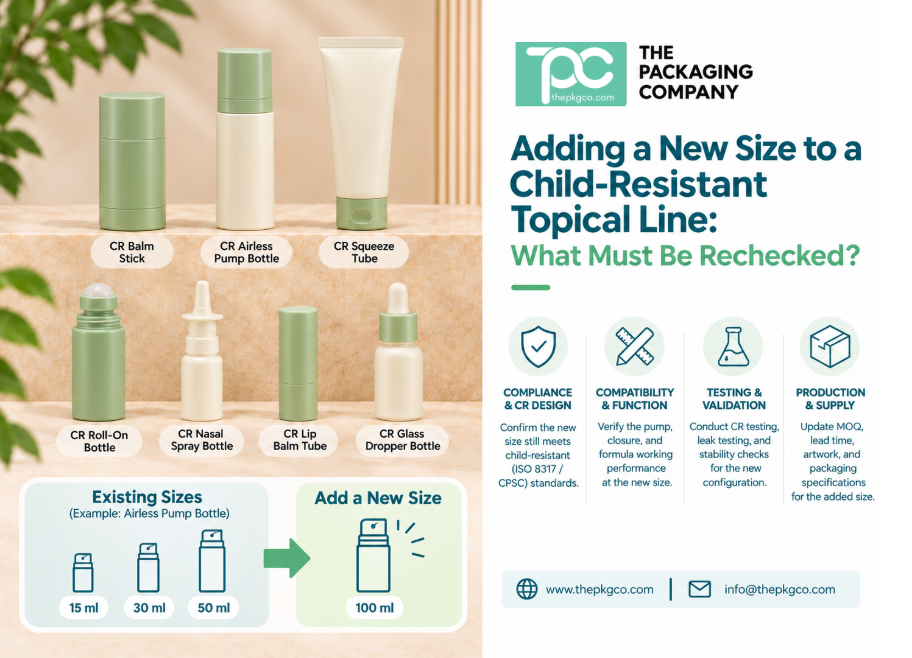
Adding another package size to an established topical product line can seem straightforward. A brand already has a container design, a recognizable label, and a child-resistant closure it uses for an existing lotion, cream, or balm. The next product may use the same formula and visual identity, just in a different quantity.
However, child resistant topical packaging cannot be scaled by capacity alone. A different body size may require a different neck finish, closure, liner, or dispensing component. The new package may also affect filling requirements, label space, and the child-resistant test evidence the brand has on file.
For regulated topical and wellness brands, the useful question is not how to choose a child-resistant package for the first time. It is which parts of an already approved packaging program remain applicable when a new size is introduced—and which parts need another review before a bulk order.
Begin With the Existing Approved Packaging Configuration
The original size should provide the starting point for the new SKU. Gather the packaging specification, the exact container and closure references, relevant technical reports, and the filling partner’s production requirements. This creates a reliable comparison rather than a general request for “the same container in a larger size.”
A product line might use a smaller child-resistant tube for a concentrated topical and plan a larger format for everyday use. Even if both designs look similar, their closure assemblies and filling processes may differ. The manufacturer should confirm which products actually belong to the same approved packaging family.
Brands can explore TPC’s child-resistant packaging options when assessing an additional format, but the final configuration and its suitability must be verified for the specific product and market.
1. A Different Container Size May Not Be the Same Closure System
When a brand increases or decreases capacity, changes in container diameter, height, opening, and body construction may follow. The child-resistant closure could be the same model, a related size, or an entirely different assembly.
That distinction matters because child-resistant performance belongs to the relevant packaging configuration—not just the general type of closure. A cap that works on one container should not be presumed interchangeable with another.
Ask the supplier to identify the actual component combination for each size, including:
- Container model, capacity, material, and opening geometry
- Exact child-resistant closure or dispensing mechanism
- Applicable liner, insert, applicator, or other components
- Changes to closure attachment or reclosure operation
- Supplier’s supported combinations and production tolerances
The comparison should use specific part numbers or drawings, not only catalog photographs. A size extension that retains the same overall appearance may still need a new closure and package reference.
2. Verify Whether Existing Child-Resistant Evidence Covers the New Size
The most important question is whether the brand can support child-resistant compliance for the new package in the market where the product will be sold.
Request the relevant test reports and other supporting documentation for the proposed container-and-closure configuration. Check that the documents identify the specific packaging components and the scope of configurations represented by the testing. The compliance team should establish whether an existing report applies to the new size or whether more evidence is necessary.
Do not assume the original size’s documentation automatically establishes the performance of another size. Equally, do not assume that every size change always requires a completely new test program. The assessment depends on the applicable regulation, what was tested, and the technical basis for covering the new configuration.
For certain products governed by the U.S. Poison Prevention Packaging Act, the Consumer Product Safety Commission’s special-packaging guidance explains that testing may support more than one size when there is an appropriate basis. It also clarifies that CPSC does not approve or certify individual package designs. Requirements for cannabis or other regulated topicals may differ by state and product classification, so the applicable jurisdiction must be checked separately.
Where federal special-packaging requirements apply, the finished-product manufacturer or other legally responsible party must ensure compliance; an empty packaging supplier’s documentation does not itself complete the finished-product obligation.
The practical procurement question is: What precise configuration is supported by the available evidence, and who has confirmed that it applies to the new SKU?
3. Keep Closure Operation and Consumer Use in the Review
Even when both sizes use a child-resistant format, the experience of opening, dispensing from, and properly resecuring them may differ. A larger tube or bottle can have different handling characteristics, while a different closure size or mechanism may affect the way users operate the package.
Brands should review the intended opening and closing steps, whether instructions remain appropriate, and whether the package can be used as intended by the target consumer without defeating the relevant child-resistant requirements.
This is particularly important for topical products used repeatedly. A package may be opened and reclosed many times over its use period. Any review of user experience should remain consistent with the product’s applicable compliance and performance requirements.
The aim is not to replace certified or required testing with informal user observations. It is to ensure the size extension is reviewed as a finished consumer packaging system, rather than merely a larger version of an existing bottle or tube.
4. Revisit Dispensing and Filling Requirements
A different fill size can change how the same topical product is dispensed and filled. For a squeeze tube, diameter, length, and construction may affect how the product is handled during filling and sealing. For a dispensing bottle, changes in pump or actuator configuration may affect output and assembly. For jars, the opening and closure arrangement may influence filling and application.
The actual formula still matters. Thick balms, creams, and lower-viscosity lotions do not necessarily behave identically across packaging sizes or dispensing formats.
The brand’s formulator and filling partner should decide whether the earlier formula-packaging evaluations remain applicable to the new size. Questions may include:
- Can the selected package accommodate the intended net quantity?
- Does the contract filler support the new container dimensions and assembly?
- Do fill accuracy, sealing, or applicable headspace requirements change?
- Is the product dispensed acceptably with the proposed opening or applicator?
- Are any additional compatibility, storage, or distribution evaluations needed?
These assessments are separate from demonstrating child-resistant performance. A package can have relevant child-resistant documentation and still need to be checked for its suitability with the actual formula and filling process.
For more detailed discussion of the original squeeze-tube selection process, see TPC’s child-resistant squeeze tubes for topicals guide. The new-size review should build on that work rather than repeat the entire selection checklist.
5. A New Size Creates a New Label and Artwork Decision
Moving from one capacity to another can change the available label or decoration area. Even if the brand wants the same artwork, it may need a separate production file for each container and its intended market.
Check that product identity, net quantity, applicable warnings, directions, lot or batch information, and other required content can be presented correctly on the new size. The exact requirements depend on the product category and jurisdiction.
A brand should also verify the placement and clarity of any closure-opening instructions. Decorative changes must not obscure or conflict with required information.
Do not rely solely on scaling the original file. Record the new artwork revision and connect it to the correct container and closure specification. That makes the production approval and future reorders much easier to manage.
6. Plan MOQ by the Actual New SKU, Not the Existing Product’s Total Volume
A product line that already purchases one child-resistant size may not be able to combine that quantity with a different size to satisfy a single manufacturing minimum. Tooling, components, decoration, and production methods may differ.
Ask for the minimum order quantity and commercial requirements of the specific new configuration. For TPC squeeze tubes, the general MOQ is 10,000 units per SKU, subject to final project specifications. Other child-resistant containers may have different minimums, which should be confirmed individually.
If the brand is extending into two or three sizes, prepare a separate quantity estimate for each planned SKU. This also helps reveal whether a particular size requires a component combination that changes lead time or sourcing requirements.
Do not treat the addition of one size as an automatic reorder of an existing component. The new package should receive its own unambiguous supplier quotation and specification.
7. Document Which Approvals Carry Over—and Which Do Not
The team should be able to compare the existing and proposed packaging side by side. A clear change record is particularly valuable when multiple people are involved across brand, packaging supplier, contract filler, and compliance teams.
| Review area | Existing size | New size: what to establish |
|---|---|---|
| Container specification | Approved model and capacity | New exact body and dimensional reference |
| CR closure configuration | Approved closure or dispensing set | Whether the same assembly is supported or another is required |
| Compliance evidence | Reports and documents for the existing configuration | Scope of evidence and any additional assessment or testing needed |
| Formula and filling | Previous technical and production evaluations | Applicability to the new size, equipment, and fill conditions |
| Artwork and instructions | Approved printed or labeled layout | New layout, required information, and revision reference |
| Commercial requirements | Current purchase order and MOQ | MOQ, price, component availability, and timing for the added SKU |
| Production approval | Existing sample or PPS references | Approval reference for the new custom configuration |
For each item, record the responsible person, what evidence is available, and whether the team has approved proceeding. Avoid labeling the overall project “approved” while significant size-specific questions remain unresolved.
8. Understand the Sampling Sequence for the Added Size
A brand extending its packaging line may already have an approved physical sample for the original size. That sample is useful as a reference for color, material, construction, or visual consistency, but it does not automatically approve the new size.
For TPC custom packaging projects, available stock samples can be reviewed before the order is placed to assess the proposed packaging direction. A pre-production sample (PPS) is provided after order placement to confirm the agreed custom packaging configuration before bulk manufacturing.
The scope of PPS approval for a newly added size should be clarified with TPC for the project. This packaging approval is distinct from the finished-product testing and compliance decisions made by the brand and its qualified partners.
For applicable custom manufacturing projects, TPC’s typical production lead time is around 90 days after PPS approval, with project-specific timing and shipping confirmed separately. If the new size requires different components or development, the total schedule may change.
For a full explanation of what each sample can establish, read stock samples versus pre-production samples.
9. Avoid Mixing the Old and New Packaging Specifications
Once the new size is added, procurement and production teams should maintain distinct identifiers for each container and child-resistant closure combination. Similar labels such as “topical tube, small” and “topical tube, large” are not adequate substitutes for detailed component records.
Separate SKU references should connect the correct container, closure, artwork, technical documentation, and production approval. If the brand later changes a component, it should be clear which size is affected and whether the change has any implications for the available compliance evidence.
This is especially important for brands with several regulated products and frequent reorders. TPC’s child-resistant packaging line planning guide covers the broader management of multiple product formats. For this article, the priority is keeping size-specific decisions controlled within one established topical product family.
Before Ordering the New Size: Six Questions to Resolve
- Is the proposed container-and-closure combination a manufacturer-supported configuration?
- Does the available child-resistant evidence cover that exact configuration under the applicable rules?
- Who is responsible for any further compliance, formula, or filling evaluation?
- Are artwork, instructions, and net-content information correct for the new size?
- What MOQ, components, and production schedule apply specifically to this SKU?
- Which approved records will procurement and the filling partner use for future orders?
For established brands, the purpose of adding a new packaging size is to expand the product line without losing control of the specifications that support its existing operation. The best approach is to carry over what is genuinely applicable—and document the remaining decisions before production.
The Packaging Company supplies custom and wholesale packaging for skincare, wellness, and regulated-product brands. If you are considering an additional size for an existing topical product, contact TPC with your current packaging reference, proposed size, intended quantity, market, and any child-resistant documentation already available. Our team can review relevant empty-packaging options and component specifications for your project.
Frequently Asked Questions About Adding a CR Topical Package Size
Does a child-resistant closure approved for one size automatically cover another size?
No automatic conclusion should be made. The brand’s compliance team should review the actual tested configurations, report scope, and requirements for the product’s market. Additional assessment or testing may be needed, while appropriately supported evidence can sometimes cover more than one size.
Can I use the same formula in a larger child-resistant topical container?
Possibly, but the formulator and filling partner should confirm that the new container and dispensing system are suitable for the product and intended filling process. Packaging compatibility and child-resistant compliance are separate considerations.
Will every new size need a different child-resistant cap?
Not necessarily. Some packaging families may support related configurations, but the supplier must confirm the precise container and closure pairing. Do not assume that nominally similar caps fit or perform equivalently.
Does TPC provide customized samples before the order?
TPC’s normal process is to review available stock samples before ordering. For custom orders, PPS is provided after the order is placed and is used to confirm the agreed custom packaging configuration prior to bulk manufacturing.
What should I send TPC when requesting another size for a topical line?
Provide the existing container and closure references, new desired capacity, product type, intended market, estimated quantity per SKU, artwork requirements, and available compliance documentation. The relevant technical and regulatory teams should determine which earlier test evidence can be applied.