



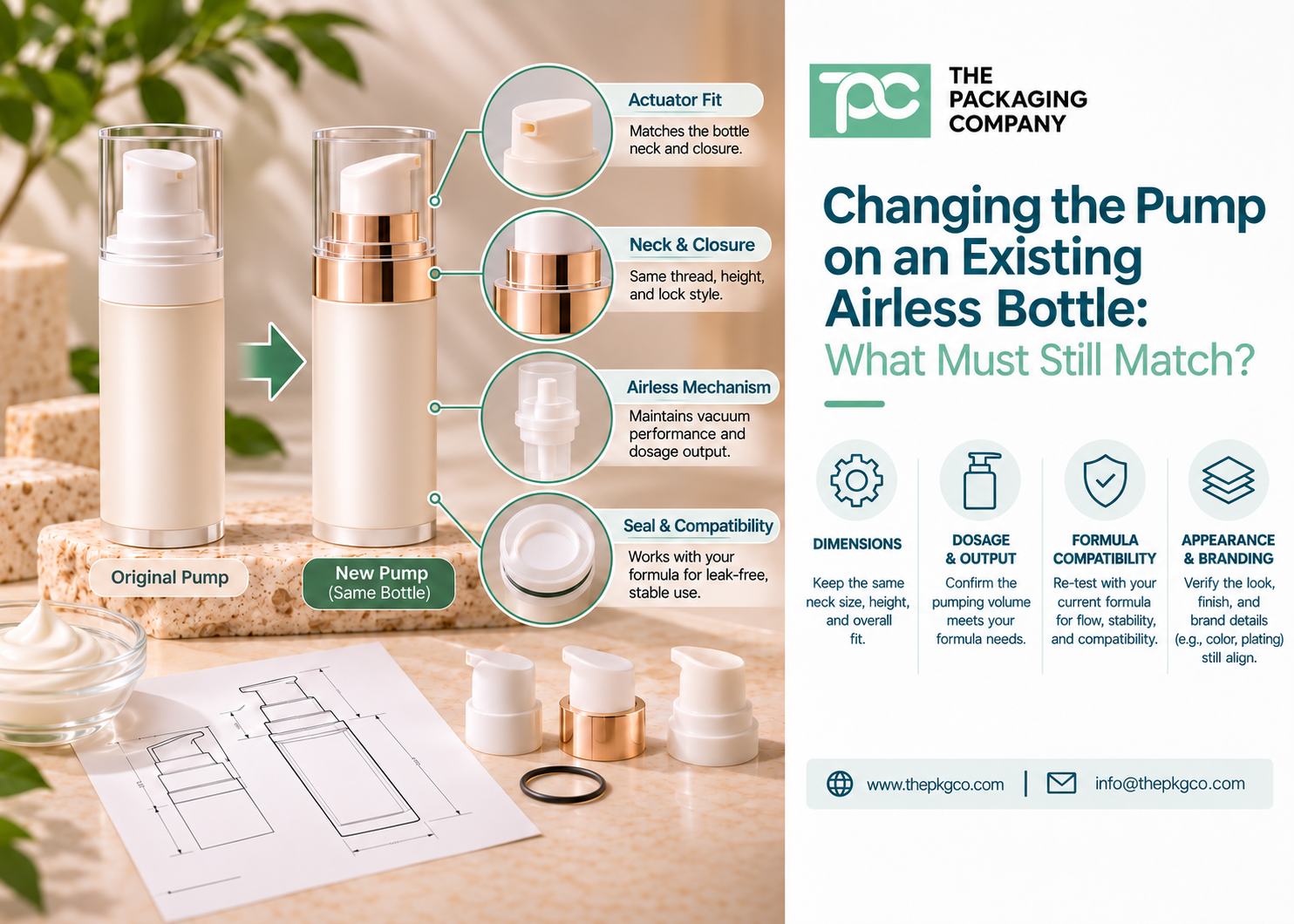
Replacing a pump on an existing airless bottle can look like a small packaging change. A skincare brand may want a different dispensing output, an updated actuator, or a replacement component because the original pump is no longer available. The brand may also want to keep the bottle shape and decoration while changing the dispensing experience.
But an airless pump is not an interchangeable accessory. The pump and bottle are parts of a designed dispensing system. A new pump may look similar to the original and still differ in its connection, sealing surfaces, internal dimensions, or operating requirements. Those differences can affect both the empty package assembly and how the filled product dispenses.
For beauty brands managing an established line, airless pump compatibility means confirming that the replacement works with the exact existing bottle configuration—not simply checking that the new pump has the same appearance or nominal size. Below are the decisions a brand, packaging supplier, and filling partner should resolve before approving a component substitution.
First, Identify Which Part the Brand Wants to Change
“Change the pump” can refer to different modifications. A brand may want a different actuator, a revised pump engine, a complete dispensing head assembly, or a pump from another supplier. These are not equivalent requests.
Before requesting an alternative, identify the existing bottle model and approved component set. Then specify which part is changing and what the change is intended to achieve.
| Requested change | What the team should clarify |
|---|---|
| Different actuator or pump head appearance | Whether the new head is approved for the same pump engine, attachment, output, and overcap |
| Different output per stroke | Whether a compatible pump variant exists for the selected bottle and formula |
| Replacement pump from another component supplier | Whether the complete connection, seal, assembly, and dispensing system has been verified |
| New complete pump assembly | Whether it remains compatible with the bottle, relevant internal mechanism, filling process, and final appearance |
| New pump to solve an existing dispensing complaint | Whether the cause is the pump, formula, filling process, or another component before selecting a replacement |
The first question is therefore not “Which other pump has this diameter?” It is “Which alternative has the manufacturer confirmed for this specific airless bottle system?”
1. Verify the Bottle-to-Pump Connection
Different airless systems can use different ways of securing a pump or dispensing assembly. Depending on the design, the connection may involve threads, a snap-fit feature, a collar, or another manufacturer-specific interface.
Two components described using the same nominal bottle size may not have identical interface dimensions or tolerances. A pump may appear to attach securely but still fail to seat correctly or meet the intended assembly requirements.
Ask the supplier to identify the actual connection and approved fit criteria, including the applicable neck or opening geometry, retaining features, assembly position, and manufacturing tolerances. These should come from the relevant engineering drawings or component specifications—not assumptions based on a sample photo.
Buying implication: Do not approve pump substitution on nominal capacity, exterior diameter, or visual similarity alone. Where a replacement is proposed, verify it against the exact bottle reference and revision.
2. Confirm That the Sealing Interfaces Still Work
A pump can be mechanically attached to a bottle without necessarily preserving the sealing and dispensing conditions required by the system. The relevant sealing arrangement may involve contact surfaces, gaskets, internal pump components, or features that vary by design.
Changing any one of those interfaces may affect leakage performance, air ingress, or operation during use. Whether a particular seal is needed—and how its effectiveness should be assessed—depends on the actual configuration.
For a proposed replacement, establish which component surfaces are intended to seal, whether the same sealing arrangement is retained, and whether the supplier has approved the revised assembly. If the new pump uses another gasket or internal sealing structure, it should be assessed as part of the complete configuration.
There is no universal seal specification that applies to every airless bottle. The supplier’s approved drawings and performance requirements should control the decision.
3. Determine Whether the Existing Airless Mechanism Can Be Retained
Many conventional airless bottles use a moving piston or platform inside the container, but not every airless system uses that same architecture. Some systems use flexible pouches or other dispensing arrangements. The pump, product chamber, and internal mechanism are designed to function together.
For a piston-based bottle, the team should establish whether a proposed pump change alters any operating conditions needed for the piston and dispensing mechanism to work as intended. A compatible pump cannot be defined only by how it attaches at the top of the bottle.
For a pouch-based or specialty system, the applicable interfaces and requirements may be different. That is why a generic statement such as “this pump fits airless bottles” does not establish compatibility with a particular product.
Brands should request confirmation of the supported component combination from the manufacturer rather than assuming pump engines, pistons, or internal dispensing parts can be mixed across product families.
For readers interested in how the different systems operate, TPC has a separate guide to airless pump mechanisms and components. The purpose of this article is narrower: evaluating a proposed replacement within an already selected system.
4. Check the Actuator, Collar, and Overcap as a Set
A new pump may preserve the internal dispensing arrangement but change the appearance or fit of visible parts. In an established skincare line, those details matter because the brand may want to keep the same silhouette, color arrangement, or shelf presentation.
Check whether the proposed actuator and collar are part of the approved pump assembly and whether the existing overcap is designed to fit that configuration.
Also consider whether a change affects the way the consumer presses the actuator, how the dispensing opening is positioned, or whether the cap can be used without unintended contact. The exact assessment depends on the packaging design.
For multi-SKU product lines, determine whether the change applies to one size or the full packaging family. A component that is available for one bottle capacity may not be approved for every variant.
5. Understand What a Different Pump May Change About Dispensing
Even if the replacement pump is mechanically compatible, it may not provide the same output, priming experience, or behavior with the actual skincare formula. A replacement intended to address a specific application requirement should be evaluated against that requirement.
For example, a brand that wants a smaller dose for a facial treatment should confirm whether the alternative assembly achieves an appropriate output when used with the real formula. A brand changing pumps because customers report difficult dispensing should first determine whether pump design, viscosity, product filling, or another factor contributes to the problem.
Record the intended difference: output, dispensing feel, first-use behavior, or another agreed performance characteristic. Without that objective, it becomes difficult to decide whether the substitution improved the product.
Detailed testing methods and dosage decisions are covered in TPC’s airless pump bottle dosage and output guide. Here, the central point is that a pump replacement may change the basis of the original approval—even if the outer bottle is unchanged.
6. Ask the Filling Partner About Assembly and Process Changes
An airless bottle delivered for bulk production must be suitable for the brand’s intended filling and assembly process. Replacing a pump may alter how components are handled, attached, or inspected at the filling facility.
Before confirming the substitution, ask the contract filler whether the revised assembly is compatible with its equipment and operating procedures. The filler may need to review component handling, application settings, applicable sealing steps, fill quantities, or other process requirements.
Do not assume that a manually assembled prototype confirms compatibility with an automated filling line. The appropriate level of review depends on the specific system and manufacturing process.
TPC’s article on preparing skincare packaging for the filling partner covers the broader handoff. This article concentrates on the consequences of a pump substitution within that handoff.
7. Keep the Replacement Configuration Separate From the Original
A brand may already have purchase orders, approved artwork, packaging drawings, and quality documents tied to the original bottle-and-pump combination. If the pump changes, teams need to know exactly which configuration is approved for future production.
Calling both configurations “50 mL airless bottle with white pump” can create avoidable confusion. Instead, the packaging specification should identify the existing assembly and the proposed replacement with separate component references or revisions.
| Record | What to document |
|---|---|
| Existing bottle | Supplier, bottle model, size, material, and applicable revision |
| Original pump assembly | Approved pump, actuator, collar, and other relevant component references |
| Proposed replacement | New component references and the exact reason for substitution |
| Fit and interface review | Supplier confirmation of the bottle-to-pump connection and sealing arrangement |
| Performance impact | Changes expected in dispensing, formula interaction, or consumer use |
| Filling and assembly review | Filler’s assessment of the revised configuration and required changes |
| Final approval | Which physical or documented reference applies to the approved production order |
That record is especially important where an old pump remains in inventory or an established product is being transitioned to a new component. Mixing original and replacement parts should never be assumed acceptable without proper approval.
For broader repeat-order control, see keeping airless packaging component specifications consistent across reorders.
8. Decide What Needs Reapproval Before Bulk Production
A pump change may affect more than the appearance of a bottle, but it does not automatically mean every original test must be repeated. The scope depends on the technical differences between the approved and proposed systems.
The brand, packaging supplier, formulator, filling partner, and appropriate testing specialists should determine which earlier evidence still applies. They should also identify any additional mechanical, formula-compatibility, dispensing, leakage, or process evaluations required for the revised configuration.
For instance, a different actuator approved by the original pump manufacturer may represent a narrower change than replacing the entire dispensing assembly with an unverified third-party part. The review should be proportional to the actual modification, not based solely on whether the part looks similar.
For TPC custom packaging orders, available stock samples can be reviewed before placing the order to evaluate possible component options. A pre-production sample (PPS) is provided after order placement for approval of the agreed customized packaging configuration before bulk manufacturing. The required PPS scope for a revised pump configuration should be confirmed for the specific project.
This process should not be confused with formula stability or finished-product validation, which must be handled by the brand and its qualified technical partners. Our stock sample versus PPS guide explains the distinction.
9. When Is a New Bottle System the Better Option?
There are situations where retaining the existing bottle is not the simplest or most dependable approach. If a proposed pump is incompatible with the bottle connection, depends on a different internal architecture, or cannot meet the product’s requirements, a complete approved bottle-and-pump configuration may be more suitable.
A brand should compare the engineering and production implications of the alternatives rather than insist on retaining a bottle that was not designed for the replacement pump.
Before making that decision, confirm whether the original manufacturer offers a supported alternative pump within the same product family. If not, a supplier may recommend another matched system rather than an unverified combination of parts.
For available formats and customization directions, explore airless packaging options from The Packaging Company.
What to Send Your Supplier When Requesting a Replacement Pump
A complete request makes it easier for the packaging supplier to determine whether the proposed change is practical. For an established product, gather the current approved specifications rather than sending only a photograph of the bottle.
- The original bottle model, size, and component specifications, where available
- The existing pump assembly reference and any approved sample or drawing
- The reason for changing pumps, such as output or component availability
- Target formula type and relevant dispensing requirements
- Any cap, collar, decoration, or appearance that must remain unchanged
- Planned quantity by SKU and the timing of the next order
- Confirmation of the filling partner and any relevant process constraints
For many TPC custom airless packaging projects, the MOQ begins at approximately 5,000 units per SKU per print run, subject to the component configuration. Typical custom manufacturing lead time is approximately 90 days after PPS approval, with the actual project schedule and shipping confirmed separately. A component substitution may affect the quotation or schedule depending on what must be changed.
The Packaging Company works with skincare and cosmetic brands seeking custom and wholesale airless packaging. If you are considering a new pump for an existing design, contact our team with the current bottle details, the intended change, and your order requirements. We can review available component options and help determine the next packaging specification questions to resolve.
Frequently Asked Questions About Airless Pump Compatibility
Can I use a pump from another manufacturer on my existing airless bottle?
Only if the proposed complete configuration has been appropriately verified and approved for that specific bottle. Similar nominal sizes and appearances do not establish interchangeability. Ask the relevant supplier for documented fit and performance confirmation.
Does every airless bottle have a piston that must match the pump?
No. Many conventional systems use a moving piston, while others use flexible pouches or different architectures. The correct compatibility questions depend on the actual airless mechanism and manufacturer-approved component set.
Can changing an airless pump affect the amount dispensed?
Yes, depending on the assembly and formula. A different pump design or output specification can change dose or dispensing behavior. The brand and its technical partners should evaluate the revised configuration using the intended product.
Does replacing only the actuator require a completely new bottle?
Not necessarily. Some pump families have compatible actuator variants. Confirm with the manufacturer whether the alternative is approved for the specific pump engine, collar, overcap, and intended use.
When would TPC provide a sample of a revised custom pump configuration?
Available stock samples can be reviewed before placing a custom order. For TPC custom packaging orders, PPS is provided after the order is placed and is used to approve the agreed configuration before bulk manufacturing. The exact approval requirements for a pump substitution should be confirmed with TPC.