



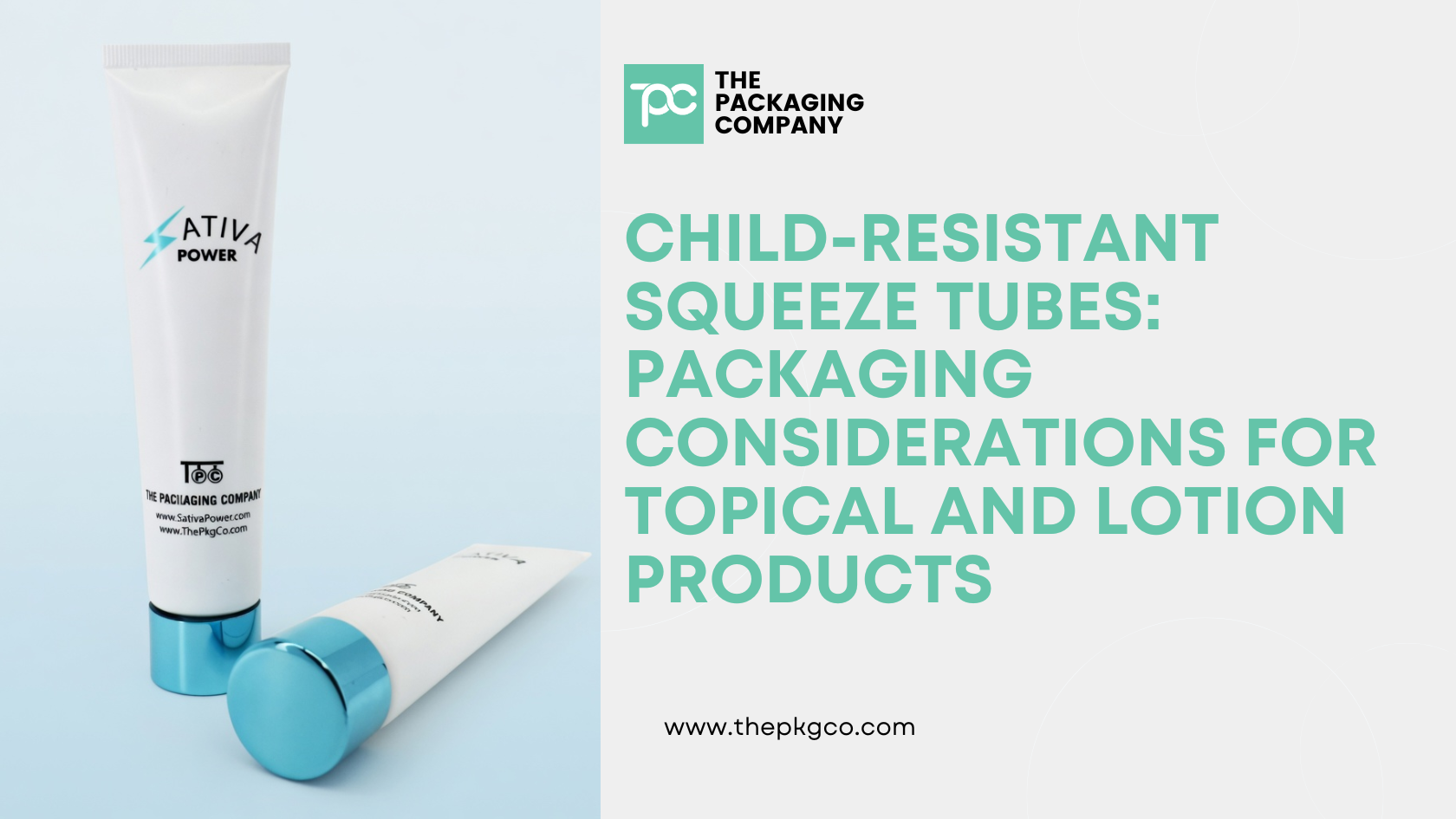
Squeeze tubes are one of the most intuitive formats for topical products. They’re portable, they dispense cleanly across a wide viscosity range, and consumers understand them immediately. Adding child-resistant certification to that format introduces a layer of engineering and compliance consideration that standard cosmetic tube sourcing doesn’t require.
The brands that navigate this well treat a CR squeeze tube as a system — closure mechanism, tube construction, formulation compatibility, and compliance documentation — rather than as a standard tube with a different cap. The ones that struggle treat it as a procurement transaction and discover the gaps at the worst possible time.
This guide covers the packaging considerations that matter before you finalize a CR squeeze tube format for a topical, lotion, or regulated wellness product.
When CR Tubes Are Required for Topicals
Not every topical product requires child-resistant packaging. The requirement depends on what’s in the formulation and which regulatory framework applies to your distribution channel.
Cannabis topicals sold in licensed US markets require CR packaging in virtually every regulated state. The requirement applies at the point of consumer sale regardless of psychoactivity — both transdermal THC products and non-psychoactive formulations fall under CR requirements in most cannabis regulatory frameworks. If your topical is being sold through a licensed dispensary, assume CR is required and confirm the specific standard your state references.
OTC pharmaceutical topicals fall under federal CR requirements through the Poison Prevention Packaging Act if they contain regulated active ingredients above specified concentration thresholds. Medicated creams, analgesics, and certain dermatological formulations may require CR packaging independent of any cannabis regulation.
CBD and hemp-derived topicals sold outside the licensed cannabis channel occupy a more variable regulatory position. Some states have implemented their own requirements for hemp-derived products at retail. Brands distributing through natural channel, pharmacy, or direct-to-consumer should verify requirements in each state they sell into rather than assuming a single standard applies.
Wellness and nutraceutical topicals sold as cosmetics generally do not require CR packaging under federal cosmetic law. However, brands positioning products for dispensary sale or through regulated channels often choose CR packaging regardless of mandate — as a product safety signal and to simplify compliance across mixed distribution.
Closure Mechanism: The CR Element in a Squeeze Tube
The child resistant function in a squeeze tube is entirely a property of the closure mechanism. The tube body itself — the laminate construction, the material, the diameter — is not what earns certification. The closure is.
Three closure configurations are used in certified CR squeeze tubes:
CR flip-top cap. The most common CR closure for squeeze tubes. The cap has a hinged cover requiring a specific directional squeeze and lift to open. The resistance comes from the hinge mechanism geometry and the force required to disengage it. A well-engineered CR flip-top is intuitive for adults after the first use but presents a genuine barrier for young children who lack the hand strength and coordination to execute the two-step open sequence cleanly.
CR screw cap with safety mechanism. Combines standard rotation with a secondary action — typically push-down-while-turning or squeeze-while-turning — to achieve CR resistance. More commonly used on tubes with wider openings or for formulations where flip-top geometry doesn’t work with the tube diameter.
Membrane seal with CR overcap. Used where the primary seal is a foil or film membrane applied at the tube shoulder, with a CR-configured overcap that must be opened through a specific mechanism before the membrane can be accessed. More common in pharmaceutical and OTC applications than cannabis or wellness topicals.
For most cannabis and wellness topical brands, the CR flip-top on a standard laminate or plastic squeeze tube is the right format. It’s the most familiar consumer experience, it works across a wide viscosity range, and it’s available in certified configurations that meet 16 CFR §1700.20.
The most important evaluation criteria for any CR closure on a squeeze tube is repeated-use performance. Open and close the tube 20–30 times and evaluate whether the closure continues to engage securely. A CR flip-top that snaps cleanly on first use but gradually loosens over a week of daily use will not maintain its certified child resistance performance through the product’s consumer lifecycle — and a closure that fails in the consumer’s hands is a compliance problem whether or not it passed certification when new.
Tube Construction and Formulation Compatibility
A squeeze tube is not a passive container. The material interacts directly with the formulation, and compatibility failures — ingredient migration, package degradation, formulation separation — are expensive to discover after a production run.
Standard laminate tubes (PE/EVOH/PE) are the most widely used construction for personal care and topical products. The EVOH barrier layer provides oxygen and chemical barrier protection for formulations containing sensitive actives, essential oils, or terpene compounds. Appropriate for most cannabis topicals, CBD creams, and wellness formulations.
Aluminum barrier laminate tubes incorporate a thin aluminum foil barrier layer for the highest level of oxygen and moisture protection. Required for formulations with significant active ingredient stability concerns — highly terpene-rich cannabis topicals, certain antioxidant formulations, products where oxidation meaningfully degrades efficacy over shelf life.
Single-material PE tubes are cost-efficient and support a cleaner recyclability story as mono-material packaging, but carry lower barrier properties than laminate constructions. Appropriate for formulations with lower sensitivity to oxygen exposure — standard moisturizers, basic balms, products without active ingredients requiring extended stability protection.
PCR content tubes incorporate post-consumer recycled plastic in the tube body, reducing virgin material consumption without changing the functional properties meaningfully. Available in various PCR content percentages for brands making upstream sustainability claims.
Before finalizing any tube format, conduct compatibility testing between the formulation and the specific tube material. For cannabis and medicated topicals specifically, test for migration (does the tube material contribute extractables to the formulation), sorption (does the tube absorb fragrance compounds, essential oils, or terpenes over time, reducing active ingredient concentration), and physical stability (does the formulation maintain texture and viscosity after extended contact with the tube material at accelerated conditions).
Label Footprint and Compliance Content
CR squeeze tubes have a cylindrical label surface with specific constraints that affect how much compliance content fits and how the design needs to be structured.
Cannabis regulations require significant mandatory label content — THC and CBD content, state-specific warnings, producer information, track-and-trace data, and other mandated text. The available label area on a squeeze tube is determined by tube diameter (circumference minus seam allowance) and tube length (the space between shoulder and crimp or base seal).
Map your required compliance text to the actual tube dimensions before finalizing artwork. This sounds like a step brands wouldn’t skip, but it is frequently skipped — designers work in the digital file, approve the layout against a dieline, and the compliance content fits fine at screen size. It doesn’t fit at actual tube size under retail lighting. Print the label at actual size and read it at arm’s length before approving.
For topical products where the tube is the primary retail package (no secondary box), the label also needs to carry all brand communication in the space not consumed by compliance text. Work with a designer who understands both the compliance requirements for your specific state and the spatial constraints of the tube format before starting artwork.
Fill Line Compatibility
CR tube formats — particularly CR flip-top closures — have specific requirements for fill and seal equipment that standard cosmetic tube lines may not be configured to handle without adjustment.
Standard tube filling lines crimp or heat-seal the base after filling from the bottom. The CR closure at the top of the tube must be pre-applied before filling or applied after, depending on the closure type and your filling equipment configuration. CR flip-top closures require specific pressure and directional application that standard capping equipment may not replicate correctly without adjustment.
Before ordering production quantities, confirm with your filling facility that the specific CR tube format and closure are compatible with their equipment. A tube that closes correctly by hand but requires excessive force or a non-standard application angle on the fill line creates production bottlenecks and potential closure damage at scale. Discovering fill line incompatibility after the tubes arrive is a costly delay that pre-production sampling would have caught.
Certification Documentation for CR Squeeze Tubes
CR squeeze tubes are certified under ASTM or 16 CFR §1700.20 depending on the closure classification and your market’s regulatory requirements. The certification covers the specific tube format and closure mechanism as tested — not the product category generally.
When sourcing CR squeeze tubes, request the third-party laboratory test report for the specific format you’re ordering. The report should confirm pass results for both the child panel (at least 85% of children ages 42–51 months unable to open within 10 minutes) and the adult panel (at least 90% of adults ages 50–70 able to open and close within 5 minutes) under the applicable standard.
A Certificate of Compliance from the supplier is useful for operational reference but is not a substitute for the underlying test report. For state cannabis compliance inspections, the test report is the evidentiary document. For a full breakdown of what CR certification documentation should include and how to maintain it across reorders, see our CR packaging audit-readiness guide.
TPC’s CR Topical Packaging Line
TPC’s child-resistant topical packaging line includes CR squeeze tubes, CR airless pump bottles across multiple volume configurations, and CR dispenser formats for cannabis topicals, medicated lotions, CBD creams, and regulated wellness products. All formats carry certification documentation and are available with full custom decoration. MOQ starts at 5,000 units with pre-production samples standard across all topical formats.
For brands evaluating CR formats beyond squeeze tubes, our child-resistant packaging solutions guide covers the full format landscape including CR tubes, CR jars, CR tins, and CR bags. To discuss your specific formulation and compliance requirements, contact our team.
Frequently Asked Questions
Do all topical products sold in cannabis dispensaries require CR packaging? In virtually all US-licensed cannabis markets, yes. CR packaging is required at the point of consumer sale for cannabis-derived topicals regardless of whether the product is psychoactive. The specific certification standard required varies by state. Confirm your state’s specific requirements before finalizing packaging.
What is the best CR closure for a squeeze tube topical? For most cannabis and wellness topical formulations, a CR flip-top cap is the standard choice. It works across a wide viscosity range, is familiar to consumers, and is available in certified configurations meeting 16 CFR §1700.20. Evaluate the closure over 20–30 repeated open/close cycles before approving any format — consistent performance over use is as important as initial certification status.
What tube material is best for cannabis topicals? For most cannabis topical formulations, a PE/EVOH/PE laminate tube with an aluminum barrier layer provides the best combination of active ingredient protection, terpene stability, and oxygen barrier performance. For brands with sustainability positioning, mono-material PE tubes offer a cleaner recyclability story with some trade-off in barrier performance. Compatibility testing against the specific formulation is required before finalizing any tube material.
Can I use a standard cosmetic fill line for CR squeeze tubes? Sometimes, but not always without adjustment. CR flip-top closures require specific pressure and application angle that standard capping equipment may not replicate. Confirm fill line compatibility with your filling facility before ordering production quantities. Pre-production sampling with a filled tube run through your actual fill process is the reliable way to catch compatibility issues before they create a production problem.
What certification standard applies to CR squeeze tubes for topicals? CR squeeze tubes are certified under ASTM or 16 CFR §1700.20 depending on how the closure is classified and which standard your market requires. Most state cannabis regulations reference 16 CFR §1700.20 for retail products. Confirm your state’s specific requirements and request test documentation covering the applicable standard from your supplier.
What MOQ applies to CR topical tubes at TPC? MOQ starts at 5,000 units for standard formats. Custom tube constructions, barrier specifications, and decorated formats may vary. Pre-production samples are standard before any production commitment.