



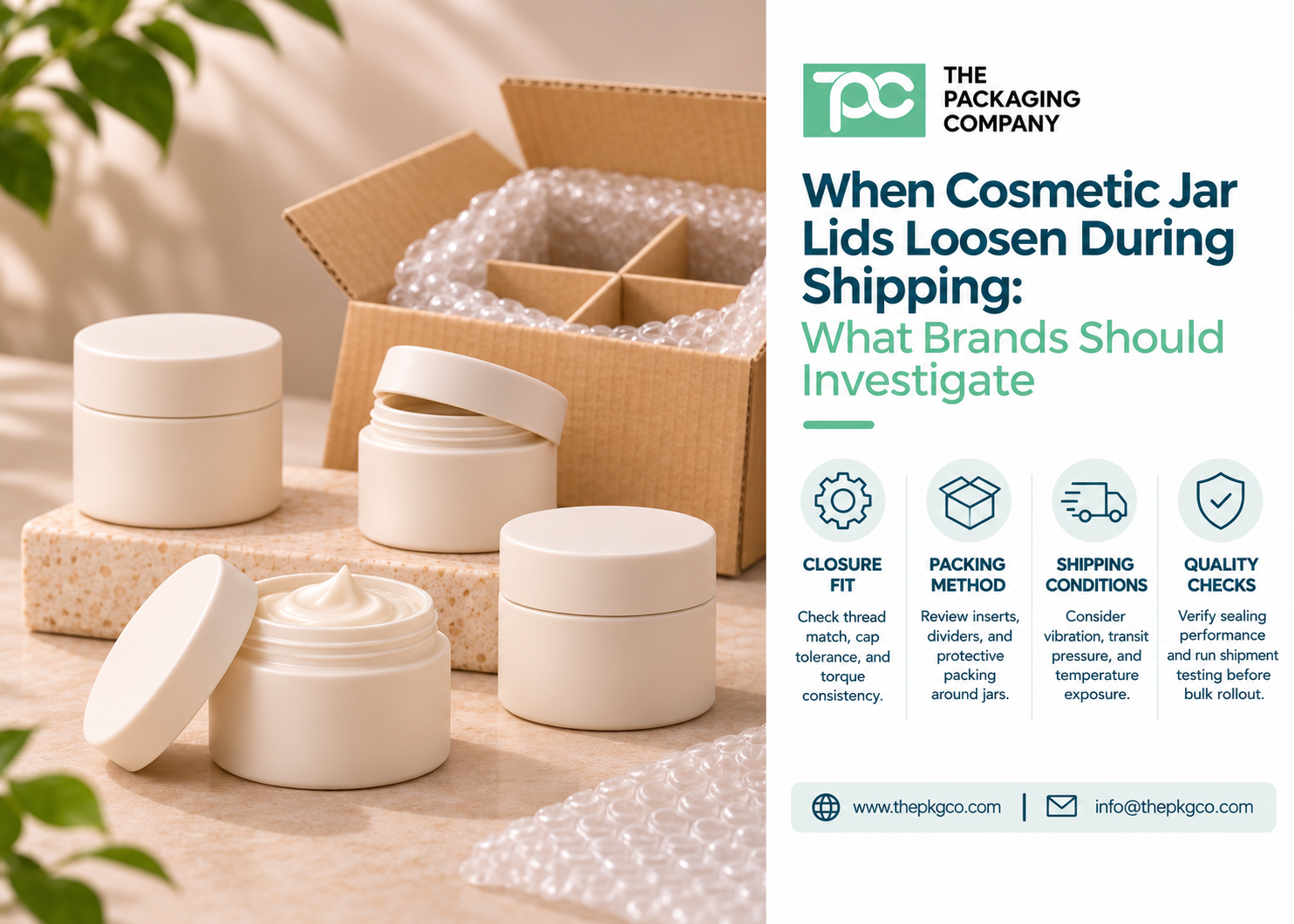
When a shipment of filled cosmetic jars arrives with loose lids, the questions are immediate: How many units are affected, has the product been compromised, and where did the problem begin? For skincare brands selling creams, masks, and body care products, a loose lid can lead to product residue around the rim, damaged cartons, or customer complaints.
These cosmetic jar lid problems do not automatically point to a shipping failure. The cause could involve the jar and cap supplied, how the closure was applied, product on the sealing surfaces, or conditions during distribution. A useful investigation follows the evidence from the affected shipment back through production, rather than assuming the first visible symptom reveals the cause.
For brands still choosing packaging rather than investigating a shipment, see our guide to cosmetic jars with lids for skincare products or explore our cosmetic jars category.
Start With the Complaint, Not a Presumed Cause
First, define what “loose” means. Is the cap easier to turn than expected, partly backed off, detached, or accompanied by leakage or a displaced liner? Those are different observations and may require different follow-up.
Ask the receiving or quality team to record how many units are affected and whether the issue is concentrated in a particular lot, carton, pallet, or route. Retain representative packages as received, and compare the findings with the approved reference and applicable acceptance criteria before proposing a design change.
1. Preserve the Evidence From Affected Shipments
Evidence is easily lost when someone wipes away residue, retightens lids, or discards damaged cartons. Photograph the packages as received and complete a short receiving log before handling changes their condition. Those records will help the packaging supplier and filling partner investigate the complaint.
| Evidence to collect | What it may help establish |
|---|---|
| SKU, jar size, component reference, and production lot | Whether affected units share a specific packaging or filling configuration |
| Quantity affected and quantity inspected | Whether the issue is isolated or widespread within the inspected sample |
| As-received photos of lid, rim, liner, and carton | The visible condition before the package is opened or retightened |
| Carton and pallet location | Whether damage follows a particular shipping or packing pattern |
| Delivery route, handling history, and relevant storage conditions | Whether distribution exposure may warrant further investigation |
| Unopened retention samples from the same lot, if available | A controlled comparison with units not known to be affected in transit |
If leakage or possible product compromise is observed, alert the brand’s quality team and follow the applicable complaint and inventory-control procedures before releasing affected units.
2. Compare the Jar and Cap Against the Approved Specification
The packaging supplier should be able to identify the exact jar and cap that were intended to be used together. If several components share a similar appearance, a substitution or mixing error may not be obvious from a photograph.
Confirm the supplied jar model, opening or thread geometry, cap construction, relevant liner or seal, material, and component revisions. If any part changed between the last successful production lot and the affected shipment, that history deserves attention.
The investigation may involve dimensional inspection, thread engagement, cap seating, and any other fit requirements defined by the manufacturer. A nominal diameter alone cannot establish whether two components are interchangeable.
An approved component specification and physical reference are more useful than a broad purchasing description. A product listing may say “cosmetic jar with lids,” for example, but that wording does not identify the exact jar, cap, or liner needed to investigate a complaint. The team needs the actual part references and approved configuration.
If a cap, liner, or component supplier changed before the affected run, check the approved change record. Our guide to changing cosmetic jar caps or liners explains what to recheck when making that substitution.
3. Review How the Closure Was Applied at the Filling Facility
Loose lids after shipment do not necessarily indicate a defect in the empty jar. The filling partner’s closure-application process can affect whether jars leave the line in the intended condition.
Depending on the package and equipment, the filler may need to review settings and records for cap application, including any specified application torque, closure alignment, handling, and in-process inspections. These settings should come from the qualified container-and-closure system and filling process.
Too little applied force may be one concern in certain threaded closures. Excessive force can also create problems, such as damaged threads, distorted components, or liner compression outside the intended range. The relationship is package-specific; applying more torque is not a universal corrective action.
Investigators should ask whether the line experienced stoppages, manual interventions, equipment adjustments, or unusual rejection rates during the affected lot. If the same supplier components were used successfully on another line or production date, the comparison may help identify where to investigate next.
Compare the affected run with the agreed filling process and the handoff records outlined in our skincare packaging filling-line checklist.
4. Check for Product Residue Around the Rim and Sealing Area
A filled jar may behave differently from an empty component sample. During filling or closure application, cream, balm, or other product can sometimes reach surfaces that are intended to remain clean for the closure to seat as designed.
If residue is visible around the rim, threads, liner, or another contact surface, document it before cleaning. The filling team should determine whether product interfered with closure seating or escaped only after the lid loosened. Residue can be a contributing factor or a result of the failure; by itself, it does not establish the cause.
The investigation should consider actual fill behavior, headspace where applicable, fill level, and any cleaning or inspection steps used before closure application. The formulation and filling teams should assess whether the product’s properties are relevant to the condition observed.
5. Inspect Liners and Other Sealing Components
Some cosmetic jars use liners, inner discs, gaskets, or other sealing features. Others rely on different closure constructions. The appropriate inspection depends on the exact assembled system.
For packages with a liner or related component, check whether it was present, seated correctly, undamaged, and appropriate for the intended closure. If the liner is displaced or torn, determine whether the damage occurred during assembly, transport, or subsequent handling.
The supplier and filler should also check whether the correct components were supplied and used together. A liner that is dimensionally similar to another version may not have the same performance characteristics.
A liner does not guarantee a leak-free package, and adding one is not automatically the right fix. Any proposed change must suit the complete jar, closure, product, and filling process.
6. Assess the Shipping Pattern and Distribution Conditions
Transport can expose packages to vibration, handling shocks, changing orientation, and environmental conditions. These exposures may reveal a weakness in the filled package or shipping configuration, but the fact that a problem was discovered after delivery does not establish that shipping caused it.
Look for patterns in the affected cartons. Did problems occur only on a particular route? Were the outer cartons crushed or wet? Were loose lids concentrated near a specific pallet position? Were intact units from the same filling lot delivered elsewhere?
Compare as-shipped packing records, carton configuration, dividers or protective materials, and relevant distribution conditions. Where justified, the brand and its qualified partners may decide to repeat transport or distribution testing using the actual filled-package system.
Testing should reflect the intended supply chain and agreed acceptance criteria. An informal shake test is not a substitute for a documented investigation, especially when leakage or product quality may be involved.
7. Separate a Component Issue From a Process or Distribution Issue
Once evidence is collected, divide the possible explanations into categories. This prevents a team from changing multiple aspects of the package without knowing which change, if any, solved the underlying problem.
| Possible investigation area | Useful follow-up | Relevant partner |
|---|---|---|
| Jar and closure mismatch | Compare part references, drawings, component revisions, and fit inspection results | Packaging supplier and brand quality team |
| Closure-application inconsistency | Review equipment settings, production records, retained units, and inspection results | Contract filler |
| Liner or sealing-component issue | Inspect actual assembly, component condition, and relevant specifications | Supplier, filler, and testing team |
| Product around sealing surfaces | Review fill process, rim condition, product behavior, and sequence of observations | Filler and formulator |
| Packing and distribution exposure | Compare shipment records, damage patterns, and suitable transport evaluations | Logistics, quality, and packaging teams |
More than one factor can contribute. For example, if jars from one filling run arrive with loose caps while jars using the same components from another run do not, compare closure-application records and shipping conditions before changing the packaging design. That pattern helps narrow the investigation; it does not prove the cause.
8. Decide Which Units Need to Be Held or Evaluated
While the cause is being investigated, the brand’s quality team must decide how to manage inventory from the affected lot. Depending on the severity and applicable requirements, this may mean holding stock, expanding inspections, or starting a formal complaint and corrective-action process. If product integrity may be compromised, qualified quality, formulation, and regulatory personnel should determine whether the filled units are suitable for sale.
An important distinction is that a packaging supplier can help review empty-component specifications and manufacturing information; the brand and its responsible finished-product partners must assess the condition and disposition of filled goods.
A decision to retighten lids or rework packages should not be treated as automatically acceptable. Any rework must follow the applicable approved procedures and provide adequate evidence that the finished package remains suitable.
9. Make One Controlled Correction and Verify the Result
Once the likely cause is supported by evidence, the team can identify corrective action. That might involve correcting the supplied component reference, refining an approved cap-application process, improving filling-line cleanliness, or adjusting the protective shipping configuration.
But a proposed change needs evaluation before it becomes the new production standard. If a different jar or lid is required, the supplier should confirm that the revised configuration is approved for the intended use. If equipment settings change, the filler should establish suitable process controls and acceptance criteria.
Document the action, who approved it, the lots affected, and how the team will check that the issue does not recur. A follow-up inspection or properly designed production and distribution evaluation should match the problem being corrected.
If the correction requires a different jar, cap, or liner, agree on the revised specifications and approval steps before bulk production. For TPC custom orders, available stock samples can be reviewed before ordering; the pre-production sample (PPS) is provided after the order is placed for approval before manufacturing. Packaging approval does not replace finished-product quality, filling, or transport validation. See how stock samples and PPS approvals differ.
10. Use the Investigation to Improve Reorder Instructions
Packaging complaints can expose gaps in documentation even when the components themselves are sound. A future reorder should identify the exact approved jar, cap, and any liner or sealing component, along with applicable packaging drawings and inspection requirements.
The brand should also ensure the filler has the correct closure-application instructions and that the logistics team understands the approved packing configuration. If an investigation resulted in changes, old and new specifications must be clearly separated so components or assembly settings are not mixed unintentionally.
If a corrective action changes custom components, reconfirm cost, MOQ, and timing before the next order. TPC’s general starting MOQ is 5,000 units per SKU per print run, and typical custom manufacturing takes around 90 days after PPS approval, subject to the specific project.
A Practical First-Response Checklist for Loose Jar Lids
Before requesting a replacement container, a new cap, or a process change, the brand should be able to answer six questions:
- What exactly was observed, and how many units were affected?
- Which SKU, packaging reference, filling lot, and shipment are involved?
- Do affected and unaffected samples show differences in components, application, or storage history?
- Are the jar, cap, and any liner the same approved configuration used in prior successful lots?
- Which qualified party is responsible for investigating the suspected cause and evaluating the finished product?
- What evidence will demonstrate that any proposed corrective action is effective?
Loose cosmetic jar lids are a problem worth investigating systematically. The strongest outcome is not merely a tighter cap on the next shipment, but a documented understanding of the failure and a production process capable of meeting the agreed specification consistently.
If loose lids point to a recurring component problem, send TPC the jar and cap references, affected quantities, and available investigation findings. We can help review relevant custom and wholesale cosmetic jar options and the specifications needed for a replacement order. Contact our packaging team to discuss your project.
Frequently Asked Questions About Cosmetic Jar Lid Problems
Why do cosmetic jar lids become loose during shipping?
Possible contributing factors include a mismatch between jar and closure components, inconsistent closure application, interference at sealing surfaces, and distribution conditions. The fact that a lid is loose after delivery does not establish the cause. A batch-based investigation is needed.
Should we simply increase cap-tightening torque?
No universal setting is appropriate for all jars. Application torque and any related controls must match the qualified closure system and filling process. Excessive torque can cause its own problems. Review the approved requirements and actual production records with the filling partner before changing settings.
Can a damaged liner explain a leaking cosmetic jar?
It may be relevant in a package that uses a liner or similar sealing component, but the team should first establish whether the liner was correctly specified and assembled and whether damage preceded or followed the leakage. Not every jar design uses a separate liner.
Can we sell filled jars after retightening their loose lids?
Do not assume retightening makes affected finished products acceptable for sale. The brand’s quality team must assess product integrity, applicable requirements, and whether any rework is permitted and adequately controlled.
What should we send our packaging supplier when reporting loose lids?
Provide the jar and cap references, lot numbers, affected quantities, as-received photos, relevant component and filling records, shipment details, and representative retained samples where available. These details help the supplier investigate whether empty packaging components may have contributed to the issue.