



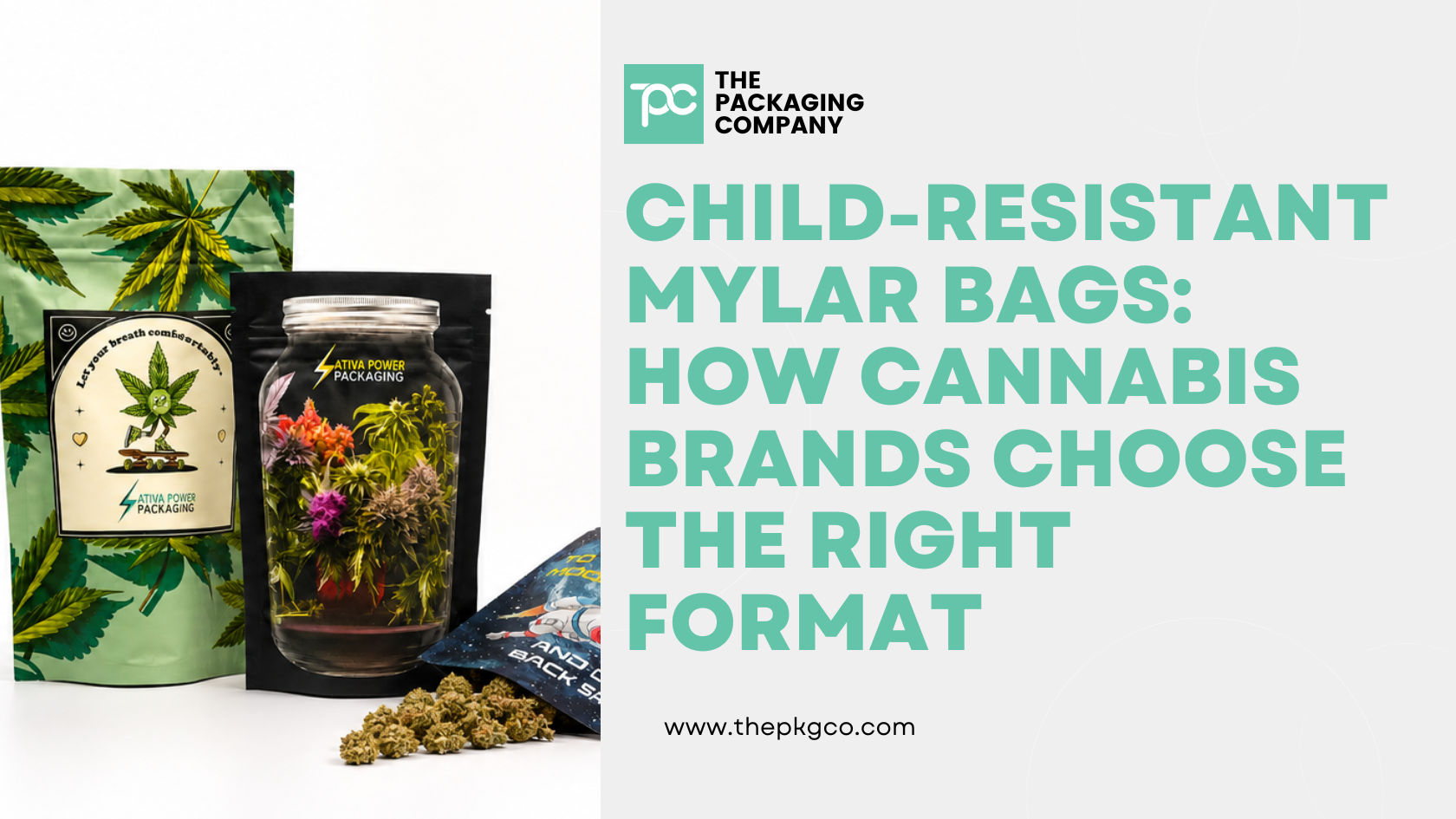
Child-resistant mylar bags account for the majority of cannabis packaging volume in the US market. They are the default format for bulk flower, high-volume edibles, and value-tier SKUs across virtually every legal state. At roughly $0.10 to $0.15 per unit, they deliver the lowest per-unit packaging cost of any CR format, which is why they dominate shelf space at accessible price points.
But not all CR mylar bags are the same, and the decisions brands make about barrier construction, fill size, print finish, and closure mechanism have real consequences for product quality, shelf presence, and whether the packaging holds up to repeated use over its consumer lifecycle.
This guide covers what goes into a CR mylar bag, how to match the format to the product, and what to evaluate before ordering.
What Makes a Mylar Bag Child Resistant
The CR certification on a mylar bag is a property of the closure mechanism, not the bag film itself. The film provides the barrier. The closure provides the child resistance.
Most CR mylar bags use one of two closure types:
Slide-lock closure. A two-piece interlocking channel that requires pinching and sliding simultaneously to open. The dual-action requirement is what creates child resistance. A slide-lock that opens with simple compression pressure, without the sliding component, is not functioning as a CR closure and will not maintain certified performance. Evaluate the closure over 20 to 25 cycles before approving any format. The resistance at cycle 20 should be essentially the same as at cycle 1.
Press-and-pull closure. A recessed zipper where the consumer must press the two sides together in a specific location before pulling the seal open. Less common than slide-lock but used in some CR bag formats.
Both closure types must pass 16 CFR §1700.20 certification, with third-party panel test documentation confirming child panel pass rates (at least 85% of children unable to open within 10 minutes) and adult panel pass rates (at least 90% of adults able to open and close within 5 minutes). The certification applies to the specific bag-and-closure combination as tested, not to a general bag format or film construction.
A note on state-specific requirements: most states accept 16 CFR §1700.20 for CR mylar bags. Several states including Minnesota, New York, New Jersey, and Missouri now specifically require ASTM D3475-2024 standards in addition. Confirm your specific state’s current requirement before finalizing any bag format.
Bag Film Construction and Barrier Performance
The film construction determines what the bag actually protects the product from. For cannabis flower and concentrate products, barrier performance is a product quality variable, not just a packaging specification.
Standard multi-layer laminate (PET/foil/LDPE). The most common construction for cannabis CR bags. The polyester outer layer provides the print surface and structural integrity. The aluminum foil middle layer creates the barrier against oxygen, moisture, and UV light. The LDPE inner layer is food-safe and in direct contact with the product. This construction blocks essentially all light and provides strong moisture and oxygen barrier properties. It is appropriate for flower, edibles, and concentrates where terpene and active-ingredient preservation over shelf life is a priority.
Barrier performance matters more than most brands assume. Cannabis flower exposed to oxygen over time loses terpene concentration and potency. A bag that provides genuine barrier protection from fill date through consumer use maintains product quality throughout. A bag with inadequate sealing or a closure that degrades with use does not. For brands making freshness or terpene-preservation claims, the bag construction is directly relevant to whether those claims are supportable.
Opaque vs. translucent. Most states require opaque packaging for cannabis retail products. California, Colorado, and many other markets explicitly prohibit packaging through which the product is visible. Confirm your state’s opacity requirement before specifying any bag format. CR mylar bags in the standard foil-laminate construction are opaque by default. Clear or window-panel configurations may not satisfy opacity requirements in regulated markets.
Fill Size Selection
The fill weight determines the bag dimensions, and the bag dimensions affect product presentation, label space, and consumer handling.
For cannabis flower:
1g and 2g: Small format bags typically 3.5 by 5 inches or similar. Used for samplers, promotional SKUs, and individual dose formats. Print area is limited, which requires a tight label hierarchy that puts the most important information first.
3.5g (eighth): The core retail format. Standard bag dimensions around 4 by 6 inches provide adequate label surface for the mandatory compliance content plus brand design elements. This is the highest-competition format on any dispensary shelf, which means print and finish quality have more impact here than at larger sizes.
7g (quarter) and 14g (half): Larger bag formats that benefit from a wider print panel. At these fill weights, the economics of premium bag finishes improve because the per-gram packaging cost stays manageable. Brands running quarter and half-ounce SKUs at value price points typically use standard matte or gloss finishes. Brands running these sizes at craft price points can invest in soft-touch lamination and spot UV without meaningfully affecting margin.
28g (ounce): The largest common retail fill. Almost exclusively sold in bags in the current market. Premium bag finishes are still viable for craft ounce pricing but are the exception rather than the rule.
For edibles, the fill configuration adds another variable: how many pieces fit in the bag at the fill weight, and whether the pieces need protection from compression. Loose gummies in an oversized bag will shift and potentially stick together. The bag dimensions should be selected for the specific edible format and count, not just the weight.
Print Finish Options and What They Communicate
The print surface of a CR mylar bag is the primary brand communication tool. The finish is as important as the design, because the finish determines how the bag feels in the consumer’s hand and how it reads under dispensary lighting.
Standard matte finish. The baseline for most value and mid-tier CR bags. Clean, readable, modern. Matte does not reflect light, which means the bag presents consistently under the LED lighting typical of dispensaries. Matte is appropriate for brands where the print design is doing the work and the finish needs to support rather than distract.
Gloss finish. Higher visual impact under light, more saturated color perception. Gloss is appropriate for brands targeting consumer attention with bold color or photographic design elements. Under retail LED lighting, a gloss bag catches the eye differently than a matte bag adjacent to it, which can create shelf differentiation when used deliberately.
Soft-touch matte lamination. The premium standard for bags at mid-to-high price points. The coating creates a velvet-like texture that communicates quality the moment the consumer picks up the bag. Soft-touch is significantly more expensive than standard matte but appropriate for brands selling above $20 retail who want the bag to hold its own against rigid format competition.
Spot UV. A high-gloss coating applied selectively over specific design elements (logo, brand name, product name) on a matte background. Creates contrast and dimension that flat finishes cannot. Used by brands building premium identity on a bag format.
Metallic foil stamping. A metallic accent on specific design elements. Gold, silver, rose gold, and holographic options. Used for limited-edition SKUs, collaboration packaging, or brands in the luxury cannabis segment where the bag needs to read as an intentional premium object.
The finish should match the price point. A standard matte finish on a $10 bag is correct. Soft-touch lamination on a $10 bag is an over-investment that does not improve margins or consumer perception at that price tier. Soft-touch or spot UV on a $30 bag is the format the price point requires.
When Bags Are the Right Call and When They Are Not
CR mylar bags are the right format for:
Cannabis flower and edibles at value and mid-tier price points where per-unit packaging cost is the primary constraint and the brand positioning does not require a rigid format.
High-volume SKUs where reorder frequency is high and the economics of rigid format MOQs would create inventory management complexity.
Larger fill weights (14g and 28g) where glass or tin at that fill weight creates a packaging cost that the retail price cannot absorb.
Brands in early-stage market validation who need to minimize upfront packaging investment before the SKU’s velocity is established.
Bags are not the right format for:
Products priced above $25 retail where the bag creates a price-signal mismatch that works against the brand at the shelf.
Infused or live resin formats where the terpene profile and product quality are primary brand claims. Glass or airtight metal provides materially better preservation for these formulations.
Brands whose retail positioning explicitly relies on premium packaging as a brand signal. A brand that has built its identity around premium presentation in tins or glass jars should not put a value-tier bag adjacent to those products, as it undermines the pricing hierarchy.
TPC’s CR Mylar Bag Line
TPC’s Child-Resistant Bags are available across the full fill weight range (1g through 28g) in standard and custom dimensions. All formats use multi-layer foil-laminate construction with slide-lock CR closures certified to 16 CFR §1700.20. Full custom printing is available in matte, gloss, soft-touch, metallic, and specialty finishes with custom Pantone color matching. MOQ 5,000 units.
Pre-production samples are standard before any bulk commitment. For the full CR packaging format overview, see our child-resistant packaging solutions guide. To discuss your specific fill configuration and finish requirements, contact our team.
Frequently Asked Questions
What makes a mylar bag child resistant? The closure mechanism, not the bag film. CR mylar bags use a slide-lock or press-and-pull closure that requires a two-step action (pinching and sliding, or pressing before pulling) to open. This dual-action requirement is what creates certified child resistance. The closure must pass third-party panel testing under 16 CFR §1700.20 as a system with the specific bag format. The certification does not apply to a general bag style.
Do CR mylar bags meet California’s opacity requirement? Standard foil-laminate CR mylar bags are opaque and meet California’s opacity requirement for cannabis retail packaging. Clear or window-panel bag configurations do not. Confirm your specific distribution state’s opacity requirements before specifying any bag format, as requirements vary by state and some states have recently updated their standards.
What fill size works best for cannabis flower? The 3.5g (eighth-ounce) bag is the dominant retail format and the most competitive shelf position in the category. Bag dimensions for this fill are typically around 4 by 6 inches, providing adequate label surface for compliance content and brand design. For larger fills (7g through 28g), select dimensions that minimize excess headspace while allowing the closure to engage correctly.
What finish should I use on a mid-tier cannabis bag? For products at $15 to $25 retail, standard matte or gloss finishes are appropriate. Soft-touch lamination is the step-up for brands moving toward the $25-plus tier. Spot UV on specific design elements adds dimension and shelf presence without the full cost of soft-touch. Match the finish investment to the price point the product is selling at.
What MOQ applies to TPC’s CR mylar bags? MOQ is 5,000 units. Custom dimensions, fill configurations, and print finishes are available within that MOQ. Pre-production samples are standard before bulk production. Contact TPC for current pricing and lead time for your specific bag specification.
Can I use the same bag format for both flower and edibles? If the dimensions match both products’ fill configurations and both products share the same state distribution requirements, yes. The more common practice is to maintain separate bag formats for flower and edibles, since the fill configuration, compliance content requirements, and often the brand positioning differ meaningfully between product categories.