



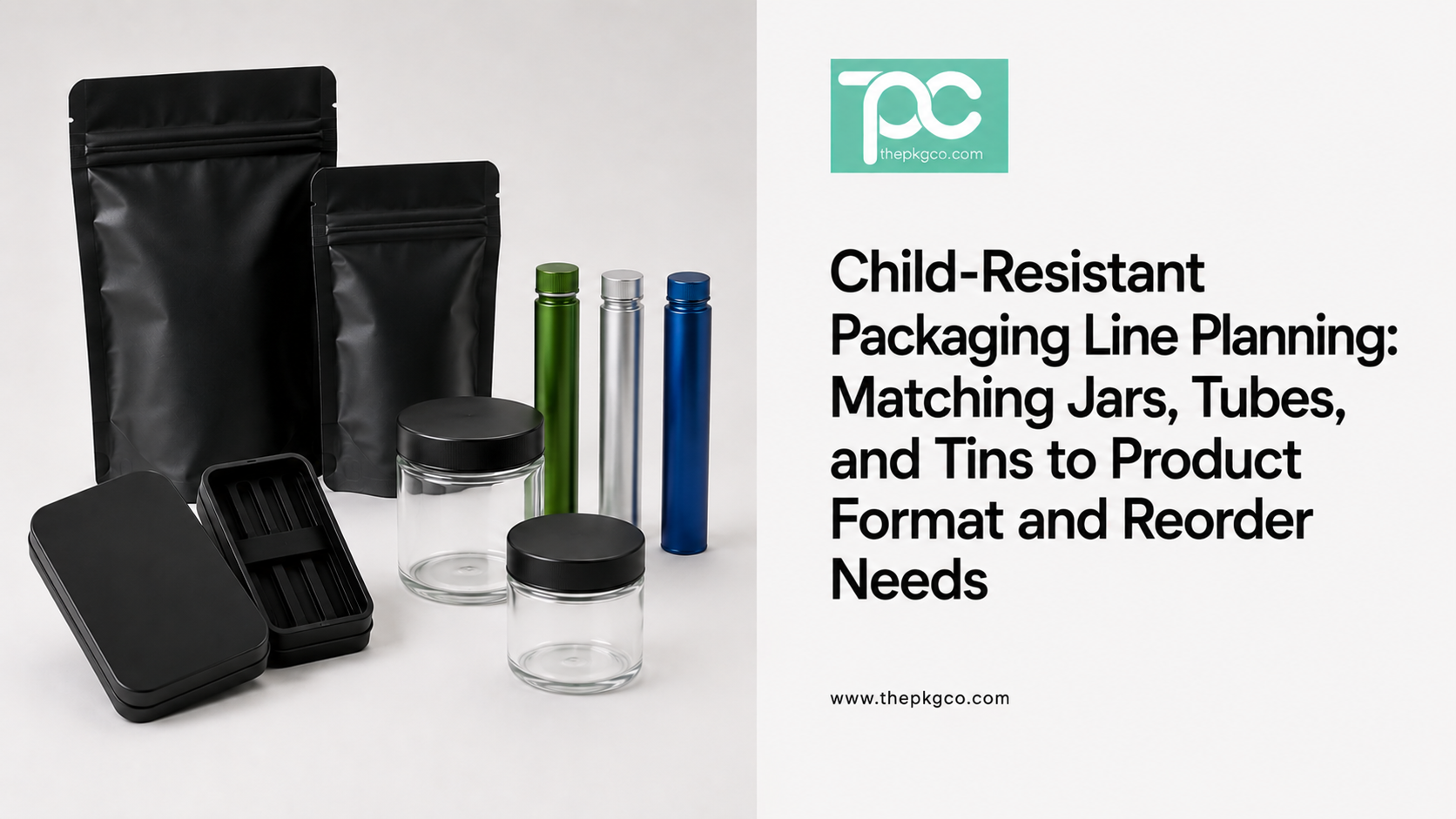
Most brands approach child-resistant packaging one SKU at a time. They have a pre-roll that needs a tube, so they source a tube. They add an edible, so they source a jar. A topical launches, and they find a squeeze tube. Each decision gets made in isolation, and the packaging line grows by accumulation rather than by design.
This works until it doesn’t. When you’re managing five CR formats across three suppliers with different MOQs, different lead times, and different certification standards — and you need to reorder two of them at the same time — the operational weight of that accumulated complexity becomes real. Reorder timing gets misaligned, documentation tracking multiplies, and supplier conversations happen reactively rather than proactively.
This guide is about planning your CR packaging line as a system — matching formats to products correctly from the start, building reorder logic that keeps inventory ahead of production needs, and structuring your supplier relationships to support scale rather than complicate it.
Start With Product Format, Not Packaging Preference
The most common planning error in CR packaging line development is choosing formats based on what looks good or what’s cheapest before mapping those formats to the actual physical and regulatory requirements of each product.
Format selection has to start with the product. Every CR packaging decision flows from three product-level inputs:
Physical dimensions. Pre-roll length and diameter determine tube and tin format. Fill weight determines bag and jar size. Product viscosity determines whether a squeeze tube, dropper, or pump format is appropriate for topicals. These are not preference decisions — they are dimensional constraints. A 120mm pre-roll does not fit in a standard snap tin. A high-viscosity concentrate does not dispense from a standard pump. Get the product dimensions locked before evaluating any packaging format.
Barrier requirements. Products with active ingredients sensitive to oxygen, UV light, or moisture need packaging with appropriate barrier properties. Cannabis flower and high-terpene infused pre-rolls need airtight, light-blocking formats — metal tins or glass jars, not clear plastic tubes. Oxidation-sensitive skincare actives in a CR topical need barrier packaging, not a standard laminate squeeze tube. The barrier requirement is a product chemistry question, not a packaging aesthetics question.
Regulatory standard required. Most state cannabis regulations require 16 CFR §1700.20 certification for retail products. Some accept ASTM F1272 for reclosable formats. The certification standard required by your market should be confirmed before sourcing any format — not after the order is placed.
Map each product SKU to these three inputs first. The packaging format options that remain after that filter are the ones worth evaluating further.
Matching CR Formats to Product Categories
Once the product-level inputs are mapped, format selection becomes more systematic. Here is how the primary CR formats align to common regulated-product categories.
Pre-Roll Products → Tubes or Tins
Single pre-rolls and small-count multi-packs (1–3 pack) are the natural fit for CR tubes — push-and-turn or squeeze-and-pull plastic, glass, or aluminum. Tube diameter and length must match pre-roll dimensions precisely; an off-spec tube that doesn’t close fully creates a CR compliance failure regardless of the tube’s certification status.
For 3-packs through multi-packs and for brands at a price point where packaging needs to communicate premium, CR snap tins are the right direction. Tins provide an airtight seal, full light blocking, and a structural rigidity that tubes can’t match. The insert tray configuration inside the tin is a separate decision — it needs to match the pre-roll count and dimensions so product sits securely rather than shifting in transit.
For infused pre-rolls specifically, glass CR jars are increasingly the format of choice. The completely inert glass surface has no interaction with terpene compounds, and the upright display orientation in a wide-mouth jar is a stronger brand presentation than a tube or flat tin for single units.
Flower (Bulk) → Jars or Bags
Bulk flower from 3.5g through 28g fits either CR jars or CR mylar bags. The format decision is primarily a brand positioning and cost-per-unit question.
CR glass jars are the premium standard — full terpene protection, no material interaction, 100% recyclable, strong shelf presence. CR mylar bags are the cost-efficient standard — flexible, light, lower per-unit cost, full custom print. The gap in consumer perceived value between the two is significant. Brands whose price point needs support choose jars. Brands optimizing for volume and margin choose bags.
Edibles → Jars or Tins
Edibles generally require wide-mouth access — a jar or tin jar format rather than a tube. The product dimensions (gummy count, chocolate format, confection size) determine which interior volume works. For edibles where the unboxing presentation is part of the brand experience, a CR tin jar with a custom insert creates a retail moment that a standard plastic jar doesn’t approach.
Topicals → Squeeze Tubes or Airless Formats
Topicals present the widest format variation in a CR product line. Lotion and cream formulations typically use CR squeeze tubes — laminate construction, flip-top or screw CR closure, volume matched to use quantity. Higher-end actives (serums, retinoids, oxidation-sensitive formulations) need airless CR formats where the vacuum-sealed dispensing eliminates air exposure per dose. The barrier requirement of the formulation is the primary differentiator.
Building Reorder Logic Into the Plan From the Start
Reorder planning for CR packaging has a complexity that standard cosmetic packaging doesn’t: the regulatory dimension means a stockout isn’t just a production problem. It’s a compliance problem if it causes a brand to bridge inventory with non-CR packaging, and it’s an operational crisis if it delays a product launch in a licensed market.
The reorder variables that matter:
Lead time by format. CR tins with custom decoration typically run 8–12 weeks from order to delivery. Decorated CR bags with rotogravure printing run 6–8 weeks. Standard CR tubes and jars run 4–6 weeks. These lead times are the baseline for building reorder triggers — if you wait until you’re low on inventory to reorder, you will run out.
MOQ and carrying cost. TPC’s CR packaging starts at 5,000 units MOQ. For a brand running a single SKU at moderate volume, 5,000 units may represent several months of inventory. For a brand with multiple CR SKUs, managing MOQs across formats creates a carrying cost and cash flow question. The practical approach is to sequence new SKU launches so that reorders across formats don’t all land at the same time.
Format-specific reorder triggers. Different formats have different production run characteristics. Tins with custom tooling have longer setup times; the cost benefit of a larger run is higher. Bags with rotogravure printing have cylinder setup costs that amortize best over larger quantities. Tubes and standard jars have more flexibility at lower quantities. Understand the economics of each format’s production run before setting reorder quantities.
Documentation currency. As covered in our CR packaging audit-readiness guide, each reorder is also a documentation trigger — a moment to confirm with your supplier in writing that the current production run matches the tested and certified format. Build this confirmation into your reorder process as a standing step, not a one-time event.
Managing Multiple CR Formats Without Multiplying Supplier Complexity
The operational case for single-supplier CR packaging is straightforward: fewer supplier relationships means fewer documentation files, fewer reorder conversations, fewer quality control variables, and less risk of cross-format inconsistency in certification standard or production quality.
For brands running CR packaging across tins, tubes, jars, and bags simultaneously, sourcing all four from one supplier is not always possible. But consolidating as much as possible — and treating each additional supplier as a deliberate decision rather than a default — keeps the operational overhead manageable.
When evaluating whether to add a supplier for a specific format, the relevant questions are: does this format exist in my current supplier’s catalog? If yes, is their version of this format competitive on specification, price, and lead time? If yes, there’s no reason to add a supplier relationship. If no, the new supplier is justified — but the documentation and reorder management overhead of that relationship should be factored into the decision.
TPC’s CR packaging line spans tins, tubes, jars, bags, and topical formats across the full range of cannabis and regulated wellness applications. For brands looking to consolidate their CR packaging line under a single supplier with full documentation support, contact our team to review your current SKU map against TPC’s available formats.
A Practical SKU Mapping Framework
Before placing any CR packaging order for a new SKU or expanding an existing line, work through this mapping exercise:
Step 1 — Product dimensions. Record length, diameter or width, fill weight or volume, and count configuration for every SKU.
Step 2 — Barrier requirement. Classify each SKU as low barrier (standard laminate or plastic acceptable), medium barrier (EVOH or aluminum barrier required), or high barrier (metal or glass required for full light and oxygen blocking).
Step 3 — Regulatory standard. Confirm whether your state requires 16 CFR §1700.20 or accepts ASTM F1272 for this product category. Note it against each SKU.
Step 4 — Format shortlist. Based on steps 1–3, identify which CR formats are viable for each SKU. Multiple options may remain at this stage.
Step 5 — Brand positioning filter. Against your price point and brand tier, eliminate formats that don’t support the packaging investment level the product requires or allows.
Step 6 — MOQ and lead time check. Confirm that the remaining format options are viable at your projected volume and timeline. Flag any formats where MOQ exceeds near-term demand — these may need a launch quantity strategy or a format adjustment.
Step 7 — Supplier consolidation review. Check whether the format options for each SKU are available from your preferred CR packaging supplier. Identify where consolidation is possible and where a second supplier is genuinely needed.
This framework takes an afternoon to complete for a full product line. The brands that do it before they start ordering avoid the misaligned formats, mismatched certifications, and reorder timing problems that accumulate when CR packaging decisions are made one SKU at a time.
TPC’s CR Packaging Line for Multi-Format Brands
TPC carries the full range of CR packaging formats needed to support a multi-SKU cannabis or regulated wellness brand:
Child-Resistant Tins — snap tins, extended snap tins, tin jars, and pre-roll tin cases. Full custom decoration, insert tray configurations, MOQ 5,000 units.
Child-Resistant Tubes — glass, aluminum, and plastic CR tubes across standard pre-roll dimensions. MOQ 5,000 units.
Child-Resistant Jars — glass, plastic, aluminum, and tin formats across the full volume range. MOQ 5,000 units.
Child-Resistant Bags — ASTM F1272 certified, 1g–28g, full custom print. MOQ 5,000 units.
Child-Resistant Topical Packaging — CR squeeze tubes, airless pump formats, and dispenser configurations for cannabis topicals and regulated wellness products. MOQ 5,000 units.
For the full overview of CR packaging types and compliance standards, see our child-resistant packaging solutions guide.
Frequently Asked Questions
How do I decide between a CR tube and a CR tin for pre-rolls? Start with your pre-roll dimensions and count configuration. For singles and 1–2 packs at standard lengths, tubes are the cost-efficient standard. For 3-packs and above, or for brands at a price point where packaging needs to communicate premium, CR snap tins are the stronger format. For 100mm+ formats, the extended snap tin (95mm × 57mm) is the right choice. For infused pre-rolls, glass CR jars offer superior terpene protection and a premium presentation.
Can I source all my CR formats from one supplier? Often yes, depending on your product range. TPC’s CR line covers tins, tubes, jars, bags, and topical formats — the full range needed for most cannabis and wellness brands. Consolidating formats under one supplier simplifies documentation management, reorder logistics, and certification consistency. Contact TPC to review your SKU map against available formats.
How far in advance should I reorder CR packaging? Plan reorders based on the lead time of your longest-lead format plus a buffer. CR tins with custom decoration run 8–12 weeks. Decorated bags run 6–8 weeks. Standard tubes and jars run 4–6 weeks. For high-velocity SKUs, maintain 3–4 months of forward inventory to absorb lead time variability without production gaps.
What happens if I need to change a CR format after I’ve already ordered? Any format change — dimensions, closure type, material — requires resampling and potentially new certification documentation. This is why getting dimensional and barrier requirements confirmed before the first order, and sampling before committing to full production, is essential. Changes after production is underway are expensive and time-consuming.
Do all my CR formats need to be certified to the same standard? Not necessarily — different formats can carry different certifications depending on how they’re classified. But confirm your state’s specific requirements for each product category. Some states require 16 CFR §1700.20 uniformly across all retail products. Others accept ASTM F1272 for reclosable formats. Document the certification standard for each SKU in your packaging compliance register.