



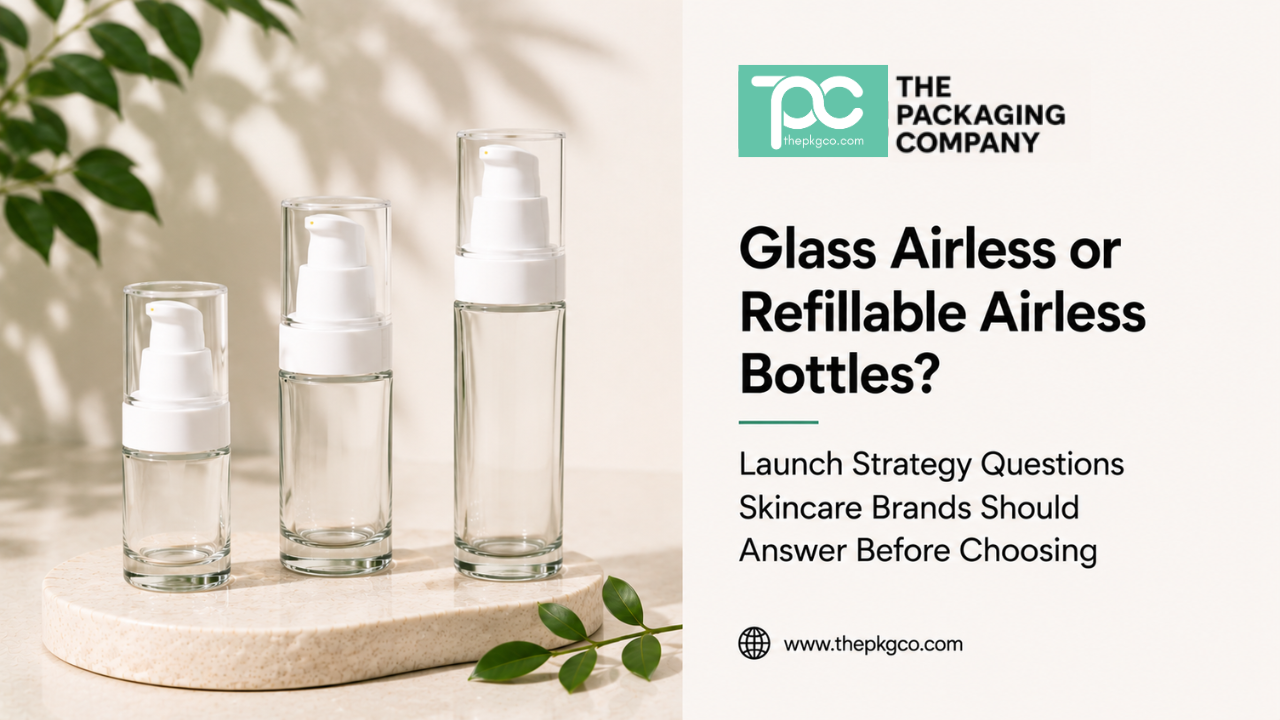
Glass airless and refillable airless bottles can both support premium skincare packaging, but they solve different launch problems. One may be better for a high-end single-product launch. The other may be better for a refill system, repeat-purchase model, or longer-term sustainability story.
For skincare brands, the decision should not be only about which bottle looks better. The better question is: which packaging model fits the launch strategy?
This guide explains how skincare brands should compare glass airless pump bottles and refillable airless packaging based on price point, refill logistics, customer education, shipping risk, and whether the brand is ready for a refill system.
Why This Is a Launch Strategy Decision
Airless packaging is commonly used for serums, moisturizers, eye creams, sunscreens, treatment lotions, and active skincare formulas. Brands choose airless containers because they can support controlled dispensing, cleaner application, and a premium customer experience.
Once a brand is deciding between glass airless pump bottles and refillable airless bottles, the decision becomes bigger than bottle style. It affects price point, product education, refill planning, inventory, shipping, and future reorder strategy.
A glass airless bottle may be easier to launch. A refillable airless bottle may create a stronger long-term system. The right answer depends on the brand’s stage, product type, and customer behavior.
Question 1: Are You Launching One Hero Product or Building a Refill System?
If the brand is launching one premium hero product, glass airless may be the simpler option. It gives the product a polished, high-end feel without requiring customers to understand a refill process.
If the brand is building a long-term refill program, a refillable airless bottle may be worth reviewing. Refillable packaging can support repeat purchases and a stronger sustainability message, but it also requires more planning.
Before choosing, ask:
- Is this a single hero product launch?
- Will customers reorder the same formula often?
- Will the brand sell refill units separately?
- Can the team manage refill inventory?
- Will the customer understand how the refill system works?
For many first launches, glass airless is easier to explain and easier to execute. Refillable airless packaging makes more sense when the brand has a repeat-purchase model already planned.
Question 2: What Price Point Does the Product Need to Support?
Packaging should support the product’s price point. Glass airless bottles often feel heavier, cleaner, and more premium in the hand. That can help support higher-end skincare positioning, especially for serums, facial treatments, and luxury moisturizers.
Refillable airless bottles can also support a premium price point, but the value story is different. The customer is not only buying the formula. They are buying into a packaging system that may include an outer bottle and future refill units.
Brands should ask:
- Does the package help justify the retail price?
- Is the customer paying for a premium first-use experience?
- Will refill pricing make sense after the first purchase?
- Can the brand explain the value of the refill model clearly?
- Does the product margin support the selected packaging format?
If the product needs immediate premium shelf appeal, glass airless may be the cleaner direction. If the product is designed for long-term repeat use, refillable airless may create a stronger customer retention story.
Question 3: How Much Customer Education Is Required?
Glass airless packaging is easy for customers to understand. They receive the product, remove the cap, and use the pump. The packaging experience feels familiar.
A refillable airless bottle may need more education. Customers need to understand how to remove the inner unit, insert the refill, dispose of or store components, and avoid damaging the outer bottle.
That education may need to appear on:
- Product pages
- Cartons
- Insert cards
- Email flows
- Refill product pages
- Retail displays
If the refill process is not clear, customers may not reorder even if they like the sustainability concept. A refillable airless bottle should be supported by clear instructions and a simple purchase path.
Question 4: Can Your Team Manage Refill Logistics?
Refillable airless packaging is not just a packaging choice. It creates an operational system.
The brand may need to manage the outer bottle, refill units, refill cartons, refill labels, SKU setup, pricing, storage, and reorder timing. This can be powerful for established brands, but it may be too complex for a launch that has not proven demand yet.
Before choosing refillable airless packaging, ask:
- Will refill units be sold separately?
- Will refills need separate labels or cartons?
- How will refill inventory be tracked?
- Will retailers accept the refill format?
- Will customers know when and how to reorder?
- Can the brand maintain refill availability?
If these questions are not answered early, refillable packaging can create delays, inventory confusion, and customer support issues.
Question 5: When Is Glass Simpler?
Glass airless bottles may be the better choice when the brand wants premium presentation without building a refill system. They can work well for a skincare brand launching a serum, moisturizer, eye treatment, or high-end facial product where shelf appeal matters immediately.
Glass may be simpler when:
- The launch is focused on one hero product
- The product needs a premium look and feel
- The brand wants a familiar customer experience
- The team does not want to manage refill SKUs yet
- The customer education needs to stay simple
- The brand can manage shipping protection
Glass can make the product feel more substantial, but brands should review shipping weight, breakage risk, carton protection, and e-commerce handling before final approval.
Question 6: When Does Refillable Make Sense?
A refillable airless bottle may make sense when the brand has a product customers are likely to use and reorder regularly. This can include daily moisturizers, serums, treatment lotions, or skincare products tied to a subscription or loyalty model.
Refillable airless packaging may be stronger when:
- The product has strong repeat-purchase potential
- Sustainability is central to the brand story
- The brand can clearly explain the refill process
- The refill unit can be priced attractively
- The team can manage multiple SKUs
- The packaging system supports long-term brand loyalty
Refillable packaging should not be chosen only because it sounds sustainable. It should fit the business model, customer behavior, and product usage cycle.
Question 7: Are You Overbuilding Too Early?
Some skincare brands want to launch with the most advanced packaging system immediately. That can work for established brands, but it can create unnecessary complexity for newer brands.
A refillable system may require more SKUs, more education, more inventory planning, more packaging components, and more customer support. If the product has not proven demand yet, this can slow down the launch.
Before choosing a refillable airless bottle, ask:
- Has the product proven repeat-purchase demand?
- Does the customer already understand the brand?
- Can the team support refill inventory?
- Will refill complexity delay launch?
- Would a premium glass airless launch be simpler first?
In many cases, a brand can launch with a premium glass airless package first, then review refillable options after demand and reorder behavior are clearer.
Question 8: What Sales Channel Are You Prioritizing?
The sales channel can also influence the decision. Retail, spa, direct-to-consumer, and subscription models each create different packaging needs.
For retail, glass airless bottles may support shelf presence and premium product positioning. For e-commerce, brands need to review breakage risk, shipping weight, and protective packaging. For subscription or replenishment models, refillable airless bottles may make more sense because the customer is expected to reorder.
Brands should consider:
- Will the product be sold online or in stores?
- Will the product ship individually?
- Does the package need to stand out on a retail shelf?
- Is the product part of a subscription model?
- Will refills be easy for customers to purchase?
The best airless packaging format should support how the product is actually sold.
Question 9: How Should Sustainability Be Presented?
Refillable airless bottles can support a stronger sustainability message, but only when customers actually use the refill system. If the refill process is unclear or the refill is difficult to reorder, the sustainability story becomes weaker.
Glass airless packaging may support a premium and durable feel, but brands should still review shipping weight, component structure, decoration, and end-of-life considerations.
Brands should avoid broad claims and focus on specific, realistic language. For example, instead of saying a package is simply “sustainable,” brands can explain the exact packaging feature, refill process, material choice, or reduction goal.
Launch Strategy Checklist
Before choosing between glass airless and refillable airless bottles, skincare brands should confirm:
- Whether the launch is one hero product or a refill system
- Target price point
- Customer education requirements
- Refill logistics
- Shipping and breakage risk
- Sales channel
- MOQ and inventory planning
- Repeat-purchase expectations
- Decoration and finish needs
- Whether the brand is overbuilding too early
Brands comparing airless packaging solutions should review these points before approving samples or placing a wholesale order.
Final Recommendation
Glass airless and refillable airless bottles can both support premium skincare launches, but they fit different strategies. Glass airless bottles are often better for a premium single-product launch where simplicity, weight, and shelf appeal matter. Refillable airless bottles are better when the brand has a clear repeat-purchase model, refill logistics, and customer education plan.
The Packaging Company works with skincare and cosmetic brands to review airless containers, glass airless packaging, refillable airless systems, MOQ, sampling, decoration options, and production requirements for upcoming launches. Brands can speak with our packaging team to compare the best airless packaging direction for their product line.
FAQ: Glass Airless or Refillable Airless Bottles
When should a skincare brand choose glass airless bottles?
Glass airless bottles may be a strong choice for premium single-product launches where weight, shelf appeal, and a familiar pump experience matter.
When should a brand choose refillable airless bottles?
Refillable airless bottles may be better when the brand has repeat-purchase demand, refill logistics, customer education, and sustainability as part of the business model.
Are refillable airless bottles always more sustainable?
Not automatically. Refillable packaging supports sustainability goals only when customers understand and use the refill system, and when the full packaging structure is planned carefully.
Are glass airless bottles harder to ship?
Glass can add shipping weight and breakage risk, so brands should review carton protection, shipping tests, and e-commerce handling before production.
Should new skincare brands launch refillable packaging right away?
Not always. Some brands should first prove product demand with a simpler premium package, then move into refillable systems once repeat purchase behavior is clearer.