



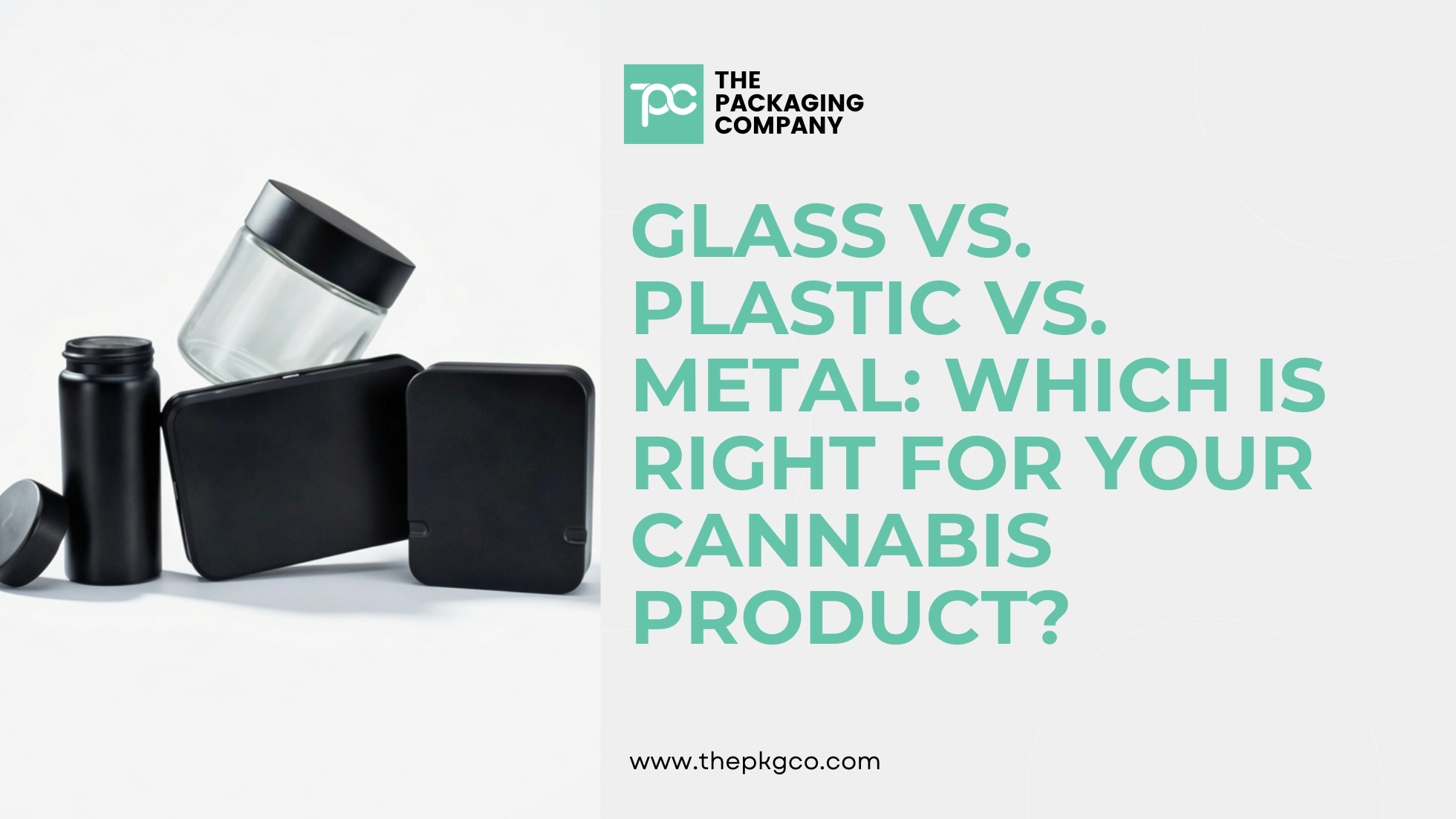
The material your child-resistant packaging is made from is not just an aesthetic decision. It determines the barrier properties your product gets, the sensory signal it sends at the shelf, how it performs through the supply chain, what happens to it at end of life, and what it costs per unit at the quantities you’re running. Every one of those variables is material-dependent, not design-dependent.
This guide compares the three primary CR packaging materials — glass, plastic, and metal — across the dimensions that actually matter for cannabis brands making real sourcing decisions.
The Variables That Matter in a Material Comparison
Before comparing materials, it helps to be clear about what you’re actually comparing them on. Price is the obvious variable. It’s also the least useful one if it’s the only thing being evaluated.
The variables that determine whether a material is right for your specific product are:
Barrier performance — how well the material protects the product from oxygen, moisture, UV light, and contamination over its shelf life and consumer use period.
Material inertness — whether the material interacts with the product, either by off-gassing compounds into the product or by absorbing compounds out of it.
Structural integrity — how well the format survives the supply chain, retail handling, and consumer use without compromising the product or the CR closure.
Brand signal — what the material communicates to a consumer who picks up the package before reading anything.
Sustainability — what happens to the material at end of life, and whether that story is verifiable.
Cost and MOQ — per-unit economics at your actual production quantity.
Run the comparison across all six variables, not just the last one.
Glass
What Glass Does Well
Glass is completely inert. It does not off-gas, does not absorb compounds from the product, and creates no material interaction with terpenes, cannabinoids, or any other active ingredient. For cannabis flower, concentrates, and any product where chemical purity is a quality claim, glass eliminates the material interaction variable entirely.
Glass also blocks UV light, which degrades cannabinoids and terpenes over time. A glass jar provides passive UV protection from the moment of packaging through the end of consumer use without any additional treatment or coating.
At the point of consumer contact, glass communicates premium and permanence. The weight, the clarity, the sound of the closure — glass creates a brand impression that plastic cannot replicate at the same price point, and that metal achieves differently (heavier, more opaque).
Glass is 100% recyclable without material degradation. The sustainability story for glass is straightforward and verifiable.
Where Glass Has Limitations
Glass is heavy and fragile relative to other packaging materials. Weight increases shipping cost at volume, and fragility increases the risk of breakage in the supply chain, particularly for brands distributing through multiple-step logistics chains or delivery-first models.
Glass is also harder to customize decoration on than metal. Screen printing on glass is available but has higher setup costs and more constraints on design complexity than lithographic printing on tinplate. For brands whose decoration is a major brand investment, glass may require a label-based approach that some premium brands prefer to avoid.
Best CR Formats in Glass
Glass CR jars are the primary format — available in wide-mouth configurations for flower, concentrate, and edibles. TPC’s CR Glass Pre-Roll Jar holds 5 pre-rolls in an upright orientation with 16 CFR §1700.20 certification and 100% recyclability.
Best for: Premium flower, live resin, rosin, infused pre-rolls where terpene preservation is a product claim, concentrate formats, edibles where product visibility matters.
Plastic
What Plastic Does Well
Plastic CR packaging is cost-efficient, lightweight, and widely available across a range of formats. For brands running high-volume SKUs where per-unit cost is the primary variable, plastic is frequently the right material for the economics.
Plastic tubes and jars are the most common CR format across the cannabis industry precisely because they work reliably at accessible price points and familiar consumer expectations. Push-and-turn and squeeze-and-pull closures in plastic have well-established consumer familiarity.
Plastic is also the most flexible material for format customization — available in more size configurations, diameter ranges, and closure types than any other material. For brands with non-standard product dimensions that don’t fit metal or glass configurations, plastic often provides the format flexibility that other materials don’t.
Where Plastic Has Limitations
Plastic is not inert in the way glass is. PET and PP can carry faint odor over extended contact, and certain terpene compounds interact with plastic at the molecular level — absorbing into the polymer and reducing active ingredient concentration over the product’s shelf life. For value-tier flower SKUs this is typically a minor concern. For premium or single-origin flower where the terpene profile is a differentiator, it’s a meaningful product quality variable.
Most plastic packaging does not block UV light unless specifically treated with UV-inhibiting additives or colored pigmentation. Clear plastic tubes and jars provide essentially no UV protection — products sitting in retail lighting for extended periods are exposed to light degradation that glass or metal eliminates.
Plastic also carries the weakest brand signal of the three materials. Lightweight, transparent, familiar — plastic communicates function and cost efficiency. In a market where consumers are making sophisticated purchase decisions, a plastic tube at a $30 price point is creating friction between the price and the impression.
On sustainability, most plastic packaging is technically recyclable but practically not — consumer participation rates in plastic recycling are low, contamination rates are high, and multi-use plastic packaging often ends up in landfill regardless of the recycling triangle on the label. Brands making sustainability claims on plastic packaging face increasing scrutiny.
Best CR Formats in Plastic
CR tubes (plastic) are the dominant pre-roll format industry-wide. CR plastic jars are the standard for mid-tier flower and edibles. Both formats are available with push-and-turn and squeeze-and-pull closures across a wide range of dimensions.
Best for: Value-tier pre-rolls, standard flower SKUs, edibles at mid-price points, high-volume SKUs where per-unit economics are the primary constraint.
Metal (Tinplate and Aluminum)
What Metal Does Well
Metal CR packaging does the most things simultaneously at the highest performance level of any packaging material. Tinplate tins are airtight, fully light-blocking, structurally rigid, infinitely recyclable, and the clearest premium signal available in cannabis packaging.
The airtight seal on a well-engineered CR snap tin is more reliable over repeated use cycles than the reseal on a plastic tube or the zip closure on a mylar bag. For terpene-sensitive products — infused pre-rolls, live resin formats, high-terpene flower — the airtight seal is a product quality variable, not just a packaging preference.
Full light blocking in metal is passive and permanent. A tin that has been on a retail shelf for three weeks provides the same UV and visible light protection as a tin that arrived yesterday. There is no degradation of protection over time.
At the brand signal level, metal communicates premium more consistently and durably than any other packaging material. The weight, the closure sound, the rigidity — these are sensory signals that register in the half-second of first consumer contact, before any conscious evaluation of the product. For brands where the packaging needs to justify a premium price, metal is doing work that no amount of label design can replicate on plastic or bag formats.
Metal is also the material with the strongest post-use brand presence. Consumers keep tins. They repurpose them for storage, travel, desk organization. Every day a branded tin sits on a consumer’s surface is a brand impression that costs nothing after the initial purchase.
On sustainability, tinplate and aluminum are infinitely recyclable in standard single-stream programs. The material retains its properties through recycling without downcycling, and municipal recycling infrastructure accepts it without specialized sorting or drop-off.
Where Metal Has Limitations
Metal costs more per unit than plastic at comparable run quantities. For value-tier SKUs where margin targets require the lowest possible per-unit packaging cost, metal may not be the right material regardless of its performance advantages.
Decoration lead times for metal are longer than for plastic or bags — lithographic printing on tinplate requires more setup and production time than label application or rotogravure print on flexible packaging. The timeline premium is 2–4 weeks in most cases.
Metal formats — particularly tins — have less dimensional flexibility than plastic. The standard and extended snap tin configurations cover most pre-roll dimensions, but brands with very non-standard formats may need custom tooling, which adds cost and lead time to the initial production run.
Best CR Formats in Metal
CR snap tins (standard and extended) for pre-roll and flower formats. CR tin jars for infused pre-rolls and edible presentation formats. CR aluminum tubes for multi-pack configurations. CR aluminum jars for topical and wellness formats where light blocking and premium tactile signal both matter.
Best for: Premium and infused pre-rolls, top-shelf flower, edibles at premium price points, brands where packaging is a brand asset rather than a compliance container.
The Decision Matrix
| Variable | Glass | Plastic | Metal |
|---|---|---|---|
| Barrier performance | Excellent | Moderate | Excellent |
| Material inertness | Complete | Partial | Complete |
| UV light blocking | Yes (colored glass) | No (clear) | Yes |
| Structural rigidity | High (fragile) | Low-Medium | High (durable) |
| Brand signal | Premium | Value/functional | Premium |
| Decoration options | Screen print / label | Label / print | Lithography / emboss |
| Recyclability | Infinitely recyclable | Limited in practice | Infinitely recyclable |
| Post-use brand life | Low | Very low | High (consumers keep tins) |
| Per-unit cost | Medium-High | Low | Medium-High |
| Lead time | Medium | Short | Medium-Long |
How to Use This Comparison
The material decision is most cleanly made by filtering on the variables where your product has non-negotiable requirements first.
If terpene preservation is a product quality claim, glass or airtight metal eliminates plastic from consideration before any other variable is evaluated.
If your retail price point is above $25, plastic creates a brand signal mismatch that is difficult to overcome with design alone — glass or metal is the right filter.
If your volume and margin requirements make the per-unit cost of glass or metal unworkable, plastic at the right format with strong decoration is the right answer — and the positioning should match.
If sustainability is a verifiable brand claim you’re making to retail buyers or consumers, glass or metal are the materials that support it. Plastic is defensible in some configurations but requires specificity about the claim being made.
The material that passes all of your non-negotiable filters is the right material. Everything else is optimization.
For a full guide on matching format to product before production, see our CR format decision framework. For a complete overview of all CR packaging formats and options, see our child-resistant packaging solutions guide.
Contact TPC to discuss material options against your specific product and price point.
Frequently Asked Questions
Is glass or metal better for cannabis flower packaging? Both are superior to plastic for premium flower applications, for different reasons. Glass is completely inert — no material interaction with terpenes — and provides UV blocking through colored glass. Metal provides full UV and visible light blocking, an airtight seal, and a stronger brand signal through weight and closure feel. For single-origin or premium flower where terpene expression is a marketing claim, glass is the technically optimal choice. For brands where the packaging experience and shelf presence are the primary priorities, metal is often the stronger overall choice.
Why does plastic dominate cannabis packaging if glass and metal perform better? Per-unit cost and format availability. Plastic tubes and jars are significantly cheaper per unit at equivalent run quantities, require shorter lead times, and are available in more dimensional configurations than glass or metal. For high-volume SKUs where margin efficiency is the primary constraint, plastic is often the economically rational choice. The performance advantages of glass and metal are most impactful at premium price points where the packaging investment is proportionate to the product’s retail value.
Can metal tins really make a difference in shelf performance? Yes — consistently so in mature cannabis markets. The weight signal and closure sound of a metal tin create a measurable difference in consumer perceived value within the first half-second of physical contact, before any label information has been processed. Brands that have made the transition from bags or plastic tubes to metal tins at the same price point typically report reduced sell-through time at retail, not increased. The packaging does brand work that the product alone cannot.
What is the most sustainable cannabis packaging material? Metal (tinplate and aluminum) and glass are both genuinely sustainable at end of life — infinitely recyclable in standard municipal programs without material degradation. Metal has the additional advantage of higher consumer recycling participation rates than glass in most markets. Standard multi-layer plastic packaging and mylar bags are the least sustainable materials in practice, despite common “recyclable” labeling. If sustainability is a verifiable brand claim, metal or glass are the materials that support it without asterisks.
Does the packaging material affect CR certification? The material itself doesn’t determine CR status — the closure mechanism does. But material properties can affect how the closure performs over time. A plastic closure that loosens with repeated use may not maintain its certified resistance through the product’s consumer lifecycle even if it passed certification when new. Metal closures with engineered snap mechanisms tend to maintain more consistent performance over repeated cycles. Always evaluate closure function over 20–30 open/close cycles when sampling any CR format regardless of material.